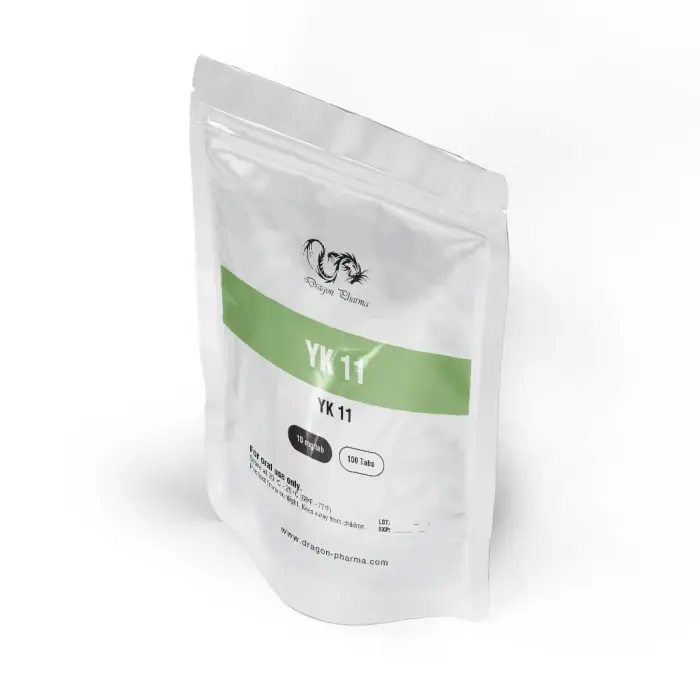
YK 11
YK-11 Dragon Pharma — Overview
YK-11 Dragon Pharma is a steroidal selective androgen receptor modulator (SARM) at 10 mg per tablet — structurally DHT-derived but pharmacologically distinct from both conventional AAS and non-steroidal SARMs. Its defining property is dual-pathway activity: partial agonism at the androgen receptor combined with upregulation of follistatin, which suppresses myostatin — the protein that acts as the body's genetic ceiling on muscle mass. No other SARM in Dragon Pharma's lineup targets myostatin. The result is lean, dry muscle accumulation without estrogen-related water retention, at a potency level that places YK-11 closer to a mild AAS than to a typical research SARM. Available at Steroid Warehouse, YK-11 is formulated for intermediate to advanced users looking for a recomp or lean gaining cycle that goes beyond what conventional non-steroidal SARMs can deliver.
About the Compound: YK-11
YK-11 (systematic name: (17α,20E)-17,20-[(1-methoxyethylidene)bis(oxy)]-3-oxo-19-norpregna-4,20-diene-21-carboxylic acid methyl ester) is a synthetic steroidal compound with a 4-ene-3-one core shared with classical androgens, making it structurally closer to DHT than to non-steroidal SARMs such as ostarine or LGD-4033. This structural similarity is what gives YK-11 its steroidal SARM classification and distinguishes its pharmacological footprint from the rest of the SARM class.
- Partial androgen receptor agonism: YK-11 binds the androgen receptor but induces a different receptor conformation than full AR agonists like testosterone or DHT. It activates a selected subset of androgen-responsive genes — specifically those associated with anabolic processes — while producing a weaker androgenic signal than a full agonist at equivalent doses. This partial agonism profile is the basis for its SARM classification despite its steroidal structure.
- Myostatin inhibition via follistatin upregulation: YK-11's most studied and clinically significant secondary mechanism is its ability to induce follistatin expression in muscle cells. Follistatin is an endogenous antagonist of myostatin — the TGF-β family protein that limits skeletal muscle hypertrophy. By upregulating follistatin, YK-11 reduces the myostatin-mediated ceiling on muscle mass. This mechanism is independent of androgen receptor signaling and is not shared by any other SARM in the catalog. The practical implication is lean mass accumulation that may exceed what androgen receptor stimulation alone could produce.
- Steroidal structure and hepatotoxicity: Unlike non-steroidal SARMs (ostarine, LGD-4033), YK-11's steroidal core places it in a different hepatic risk category. Oral steroidal compounds with structural similarity to 17α-alkylated androgens carry measurable hepatotoxic potential. YK-11 is not confirmed 17α-alkylated in the classical sense, but liver enzyme monitoring is warranted — clinical and field data suggest ALT/AST elevation at moderate to high doses.
- HPG suppression: YK-11 suppresses LH and FSH more significantly than non-steroidal SARMs at typical doses. Users who report no suppression at 5 mg/day are outliers — at 10–15 mg/day, HPG suppression sufficient to require PCT is the expected outcome.
What YK-11 Does
- Lean, dry muscle accumulation: YK-11 produces lean mass gains without estrogen-related water retention — a consistently reported characteristic across user data and the limited in-vitro literature. The gains are not as rapid as those from full AR agonists but they are cleaner. Over a 6–8 week cycle most users report 4–8 lb of lean tissue retention that holds after cycle, not the inflated wet-weight numbers seen with aromatizing compounds.
- Myostatin inhibition — the genetic ceiling effect: The follistatin-mediated suppression of myostatin represents a mechanistic advantage that standard AAS and other SARMs do not have. Myostatin sets an individual ceiling on muscle cross-sectional area. Reducing myostatin activity — even transiently during a cycle — allows muscle fibers to hypertrophy beyond the point that androgen receptor stimulation alone would support. This is the core argument for YK-11 over LGD-4033 or RAD-140 for users who have already maximized response to conventional anabolic compounds.
- Strength increase: Strength gains accompany the lean mass accumulation. Users report increases in working weights across compound movements within the first 2–3 weeks — earlier than the lean mass becomes visually apparent. The mechanism is both direct AR-mediated neuromuscular activation and the anabolic support to connective tissue and muscle fiber remodeling.
- Recomposition effect: At maintenance or mild caloric deficit, YK-11 supports simultaneous fat loss and lean mass gain — the recomp outcome that most anabolic protocols produce poorly. The combination of lean anabolic activity without water retention makes it particularly useful for athletes who need to improve body composition without bulk-phase mass accumulation.
- No estrogenic activity: No aromatization, no water retention, no estrogen-mediated side effects. No aromatase inhibitor is required during a YK-11 solo cycle.
Who It's For
YK-11 occupies a specific position in the SARM hierarchy — not a beginner compound, not an AAS replacement, but a targeted tool for users who have exhausted what non-steroidal SARMs offer.
- What differentiates YK-11 from similar options: YK-11 is the only compound in the Dragon Pharma SARM lineup that targets myostatin via follistatin upregulation. LGD-4033 and MK-2866 are pure AR agonists with no myostatin mechanism. S-23 is a more potent AR agonist but also lacks myostatin activity. MK-677 raises GH/IGF-1 but does not affect AR or myostatin directly. YK-11 is therefore the only option when the goal is to push beyond the AR-stimulation ceiling into myostatin-pathway territory.
- The specific scenario where it's the better choice: Intermediate to advanced users who have run multiple SARM or mild AAS cycles and are finding lean mass response diminishing. Athletes in physique sports running lean recomp cycles where adding wet mass from aromatizing compounds is counterproductive. Users who want a steroidal-level anabolic stimulus without full AAS commitment. Anyone specifically targeting the follistatin-myostatin pathway for a cycle.
- Who should choose something else: First-time SARM users — start with MK-2866 (Ostarine) to establish baseline SARM response before escalating to a compound with this suppression and hepatic profile. Anyone unwilling or unable to run post-cycle therapy — YK-11's HPG suppression makes PCT non-optional at typical doses. Women: YK-11's androgenic and myostatin-modulating activity in females is insufficiently characterized; the risk-benefit profile does not support use.
YK-11 vs Alternatives
| Compound | Key Differences | Choose YK-11 When | Choose Alternative When |
|---|---|---|---|
| YK-11 (10 mg/tab) | Steroidal SARM; dual mechanism — partial AR agonism + follistatin upregulation / myostatin inhibition; more suppressive than non-steroidal SARMs; hepatic monitoring required; no aromatization; lean, dry gains | Pushing beyond conventional SARM response; myostatin pathway is the target; lean recomp requiring anabolic intensity above non-steroidal SARMs | — |
| LGD-4033 (Ligandrol) | Non-steroidal SARM; full AR agonist; no myostatin mechanism; stronger AR activation per mg than YK-11; significant lean mass gains; suppressive but typically less so than YK-11; well-studied safety profile | — | Lean mass gain via AR pathway is the primary goal; myostatin inhibition not required; prefer a more extensively researched non-steroidal SARM; first SARM cycle with suppression expected |
| MK-2866 (Ostarine) | Non-steroidal SARM; mildest in the lineup; minimal HPG suppression at low doses; joint support properties; beginner-appropriate; lower anabolic potency than YK-11 or LGD-4033; no myostatin mechanism | — | First SARM cycle; joint pain management is a goal; minimal suppression is required; maintaining gains during a cut with minimal side effects |
| S-23 (Mastorin) | Non-steroidal but highly potent SARM; strongest AR agonist in the lineup; hardening and lean mass effects; among the most suppressive SARMs available — complete HPG shutdown at standard doses; no myostatin mechanism; more comparable to AAS in suppression profile | — | Maximum AR-pathway anabolic stimulation is the goal; myostatin inhibition not required; prepared for full HPG suppression and aggressive PCT; advanced cycle context |
Combinations
| Goal | Stack | Why It Works |
|---|---|---|
| Lean mass + recovery (most common) | YK-11 (10–15 mg/day) + MK-677 (Ibutamoren) (25 mg/day) |
MK-677 is a GH secretagogue — it raises GH and IGF-1 without suppressing LH or FSH, contributing no additional HPG burden to the stack. IGF-1 elevation complements YK-11's follistatin-mediated myostatin suppression via overlapping muscle hypertrophy signaling. Improved sleep quality and recovery from MK-677 supports the lean mass accumulation YK-11 drives. This stack requires only standard post-cycle SERM recovery for the YK-11 component. |
| Lean bulk | YK-11 (10 mg/day) + LGD-4033 (5–10 mg/day) |
YK-11 brings myostatin inhibition; LGD-4033 brings the strongest non-steroidal AR agonism in the SARM lineup. Both compounds target muscle hypertrophy but via partially distinct pathways — the combination aims to stack the ceiling-raising effect of follistatin upregulation with full AR activation. Both are suppressive — plan PCT for the combined suppression load, not just one compound individually. |
| Recomp cycle | YK-11 (10 mg/day) + MK-2866 (Ostarine) (20–25 mg/day) |
Ostarine's joint-supportive properties and lean mass retention during a caloric deficit complement YK-11's more potent anabolic stimulus. The combination provides lean tissue preservation (Ostarine) plus active myostatin-pathway muscle gain (YK-11) — a practical recomp stack with manageable suppression relative to more aggressive SARM combinations. |
| Advanced hardening / pre-contest | YK-11 (10 mg/day) + S-23 (Mastorin) (10–20 mg/day) |
S-23 provides the strongest AR-driven hardening and lean mass signal in Dragon Pharma's SARM range. Combined with YK-11's follistatin-mediated myostatin inhibition, this stack targets both major muscle hypertrophy pathways simultaneously. Suppression from this combination is significant — expect complete HPG shutdown requiring aggressive PCT. Advanced cycle context only. |
| Maximum anabolic cycle with GH axis support | YK-11 (10–15 mg/day) + LGD-4033 (5 mg/day) + MK-677 (25 mg/day) |
Three-compound stack covering androgen receptor activation (LGD-4033), myostatin inhibition (YK-11), and GH/IGF-1 axis stimulation (MK-677). MK-677 adds no suppressive burden, making PCT requirements equivalent to the YK-11 + LGD-4033 component only. steroidwarehouse.com carries all three for a single-order stack. |
Side Effects and How to Manage Them
YK-11's side effect profile reflects its position between non-steroidal SARMs and mild AAS. The steroidal structure introduces hepatic risk absent from compounds like ostarine, and the suppression profile is more aggressive than most SARMs. Proactive monitoring is more important here than with beginner SARM compounds.
| What May Occur | Background | How to Handle It |
|---|---|---|
| Hepatotoxicity (ALT/AST elevation) | YK-11's steroidal structure — unlike non-steroidal SARMs — carries hepatotoxic potential. In vitro data and user reports indicate ALT/AST elevation at moderate to high doses, most pronounced at 15+ mg/day and in cycles exceeding 6 weeks. | Liv.52, NAC (Mucinac), and UDCA (Ursocol) throughout the cycle. Check ALT/AST at mid-cycle (week 3–4). If >3× upper normal limit, reduce dose or stop. Do not run YK-11 concurrently with other hepatotoxic orals. |
| HPG axis suppression | The most consistently reported and clinically significant side effect at standard doses. LH and FSH suppression occurs within weeks; at 10–15 mg/day complete suppression is reported by most users. Unlike mild SARMs (Ostarine at low doses), YK-11 reliably suppresses endogenous testosterone to levels requiring PCT. | PCT is mandatory — not optional based on cycle length or perceived symptom absence. See Post-Cycle Recovery section. Bloodwork post-cycle to confirm LH/FSH recovery before planning the next run. |
| Joint discomfort | A subset of YK-11 users report joint pain — likely related to the compound's partial agonism profile and the lack of estrogen (estrogen contributes to collagen synthesis and joint lubrication). Not universal, but more commonly reported with YK-11 than with Ostarine, which actively supports joint tissue. | Adequate hydration and avoiding maximum training loads on joint-intensive movements during the cycle. If significant: reduce dose from 15 mg to 10 mg/day. Stacking with MK-2866 (Ostarine), which has documented joint support properties, mitigates this in combination cycles. |
| Hair loss (androgenic sensitivity) | YK-11's partial AR agonism includes androgenic receptor-expressing follicles in genetically predisposed individuals. Less pronounced than with full AAS but present, particularly at 15 mg/day and above. | Minoxidil topically. Reduce to 10 mg/day if shedding is observed. Users with strong genetic predisposition to male-pattern hair loss should factor this into their compound selection. |
| Acne / oily skin | Mild androgenic sebaceous stimulation. Less prominent than with full AR agonists or AAS but reported at higher doses. | Topical benzoyl peroxide or salicylic acid for mild presentations. Accutane (Isotretinoin) for severe or persistent cases at the prescribing threshold. |
| Lipid changes | Less aggressive than stanozolol or non-aromatizing AAS, but androgenic partial agonism can modestly suppress HDL and elevate LDL over a full cycle. Not the primary concern with YK-11 but worth tracking. | Lipid panel before and after cycle. Atorvastatin if LDL exceeds 160 mg/dL post-cycle. Omega-3-supportive diet throughout. |
| Blood pressure | Modest androgenic activity may contribute to blood pressure increase. Less significant than with full AAS protocols but not zero at 15 mg/day. | Monitor BP every 2 weeks. Amlodipine (Amlip) or Telmisartan (Sartel) if >135/85 mmHg. Ecosprin (Aspirin) 75 mg/day as antiplatelet support. |
Bloodwork Monitoring
| Lab | When to Test | Target & Action Threshold |
|---|---|---|
| ALT / AST | Before cycle; week 3–4 (mid-cycle) | <3× upper limit of normal. Unique among SARM cards — YK-11's steroidal structure makes this check meaningful in a way it is not for non-steroidal SARMs like Ostarine or LGD-4033. |
| LH + FSH | Before cycle; 4–6 weeks post-PCT | Return toward pre-cycle baseline confirms HPG recovery. YK-11 suppresses LH/FSH more aggressively than most SARMs — do not skip the post-PCT confirmation test. |
| Total testosterone | Before cycle; end of PCT | Pre-cycle baseline established; post-PCT confirms endogenous testosterone recovery. Recovery to >400 ng/dL or personal baseline before planning the next cycle. |
| Lipid panel (HDL / LDL) | Before cycle; end of cycle | HDL >40 mg/dL; LDL <130 mg/dL. Less critical than with stanozolol but still a useful baseline marker. |
| Hematocrit / CBC | Before cycle; end of cycle | Hematocrit <52% (male). Partial AR agonism can stimulate mild erythropoiesis over a full cycle. |
| Blood pressure | Every 2 weeks during cycle | <135/85 mmHg. Lower priority than with full AAS protocols but still warrants monitoring at 15 mg/day and above. |
Post-Cycle Recovery
PCT after YK-11 is more similar to mild AAS recovery than to the light SARMs protocols adequate for Ostarine at 20 mg/day. Expect 4 weeks of SERM-based PCT minimum; confirm LH/FSH recovery via bloodwork before ending the protocol.
| Product | Role in PCT |
|---|---|
| Nolvadex (Tamoxifen) | Primary SERM. Blocks estrogenic feedback at the pituitary to stimulate LH and FSH release and restart endogenous testosterone. First-line PCT agent for YK-11 cycles — more appropriate than Clomid alone for this suppression level. |
| Clomid (Clomiphene) | Added in the first 2 weeks of PCT when suppression from YK-11 solo or YK-11 stacks (particularly with LGD-4033 or S-23) requires stronger gonadotropin stimulation to initiate recovery. |
| Enclomiphene | Preferred alternative to standard Clomid for users who experience mood or vision side effects from clomiphene. Cleaner SERM profile for the recovery phase. |
| HCG 5000 IU | For YK-11 + LGD-4033 or YK-11 + S-23 stacks where HPG suppression is more complete: run HCG in the final week before SERM-based PCT begins to restore testicular sensitivity. |
For full PCT timing and dosing protocols see the PCT guide.
Practical Summary — YK-11 Dragon Pharma
- YK-11 is not an entry-level SARM — run at least one full Ostarine or LGD-4033 cycle first to understand your individual SARM response before adding the suppression and hepatic profile of YK-11
- Liver support is mandatory from day 1 (Liv.52 + NAC + UDCA), check ALT/AST at week 3–4 — this is the one SARM in the Dragon Pharma lineup where mid-cycle liver bloodwork is genuinely warranted
- Start at 5–10 mg/day for the first week to assess tolerance; most users find the 10–15 mg/day range gives the best effect-to-side-effect ratio; doses above 20 mg/day increase hepatic and androgenic load without proportional benefit
- PCT is required — not optional based on "feeling fine": LH/FSH suppression occurs before symptom onset; run 4 weeks Nolvadex minimum and confirm bloodwork before ending recovery
- The MK-677 stack is the most practical entry point — MK-677 adds no suppressive burden and its GH/IGF-1 benefit complements YK-11's myostatin pathway without complicating PCT
- steroidwarehouse.com carries the full SARM lineup alongside Nolvadex, Clomid, and liver support for complete cycle and recovery ordering
YK-11 occupies a position in the SARM category that no other compound in Dragon Pharma's lineup fills: the dual mechanism of partial androgen receptor agonism alongside myostatin inhibition via follistatin upregulation gives athletes a pathway to lean mass accumulation that goes beyond what conventional SARMs can achieve at any dose. It demands more in return — consistent liver support, proper PCT, and mid-cycle bloodwork — but for intermediate and advanced users who have already characterized their response to first-generation SARMs, steroidwarehouse.com's YK-11 offers a meaningful step up in the recomp and lean gaining stack.
References
| Source | Topic | Link |
|---|---|---|
| Biological & Pharmaceutical Bulletin / PubMed | Kanno Y, et al. 2013 — study of YK11 as a selective androgen receptor modulator; showed androgen receptor-mediated myogenic differentiation of C2C12 myoblasts through increased follistatin expression | Kanno Y, et al. (2013) ↗ |
| Current Opinion in Clinical Nutrition and Metabolic Care / PubMed | Bhasin S & Jasuja R 2009 — review of selective androgen receptor modulators as function-promoting anabolic therapies; covers SARM rationale, androgen receptor targeting, tissue-selective anabolic effects, and clinical development context | Bhasin S & Jasuja R (2009) ↗ |
| Frontiers in Endocrinology / PubMed | Bond P, Smit DL, de Ronde W. 2022 — evidence-based review of anabolic-androgenic steroids and androgen receptor pharmacology; discusses anabolic mechanisms, endocrine suppression, health risks, and related androgen-modulating compounds | Bond P, et al. (2022) ↗ |
| Frontiers in Endocrinology / PubMed | Bond P. 2025 — critical appraisal of selective androgen receptor modulators; reviews the concept of tissue selectivity, androgen receptor pharmacology, historical SARM development, and limitations of the claimed anabolic-androgenic separation | Bond P. (2025) ↗ |
What is YK 11?
YK 11 is an oral SARM and myostatin inhibitor for muscle growth; see What is YK 11. It's potent—consult professionals for safe use.
What does YK 11 do?
It promotes muscle growth and strength via myostatin inhibition; see What Does YK 11 Do. It enhances size—monitor with labs.
How long does YK 11 stay in your system?
Detectable for 1-2 weeks; see How Long Does YK 11 Stay in Your System. Monitor with professional guidance.
What is YK 11 used for in bodybuilding?
It's used for rapid muscle growth and strength; see What is YK 11 Used For in Bodybuilding. It suits bulking—use with oversight.
How does YK-11 work?
YK-11 is believed to interact with androgen receptors while also influencing myostatin-related pathways. Myostatin is a protein involved in regulating muscle growth, making YK-11 a subject of interest in muscle development research
How long does it take to notice effects from YK-11?
Users commonly report gradual improvements in strength, muscle fullness, and physique appearance over several weeks, depending on training, nutrition, and individual response.
What are the main benefits of YK-11?
Commonly discussed benefits include increased lean muscle mass, enhanced strength, improved muscle density, accelerated physique development, and support for body recomposition goals.
Is YK-11 better for bulking or recomposition?
YK-11 is most commonly associated with lean bulking and recomposition phases due to its reputation for promoting muscle growth while supporting a relatively lean appearance.
Related Products