Nolvadex
Nolvadex Dragon Pharma — Overview
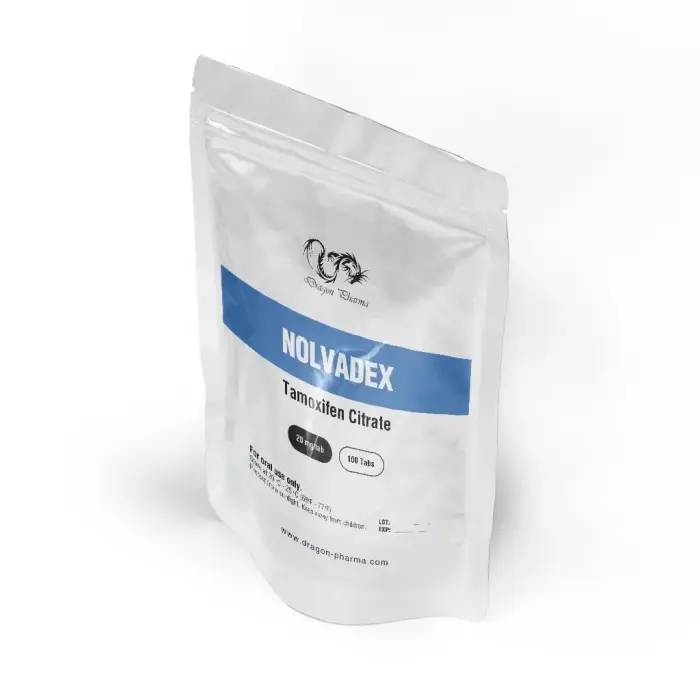
Nolvadex Dragon Pharma is tamoxifen citrate in 20 mg oral tablet form — the most widely used SERM (Selective Estrogen Receptor Modulator) in AAS and SARM post-cycle protocols. Tamoxifen acts as a competitive estrogen receptor antagonist in breast tissue and the hypothalamus, while functioning as an agonist in the liver and bone. This tissue-selective profile is what makes it useful for PCT: by blocking estrogen's negative feedback signal at the hypothalamus and pituitary, Nolvadex prompts a rise in LH and FSH, which in turn restores endogenous testosterone production that was suppressed during a steroid cycle.
A critical distinction that determines when Nolvadex is the right tool: it does not lower circulating estradiol (E2). Users experiencing high-E2 side effects — water retention, blood pressure elevation, mood instability, libido changes — need an aromatase inhibitor such as Aromasin or Arimidex, not Nolvadex. Nolvadex is specifically indicated for PCT recovery and for suppressing the breast tissue response (gynecomastia) when systemic E2 control is already adequate. This page covers the SERM mechanism, PCT dosing, how Nolvadex compares to Clomid and aromatase inhibitors, and the one important drug interaction users running AIs alongside PCT need to know.
About the Compound: Tamoxifen Citrate
Tamoxifen is a triphenylethylene SERM first developed in the 1960s and clinically established primarily as a breast cancer treatment. In the performance context its utility lies in two distinct pharmacological properties: ER antagonism in breast tissue and the hypothalamic-pituitary axis, and ER agonism in the liver.
The antagonist action at the hypothalamus removes the estrogen-mediated suppression of GnRH pulsatility. With this brake released, GnRH rises, LH and FSH secretion increase from the anterior pituitary, and the Leydig cells of the testes respond by resuming testosterone synthesis. This is the core PCT mechanism and why tamoxifen is effective at accelerating HPTA recovery after suppressive AAS or SARM cycles.
The partial agonist action in the liver is practically relevant: unlike aromatase inhibitors that reduce E2 system-wide and can worsen the cholesterol profile, tamoxifen's liver estrogenicity tends to maintain or mildly improve HDL during PCT. This is one pharmacological reason Nolvadex is generally preferred over AIs as the primary HPTA recovery agent post-cycle.
Tamoxifen is extensively metabolized by CYP2D6 to its most active metabolite, endoxifen, which has a longer half-life (~10–14 days) and higher ER affinity than the parent compound. The clinical implication: CYP2D6 inhibitors (including certain antidepressants) can reduce endoxifen levels significantly. The drug interaction with anastrozole (Arimidex) — covered in the Context section — operates through a different mechanism but is equally important.
What Nolvadex Does
- HPTA recovery during PCT — this is the primary use in performance protocols; tamoxifen blocks estrogen's negative feedback on the hypothalamus, allowing GnRH → LH → FSH signaling to rise; Leydig cells respond to increased LH by producing testosterone; clinical studies in men show significant rises in LH, FSH, and total testosterone within 1–2 weeks of tamoxifen initiation; a standard 4–6 week PCT at 20–40 mg/day allows the HPTA to re-establish autonomous testosterone production after suppressive AAS or SARM cycles
- Gynecomastia prevention and early reversal — tamoxifen competitively blocks estrogen receptors in glandular breast tissue; this prevents the proliferative estrogenic signal that drives gynecomastia development; at 10–20 mg/day on cycle, it is effective at suppressing early gyno symptoms (nipple sensitivity, puffy nipple) when circulating E2 is elevated but systemic estrogen control with an AI is not being used or is insufficient; early-stage gynecomastia (tender, mobile tissue under the nipple) may partially regress with tamoxifen; established firm glandular tissue does not reverse with tamoxifen
- Maintenance of estrogenic benefits during PCT — because tamoxifen blocks estrogen receptors selectively rather than lowering circulating E2, it preserves the physiological benefits of estrogen during recovery: cardiovascular protection, joint lubrication, libido maintenance, and mood stability are not compromised the way they can be during aggressive AI use; the liver agonist action also supports HDL through PCT; this is a meaningful clinical advantage over running an AI through PCT, which often leads to estrogen crash symptoms
- Testosterone elevation in men (independent of cycle context) — tamoxifen's HPTA stimulating effect is measurable in eugonadal men as well; it raises total and free testosterone by blocking hypothalamic ER and stimulating the LH axis; this effect is the basis of its occasional off-label use for secondary hypogonadism or low testosterone in men who want to preserve fertility and testicular volume, unlike exogenous TRT which suppresses both
Who It's For
- Users running PCT after suppressive AAS or SARM cycles — Nolvadex is the first-choice standalone SERM for the majority of PCT protocols; after any cycle that suppresses endogenous testosterone — including single-compound testosterone cycles, oral-only cycles, or SARM cycles that produce measurable LH/FSH suppression — Nolvadex at 20–40 mg/day for 4–6 weeks is the standard recovery protocol; it is better tolerated than Clomid at comparable LH-stimulating doses and does not carry Clomid's visual disturbance risk; for heavy multi-compound cycles where HPTA suppression is more pronounced, Nolvadex is often combined with Clomid in the first 2–3 weeks
- Users developing early gynecomastia on cycle who are not already running an AI — when nipple sensitivity or early breast tissue changes appear during an estrogenic AAS cycle, adding Nolvadex at 20 mg/day addresses the breast tissue receptor directly without requiring an abrupt AI introduction; note that Nolvadex does not resolve the underlying high E2 — it only protects breast tissue; if the high E2 is causing other symptoms (water retention, blood pressure, mood), an AI is still needed alongside or instead
- Users who should choose something else: users experiencing active high-E2 symptoms during a cycle (water retention, elevated blood pressure, E2-driven mood changes, libido issues) need an aromatase inhibitor — Aromasin or Arimidex — not Nolvadex; Nolvadex will not reduce water retention or blood pressure because it does not lower circulating E2; users with pre-existing clotting disorders or thromboembolic risk should be aware that tamoxifen slightly increases clot risk even at PCT doses, though this is a minor concern in short-term use in otherwise healthy men
Context & Related Products
| Compound | Key Differences | Choose Nolvadex When | Choose Alternative When |
|---|---|---|---|
| Clomid Dragon Pharma | Also a SERM; clomiphene is a mixture of enclomiphene (active) and zuclomiphene (less active, longer-lasting); raises LH and FSH comparably to tamoxifen at standard doses; more likely to cause visual disturbances (blurred vision, floaters, after-images), mood disturbances, and emotional instability at standard doses; some protocols prefer Clomid's FSH-stimulating effect for spermatogenesis recovery | Standard PCT for most cycles, especially testosterone-only or SARM cycles where single-SERM PCT is sufficient; better tolerability profile than Clomid; preferred when visual side effects from Clomid are a concern; gyno prevention on-cycle | Maximum FSH stimulation for fertility restoration or spermatogenesis recovery is the goal; heavy suppression (high-dose multi-compound blast) where combining both SERMs in the first 2–3 weeks of PCT is warranted; some users simply tolerate Clomid better |
| Aromasin Dragon Pharma | Aromatase inhibitor (steroidal, irreversible); reduces circulating E2 at the source by inactivating the aromatase enzyme; addresses water retention, blood pressure, mood, and libido issues caused by high E2 on cycle; does not selectively protect breast tissue; can run alongside Nolvadex in PCT without the pharmacokinetic interaction that affects Arimidex | Breast tissue protection or PCT recovery with LH/FSH stimulation without reducing circulating E2; maintaining estrogenic benefits during PCT (joints, libido, HDL); well-controlled E2 on a lower-aromatizing cycle where gyno prophylaxis is the only concern | High E2 symptoms on cycle: water retention, blood pressure elevation, mood changes; pre-cycle or cycle E2 management; PCT where residual E2 is still high and needs lowering alongside HPTA stimulation (Aromasin + Nolvadex can be combined safely) |
| Arimidex Dragon Pharma | Aromatase inhibitor (non-steroidal, competitive); reduces E2 effectively on cycle; known pharmacokinetic interaction with tamoxifen: tamoxifen reduces anastrozole plasma exposure by approximately 27% according to ATAC pharmacokinetic data, meaning the AI operates at lower systemic concentrations when both are combined; anastrozole does not meaningfully reduce tamoxifen concentrations in return; the combination is therefore less efficient for E2 control than using either compound alone at full dose; exemestane (Aromasin) does not produce this interaction and is the appropriate AI to combine with Nolvadex when both are needed | On-cycle E2 management when Nolvadex is not being run simultaneously; Arimidex is effective alone for E2 control during cycle | Running alongside Nolvadex — avoid combining Arimidex with Nolvadex; tamoxifen pharmacokinetically reduces anastrozole plasma exposure, making the AI less effective at controlling E2; use Aromasin (exemestane) if an AI is needed during Nolvadex PCT — no pharmacokinetic interaction exists between exemestane and tamoxifen |
| Enclomiphene Dragon Pharma | The trans-isomer of clomiphene; cleaner SERM activity without the zuclomiphene component that drives most of Clomid's side effects; newer option for HPTA stimulation; well-tolerated at low doses; less established in heavy-cycle PCT than tamoxifen but increasingly used for TRT bridge protocols and milder cycle recovery | Standard PCT where tolerability is the priority; most cycles where single-SERM recovery is appropriate | Milder cycles, TRT bridge protocols, or situations where the user specifically prefers enclomiphene for HPTA stimulation with minimal side effects |
PCT protocol reference:
| Cycle Type | Protocol | Notes |
|---|---|---|
| Testosterone-only or mild SARM cycle | Nolvadex 40 mg/day weeks 1–2, 20 mg/day weeks 3–4 | Standard 4-week PCT; begin 2 weeks after last long-ester injection (e.g., Testosterone Enanthate or Cypionate) or 3 days after last short-ester (Testosterone Propionate) or oral SARM dose; most users recover fully on this protocol |
| Multi-compound or heavier suppression cycle | Nolvadex 40 mg/day + Clomid 50 mg/day weeks 1–2; Nolvadex 20 mg/day weeks 3–6 | Combined SERM approach for the first 2 weeks addresses heavier HPTA suppression; Clomid's stronger FSH stimulation complements Nolvadex; transition to Nolvadex-only for the final weeks; total PCT duration 6 weeks; if residual E2 is elevated entering PCT, low-dose Aromasin 12.5 mg every other day can be added safely |
| On-cycle gyno prevention or early reversal | Nolvadex 10–20 mg/day throughout estrogenic cycle or at first sign of symptoms | Does not replace an AI for overall estrogen management; addresses breast tissue receptor specifically; 10 mg/day is sufficient prophylaxis; 20 mg/day for active early gyno symptoms; if symptoms do not respond within 2–3 weeks, AI addition or dose increase is needed |
Side Effects & Management
| What May Occur | Background | How to Handle It |
|---|---|---|
| Hot flashes | The most commonly reported side effect of tamoxifen in both male and female users; results from estrogen receptor blockade at the hypothalamus disrupting thermoregulatory set points; typically intermittent, more common in the first 1–2 weeks of PCT, and reduces as the body adapts; generally mild at 20 mg/day | Usually self-limiting; no pharmacological management typically needed for short-term PCT use; staying hydrated and avoiding hot environments reduces frequency; if hot flashes are severe, reducing to 10 mg/day (split dosing) can help while still providing HPTA stimulation |
| Mood disturbances / emotional lability | Less pronounced than with Clomid but can occur; the ER antagonism in the CNS alters the estrogenic tone that influences mood, serotonin signaling, and emotional regulation; may manifest as irritability, anxiety, or emotional flatness; concurrent low testosterone during early PCT (before testosterone levels recover) compounds this effect | Mood effects during PCT are often a combination of low testosterone (recovering) and SERM-related CNS ER blockade; they improve as testosterone recovers over weeks 3–4; if mood disturbances are severe, assess whether reducing Nolvadex dose (20 → 10 mg) while ensuring PCT duration is extended compensates; the mood effect is transient |
| Visual disturbances | Rare at tamoxifen doses used in PCT (20–40 mg/day for 4–6 weeks); visual complaints including blurred vision, sensitivity to light, and visual floaters are more characteristically associated with Clomid (zuclomiphene component); they have been reported with long-term tamoxifen use at higher doses (breast cancer treatment context) but are uncommon in the short PCT context | Any new visual symptoms during Nolvadex PCT should prompt a dose hold and evaluation; if symptoms resolve after stopping, the compound is the likely cause; the risk is very low for 4–6 week PCT protocols at standard doses |
| Anastrozole interaction (reduced AI efficacy) | ATAC pharmacokinetic data show that co-administration of tamoxifen reduces anastrozole plasma exposure by approximately 27%; anastrozole levels are meaningfully lower when tamoxifen is present; importantly, anastrozole does not reduce tamoxifen or endoxifen concentrations in return; the practical result is that combining the two compounds makes the AI less effective at suppressing E2, not that the SERM loses potency; exemestane (Aromasin) does not produce this interaction and is the appropriate AI to use alongside Nolvadex when E2 control is also needed | Avoid combining Arimidex with Nolvadex; if an AI is needed alongside Nolvadex (e.g., for residual E2 control entering PCT), use Aromasin 12.5 mg every other day instead; Aromasin + Nolvadex is pharmacokinetically safe; this is the single most practically important drug interaction to know when running tamoxifen alongside any AI |
| Nausea | Mild nausea is occasionally reported, more common when tamoxifen is taken on an empty stomach; not a significant concern at PCT doses for most users | Take Nolvadex with food; splitting the 40 mg dose (20 mg morning + 20 mg evening with meals) reduces peak plasma fluctuation and nausea risk compared to single-dose administration |
References
| Source | Topic | Link |
|---|---|---|
| British Journal of Pharmacology / PubMed | Kicman 2008 — comprehensive review of anabolic-androgenic steroid pharmacology covering androgen receptor activity, anabolic-androgenic effects, misuse patterns, HPG-axis suppression context, aromatization, adverse effects, and the endocrine background in which post-cycle recovery compounds are often discussed | Kicman AT (2008) ↗ |
| NCBI Bookshelf / StatPearls | Tamoxifen — StatPearls entry covering tamoxifen as a selective estrogen receptor modulator, tissue-selective estrogen receptor agonist/antagonist activity, pharmacology, CYP2D6-related metabolism, clinical indications, contraindications, and adverse-effect profile | StatPearls: Tamoxifen ↗ |
| British Journal of Cancer / PubMed | Dowsett et al. 2001 — ATAC pharmacokinetic sub-protocol evaluating anastrozole and tamoxifen alone or in combination; shows that tamoxifen reduced anastrozole plasma exposure by about 27%, while anastrozole did not meaningfully reduce tamoxifen concentrations; primary reference for the pharmacokinetic interaction between these two compounds | Dowsett M, et al. (2001) ↗ |
| Hormone and Metabolic Research / PubMed | Vermeulen et al. 1978 — study of tamoxifen administration in normal males showing increased LH, FSH, testosterone, and estradiol after short-term tamoxifen exposure; classic human endocrine reference for tamoxifen's hypothalamic-pituitary-testicular axis stimulation in men | Vermeulen A, et al. (1978) ↗ |
| Indian Journal of Urology / PubMed | Tadros & Sabanegh 2017 — review of empiric hormonal therapy for idiopathic male infertility; covers selective estrogen receptor modulators, aromatase inhibitors, gonadotropins, hormone optimization, semen parameters, and clinical uncertainty around empiric male fertility treatment | Tadros NN & Sabanegh ES (2017) ↗ |
| Andrology / PubMed | Chua et al. 2013 — meta-analysis of estrogen antagonists including clomiphene and tamoxifen as empiric therapy for idiopathic male subfertility; useful evidence context for SERM use in male reproductive endocrinology, while emphasizing that results should not be treated as direct PCT protocol proof | Chua ME, et al. (2013) ↗ |
What is Nolvadex?
Nolvadex is an oral SERM for PCT and estrogen control; see What is Nolvadex. It restores testosterone—consult professionals for safe use.
What does Nolvadex do?
It blocks estrogen and boosts testosterone production; see Mechanism of Action. It prevents gynecomastia—monitor with labs.
Does Nolvadex boost testosterone?
Yes, Nolvadex stimulates LH/FSH to boost natural testosterone; see Mechanism of Action. It's effective in PCT—consult professionals.
What is Nolvadex used for?
It's used for PCT and estrogen control post-cycle; see Key Benefits. It suits bodybuilders—use with professional oversight.
What is Nolvadex used for in bodybuilding?
In bodybuilding, Nolvadex is used for PCT to restore testosterone and block estrogenic side effects; see Key Benefits. It ensures recovery—consult professionals.
How quickly does Nolvadex start working?
Nolvadex begins interacting with estrogen receptors shortly after administration, although the timeline for noticeable effects can vary depending on individual hormone levels and circumstances.
What are the main benefits of Nolvadex?
Commonly discussed benefits include estrogen receptor modulation, support for hormonal balance, and assistance in maintaining normal endocrine function.
How is Nolvadex different from aromatase inhibitors?
Unlike aromatase inhibitors, which reduce estrogen production, Nolvadex works by blocking estrogen receptors while allowing estrogen levels to remain present in the body.
Related Products