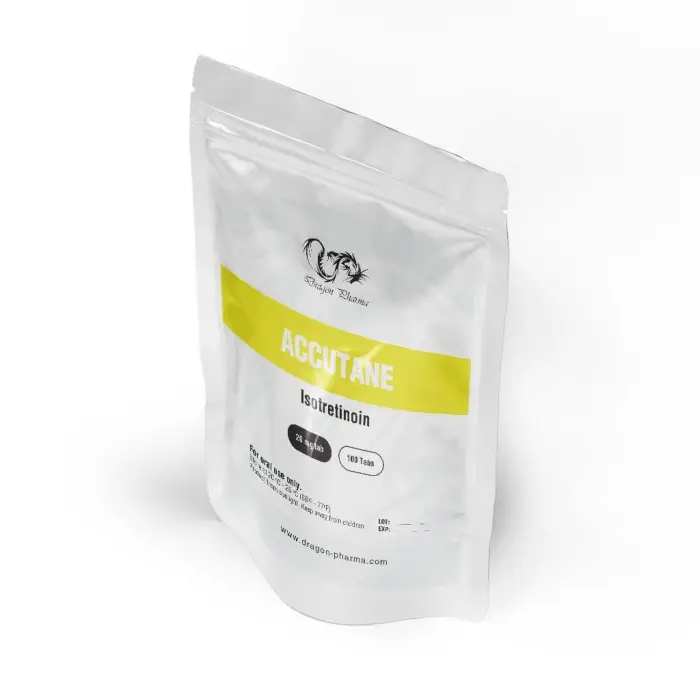
Accutane
Accutane 20 Dragon Pharma — Overview
Accutane 20 Dragon Pharma contains isotretinoin, an oral retinoid derived from vitamin A. It is not an anabolic steroid, aromatase inhibitor, or SERM. Its role in physique sports is specific: acne management for users dealing with severe, cystic, or androgen-driven breakouts that do not respond to standard topical routines.
This Steroid Warehouse product page covers how isotretinoin works, what results to expect on a course, why physique athletes research it, which lab markers to track, and how it fits alongside androgen-heavy cycles.
About Isotretinoin
Isotretinoin belongs to the retinoid family — synthetic derivatives of vitamin A used in dermatology for conditions driven by excess sebum production and abnormal skin cell growth. Unlike topical acne products that work on the skin surface, isotretinoin works systemically: it reaches sebaceous glands through the bloodstream and changes the internal conditions that allow deep, inflammatory acne to keep returning.
The American Academy of Dermatology describes isotretinoin as the treatment of choice for severe nodular acne and acne that has not responded to other therapies. In physique contexts, it is relevant not because it enhances performance, but because it targets one of the primary biological drivers of androgen-related acne — excessive sebaceous gland activity.
What Isotretinoin Does
Isotretinoin acts on four overlapping mechanisms that together create a sustained reduction in acne severity:
- Reduces sebaceous gland size — directly shrinks the oil-producing glands in the skin, cutting off one of the main inputs that feeds inflammatory acne
- Lowers sebum output — less surface oil means fewer clogged follicles, fewer comedones, and less environment for acne-causing bacteria to proliferate
- Normalizes follicular keratinization — improves how skin cells shed inside hair follicles, reducing plugging and the formation of deep lesions
- Anti-inflammatory activity — isotretinoin has direct anti-inflammatory effects in the skin, separate from and additive to its sebum-reduction mechanism
- Long-term remission — a completed course is associated with prolonged acne-free periods, unlike antibiotics which require continuous use to maintain effect
What to expect during a course: dryness of the lips, skin, and nasal passages is common and expected — it reflects the sebum-reduction mechanism working. Most users manage with a lip balm and a gentle non-comedogenic moisturizer. Visible improvement in acne typically begins at weeks 4–8, with full results assessed at course end. Initial flaring in the first 2–4 weeks is also common before improvement sets in.
Who It's For
Accutane 20 is discussed by people for whom standard acne management has not been enough. The core use cases are:
- Severe or cystic acne — painful nodules and cysts that don't respond to topicals, antibiotics, or basic skincare
- Persistent back and shoulder acne — recurring lesions that leave marks or scars and haven't cleared with surface products
- Cycle-induced acne in physique athletes — users whose skin worsened significantly during androgen-heavy phases and who have not found adequate control with topical treatments
- Post-antibiotic relapse — users whose acne returned after a course of doxycycline or similar ended, and who are looking for a longer-lasting result
Isotretinoin is not a first step for minor oily skin or occasional breakouts. It is relevant when acne has become persistent, inflammatory, or difficult to manage by other means.
Androgen Context & Related Products
Androgens stimulate sebaceous gland activity. When androgen levels are elevated — whether endogenous or through a performance phase — some users experience a noticeable increase in skin oiliness and acne on the face, chest, back, and shoulders. Compounds with high androgenic activity are discussed most often in this context.
Isotretinoin does not lower androgen levels and does not work like an aromatase inhibitor, SERM, or any hormonal support product. It addresses the skin response to androgenic activity rather than the androgens themselves — which is why it can be relevant during an ongoing cycle rather than only after it ends.
| Compound | Why It's Researched Alongside Accutane 20 | Link |
|---|---|---|
| Testosterone Cypionate | Elevated testosterone is one of the most commonly cited drivers of increased sebum production and androgen-related acne in physique contexts | Cypionat 250 |
| Trenbolone 200 | High androgenic activity; frequently discussed in bodybuilding communities in relation to acne, oiliness, and harsh skin effects | Trenbolone 200 |
| Dianabol 20 | Oral androgens are associated with skin changes and acne flare-ups; Dianabol is among the most commonly researched in this context | Dianabol 20 |
| Atorvastatin 40 mg | Isotretinoin can raise LDL and triglycerides; users already managing lipid strain from a cycle sometimes research atorvastatin as lipid support | Atorvastatin 40 mg |
Monitoring & Side Effects
Isotretinoin has a defined monitoring profile. The most common effects are dose-related and resolve after the course ends. For physique athletes who already manage compounds affecting liver enzymes, cholesterol, and blood pressure, isotretinoin adds specific markers worth tracking separately — particularly since the overlap between AAS-related lipid strain and isotretinoin-related lipid changes can compound each other.
| What May Occur | Background | How to Manage |
|---|---|---|
| Dry lips, skin, eyes, nasal passages | Direct result of reduced sebum production — expected on any meaningful dose and generally proportional to dose level | Lip balm daily, non-comedogenic moisturizer, lubricating eye drops if needed. Resolves after course ends |
| Elevated LDL / triglycerides | Isotretinoin can raise serum triglycerides and LDL; especially relevant for users whose cycle compounds already put pressure on lipids | Baseline lipid panel before starting; recheck at 4–6 weeks. Atorvastatin is commonly discussed when support is needed |
| Elevated ALT / AST | Aminotransferase elevation is possible, usually mild and dose-dependent — but worth monitoring closely when stacked with oral AAS that also stress the liver | Baseline liver panel before starting; recheck monthly. Limit alcohol during course |
| HDL reduction | Some studies show a modest drop in HDL during isotretinoin use — compounds the cardiovascular lipid picture when other suppressive agents are present | Track on the same lipid panel. Omega-3 supplementation is commonly used alongside for lipid support |
| Sun and skin sensitivity | Reduced sebum makes skin thinner and more reactive; UV sensitivity increases during the course | SPF 30+ when outdoors. Avoid harsh exfoliants, retinol serums, and waxing during treatment |
| Musculoskeletal discomfort | Joint and muscle aches are reported at higher doses or in users training at high intensity; the mechanism is not fully established | Worth tracking during heavy training blocks. Usually resolves with dose reduction or course completion |
References
| Source | Topic | Link |
|---|---|---|
| American Academy of Dermatology | Isotretinoin overview for severe acne | AAD isotretinoin guide |
| NCBI Bookshelf — StatPearls | Isotretinoin pharmacology and severe acne use | NCBI StatPearls |
| NCBI LiverTox | Isotretinoin and liver enzyme considerations | NCBI LiverTox |
| PMC Review | Isotretinoin effects on blood lipids and liver enzymes | Lipids and liver enzymes review |
-
Accutane has helped my acne stay under control. I started with a microdose and then upped to a traditional dose. Highly recommend from Dragon Pharma. Works great.
-
This accutane will dry your skin out and clear up acne fast. Be careful if you work outside or spend a lot of time in the sun as you can burn much more easily, so apply a good SPF sunscreen. Product works exactly as it should. Recommend from Dragon Pharma.
-
This product exceeded my expectations! I noticed results quickly, and the shipping was lightning fast. The packaging was secure, and the product quality is top-notch. I couldn't be happier with this purchase and will definitely be ordering again soon. Highly recommend it to anyone looking for something effective and reliable!
How long does Accutane 20 take to work for acne?
Most people researching Accutane 20 expect gradual improvement, not overnight clearing. Noticeable changes are often discussed over several weeks, while deeper acne improvement may take longer.
Can Accutane 20 help with steroid-induced acne?
Accutane 20 is commonly discussed by bodybuilders because isotretinoin targets sebaceous gland activity and oil production, which may be relevant when acne worsens during androgen-heavy phases.
What are the most common Accutane 20 side effects?
Commonly discussed Accutane 20 side effects include dry lips, dry skin, skin sensitivity, nose dryness, elevated liver enzymes, and changes in cholesterol or triglycerides.
Can Accutane 20 affect liver enzymes and cholesterol levels?
Yes. ALT, AST, total cholesterol, LDL, HDL, and triglycerides are commonly discussed monitoring markers during isotretinoin use.
Is Accutane 20 stronger than topical acne treatments?
Accutane 20 is usually discussed as a stronger systemic option because isotretinoin works inside the body, while topical acne treatments act mainly on the skin surface.
Why do bodybuilders use isotretinoin during steroid cycles?
Bodybuilders research isotretinoin during steroid cycles when androgen-related oiliness, back acne, shoulder acne, or cystic acne becomes difficult to control with basic skincare.
Does Accutane 20 permanently reduce oil production?
Isotretinoin is often discussed for long-lasting reduction in oil production because it affects sebaceous gland activity, although individual results vary.
Can isotretinoin help severe cystic acne when antibiotics fail?
Isotretinoin is commonly researched for severe cystic acne that has not responded well to antibiotics, topical retinoids, benzoyl peroxide, or standard skincare routines.
Related Products