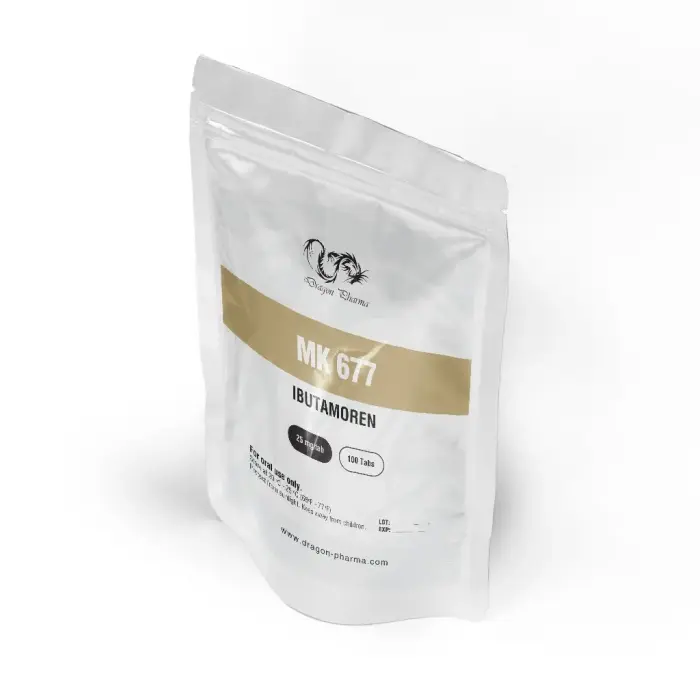
MK 677 (Ibutamoren)
MK-677 Ibutamoren Dragon Pharma — Overview
MK-677 Ibutamoren Dragon Pharma is an oral GH secretagogue in 25 mg tablet form. Despite being listed alongside SARMs commercially, ibutamoren is mechanistically a different class of compound entirely: it is a non-peptide ghrelin receptor agonist that stimulates the pituitary to release growth hormone in a pulsatile pattern, closely mimicking the body's natural GH secretion rhythm. It has no androgenic activity, does not bind the androgen receptor, and does not suppress LH, FSH, or testosterone production.
The practical consequence of this pharmacological profile is that MK-677 can be used long-term, across cycles, through PCT, and as a standalone compound without any of the hormonal recovery concerns that apply to SARMs or AAS. It elevates IGF-1, improves sleep architecture, accelerates connective tissue repair, supports body recomposition over extended use, and functions as a recovery amplifier in any AAS or SARM stack. This page covers the GH secretagogue mechanism, practical effects, how MK-677 compares to injectable HGH and CJC-1295 DAC, combination options, and the bloodwork monitoring that matters for long-term use.
About the Compound: Ibutamoren (MK-677)
Ibutamoren acts on the growth hormone secretagogue receptor (GHSR-1a), the same receptor that endogenous ghrelin activates. Ghrelin is a gut-derived peptide hormone that signals hunger and stimulates GH release from the anterior pituitary. MK-677 mimics this signal orally and with a long half-life (~24 hours), producing sustained stimulation of the pituitary's GH release mechanism rather than a single short pulse.
The result is an increase in both the amplitude and frequency of GH pulses throughout the day, with the largest pulse occurring during slow-wave sleep — which is relevant because deep sleep is when the body's natural GH release is highest. This mechanism preserves the pulsatile nature of GH secretion, which is important: unlike injecting exogenous HGH (which saturates receptors non-pulsatily and can cause desensitization), MK-677-driven GH release maintains physiological pulsatility. Elevated GH then stimulates hepatic IGF-1 production, and IGF-1 is the primary downstream mediator of GH's anabolic, lipolytic, and recovery effects.
MK-677 does not interact with the androgen receptor, does not aromatize, and has no effect on the HPG axis (LH, FSH, testosterone). It is not 17-alpha alkylated and does not impose hepatic burden. The dominant metabolic concern with long-term use is its ghrelin-agonist activity increasing appetite and potentially impairing insulin sensitivity, which requires glucose monitoring in long-term protocols.
What MK-677 Does
- IGF-1 elevation — this is the primary downstream measurable effect of MK-677 use; IGF-1 is the anabolic mediator through which GH exerts most of its tissue effects — nitrogen retention, amino acid uptake, protein synthesis, lean tissue preservation, and lipolysis; clinical studies show IGF-1 increases of 40–90% from baseline within 8–12 weeks at 25 mg/day; elevated IGF-1 is the primary driver of MK-677's long-term body composition effects and the metric used to confirm the compound is working
- Improved sleep quality (slow-wave stage) — MK-677 amplifies the dominant GH pulse that occurs during stage 4 deep sleep; clinical data specifically documents increased slow-wave sleep time in users, which translates to better overnight recovery, improved next-day cognitive function, and enhanced muscle repair during sleep; users consistently report more vivid dreams and feeling more rested; this effect is evident within the first 1–2 weeks of use and is often the first subjectively noticeable benefit
- Accelerated recovery and connective tissue repair — elevated GH and IGF-1 increase collagen synthesis and support extracellular matrix remodeling; this is particularly relevant for users managing joint or tendon issues alongside training; MK-677 added to an AAS cycle meaningfully reduces the recovery time between sessions and supports connective tissue integrity under the increased load that androgenic compounds allow; the recovery benefit compounds over several months of use
- Lean body mass preservation and modest body recomposition — over extended use (>3 months), users report improved body composition with partial fat redistribution away from visceral stores; this effect is driven by IGF-1's anabolic action on lean tissue combined with GH's lipolytic activity; the timeline for visible body composition changes is longer than for AAS or SARMs and requires sustained use; MK-677 is not a short-cycle compound
- Increased appetite — ghrelin receptor agonism directly stimulates the hunger signal; this is a pharmacological inevitability of the mechanism, not a side effect in the traditional sense; during bulking phases it supports caloric surplus; during cutting phases it requires dietary discipline to manage; users who run MK-677 during a cut typically run it at 10–15 mg/day rather than 25 mg to reduce the appetite drive
Who It's For
- Users who want the benefits of elevated GH/IGF-1 without injections or exogenous HGH cost — injectable HGH (Dragontropin) is the gold standard for GH-axis enhancement but requires daily subcutaneous injection, refrigerated storage, and carries a significantly higher cost; MK-677 is an oral, room-temperature-stable alternative that stimulates endogenous GH release; results accumulate more slowly than injectable HGH but the convenience, cost, and preserved pulsatility profile make it the preferred starting point for users exploring GH-axis enhancement
- AAS and SARM users adding a recovery and body composition layer to their cycle — MK-677 adds GH-axis stimulation to any AAS or SARM protocol without adding hormonal suppression; it can run through the entire cycle period, through PCT, and into the off-cycle phase without any pharmacological conflict; this makes it the most versatile add-on compound available; the combination of AAS-driven androgen receptor anabolism and MK-677-driven IGF-1 elevation covers two distinct anabolic pathways simultaneously
- Users focused on sleep, recovery, and connective tissue health rather than acute muscle gain — the compound's sleep quality improvement and collagen synthesis effects are often undervalued; athletes managing high training volumes, joint stress from heavy compound lifts, or recovering from soft-tissue injuries find MK-677's connective tissue and recovery profile as valuable as its body composition effects; for this use case, 10–15 mg/day before sleep is often sufficient and reduces glucose-related side effects
- Users who should approach MK-677 carefully or choose alternatives: users with pre-existing insulin resistance, type 2 diabetes, or impaired fasting glucose should have a baseline HbA1c and fasting glucose before starting and monitor closely; the compound's appetite stimulation and insulin-blunting effects are the primary risk in this group; users seeking acute strength or mass gains comparable to AAS on a short timeline will not achieve them with MK-677 alone — results require sustained use over months
MK-677 vs Alternatives
| Compound | Key Differences | Choose MK-677 When | Choose Alternative When |
|---|---|---|---|
| Dragontropin (Injectable HGH) | Exogenous recombinant HGH; delivers GH directly rather than stimulating endogenous production; more precise and faster-acting than MK-677; requires subcutaneous injection daily or multiple times per week; requires refrigeration; significantly higher cost per unit GH effect; produces measurable body composition changes more rapidly than MK-677 | Oral, convenient daily administration preferred; budget is a priority; preserving pulsatile GH release pattern is important; adding GH-axis support to an existing AAS/SARM cycle without injectable overhead; long-term maintenance over 6+ months | Maximum GH effect in the shortest time is the goal; user is experienced with injectable protocols; budget supports pharmaceutical HGH; precise dose titration against IGF-1 labs is required |
| CJC-1295 DAC Dragon Pharma | GHRH analog acting on the GHRH receptor (different mechanism from MK-677's ghrelin receptor action); injectable; DAC variant extends half-life to ~8 days allowing once-weekly injection; combining MK-677 with CJC-1295 DAC addresses two distinct GH-releasing pathways and produces synergistic IGF-1 elevation above what either compound achieves alone | Fully oral protocol with no injections; cost-efficiency over peptide injection schedule; standalone use; stacking with SARMs or as AAS cycle support without injectable commitment | Maximum GH secretion is the goal and the user is comfortable with injections; combining with MK-677 for dual-pathway stimulation (the combination is a recognized stack for maximal endogenous GH output) |
Combinations
| Goal | Stack | Protocol Notes |
|---|---|---|
| Sleep, recovery & connective tissue (solo) | MK-677 10–15 mg/day before bed | Lower dose preserves the primary sleep and recovery benefits while reducing appetite stimulation and glucose impact; ideal for users focused on recovery quality rather than body composition; sustainable long-term protocol; no PCT or supporting compounds needed |
| Lean recomp + recovery | MK-677 25 mg/day + Ostarine 25 mg/day | Classic SARM + GH secretagogue recomp stack; Ostarine provides AR-mediated anabolism; MK-677 provides IGF-1 elevation and sleep/recovery support; MK-677 continues through Ostarine PCT and into the off period; the combination covers two independent anabolic pathways without HPG-axis crash compounding |
| Cutting + fat oxidation | MK-677 10 mg/day + GW-501516 20 mg/day | Lower MK-677 dose reduces appetite stimulation during a cut; Cardarine adds PPARδ-mediated fat oxidation and endurance; MK-677 preserves lean mass and maintains GH-axis support during caloric deficit; GW-501516 addresses the fat loss side independently of the GH axis |
| AAS cycle support | MK-677 25 mg/day added to any AAS cycle | MK-677 runs the full cycle duration and continues through PCT and the off period; it adds IGF-1-driven anabolism to AR-driven AAS anabolism without any pharmacological conflict; the GH-axis benefit of improved sleep quality is particularly valuable during heavy AAS cycles where sleep disruption is common; no dose adjustment needed based on the AAS compounds used |
| Maximum GH output (dual-pathway) | MK-677 25 mg/day + CJC-1295 DAC 2 mg once weekly | Addresses GH release through both the ghrelin receptor (MK-677) and the GHRH receptor (CJC-1295 DAC); synergistic IGF-1 elevation above either compound alone; glucose monitoring is important when stacking for maximal GH output; available at Steroid Warehouse |
Side Effects & Management
| What May Occur | Background | How to Handle It |
|---|---|---|
| Increased appetite / hunger | Ghrelin receptor agonism directly activates the hunger signaling pathway; this is a pharmacological consequence of the mechanism; appetite increase is most pronounced in the first 2–4 weeks and partially adapts over time; stronger at 25 mg/day, more manageable at 10–15 mg/day | Manage with meal timing and dietary structure; for cutting phases, reduce to 10–15 mg/day; take MK-677 before sleep rather than in the morning to blunt daytime hunger; the appetite effect is dose-dependent and reduces at lower doses without proportionally reducing the GH/IGF-1 benefit |
| Water retention / morning puffiness | GH elevation causes sodium and water retention through direct renal effects; typically presents as morning puffiness in the hands, wrists, and ankles; most pronounced in the first 4–6 weeks, partially subsides as the body adapts; more significant at 25 mg/day; compounded if the user is also running an estrogenic AAS concurrently | Reduce to 10–15 mg/day if edema is persistent and bothersome; ensure adequate water intake; if running alongside estrogenic AAS, manage estrogen first — E2-driven retention compounds the GH-driven retention; most users find the edema largely resolves by weeks 6–8 without intervention |
| Lethargy / fatigue (early weeks) | Common in the first 2–4 weeks as the body adjusts to elevated GH pulses and changes in sleep architecture; the amplified stage 4 slow-wave sleep can temporarily increase perceived morning grogginess; typically resolves as the body adapts | Shift dosing to 1–2 hours before sleep rather than at bedtime or morning; most users tolerate MK-677 well once the first adaptation phase passes; if lethargy persists beyond week 6, assess fasting glucose — insulin resistance can contribute to fatigue independently |
| Elevated blood glucose / reduced insulin sensitivity | GH has counter-regulatory effects on insulin; elevated GH from MK-677 blunts insulin's glucose-lowering action, increasing fasting glucose and reducing insulin sensitivity over time; dose-dependent and more significant with continuous long-term use at 25 mg/day; reversible after discontinuation | Monitor fasting glucose at baseline and every 8–12 weeks; for users with pre-existing glucose concerns, limit dose to 10–15 mg/day; dietary management (limiting refined carbohydrates, prioritizing fiber and protein) attenuates the glucose impact; fasting glucose consistently above 100 mg/dL warrants dose reduction |
| Carpal tunnel-like symptoms (numbness / tingling in hands) | GH-induced fluid retention increases pressure in the carpal tunnel, compressing the median nerve; transient numbness, tingling, or weakness in the fingers upon waking is a recognized GH class effect seen with both injectable HGH and MK-677; typically resolves with dose reduction or cessation | Reduce to 10–15 mg/day if symptoms develop; dosing before sleep concentrates the GH pulse overnight when hands are less active; wrist braces during sleep are a non-pharmacological option for acute relief; if symptoms are severe, temporarily pause MK-677 for 1–2 weeks to confirm the etiology |
Bloodwork Monitoring
| Lab | When to Test | Target & Action Threshold |
|---|---|---|
| IGF-1 | Baseline before starting; 8–12 weeks into use; every 6 months during ongoing long-term use | IGF-1 increase of 40–90% from baseline confirms the compound is producing its intended effect; above the upper age-adjusted reference limit (>400 ng/mL in most adults) on a sustained basis → reduce dose; if IGF-1 has not increased from baseline at 8–12 weeks, assess product authenticity and absorption timing |
| Fasting glucose | Baseline; every 8 weeks during use | Target <100 mg/dL; 100–125 mg/dL = impaired fasting glucose → reduce dose to 10–15 mg/day and reassess after 4 weeks; ≥126 mg/dL on two occasions → pause MK-677 and evaluate further |
| HbA1c | Baseline; every 6 months during sustained use | Target <5.7%; rising HbA1c trend during MK-677 use indicates cumulative glucose impact; HbA1c ≥5.7% on MK-677 should prompt reassessment of dose and dietary composition; most meaningful long-term glucose metric |
| Blood pressure | Baseline; monthly for first 3 months | Target <130/80 mmHg; water retention from GH elevation can contribute to mild BP increase; if systolic consistently >140 mmHg on MK-677 alone, reduce dose to 10 mg/day and manage dietary sodium first |
| Prolactin | Baseline; at 8–12 weeks if libido changes or nipple sensitivity appear | Some users report mild prolactin elevation on MK-677; if prolactin rises above upper reference limit (>20 ng/mL in men) with symptoms, assess whether dose reduction resolves it before attributing to other compounds in the stack |
PCT — Not Required
MK-677 does not require post-cycle therapy. The compound has no effect on the HPG axis, does not suppress LH or FSH, and does not reduce endogenous testosterone. Stopping MK-677 does not cause a hormonal rebound or recovery crisis.
The GH axis naturally returns to baseline GH secretion within 1–2 weeks of stopping MK-677 once the ghrelin receptor stimulation is removed — no pharmacological intervention accelerates this. IGF-1 levels return to baseline over 2–4 weeks post-cessation. When running MK-677 alongside Ostarine or other suppressive SARMs, PCT is run for the SARM component only; MK-677 can be continued through PCT and beyond without any conflict with Nolvadex or Clomid.
Practical Summary
- Take MK-677 once daily, 1–2 hours before sleep; dosing before sleep aligns the GH pulse with the natural nocturnal peak, maximizes slow-wave sleep enhancement, and reduces daytime appetite and lethargy during the adaptation phase
- Use 25 mg/day for body composition and IGF-1 goals; use 10–15 mg/day if the priority is sleep and recovery with minimal appetite stimulation or glucose impact; the relationship between dose and GH output is not linear above 25 mg — higher doses do not produce proportionally more benefit
- Results from MK-677 require a minimum of 3 months of sustained use to become meaningfully visible; IGF-1 elevation is measurable by weeks 8–12; body composition and connective tissue effects accumulate over 3–6 months; short cycling of MK-677 the way AAS are cycled is not appropriate for this compound
- Monitor fasting glucose at baseline and every 8 weeks; the insulin resistance effect is the primary long-term risk and is dose-dependent; fasting glucose above 100 mg/dL on repeated checks signals a dose reduction
- MK-677 can run continuously through AAS cycles, SARM cycles, PCT, and off periods without any pharmacological conflict; it is the only compound in a physique protocol that carries no endocrine recovery cost
- IGF-1 measurement at 8–12 weeks is the confirmation test that the compound is working; if IGF-1 has not increased from baseline, assess product authenticity or absorption timing
Ibutamoren occupies a unique position in the physique athlete's toolkit as the only orally active GH-axis enhancer that preserves the natural pulsatile pattern of GH secretion, requires no injection protocol, and carries no hormonal recovery burden. Over a 3–6 month window, the combination of elevated IGF-1, improved deep sleep, and enhanced connective tissue synthesis delivers a recovery and body composition benefit that compounds with every other compound in the stack. Dragon Pharma's 25 mg tablet format is available at Steroid Warehouse alongside the full SARM and cycle-support lineup.
References
| Source | Topic | Link |
|---|---|---|
| Annals of Internal Medicine / PubMed | Nass et al. 2008 — randomized, placebo-controlled trial of oral MK-677 25 mg/day in healthy older adults; shows enhanced pulsatile GH secretion, increased IGF-1, increased fat-free mass over 12 months, and general tolerability, while strength and functional outcomes did not clearly improve | Nass R, et al. (2008) ↗ |
| Journal of Clinical Endocrinology & Metabolism / PubMed | Svensson et al. 1998 — 2-month randomized study of oral MK-677 25 mg/day in healthy obese men; reports sustained increases in GH, IGF-1, and IGFBP-3, increased fat-free mass, transient increase in basal metabolic rate, and impaired glucose tolerance during treatment | Svensson J, et al. (1998) ↗ |
| Neuroendocrinology / PubMed | Copinschi et al. 1997 — placebo-controlled sleep study of oral MK-677 in healthy young and older adults; documents improved sleep architecture, including increased stage IV sleep in young subjects and increased REM sleep in young and older subjects | Copinschi G, et al. (1997) ↗ |
| Journal of Clinical Endocrinology & Metabolism / PubMed | Chapman et al. 1996 — dose-ranging study of oral MK-677 in older adults; shows dose-dependent stimulation of pulsatile GH release and significant IGF-1 elevation after once-daily administration for up to 4 weeks | Chapman IM, et al. (1996) ↗ |
| Clinical Endocrinology / PubMed | Freda 2009 — review on interpreting GH and IGF-1 when biochemical markers are discrepant in acromegaly; useful supporting reference for cautious interpretation of IGF-1 monitoring during GH-stimulating interventions | Freda PU (2009) ↗ |
What is MK-677 used for?
MK-677 is commonly associated with supporting growth hormone levels, recovery, sleep quality, appetite stimulation, and body composition improvements in research contexts.
What is MK-677 (Ibutamoren)?
MK-677, also known as Ibutamoren, is a growth hormone secretagogue that is widely discussed in research related to growth hormone and IGF-1 elevation.
How does MK-677 work?
MK-677 works by mimicking the action of ghrelin, binding to growth hormone secretagogue receptors (GHS-R1a), which stimulates the body's natural release of growth hormone and increases IGF-1 levels.
How long does it take to notice effects from MK-677?
Many users report gradual changes such as increased appetite, improved sleep, and recovery within days to weeks, while body composition changes typically take longer.
What are the main benefits of MK-677?
Commonly discussed benefits include increased growth hormone and IGF-1 levels, improved sleep quality, enhanced recovery, increased appetite, and support for lean mass development.
Is MK-677 used for bulking or cutting?
MK-677 is more commonly associated with bulking or recomposition phases due to its appetite-stimulating effects and support for lean mass gains.
What are the possible side effects of MK-677?
Potential side effects may include increased appetite, water retention, lethargy, numbness or tingling sensations, and temporary insulin sensitivity changes.
What makes MK-677 different from other growth hormone compounds?
Unlike injectable growth hormone or peptides, MK-677 is orally active and stimulates the body's own growth hormone production rather than supplying exogenous hormone directly.
Related Products