Raloxifene
Raloxifene Dragon Pharma — Overview
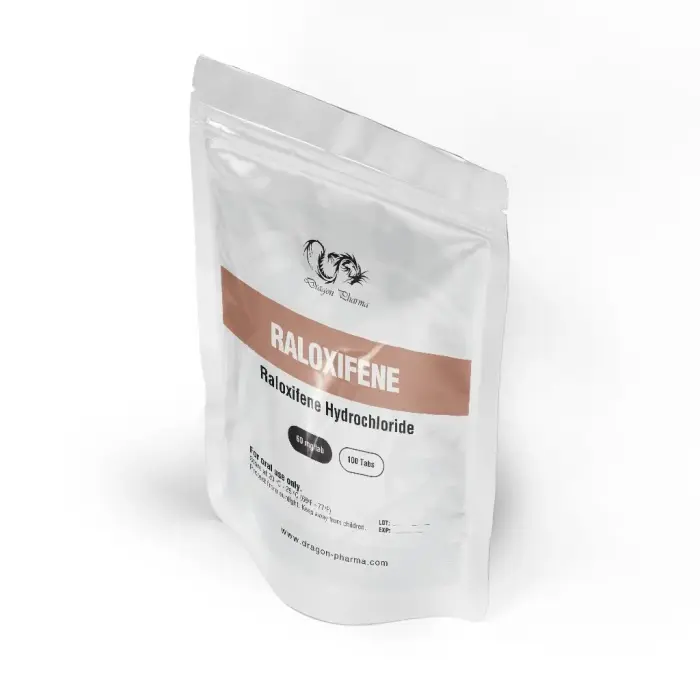
Raloxifene Dragon Pharma is a second-generation selective estrogen receptor modulator (SERM) supplied at 60 mg per tablet. Its primary application in performance protocols is the treatment and prevention of gynecomastia — and specifically the reversal of existing glandular breast tissue, where clinical evidence consistently shows raloxifene 60 mg/day outperforms tamoxifen (Nolvadex) 20 mg/day in reducing gynecomastia volume. Like all SERMs, raloxifene also stimulates LH and FSH by blocking estrogen's negative feedback on the hypothalamus-pituitary axis, making it a functional PCT agent.
The defining pharmacological difference between raloxifene and first-generation SERMs like tamoxifen is tissue selectivity profile. Tamoxifen has partial agonist activity in some tissues (liver, endometrium) that can elevate SHBG and introduce estrogenic side effects; raloxifene has a cleaner antagonist profile in breast tissue with no meaningful pro-estrogenic activity at the uterus. Raloxifene does not reduce circulating estradiol (E2) — it blocks the estrogen receptor in breast tissue rather than inhibiting aromatization — so it is used alongside aromatase inhibitors when the goal is both preventing new estrogen-driven tissue development and reversing existing glandular mass. Available at Steroid Warehouse at 60 mg/tab, one tablet per day covers standard PCT and gynecomastia reversal protocols.
About the Compound: Raloxifene
Raloxifene is a benzothiophene-derived SERM that binds the estrogen receptor (ER) with high affinity and produces tissue-selective agonist or antagonist effects depending on the cell type. In breast tissue and the hypothalamus, raloxifene acts as an ER antagonist: it displaces estradiol from the receptor and blocks the downstream transcriptional effects of estrogen, which is the mechanism underlying both its gynecomastia-reducing activity and its LH/FSH-stimulating effect in PCT. In bone and the cardiovascular system (lipid metabolism), raloxifene acts as an ER agonist, which drives its FDA-approved clinical indications in osteoporosis.
The critical mechanistic difference from aromatase inhibitors (Aromasin, Letrozole, Anastrozole) is the point of intervention: aromatase inhibitors reduce estradiol production upstream by blocking the aromatase enzyme; raloxifene does not change circulating E2 levels at all — it blocks what E2 does at the receptor in target tissues. This means raloxifene does not produce the joint pain, mood decline, or libido loss associated with E2 over-suppression, but it also cannot address the systemic consequences of excess circulating E2 (water retention, blood pressure elevation) that an AI would prevent. For gynecomastia specifically, receptor blockade is the targeted intervention: the breast gland tissue must be deprived of its ER signaling, which is precisely what raloxifene accomplishes.
Raloxifene has a half-life of approximately 28 hours, supporting once-daily oral dosing with stable plasma levels. At 60 mg/day, it is the standard dose for both PCT and gynecomastia protocols; at 120 mg/day it is used for accelerated reversal of established gynecomastia tissue.
What Raloxifene Does
- Reverses existing gynecomastia glandular tissue — raloxifene's primary and most clinically documented performance use is the reversal of established gynecomastia; by blocking estrogen receptors in breast glandular tissue, it deprives the tissue of the estrogenic signal required to maintain and grow the gland; clinical studies comparing raloxifene 60 mg/day to tamoxifen 20 mg/day in pubertal gynecomastia consistently show greater reduction in glandular volume with raloxifene; the effect requires 8–12 weeks of consistent daily use; it is most effective on softer, more recent glandular tissue and less effective on older fibrotic tissue that has already calcified
- Prevents new estrogen-driven breast gland development — on a cycle where E2 is elevated, raloxifene 60 mg/day blocks the estrogen receptor in breast tissue and prevents the initial glandular stimulation that leads to gynecomastia; this prevention mechanism makes it suitable as an on-cycle gynecomastia protocol for users who cannot tolerate or choose not to use an aromatase inhibitor; it does not address the systemic consequences of elevated E2 (water retention, blood pressure) — only breast tissue ER blockade
- Stimulates LH and FSH for PCT — raloxifene blocks estrogen receptors in the hypothalamus and pituitary, removing E2's negative feedback on GnRH and gonadotropin release; the result is increased LH and FSH secretion, which stimulates Leydig cell testosterone production and restores the HPG axis following AAS-induced suppression; the LH/FSH stimulation is clinically equivalent to tamoxifen at comparable doses; for athletes who have used high-aromatizing cycles and want a SERM that simultaneously stimulates LH/FSH recovery and protects against residual E2-driven gynecomastia, raloxifene covers both goals in one compound
- No E2 over-suppression risk — because raloxifene acts at the receptor level rather than upstream at aromatase, circulating estradiol concentrations are unchanged; joint lubrication, mood stability, libido, and bone mineralization that depend on systemic E2 are preserved during raloxifene use; this contrasts with AI use, where aggressive E2 reduction produces measurable physiological deficits; raloxifene can be run on a cycle or in PCT without the concern of pushing E2 below the functional threshold
- No retinal toxicity risk (unlike tamoxifen) — tamoxifen at long-term high doses carries a documented risk of retinal toxicity and keratopathy; raloxifene does not share this profile; for athletes who require extended SERM therapy for persistent gynecomastia (8–12 weeks or more) or who use SERMs across multiple cycles, raloxifene's cleaner safety profile at the eye is a practical clinical advantage
Who It's For
- Users with established gynecomastia that did not respond adequately to Nolvadex — tamoxifen 20 mg/day is the most commonly used first-line gynecomastia SERM because of familiarity and availability; when it fails to produce sufficient reduction, raloxifene 60–120 mg/day is the appropriate escalation; the clinical evidence for raloxifene's superiority in glandular volume reduction makes it the preferred choice when gyno reversal — rather than just prevention — is the goal; it is also a reasonable first-line choice for any user who has an established gynecomastia nodule they want to address
- Users who want a single compound covering both PCT and gynecomastia management — Nolvadex for PCT + separate gyno management requires juggling two SERMs or adding an AI; raloxifene at 60 mg/day handles LH/FSH stimulation for testosterone recovery while simultaneously maintaining breast tissue ER blockade; for users whose cycle involved high aromatization (testosterone, Dianabol) and who experienced some gynecomastia development, raloxifene is the most efficient single-compound PCT option
- What differentiates Raloxifene from similar alternatives: compared to Nolvadex (tamoxifen), raloxifene has better clinical evidence for gynecomastia reversal, no retinal toxicity risk, and does not elevate SHBG through liver agonism; Nolvadex has longer PCT track record and is generally better documented for LH/FSH stimulation at higher doses; compared to Aromasin (exemestane), raloxifene blocks the ER while Aromasin eliminates the E2 signal upstream; Aromasin is superior for controlling systemic E2 effects; raloxifene is superior for protecting breast tissue specifically without affecting systemic E2; compared to Clomid (clomiphene), Clomid produces stronger gonadotropin stimulation but with more frequent side effects (visual disturbances, mood swings); raloxifene produces reliable LH/FSH recovery with a more manageable side effect profile
- Users who should choose something else: users who need aggressive systemic E2 reduction (water retention, BP from high-dose aromatizing cycles) should use an AI, not raloxifene; if the only goal is PCT with no gyno concern, Nolvadex or Clomid are equally effective with more PCT-specific data; users with a personal or family history of venous thromboembolism should assess thromboembolic risk before using any SERM
Raloxifene vs Alternatives
| Compound | Key Differences | Choose Raloxifene When | Choose Alternative When |
|---|---|---|---|
| Nolvadex Dragon Pharma (Tamoxifen 20 mg) |
First-generation SERM; same mechanism (ER antagonist in breast, agonist in bone); partial agonist activity in liver (elevates SHBG, can mildly suppress free testosterone at high doses); longer PCT history with well-documented LH/FSH stimulation data; retinal toxicity risk with extended high-dose use; clinical evidence for gynecomastia reversal is inferior to raloxifene at equivalent doses; 20 mg/day standard PCT; widely used and familiar | Gynecomastia reversal is needed; Nolvadex has failed to reduce existing gland tissue; single compound covering both PCT and gyno is preferred; avoiding SHBG elevation from tamoxifen liver agonism | Gyno prevention only (no existing glandular tissue); PCT only with no gyno concern; tamoxifen familiarity and cost is a priority; higher doses needed for aggressive HPG axis stimulation |
| Aromasin Dragon Pharma (Exemestane) |
Irreversible aromatase inhibitor; reduces circulating E2 at source rather than blocking the receptor; eliminates systemic estrogenic effects (water retention, BP); does not stimulate LH/FSH directly; no gynecomastia reversal mechanism; essential when systemic E2 elevation is the problem; combining Aromasin + Raloxifene is the standard protocol for active gynecomastia on a high-aromatizing cycle | Breast tissue ER blockade is the specific goal; gyno reversal alongside PCT; systemic E2 is already controlled (or naturally low); E2 over-suppression risk is a concern | Systemic E2 effects need addressing (water retention, BP elevation); E2 is elevated and requires meaningful reduction; combine Aromasin + Raloxifene for both mechanisms simultaneously |
| Clomid Dragon Pharma (Clomiphene 50 mg) |
SERM with dual ER activity; strong LH/FSH stimulation — often considered the most powerful PCT SERM for gonadotropin recovery; frequent visual disturbances, mood effects, and emotional side effects; no clinical advantage over raloxifene for gynecomastia; sometimes combined with Nolvadex or Raloxifene in PCT weeks 1–2 for accelerated recovery from deep HPTA suppression | Gynecomastia reversal or prevention is a primary goal alongside PCT; manageable side effect profile preferred; clean ER antagonism without Clomid's CNS-related mood and visual side effects | Maximum LH/FSH stimulation is needed above all else; visual side effects are acceptable; deep HPTA suppression from long or aggressive cycles; combine Clomid weeks 1–2 + Raloxifene for the full 4 weeks for both goals |
Protocols
| Goal | Protocol | Notes |
|---|---|---|
| Standard PCT | Raloxifene 60 mg/day for 4 weeks; begin at the appropriate post-cycle clearance time based on the longest ester used (propionate: 3–5 days; enanthate/cypionate: 2 weeks; decanoate: 3 weeks) | 60 mg/day is the standard single-dose protocol; once-daily dosing at a consistent time; no taper required after 4 weeks at 60 mg/day; confirm LH, FSH, and total testosterone recovery at 4 weeks post-PCT; if LH/FSH have not returned to reference range, extend by 2 weeks |
| Accelerated PCT (deep suppression) | Clomid 50 mg/day + Raloxifene 60 mg/day weeks 1–2; Raloxifene 60 mg/day alone weeks 3–4 | For cycles with deep HPTA suppression (long cycles, 19-nor compounds, high-dose testosterone); Clomid weeks 1–2 provides stronger early gonadotropin stimulation; Raloxifene covers the full 4-week run and handles any residual gyno risk; Clomid side effects (visual disturbances, mood) are limited to the first 2 weeks |
| Gynecomastia reversal (active glandular tissue) | Raloxifene 60 mg/day for 8–12 weeks; if insufficient response at 6 weeks: increase to 120 mg/day; often combined with Aromasin 12.5 mg EOD to simultaneously reduce circulating E2 | Raloxifene works best on softer, more recently developed glandular tissue; older fibrotic or calcified gyno responds poorly to any SERM; assess response at week 6 — meaningful reduction should be palpable; if none: consider increasing to 120 mg/day; no benefit to exceeding 12 weeks if no response is observed; Aromasin combination addresses the E2 source while Raloxifene blocks the receptor target |
| On-cycle gynecomastia prevention | Raloxifene 60 mg/day throughout the cycle when nipple sensitivity or early gland development is detected; continue until the source of E2 elevation (aromatizing AAS) is removed | First-choice intervention when nipple sensitivity or early gland formation appears on-cycle; Raloxifene 60 mg/day blocks breast ER immediately; if water retention and BP are also elevated, add Aromasin 12.5 mg EOD to address systemic E2; do not use Raloxifene as a substitute for an AI when systemic E2 symptoms are present |
Side Effects & Management
| What May Occur | Background | How to Handle It |
|---|---|---|
| Hot flashes | The most common adverse effect of all SERMs; driven by ER antagonism in the hypothalamus disrupting thermoregulatory signaling; severity is variable between individuals; typically transient, most pronounced in the first 1–2 weeks of use; more common in female users; at 60 mg/day it is generally mild and well tolerated; more frequent at 120 mg/day | No specific intervention required for mild flashes; severity typically reduces after 1–2 weeks as the hypothalamus adjusts; for severe or persistent hot flashes: consider dose timing adjustment (taking raloxifene at night); dose reduction to 60 mg/day if using 120 mg |
| Leg cramps | A documented class effect of raloxifene in clinical trials, more common in women with established osteoporosis; in the performance context at 60–120 mg/day over 4–12 weeks, leg cramps are occasionally reported; mechanism is not fully established but may relate to changes in calcium metabolism; not a serious safety concern but can be uncomfortable | Adequate hydration; magnesium supplementation (magnesium glycinate 300–400 mg/day) reduces cramp frequency; if severe: temporary dose reduction; stretch routine before sleep (when cramps most commonly occur) |
| Thromboembolic risk (DVT / PE) | A class effect of SERMs including raloxifene; raloxifene has FDA black-box warning for increased venous thromboembolism risk in its approved indication (postmenopausal osteoporosis); in the performance context at short-duration 4–12 week use in generally younger, active male users, absolute risk is low but not zero; risk is compounded by polycythemia (elevated hematocrit from AAS), sedentary periods, and personal or family history of clotting disorders | Ecosprin 75 mg/day throughout SERM use; maintain hematocrit <52%; avoid prolonged immobility (flights, bed rest) during SERM use; if personal or family history of DVT/PE or clotting disorders: consult appropriately; discontinue immediately and seek evaluation if unilateral leg swelling, warmth, or respiratory symptoms appear |
| Mood changes / emotional effects | Raloxifene's hypothalamic ER antagonism may produce mild mood-related effects in sensitive individuals; notably, raloxifene produces significantly fewer CNS side effects than Clomid (which has well-documented mood and emotional side effects); at 60 mg/day most users report no meaningful mood impact; the effects are more relevant at 120 mg/day or in combination with other hormonal changes during PCT | Consistent sleep schedule and exercise; if mood effects are significant: reassess whether concurrent hormonal changes (low testosterone during PCT window) are contributing; Raloxifene's ER antagonism in the CNS is typically well tolerated compared to Clomid |
Bloodwork Monitoring
| Lab | When to Test | Target & Action Threshold |
|---|---|---|
| LH + FSH | Baseline (start of PCT); 4 weeks post-PCT completion | Near-zero at PCT start (suppressed by AAS cycle); return to reference range (LH 1.7–8.6 IU/L; FSH 1.5–12.4 IU/L) at 4 weeks post-PCT confirms HPG axis recovery; if still suppressed: extend PCT by 2 weeks; if suppression persists beyond 8 weeks post-cycle, investigate prolactin and broader endocrine status |
| Total testosterone | Baseline; 4 weeks post-PCT | Post-PCT target ≥400 ng/dL; raloxifene's LH/FSH stimulation typically produces meaningful testosterone recovery within 3–4 weeks; values below 300 ng/dL at 4 weeks post-PCT indicate incomplete recovery — extend protocol or investigate prolactin |
| Estradiol (E2) | Baseline; week 4 of PCT | Raloxifene does not reduce E2; circulating estradiol may remain elevated through PCT if high-aromatizing AAS were used; this is not a problem for breast tissue (ER is blocked) but may cause persistent water retention or mood effects; if E2 remains above 60 pg/mL at week 4 of PCT: add Aromasin 12.5 mg EOD; target E2 20–40 pg/mL by PCT end |
| Prolactin | If LH/FSH recovery is delayed; after 19-nor AAS cycles | Elevated prolactin directly suppresses LH/FSH and testosterone recovery; if prolactin is above 25 ng/mL during PCT, SERMs alone will not fully restore the HPG axis; add Cabergoline 0.25 mg twice weekly to normalize prolactin before or during PCT |
| Lipid panel | Baseline; end of PCT or gyno protocol | Raloxifene has a favorable lipid profile in clinical studies (mild LDL-lowering effect via bone/lipid ER agonism); lipid monitoring during PCT is standard practice driven by the AAS cycle, not specifically by raloxifene; expect improvement in HDL/LDL trajectory during PCT as AAS clear and estrogen signaling normalizes |
Tapering & Discontinuation
Raloxifene at 60 mg/day for a standard 4-week PCT does not require tapering — discontinuation is abrupt at the end of the protocol. For longer gynecomastia reversal protocols (8–12 weeks), the same applies: stop at the end of the planned duration. There is no rebound gynecomastia effect from stopping raloxifene once the primary AAS cycle has cleared and E2 has normalized. The key discontinuation rules are:
| Context | Discontinuation Approach | Notes |
|---|---|---|
| Post-4-week PCT | Stop raloxifene abruptly at day 28; confirm LH, FSH, testosterone at 4 weeks post-PCT | If testosterone <400 ng/dL or LH/FSH still suppressed at the 4-week check: extend PCT by 2 weeks at 60 mg/day; recheck |
| Post-gynecomastia protocol (8–12 weeks) | Stop abruptly at end of planned duration; assess glandular tissue response | Palpate glandular tissue at week 8 and week 12; if glandular mass is reducing, continue to 12 weeks; if no measurable reduction at week 6–8: reassess whether the tissue is fibrotic (surgical consultation may be appropriate) |
| On-cycle use (prevention) | Discontinue when the AAS cycle ends; transition to PCT protocol if recovery is the next step | Transition from on-cycle raloxifene to PCT-phase raloxifene is continuous — no gap needed; the same 60 mg/day dose covers both applications; ensure AI is discontinued or tapered appropriately at cycle end to allow E2 to recover during PCT |
Practical Summary
- First choice for gynecomastia reversal: if an existing gynecomastia nodule needs to be reduced, raloxifene 60–120 mg/day for 8–12 weeks is clinically superior to Nolvadex 20 mg/day; start at 60 mg/day; assess at week 6 and increase to 120 mg/day if response is insufficient; the most important factor for success is tissue age — recent, soft glandular tissue responds; old fibrotic tissue does not
- Combine with Aromasin when E2 is elevated: raloxifene blocks the breast tissue ER but does not reduce circulating E2; if the E2 source (aromatizing AAS) is still active, add Aromasin 12.5 mg EOD to reduce aromatization upstream; the combination covers both the production and the receptor sides of the estrogenic pathway
- 60 mg/day is a single tablet — take at a consistent daily time: the 28-hour half-life allows full flexibility on timing; morning or evening, consistent timing reduces variability; no split dosing required
- Raloxifene does not reduce E2 — do not use it as a substitute for an AI when systemic E2 effects are present: water retention, blood pressure elevation, and mood changes from elevated E2 require an aromatase inhibitor; raloxifene only addresses the breast tissue receptor endpoint
- Ecosprin 75 mg/day throughout: DVT/PE risk is a class effect of SERMs; Ecosprin 75 mg/day is standard cardiovascular baseline; maintain hematocrit below 52% (elevated hematocrit from AAS compounds the thromboembolic risk)
- Check LH, FSH, and testosterone 4 weeks post-PCT: these three values confirm HPG axis recovery; raloxifene's LH/FSH stimulation is reliable, but prolactin elevation (from 19-nor cycles) can blunt recovery independently; if recovery is incomplete, investigate prolactin before extending the SERM protocol
Raloxifene from Dragon Pharma at Steroid Warehouse is the most targeted SERM available for gynecomastia reversal — combining estrogen receptor blockade in breast tissue with reliable LH/FSH stimulation for PCT in a single 60 mg once-daily tablet. For athletes managing existing glandular tissue, running PCT after high-aromatizing cycles, or seeking SERM coverage without tamoxifen's retinal toxicity or SHBG-elevating liver agonism, raloxifene remains the most versatile and evidence-supported option in this compound class.
References
| Source | Topic | Link |
|---|---|---|
| Journal of Pediatrics / PubMed | Lawrence et al. 2004 — retrospective chart review of tamoxifen and raloxifene for persistent pubertal gynecomastia; reports reduction in breast nodule diameter with both SERMs and a higher proportion of greater than 50% reduction with raloxifene, while noting that further study is required to confirm treatment effect | Lawrence SE, et al. (2004) ↗ |
| NCBI Bookshelf / StatPearls | Raloxifene overview — clinical pharmacology of raloxifene as a selective estrogen receptor modulator; covers estrogen-agonist effects in bone, estrogen-antagonist effects in breast and uterus, approved indications, dosing, contraindications, adverse effects, and venous thromboembolism risk context | StatPearls: Raloxifene ↗ |
| New England Journal of Medicine / PubMed | Delmas et al. 1997 — randomized clinical study of raloxifene in postmenopausal women; evaluates bone mineral density, serum cholesterol concentrations, and uterine endometrium, providing foundational tissue-selective SERM pharmacology context for raloxifene | Delmas PD, et al. (1997) ↗ |
| JAMA / PubMed | Vogel et al. 2006 — NSABP STAR P-2 trial comparing tamoxifen 20 mg/day with raloxifene 60 mg/day for breast cancer risk reduction in postmenopausal women; provides large-scale comparative SERM safety context including thromboembolic events, cataracts, uterine cancer, and differential risk-benefit profiles | Vogel VG, et al. (2006) ↗ |
| Journal of Pediatric Endocrinology & Metabolism / PubMed | Berger et al. 2022 — systematic review of pharmacological treatments for pubertal gynecomastia; summarizes available evidence for SERMs and other medical approaches, while emphasizing that the evidence base is limited and stronger randomized data are still needed | Berger O, et al. (2022) ↗ |
How does Raloxifene work?
It blocks estrogen in breast tissue and supports testosterone recovery; see Mechanism of Action. It prevents gynecomastia—monitor with labs.
Is Raloxifene safe?
It's safe with proper dosing and monitoring, but avoid in clotting disorders; see Side Effects. Consult professionals for safety.
What is Raloxifene?
Raloxifene is an oral SERM for gynecomastia prevention and PCT; see What is Raloxifene. It manages estrogen—consult professionals for safe use.
What is Raloxifene used for?
It's used for gynecomastia prevention and PCT support; see Key Benefits. It suits bodybuilders—use with professional oversight.
When to take Raloxifene?
Take 30-60 mg daily during PCT or for gynecomastia; see How to Use. Use with labs—consult for tailored plans.
How long does it take to notice effects from Raloxifene?
The timeline varies depending on the intended use and individual response, but its interaction with estrogen receptors begins shortly after consistent administration.
How is Raloxifene different from Nolvadex?
Both compounds are SERMs, but they differ in how they interact with estrogen receptors across various tissues, resulting in distinct activity profiles.
What makes Raloxifene different from aromatase inhibitors?
Unlike aromatase inhibitors, which reduce estrogen production, Raloxifene works by selectively modulating estrogen receptor activity while allowing estrogen to remain present in circulation.
Related Products