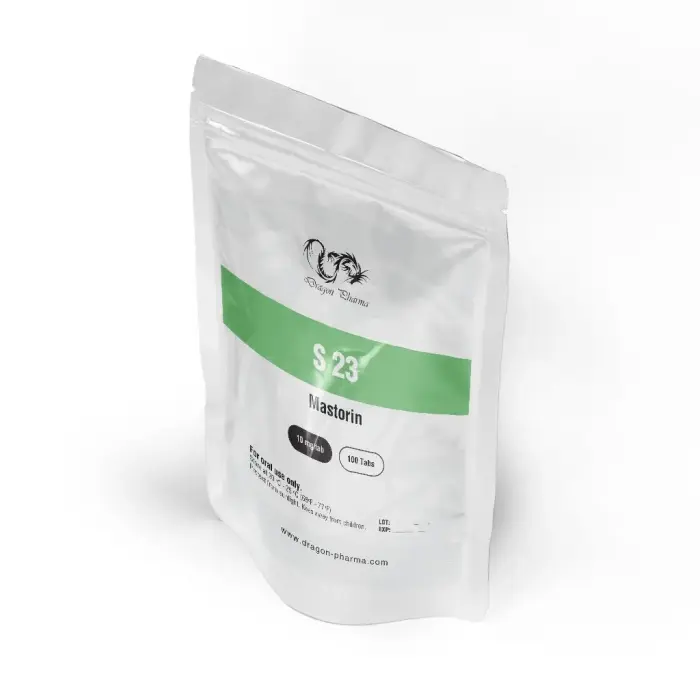
S 23 (Mastorin)
S-23 Mastorin Dragon Pharma — Overview
S-23 Mastorin Dragon Pharma is the highest-potency selective androgen receptor modulator (SARM) currently available, supplied at 10 mg per tablet. S-23 binds the androgen receptor with greater affinity than any other SARM, producing anabolic effects on muscle and bone that more closely approach those of traditional anabolic steroids than any compound in its class. Unlike most SARMs, which produce partial or low-level HPTA suppression, S-23 causes significant and consistent suppression of LH and FSH — comparable to a moderate-dose AAS cycle — and requires a proper PCT protocol at the conclusion of every run regardless of dose.
S-23 does not aromatize, produces no water retention, and delivers fully dry lean-mass gains with simultaneous fat-loss properties, making it one of the most effective body-recomposition compounds in the SARM category. Originally studied as a male hormonal contraceptive due to its potent FSH/LH suppression, its performance applications center on lean bulking, contest preparation, and recomposition phases where dry, quality gains are the priority. Available at Steroid Warehouse at 10 mg/tab, S-23 is dosed twice daily to account for its approximately 12-hour half-life and maintain stable plasma levels.
About the Compound: S-23
S-23 is a non-steroidal SARM developed originally by GTx Inc. as a potential male hormonal contraceptive. Its chemical structure — a halogenated arylpropionamide — allows it to bind the androgen receptor (AR) with exceptionally high affinity and full agonist activity in anabolic tissues (muscle, bone) while producing tissue-selective, partial antagonist effects in reproductive tissues (testis, prostate) at lower doses. At performance doses (15–30 mg/day), the dominant pharmacological effect is potent anabolic AR activation throughout skeletal muscle with concurrent robust HPTA suppression.
The degree of HPTA suppression is the key clinical distinction between S-23 and other SARMs. Compounds like Ostarine (MK-2866) or even LGD-4033 produce partial suppression from which natural testosterone recovery occurs relatively quickly and sometimes without formal PCT. S-23 at doses above 10 mg/day suppresses LH and FSH to near-zero consistently, producing a hormonal environment analogous to an anabolic steroid cycle: testosterone production shuts down, and recovery requires active intervention through SERM-based PCT. This suppressive profile is a direct consequence of the compound's high AR binding affinity and full agonist activity at hypothalamic and pituitary AR, which triggers strong negative feedback on GnRH and gonadotropin release.
S-23 has a half-life of approximately 11.9 hours, necessitating twice-daily dosing (morning and evening) to maintain stable plasma levels and avoid concentration troughs that would reduce anabolic signaling consistency. With Dragon Pharma's 10 mg/tab format, the standard 15 mg/day protocol uses one tab in the morning and half a tab (5 mg) in the evening, while the 20 mg/day protocol uses one tab twice daily.
What S-23 Does
- Lean muscle mass accrual with zero water retention — S-23's high-affinity AR binding in skeletal muscle drives anabolic signaling at a level meaningfully above other SARMs; gains are fully dry and appear quickly — within 2–3 weeks at doses of 15 mg/day and above; a well-executed 8-week cycle at 20 mg/day with adequate training and caloric surplus typically yields 4–7 kg of lean mass; because there is no aromatization and no water retention, all mass gained is functional; cuts and muscle definition visibly improve even when calories are maintained at maintenance
- Significant strength increases — androgenic drive on the CNS and neuromuscular junction is a well-documented effect of AR agonism; S-23 produces strength increases that begin in week 2–3 and accelerate through week 6–8; the strength effect is more pronounced than with Ostarine or LGD-4033 and approaches that of mild anabolic steroid use; trained athletes typically report 5–10% progression on compound lifts across an 8-week run
- Simultaneous fat loss (body recomposition) — AR activation in adipose tissue promotes lipolysis; S-23's potency at the AR produces measurable fat-loss effects even in a slight caloric surplus; in a caloric deficit, the fat-loss rate is amplified while lean mass is preserved due to the anabolic AR signaling in muscle; this dual fat-loss and lean-mass preservation effect makes S-23 one of the most effective single-compound recomposition agents in the SARM class
- Bone mineral density improvement — AR agonism in osteoblasts promotes bone formation; S-23 was originally studied for its anabolic effects on bone; at performance doses it produces meaningful increases in bone mineral density over 6–8 weeks; this is clinically relevant for athletes under repetitive mechanical stress or with low baseline bone density
- No estrogen-related side effects — S-23 does not undergo aromatase-mediated conversion to estradiol; circulating E2 does not increase during an S-23 cycle; gynecomastia, water retention, and blood pressure elevation from estrogenic pathways are not concerns; the hormonal environment during S-23 use is defined by elevated androgen signaling at the AR with stable or mildly declining E2 (as endogenous testosterone falls due to HPTA suppression); an aromatase inhibitor is not required or appropriate
Who It's For
- Intermediate-to-advanced athletes who have completed at least one SARM cycle and understand PCT protocols — S-23 is not an entry-level SARM; its HPTA suppression profile requires the same management awareness as a mild AAS cycle; users who have run Ostarine or LGD-4033 and are ready to step up to the highest-potency SARM available while remaining within the SARM category are the primary target; it is also used by AAS-experienced athletes who want a dry-gains phase between heavier compound cycles
- Athletes prioritizing dry gains, body recomposition, or contest preparation — where compounds like Testosterone produce wet gains alongside muscle from aromatization, S-23 produces exclusively dry, dense lean mass; for athletes whose goal is conditioning, muscle definition, and visible recomposition rather than maximum scale weight, S-23 delivers the highest quality gains of any SARM; it is particularly effective in 6–8 week cutting or recomposition phases
- What differentiates S-23 from similar alternatives: compared to LGD-4033, S-23 has higher AR binding affinity and greater anabolic output but is more suppressive and requires more diligent PCT; LGD-4033 is often considered the standard potent SARM — S-23 is a meaningful step above it in both efficacy and suppression; compared to YK-11, S-23 is a pure AR agonist while YK-11 adds myostatin inhibition; both are high-potency options but operate through different mechanisms; YK-11 may offer greater raw mass ceiling while S-23 produces more predictable and dose-linear anabolic response; compared to Ostarine (MK-2866), S-23 is dramatically more suppressive and more anabolically potent — Ostarine is appropriate for first-time SARM users and those prioritizing minimal suppression, while S-23 is for users who need maximum SARM output and are prepared for the corresponding PCT requirement
- Users who should choose something else: first-time SARM users should start with Ostarine or LGD-4033 before running S-23; users unwilling or unable to run a proper 4-week PCT should not use S-23 at any dose; users with an existing active hormonal issue (low testosterone, fertility concerns) should address those before introducing a highly suppressive compound; S-23 at doses above 20 mg/day may produce androgenic side effects (acne, increased aggression) that are inconsistent with the typical SARM-use expectation of minimal androgenic activity
S-23 vs Alternatives
| Compound | Key Differences | Choose S-23 When | Choose Alternative When |
|---|---|---|---|
| LGD-4033 Dragon Pharma (Ligandrol) |
The benchmark potent bulking SARM; anabolic output is meaningful but below S-23; suppression is moderate-to-high and consistent but typically recovers faster than S-23 post-cycle; some water retention possible at higher doses (5–10 mg/day); daily dosing adequate (half-life ~24–36 hrs); PCT recommended but recovery is sometimes adequate without it at 5 mg; more clinical safety data available; ideal first bulking SARM before stepping up to S-23 | Maximum SARM-class anabolic output is needed; dry gains with zero water retention are required; user has prior SARM experience; full PCT is planned regardless | First bulking SARM cycle; minimal suppression preferred; some water retention is acceptable; less aggressive PCT requirement; intermediate step before committing to S-23 |
| YK-11 Dragon Pharma (Myostatin Inhibitor + SARM) |
Dual mechanism: partial AR agonist + myostatin inhibitor; myostatin inhibition removes a genetic ceiling on muscle fiber proliferation; high potential for raw mass beyond what AR agonism alone can produce; less predictable dose-response than S-23; some mild androgenic and hepatotoxic effects; half-life ~6–10 hours, requires twice-daily dosing; suppression profile similar to S-23; both require full PCT; YK-11 and S-23 are occasionally stacked (advanced protocol) | AR agonism potency is the primary requirement; predictable and dose-linear anabolic response preferred; recomposition goal (fat loss + lean mass simultaneously) is the priority | Breaking through a genetic muscle-building plateau is the specific goal; myostatin inhibition is relevant to the user's goals; raw mass ceiling beyond AR-only agonism is needed; willing to manage YK-11's less-characterized side effect profile |
| Ostarine Dragon Pharma (MK-2866) |
Entry-level SARM; minimal HPTA suppression at doses ≤20 mg/day; well-characterized safety profile with more human trial data than S-23; modest anabolic output (lean mass preservation, mild gains); no water retention; once-daily dosing (half-life 24 hrs); PCT not always required at lower doses; appropriate first SARM; used in PCT, injury recovery, or as a base in stacks; anabolic output substantially below S-23 | Maximum SARM-class anabolic and recomposition output is needed; full PCT is already planned; user has confirmed SARM tolerance in prior cycles | First SARM cycle; minimal suppression is a priority; PCT is not planned or desired; lean mass preservation (not building) is the goal; injury recovery protocol; bridge between cycles |
Combinations
| Goal | Stack | Notes |
|---|---|---|
| Lean bulk | S-23 20 mg/day + MK-677 (Ibutamoren) 12.5–25 mg/day | MK-677 stimulates GH and IGF-1 release without adding HPTA suppression; the combination produces lean mass and recovery gains above either compound alone; MK-677 does not require PCT and can be continued through PCT; improved sleep quality from MK-677 enhances recovery; does not add hormonal complexity to the PCT calculation; S-23 covers the anabolic AR-mediated pathway; MK-677 covers the GH/IGF-1 recovery and nitrogen retention pathway |
| Body recomposition | S-23 15 mg/day + Ostarine 12.5 mg/day | Adding Ostarine allows a lower S-23 dose while maintaining full AR tissue coverage; reduces total suppression load slightly compared to S-23 alone at 25+ mg/day; combined anabolic stimulus is strong across multiple tissue types; useful when the user wants to limit high-dose S-23 androgenic effects while maintaining recomposition output; total SARM load still requires full PCT |
| Advanced mass phase | S-23 20 mg/day + YK-11 10 mg/day | Combines S-23's high-affinity AR agonism with YK-11's myostatin inhibition; the two mechanisms are additive; produces the highest lean-mass output of any SARM-only stack; suppression is significant at this combination and PCT is mandatory; experienced users only; cycle length 6 weeks maximum at this combination; liver support recommended throughout (N-acetylcysteine 600 mg/day); monitor ALT/AST at week 3 and end of cycle |
| Cutting / contest prep | S-23 15–20 mg/day standalone | S-23 alone is sufficient for a cutting phase; additional SARMs add suppression without meaningful additional fat-loss benefit; the AR-driven lipolysis and lean-mass preservation effects of S-23 produce visible recomposition in caloric deficit; maintain protein at 2.0–2.5 g/kg; caloric deficit of 300–500 kcal/day; adding MK-677 is optional to protect lean mass during deeper deficits |
Side Effects & Management
| What May Occur | Background | How to Handle It |
|---|---|---|
| HPTA suppression (low testosterone symptoms) | The primary and most significant adverse effect of S-23; LH and FSH are suppressed to near-zero within 1–2 weeks at doses of 15 mg/day and above; as endogenous testosterone falls, symptoms of low testosterone emerge in the second half of the cycle — reduced libido, mood decline, fatigue, reduced spontaneous erections; this is the expected physiological consequence of strong HPTA suppression and is resolved by PCT | Manage expectations: mid-to-late cycle low-T symptoms are normal and temporary; do not add exogenous testosterone without switching to an AAS framework; run MK-677 through the cycle and PCT to support recovery; begin PCT immediately at cycle end (see PCT section); monitor testosterone recovery at 4 weeks post-PCT |
| Androgenic side effects (acne, mood, aggression) | S-23's high AR affinity produces mild androgenic activity in skin and CNS at performance doses; acne is the most common androgenic side effect, particularly on the back and shoulders; increased aggression or assertiveness is reported at doses above 20 mg/day; these effects are dose-dependent and significantly milder than equivalent-potency anabolic steroids because S-23 lacks DHT conversion and does not activate the 5α-reductase pathway; hair loss risk is low but exists in genetically predisposed individuals | Topical salicylic acid wash for acne; Doxycycline 100 mg/day for moderate acne if needed; aggressive aggression management (training, structured sleep); dose reduction to 15 mg/day if androgenic effects are significant at 20+ mg/day; hair-loss-prone users: keep S-23 at 10–15 mg/day maximum |
| Mild hepatic stress (ALT/AST elevation) | Like all orally bioavailable SARMs, S-23 undergoes hepatic first-pass metabolism; ALT/AST elevations are typically mild at 10–20 mg/day and clinically benign; more relevant at doses of 25–30 mg/day or in combination stacks; S-23 is not C-17 alpha-alkylated and does not produce the hepatotoxicity profile of oral anabolic steroids; significant liver damage from S-23 alone at standard doses has not been documented in the literature but monitoring is standard practice | N-acetylcysteine (NAC) 600 mg/day throughout cycle; Ursodiol (UDCA) 300 mg/day for hepatic support; avoid alcohol; avoid other hepatotoxic compounds during the cycle; check ALT/AST at baseline and end of cycle; if ALT exceeds 3× upper limit of normal: discontinue immediately |
| Lipid profile changes | AR agonism suppresses HDL cholesterol to a degree proportional to anabolic potency; S-23 produces more significant HDL reduction than milder SARMs like Ostarine; the effect is less severe than oral anabolic steroids but measurable at 20+ mg/day over 6–8 weeks; LDL may increase mildly; triglycerides are generally unaffected; the lipid impact reverses after cycle completion and PCT | Ecosprin 75 mg/day for cardiovascular baseline; maintain cardiovascular training throughout cycle; omega-3 fatty acids 2–4 g/day; check lipid panel at baseline and end of cycle; if HDL drops below 30 mg/dL: reduce dose or consider early cycle termination |
| Reduced testicular volume | A direct consequence of LH/FSH suppression; with gonadotropin stimulation absent, the testes reduce sperm production and may physically shrink in volume; this effect is fully reversible with successful PCT and HPG axis recovery; it is not damaging but can be psychologically uncomfortable if unexpected; severity correlates with cycle length and dose | Expected and reversible; resolved by PCT; for users sensitive to this: limit cycle to 6 weeks; HCG during cycle (250 IU twice weekly) maintains testicular volume and function during suppression — discontinue HCG 3 days before starting PCT |
Bloodwork Monitoring
| Lab | When to Test | Target & Action Threshold |
|---|---|---|
| Total testosterone | Baseline (pre-cycle); end of cycle; 4 weeks post-PCT | Baseline establishes pre-cycle status; expect significant suppression by end of cycle (below 200 ng/dL is common); 4 weeks post-PCT target ≥400 ng/dL for full recovery; if below 300 ng/dL at 4-week post-PCT check: extend PCT by 2 weeks and recheck |
| LH + FSH | Baseline; 4 weeks post-PCT | Near-zero during cycle (expected); recovery to reference range (LH 1.7–8.6 IU/L; FSH 1.5–12.4 IU/L) at 4 weeks post-PCT confirms HPG axis restoration; if LH/FSH remain suppressed at 4-week check: investigate prolactin and extend PCT; S-23's suppression is strong but fully reversible with correct PCT |
| Lipid panel | Baseline; end of cycle | HDL target ≥40 mg/dL throughout; if end-of-cycle HDL is below 30 mg/dL: do not stack S-23 with additional suppressive compounds on next cycle; LDL should not exceed 1.5× baseline; lipid markers recover within 4–6 weeks post-cycle as testosterone normalizes and AR-driven HDL suppression resolves |
| ALT / AST | Baseline; end of cycle; or at week 4 if using stacked protocols | Target: below 2× upper limit of normal throughout; S-23 at 10–20 mg/day typically produces mild or no elevation; ALT/AST >3× ULN: discontinue immediately and allow recovery before reassessing; routine UDCA and NAC supplementation keeps liver enzymes in range in the vast majority of users |
| Hematocrit / CBC | Baseline; end of cycle | AR agonism stimulates erythropoiesis; S-23 produces milder hematocrit elevation than AAS but a baseline and end-of-cycle check is standard practice; hematocrit target <52%; if above: donate blood or reduce dose; CBC also screens for other hematological changes |
| Blood pressure | Weekly self-monitoring | S-23 does not cause E2-driven water retention; blood pressure elevation from S-23 is typically mild and driven by hematocrit and androgenic effects on vascular tone rather than sodium retention; target below 135/85 mmHg; if elevated: Ecosprin 75 mg/day baseline; assess hematocrit;Sartel (telmisartan) 40 mg/day if persistently above 140/90 |
PCT
PCT after S-23 is mandatory at every dose and cycle length. Unlike Ostarine or low-dose LGD-4033 where "natural recovery without PCT" is sometimes discussed, S-23's suppression depth makes this option unreliable and high-risk. The PCT goal is to rapidly restore LH and FSH, which then reactivate testicular testosterone production and restore HPG axis function within 4–6 weeks.
| PCT Option | Protocol | Notes |
|---|---|---|
| Standard PCT — Nolvadex | Nolvadex (Tamoxifen) 20 mg/day for 4 weeks; begin 24 hours after the last S-23 dose | Most commonly used PCT SERM after SARM cycles; 20 mg/day is the standard effective dose; LH/FSH stimulation is reliable; begin within 24 hours of last S-23 dose (no ester clearance delay required); confirm testosterone recovery at 4-week post-PCT bloodwork |
| Standard PCT — Raloxifene | Raloxifene 60 mg/day for 4 weeks; begin 24 hours after the last S-23 dose | Preferred over Nolvadex by users concerned about SHBG elevation from tamoxifen's liver agonism; equivalent LH/FSH stimulation at 60 mg/day; does not elevate SHBG; simpler once-daily dosing vs Nolvadex's twice-daily option; both are valid and produce equivalent HPG axis recovery outcomes |
| Accelerated PCT (deep suppression / long cycle) | Clomid 50 mg/day + Nolvadex 20 mg/day for weeks 1–2; Nolvadex 20 mg/day alone for weeks 3–4 | For 8-week S-23 cycles at 20–30 mg/day or advanced stacks; Clomid's stronger gonadotropin stimulation accelerates the initial LH/FSH recovery; Clomid side effects (visual, mood) are limited to the first 2 weeks; Nolvadex carries the full 4-week run; confirm recovery at 4-week post-PCT bloodwork; if incomplete, add 2 more weeks of Nolvadex alone |
PCT start timing: begin the day after the last S-23 tablet. No ester clearance waiting period applies (S-23 is a non-esterified oral SARM with a ~12-hour half-life; it clears completely within 48–72 hours of the last dose).
Practical Summary
- Twice-daily dosing is not optional: S-23's 12-hour half-life means once-daily dosing produces a trough where plasma levels drop significantly; split the daily dose evenly — morning and evening, 10–12 hours apart; consistency in timing prevents fluctuations in anabolic signaling and reduces side-effect spikes at peak concentration
- PCT starts the day after the last tab — no delay: unlike esterified AAS where ester clearance dictates PCT timing, S-23 clears within 48–72 hours; begin Nolvadex 20 mg/day or Raloxifene 60 mg/day the morning after the last dose; any delay in PCT start allows the suppressed HPG axis to remain inactive longer without active stimulation
- 10–20 mg/day covers 90% of use cases: 10 mg/day is a viable entry dose for users new to S-23 from prior LGD-4033 experience; 15–20 mg/day is the standard efficacy range; 25–30 mg/day is for advanced users only and meaningfully increases androgenic and suppressive burden without proportional anabolic gain; Dragon Pharma's 10 mg/tab format makes 20 mg/day (1 tab BID) the most practical standard protocol
- Check ALT/AST and lipids at end of every cycle: S-23 is mild hepatically at standard doses but not without any hepatic load; NAC 600 mg/day and UDCA 300 mg/day throughout the cycle keep liver enzymes in range in most users; the lipid panel at cycle end documents HDL impact and informs stacking decisions on future cycles
- MK-677 through the cycle and PCT preserves gains and supports recovery: Ibutamoren (MK-677) does not suppress the HPG axis and does not interfere with PCT; running it through the full cycle and into PCT maintains GH/IGF-1 signaling when endogenous testosterone is low, protecting lean-mass gains during the recovery window
- Ecosprin 75 mg/day is standard throughout: Ecosprin 75 mg/day as cardiovascular baseline; S-23 suppresses HDL and has mild androgenic effects on vascular tone; low-dose aspirin reduces platelet aggregation risk during the elevated-androgen window
S-23 Mastorin from Dragon Pharma is the highest-potency SARM available — the compound of choice for experienced athletes who need maximum lean-mass and recomposition output within the SARM framework without the full suppressive and androgenic commitment of a traditional anabolic steroid cycle. With a properly executed 6–8 week protocol at 15–20 mg/day, twice-daily dosing, and a structured 4-week PCT, S-23 delivers dry, quality gains and visible recomposition that no other compound in the SARM class can match.
References
| Source | Topic | Link |
|---|---|---|
| Endocrinology / PubMed | Jones et al. 2009 — preclinical characterization of S-23 as an aryl-propionamide selective androgen receptor modulator; evaluates androgen receptor activity, tissue-selective anabolic-androgenic effects, suppression of spermatogenesis, and reversible hormonal male contraception effects in rat models | Jones A, et al. (2009) ↗ |
| Endocrinology / PubMed | Gao et al. 2004 — comparative pharmacology study of nonsteroidal selective androgen receptor modulators, finasteride, and hydroxyflutamide in intact rats; provides mechanistic context for tissue-selective AR activation, prostate-sparing concepts, and anabolic-versus-androgenic differentiation in early SARM research | Gao W, et al. (2004) ↗ |
| Nuclear Receptor Signaling / PubMed | Narayanan et al. 2008 — review of selective androgen receptor modulators in preclinical and clinical development; covers androgen receptor structure and function, SARM tissue selectivity, anabolic and androgenic differentiation, crystallography, therapeutic rationale, and limitations of early evidence | Narayanan R, et al. (2008) ↗ |
| Current Opinion in Clinical Nutrition and Metabolic Care / PubMed | Bhasin & Jasuja 2009 — review of selective androgen receptor modulators as function-promoting therapies; explains the rationale for SARM development, tissue-selective androgen receptor signaling, potential clinical uses, early human data, and safety questions around this drug class | Bhasin S & Jasuja R (2009) ↗ |
How does S 23 (Mastorin) work?
It binds androgen receptors to promote lean muscle and fat loss; see Mechanism of Action. It delivers definition—monitor with labs.
Is S 23 (Mastorin) safe?
It's safe with proper dosing and monitoring; see Side Effects. Manage risks with PCT—consult professionals for safety.
What is S 23 (Mastorin)?
S 23 (Mastorin) is a SARM for lean muscle and definition; see What is S 23 (Mastorin). It enhances performance—consult professionals for safe use.
What is S 23 (Mastorin) used for?
It's used for lean muscle growth, strength, and fat loss in cutting; see Key Benefits. It suits bodybuilders—use with professional oversight.
When to take S 23 (Mastorin)?
Take 10-30 mg daily, split doses; see How to Use. Use with diet and labs—consult for tailored plans.
How long does it take to notice effects from S-23?
Users often report gradual improvements in muscle hardness, strength, and physique appearance within several weeks, depending on training, nutrition, and individual response.
What are the main benefits of S-23?
Commonly discussed benefits include increased lean muscle mass, enhanced strength, improved muscle definition, support for fat-loss phases, and a harder physique appearance.
What are the possible side effects of S-23?
Potential side effects may include testosterone suppression, mood changes, increased aggression, and alterations in lipid levels depending on individual response.
Related Products