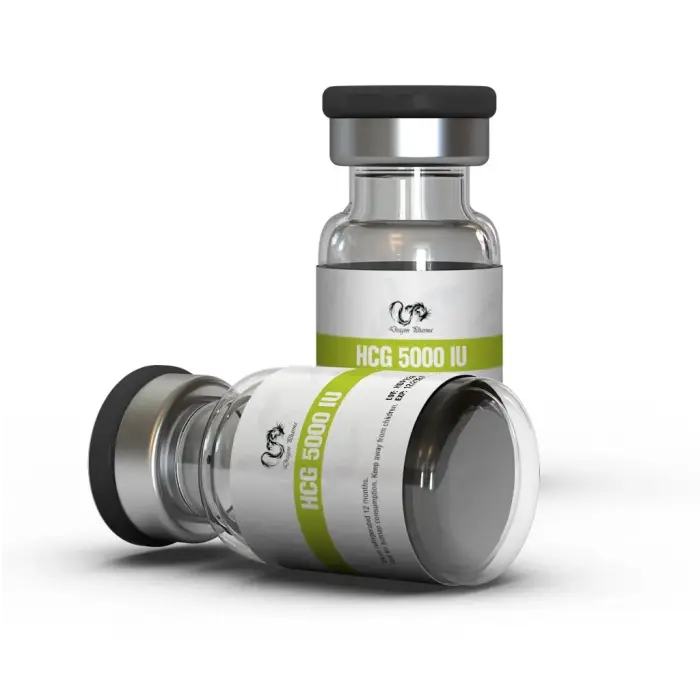
HCG 5000 IU Dragon Pharma
HCG 5000IU Dragon Pharma — Overview
HCG 5000IU Dragon Pharma delivers 5,000 IU of human chorionic gonadotropin per vial — the standard format for sustained on-cycle gonadotropin support across full 10–16 week AAS cycles. Where the 2,500 IU vial is precision-sized for a single blast injection, the 5,000 IU vial is built for economics: at 500 IU twice weekly — the most widely used on-cycle maintenance dose — one vial covers five weeks of injections. A 12-week cycle requires three vials, a 16-week cycle requires four. No waste, no mid-cycle reorders, no gaps in Leydig cell stimulation.
The mechanism is the same as all hCG formats: HCG binds the LH/hCG receptor on Leydig cells, activates the steroidogenic cascade via cAMP, and drives intratesticular testosterone production directly — independent of the hypothalamic-pituitary axis. Exogenous androgens suppress pituitary LH output to near-zero within weeks, and without an LH signal, Leydig cells enter a quiescent state. Testicular volume decreases, intratesticular testosterone (ITT) — which is required at far higher concentrations inside the testes than in peripheral blood for normal seminiferous tubule function — drops precipitously. HCG replaces the absent LH signal directly at the Leydig cell, maintaining steroidogenesis regardless of pituitary output. This action is entirely peripheral: HCG does not signal at the hypothalamus or anterior pituitary, it does not restore HPG function, and it does not accelerate or delay the recovery driven by SERMs at the pituitary level. Available at Steroid Warehouse alongside the complete Dragon Pharma PCT lineup.
About the Compound: HCG (Human Chorionic Gonadotropin)
Human chorionic gonadotropin is a glycoprotein hormone built from two subunits: a shared α-subunit structurally identical to LH, FSH, and TSH, and a unique β-subunit that confers high-affinity binding specifically to the LH/hCG receptor. In males, this receptor is expressed on Leydig cells in the testes. Binding of hCG activates Gs-coupled adenylyl cyclase, raises intracellular cAMP, and drives the full steroidogenic cascade from cholesterol to testosterone — the same pathway triggered by pituitary LH under normal physiological conditions.
During an AAS cycle, exogenous androgen concentrations suppress gonadotropin release at the hypothalamus and pituitary via negative feedback. LH falls to near-zero within weeks, and without an LH signal, Leydig cells enter a quiescent state. Testicular volume decreases, intratesticular testosterone (ITT) — which is required at far higher concentrations inside the testes than in peripheral blood for normal seminiferous tubule function — drops precipitously. HCG replaces the absent LH signal directly at the Leydig cell, maintaining steroidogenesis regardless of pituitary output. This action is entirely peripheral: HCG does not signal at the hypothalamus or anterior pituitary, it does not restore HPG function, and it does not accelerate or delay the recovery driven by SERMs at the pituitary level.
What HCG Does
HCG has a single pharmacological target in male users: the LH/hCG receptor on Leydig cells. Everything downstream follows from sustained activation of that receptor throughout a cycle where the endogenous LH signal is suppressed to near-zero by exogenous androgens.
- Preserves intratesticular testosterone (ITT) — spermatogenesis requires ITT concentrations 50–100× higher than peripheral serum testosterone; exogenous androgens at any dose cannot reproduce ITT at the testicular level without local Leydig cell production; HCG is the only practical tool to maintain ITT when pituitary LH is suppressed
- Prevents progressive testicular atrophy — Leydig cell activity and testicular volume track directly with LH/hCG receptor stimulation; without HCG on a 12–16 week cycle, meaningful atrophy typically becomes apparent by week 4–6 and continues to worsen; atrophy accumulated over months is significantly slower to reverse post-cycle than atrophy from a short run
- Maintains Leydig cell responsiveness for PCT — atrophied, chronically understimulated Leydig cells respond poorly to the LH surge generated by SERM-based PCT; testes that have been kept active by continuous HCG maintenance recover faster and more completely when the HPG axis re-engages after SERMs are introduced
- Partial spermatogenesis support — while FSH drives spermatogenesis at the Sertoli cell level, the adequate ITT maintained by HCG provides the testosterone concentration required at the seminiferous tubule for Sertoli cell function; continuous HCG during long cycles reduces (but does not eliminate) spermatogenic disruption relative to no gonadotropin support
- No additional HPG suppression — HCG acts exclusively at the Leydig cell; it does not contribute to the gonadotropin suppression already driven by exogenous AAS and does not make HPG recovery more difficult after the cycle ends
Who It's For
HCG 5000IU Dragon Pharma is the standard gonadotropin format for athletes running full-length AAS cycles of 10 weeks or longer, where sustained on-cycle Leydig cell maintenance is the goal. Its value proposition is straightforward: maximum vial yield per unit, minimum mid-cycle logistics.
What sets the 5000IU format apart: at the most common on-cycle maintenance dose — 500 IU twice weekly — a single 5,000 IU vial covers exactly five weeks of injections. A 12-week cycle requires three vials total from week 1 to week 11 (stopping one week before PCT start). A 16-week cycle requires four. Compared to the 2,500 IU format at the same dose, the 5,000 IU vial requires roughly half the vials, which means fewer reconstitutions, fewer vials to stock, and significantly lower per-IU cost. For athletes who plan their cycles in advance and want a complete gonadotropin protocol from day 1 through the pre-PCT period, the 5,000 IU format is the natural choice.
Ideal use cases:
- Any athlete running a testosterone-based cycle of 10–16 weeks or longer at standard performance doses, who wants to maintain testicular volume and Leydig cell function throughout and not rely on post-cycle recovery from a fully atrophied state
- Athletes running stacked cycles (testosterone + nandrolone, testosterone + trenbolone) where HPG suppression is both deep and prolonged — the combination of multiple suppressive compounds over extended periods makes maintained Leydig cell stimulation more important, not less
- Users who want to minimize the volume of vials purchased overall and consolidate their cycle-support order: at 500 IU 2×/week for a 12-week cycle, three 5,000 IU vials cover the full on-cycle window plus a pre-PCT blast injection
Who should choose the 2,500 IU format instead: athletes on shorter cycles (6–8 weeks) who want a single pre-PCT blast with zero leftover product; the 2,500 IU vial is sized for a single 2,500 IU injection with no waste. At that protocol, buying a 5,000 IU vial means half the vial goes unused after one blast injection unless on-cycle maintenance was also running. For pure blast-only use with a short cycle, the HCG 2500IU Dragon Pharma vial is the more efficient choice.
HCG 5000IU vs Alternatives
| Compound | Key Differences | Choose HCG 5000IU When | Choose Alternative When |
|---|---|---|---|
| HCG 2500IU Dragon Pharma hCG 2,500 IU/vial |
Identical compound at half the vial volume; one vial = one 2,500 IU blast injection (zero waste for single-dose use); at 500 IU 2×/wk: 1 vial covers 2.5 weeks only (vs 5 weeks for 5000IU); higher per-IU cost at extended maintenance doses; optimal precision for short cycles | Sustained on-cycle maintenance across a 10–16 week cycle at 250–500 IU 2×/wk; minimum vials and reconstitutions; pre-PCT blast where some remaining volume is acceptable | Cycle is 6–8 weeks; only 1–2 blast injections planned with no on-cycle maintenance; single-dose zero-waste precision is the priority |
| HMG 150IU Dragon Pharma Human Menopausal Gonadotropin (FSH+LH) |
HMG contains both FSH and LH activity; addresses Sertoli cell function directly via FSH in addition to Leydig cell stimulation via LH — a component HCG alone cannot provide; required when spermatogenesis restoration is the explicit goal; significantly higher cost; used alongside HCG in fertility-focused stacks, not as a standalone substitute | Standard testicular volume and Leydig cell maintenance throughout a performance cycle; no active fertility concern; single-mechanism gonadotropin support sufficient | Spermatogenesis restoration is the primary objective (e.g. planning conception after a prolonged suppressive cycle); the full FSH+LH combination targeting both Sertoli and Leydig cell function is specifically required |
Combinations
| Goal | Stack | Protocol / Timing | Notes |
|---|---|---|---|
| 12-week on-cycle maintenance (standard) | HCG 5000IU + testosterone base + Arimidex Dragon Pharma | 500 IU HCG SubQ twice weekly from week 1; Arimidex 0.5 mg EOD to manage cumulative E2 from testosterone aromatization and HCG-driven Leydig cell output; stop HCG at week 11 (1 week before PCT start); run 3 vials total. Vial math: 12 wk × 2 inj/wk = 24 inj × 500 IU = 12,000 IU ÷ 5,000 IU per vial = 2.4 vials → 3 vials covers 11–12 weeks with margin | Always pair with an AI when running HCG alongside aromatizing AAS. HCG adds to the total E2 burden on cycle — skipping the AI produces a combined estrogenic load higher than testosterone alone would generate. Adjust Arimidex dose from E2 bloodwork at week 4–6. |
| 16-week cycle + pre-PCT blast | HCG 5000IU + testosterone base + Aromasin Dragon Pharma → Clomid Dragon Pharma + Nolvadex Dragon Pharma | HCG 500 IU 2×/wk weeks 1–15; stop at week 15; use remainder of vial 4 for the pre-PCT blast (2,500 IU on day 0 + day 3 if volume allows); wait 72 hours after last HCG injection; start Clomid 50 mg + Nolvadex 20 mg/day. Vial math: 15 wk × 2 inj × 500 IU = 15,000 IU ÷ 5,000 = 3 full vials + partial 4th for blast | Aromasin (suicidal AI) preferred over Arimidex for long cycles to avoid anastrozole rebound at cycle end. A 16-week cycle with 4 vials of HCG 5000IU is one of the most cost-efficient full-cycle gonadotropin protocols available. |
| Fertility support stack | HCG 5000IU + HMG 150IU Dragon Pharma | HCG 1,000–2,000 IU 3×/week + HMG 75–150 IU 3×/week; specific dosing and duration determined by the degree of spermatogenic disruption and fertility timeline; this is a post-cycle fertility restoration protocol, not a standard PCT sequence | HMG contributes the FSH activity required for Sertoli cell function and active spermatogenesis that HCG alone cannot supply. Not a routine post-cycle protocol — used when conception within a defined window after a long AAS cycle is the explicit clinical goal. |
Side Effects & Management
| Side Effect | Severity | How to Handle It |
|---|---|---|
| Estradiol (E2) elevation | Moderate — cumulative with AAS aromatization; more pronounced on extended maintenance than short blast | HCG-stimulated Leydig cell testosterone production aromatizes alongside any testosterone base already in the cycle — the two E2 loads are additive. The longer the HCG run, the more consistent the AI management must be. Use Arimidex Dragon Pharma 0.5 mg EOD as a starting point; adjust from E2 bloodwork at week 4–6. On a 12–16 week cycle, test E2 at least twice during the maintenance phase. Stop AI when HCG is stopped before PCT. |
| Leydig cell desensitization | Low at recommended doses | Sustained high-dose HCG can downregulate LH/hCG receptor expression over time, reducing the testicular response to both exogenous HCG and endogenous LH recovery. Keep on-cycle doses at or below 500 IU per injection. Do not exceed 16 consecutive weeks of continuous HCG without a bloodwork-based assessment of testicular response. The 500 IU 2×/wk protocol used across a 12–16 week cycle is within the range where meaningful desensitization is not expected at standard performance doses. |
| Gynecomastia risk | Low with AI management | Elevated E2 from HCG-driven testosterone production carries the same gynecomastia risk as any other source of elevated estradiol. Proactive AI management during the entire maintenance phase eliminates most of this risk. If breast tenderness develops, assess E2 and adjust AI dose promptly. Nolvadex Dragon Pharma provides direct breast tissue protection and can be added if E2 management with AI alone is insufficient. |
| Injection site reaction | Low | SubQ injection with a 29–31 G × 8–12 mm insulin syringe is well-tolerated. At 500 IU per injection from a 5,000 IU/mL solution, draw 0.1 mL per injection — a very small volume. Rotate sites across abdomen, lateral thigh, and upper arm. Minor transient bruising may occur. Store reconstituted vial at 2–8°C; use within 28–30 days; do not freeze. |
| HPG axis interaction (suppression vs. recovery) | None — HCG bypasses HPG | HCG does not act at hypothalamic or pituitary level in a suppressive direction. It does not worsen HPG suppression relative to AAS alone, and it does not accelerate HPG recovery — that function belongs to SERMs. HCG use does not create a longer recovery window when it is stopped on schedule; the HPG axis resumes recovering at the pace determined by SERM stimulation, and the testes start that recovery in better functional condition than if no HCG had been used. |
Bloodwork Monitoring
| Lab | When to Test | Target & Action Threshold |
|---|---|---|
| E2 (Estradiol) | Baseline → weeks 4–6 during maintenance → week 10–12 → 4–6 weeks post-PCT | Target 20–40 pg/mL on cycle. On extended maintenance (12–16 weeks), test E2 at minimum twice during the HCG phase — not just baseline and end. If E2 exceeds 60 pg/mL with active AI use, increase Arimidex to 1 mg EOD or consider switching to Aromasin. Confirm E2 falling back toward baseline at 4–6 weeks post-PCT. |
| LH + FSH | Baseline (pre-cycle) → 4–6 weeks post-PCT | Both will be fully suppressed throughout the cycle and HCG maintenance phase — HCG bypasses HPG, not restores it. Post-PCT recovery target: LH >2 IU/L and FSH >1.5 IU/L within 4–6 weeks of completing SERM-based PCT confirms HPG axis re-engagement. On long cycles (16 weeks), HPG recovery may take 6–8 weeks post-PCT; persistent suppression at 8 weeks warrants extended monitoring. |
| Total testosterone | Baseline (pre-cycle) → 4–6 weeks post-PCT | Not meaningful on-cycle (dominated by exogenous AAS). Post-PCT recovery target: ≥70% of pre-cycle baseline or lower-normal range (≥300 ng/dL) within 4–6 weeks. Values still below 250 ng/dL at 8 weeks post-PCT after a long cycle indicate incomplete recovery — extend PCT monitoring window before any further cycle. |
| Hematocrit / CBC | Baseline → week 6–8 → end of cycle | HCG-stimulated Leydig cell production contributes a mild additive erythropoietic component to the AAS-driven stimulus. On long cycles with testosterone, nandrolone, or boldenone bases (all of which elevate hematocrit), monitor mid-cycle. Target hematocrit <52%; investigate and manage if >54%. |
| Blood pressure | Self-monitor every 2–3 days throughout cycle | HCG's contribution to BP is indirect via increased Leydig cell testosterone and E2 output. On a 12–16 week high-dose cycle, BP management is primarily driven by the AAS base. Monitor as part of the standard cycle protocol. Target <130/85 mmHg; Amlip (Amlodipine) or Sartel (Telmisartan) if sustained >140/90 mmHg. Add Ecosprin (Aspirin) 75 mg/day for cardiovascular protection. |
Protocol & Administration
Reconstitution: add exactly 1 mL of bacteriostatic water Dragon Pharma to the HCG vial → final concentration 5,000 IU/mL. Inject the water slowly down the inside vial wall; swirl gently to dissolve — do not shake. Store reconstituted vial at 2–8°C; use within 28–30 days. Do not freeze. Discard if solution is cloudy or shows any particulate matter.
Injection: SubQ is preferred for the small volumes used in maintenance dosing. Use a 29–31 G × 8–12 mm insulin syringe; pinch skin; inject into abdomen, lateral thigh, or upper arm; rotate sites each injection. IM (deltoid, ventroglute) is also acceptable and preferred by some users for the larger blast-dose volumes.
| Protocol | Dose | Draw Volume | Frequency | Vials for 12-wk Cycle | Notes |
|---|---|---|---|---|---|
| On-cycle maintenance (low dose) | 250 IU | 0.05 mL | Twice weekly | 1 vial covers 10 weeks; 12-wk cycle = 2 vials (5,000 ÷ 250 = 20 inj ÷ 2 per week = 10 wk) | Preferred when minimizing additional E2 load is the priority alongside testicular maintenance. At 0.05 mL per injection, use an insulin syringe and draw carefully; alternatively dilute to 2,500 IU/mL with a second mL of bacteriostatic water for easier measurement. |
| On-cycle maintenance (standard dose) | 500 IU | 0.1 mL | Twice weekly | 1 vial covers 5 weeks; 12-wk cycle = 3 vials (5,000 ÷ 500 = 10 inj ÷ 2 per week = 5 wk) | Most widely used on-cycle maintenance dose. More effective for volume maintenance over extended cycles. Requires consistent AI management — E2 check at week 4–6 to confirm Arimidex dose is adequate. |
| Pre-PCT blast | 2,500 IU | 0.5 mL | Every 3 days × 3 injections | 2 vials (vial 1: inj 0 & 3 = 5,000 IU; vial 2: inj 6 = 2,500 IU — 2,500 IU remaining). For a 2-injection blast (days 0 & 3 only): 1 vial, zero waste | After last injection (day 6): wait 72 hours before starting Clomid Dragon Pharma 50 mg + Nolvadex Dragon Pharma 20 mg/day. HCG and SERMs must not overlap — the 72-hour gap allows HCG to clear before SERM stimulation of the HPG axis begins. |
Practical Summary
- At 500 IU twice weekly, 1 vial = 5 weeks — plan ahead: a 12-week cycle needs 3 vials, a 16-week cycle needs 4; order the full quantity before the cycle starts so there is no gap in Leydig cell stimulation mid-cycle; atrophy accumulates faster than it reverses
- Stop HCG 1 week before PCT, then wait 72 hours before SERMs: the final HCG injection should be at week 11–15 (depending on cycle length); after stopping HCG, allow 72 hours for clearance, then begin Clomid Dragon Pharma + Nolvadex Dragon Pharma; running HCG and SERMs simultaneously creates competing signals at two different levels of the reproductive axis
- Sustained AI coverage throughout the entire maintenance phase: unlike a short blast (1 week of injections), a 12–16 week maintenance protocol generates a continuous additional E2 load on top of the aromatizing AAS base; Arimidex Dragon Pharma at 0.5 mg EOD is the standard starting point — validate with E2 bloodwork at weeks 4–6 and again at weeks 10–12
- Leydig cells maintained continuously are easier to recover than atrophied ones: the primary argument for using HCG throughout a long cycle (not just at the end) is that responsiveness to the LH surge generated by SERMs is preserved; a 12-week cycle without HCG followed by a pre-PCT blast is a second-best option compared to continuous low-dose maintenance from week 1
- For a 2-injection blast from a single 5000IU vial: use days 0 and 3 only: 1 vial ÷ 2,500 IU per injection = exactly 2 injections with zero waste; this covers the minimum effective pre-PCT blast for cycles up to 12 weeks where on-cycle maintenance was not used
- Reconstitute with bacteriostatic water, refrigerate immediately, discard after 30 days: lyophilized powder is shelf-stable at room temperature; reconstituted solution must be kept cold; the 30-day use window is sufficient to exhaust 1 vial at any dosing frequency listed above
HCG 5000IU Dragon Pharma is the practical choice for athletes who take cycle planning seriously. The difference between running 16 weeks of suppressive androgens with continuous gonadotropin support versus without it becomes apparent not at the end of the cycle but in the months after — in how quickly testosterone normalizes, how effectively the HPG axis re-engages, and whether PCT works on the expected timeline. Three vials across a 12-week cycle is a modest addition to a full cycle protocol, and Steroid Warehouse stocks HCG 5000IU Dragon Pharma alongside the complete Dragon Pharma PCT lineup so everything can be sourced in one order.
References
| Source | Topic | Link |
|---|---|---|
| Journal of Clinical Endocrinology & Metabolism / PubMed | Coviello et al. 2005 — controlled study showing that low-dose human chorionic gonadotropin maintains intratesticular testosterone in normal men with testosterone-induced gonadotropin suppression; foundational mechanistic evidence for using hCG to preserve testicular steroidogenesis during exogenous testosterone exposure | Coviello AD, et al. (2005) ↗ |
| Journal of Urology / PubMed | Hsieh et al. 2013 — clinical study showing that concomitant intramuscular human chorionic gonadotropin preserves spermatogenesis in men undergoing testosterone replacement therapy; practical fertility-preservation evidence for concurrent gonadotropin support | Hsieh TC, et al. (2013) ↗ |
| Asian Journal of Andrology / PubMed | McBride & Coward 2016 — review of spermatogenesis recovery after testosterone replacement therapy or anabolic-androgenic steroid use; covers spontaneous recovery timelines and gonadotropin-based strategies used to restore sperm production after exogenous androgen suppression | McBride JA & Coward RM (2016) ↗ |
| Frontiers in Endocrinology / PubMed | Oduwole et al. 2021 — comprehensive review of luteinizing hormone, follicle-stimulating hormone, testosterone, and intratesticular testosterone in spermatogenesis; explains why LH/hCG signaling and adequate intratesticular testosterone are central to normal seminiferous tubule function | Oduwole OO, et al. (2021) ↗ |
| Translational Andrology and Urology / PubMed | Lee & Ramasamy 2018 — focused review on human chorionic gonadotropin for the management of infertility in hypogonadal men; discusses hCG use to maintain or re-establish spermatogenesis, support intratesticular testosterone, and preserve fertility during testosterone-related suppression | Lee JA & Ramasamy R (2018) ↗ |
What is HCG 5000IU?
HCG 5000IU is an injectable hormone for testosterone recovery and fertility; see What is Human Chorionic Gonadotropin. It's key for PCT—consult professionals for safe use.
What is HCG 5000IU used for?
It's used for testosterone restoration and fertility in PCT; see Key Benefits. It suits bodybuilders—use with professional oversight.
How does HCG 5000IU work?
It mimics LH to stimulate testosterone production; see Mechanism of Action. It restores hormones—monitor with labs.
What are the side effects of HCG 5000IU?
Side effects include mild estrogenic effects or injection site reactions; see Side Effects. Manage with ancillaries—consult professionals for safety.
How long does HCG 5000IU stay in your system?
With a 24-36 hour half-life, it's detectable for ~5-7 days; see Mechanism of Action. Plan PCT—consult professionals.
What are the main benefits of HCG 5000IU?
Commonly discussed benefits include stimulation of endogenous testosterone production, support for testicular function, and maintenance of normal hormonal activity.
Is HCG 5000IU different from lower-dose HCG products?
The main difference is concentration. HCG 5000 IU provides a higher total hormone amount per vial, which may be used for different dosing strategies depending on individual protocols.
What makes HCG 5000IU different from other hormonal support compounds?
HCG directly mimics luteinizing hormone, acting directly on the testes rather than stimulating upstream hormonal pathways, making it a direct gonadotropin-based compound.
Related Products
- Accelerates muscle and tendon repair for quick recovery.
- Reduces inflammation systemically and locally.
- Enhances joint and tissue resilience for intense training.
- Supports comprehensive healing for uninterrupted performance.