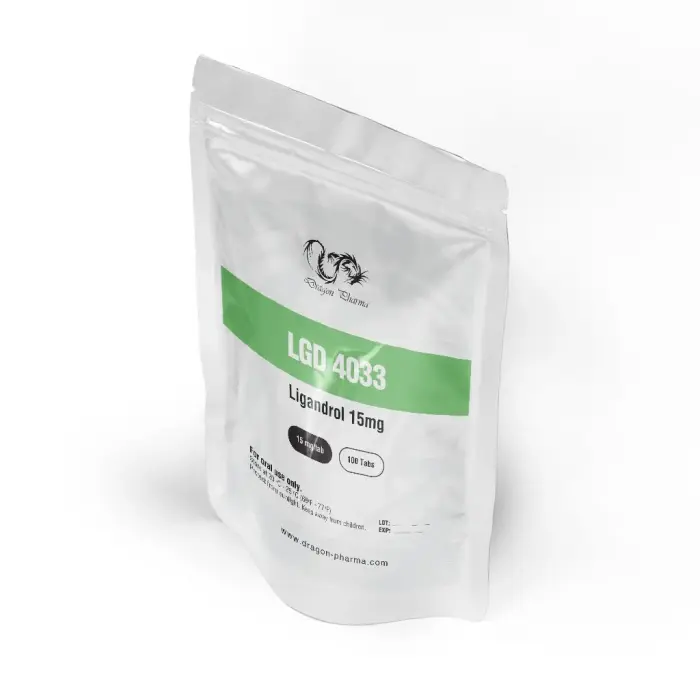
LGD 4033
LGD-4033 Dragon Pharma — Ligandrol 15 mg Tablets
LGD-4033 (Ligandrol) is a non-steroidal selective androgen receptor modulator developed to deliver anabolic effects in muscle and bone with tissue selectivity beyond what traditional androgens offer. Dragon Pharma's LGD 4033 comes in 15 mg tablets — the highest per-tab dose available in the Dragon Pharma SARM lineup — and is used primarily for lean mass accumulation, body recomposition, and strength cycles that avoid the injection protocols and estrogen management associated with injectable AAS.
With a half-life of approximately 24–36 hours, LGD-4033 reaches stable plasma concentration on a once-daily oral dose. It does not aromatize, does not convert to DHT, and does not require an aromatase inhibitor. HPG axis suppression is real and dose-dependent, making a structured PCT mandatory for cycles of 8 weeks or longer at doses of 10 mg and above.
About the Compound
LGD-4033 was originally synthesized by Ligand Pharmaceuticals and later developed clinically by Viking Therapeutics under the designation VK5211. It belongs to the non-steroidal SARM class — compounds that bind the androgen receptor with high affinity and functional potency while demonstrating selectivity for anabolic tissues over androgenic ones. Unlike testosterone and its derivatives, LGD-4033 does not carry a steroid backbone, which eliminates aromatization to estradiol and 5-alpha reduction to DHT. Its androgen receptor binding affinity is high, comparable to testosterone enanthate in receptor assays, but its downstream tissue profile differs markedly from traditional AAS.
Dragon Pharma supplies LGD-4033 in 15 mg tablets. The standard effective dose for lean mass cycles is 10 mg/day (two-thirds of one tablet, using a pill cutter) to 15 mg/day (one full tablet). The compound has a biological half-life of approximately 24–36 hours, which supports once-daily oral dosing and produces stable androgen receptor occupancy throughout the cycle. SHBG binding affinity for LGD-4033 is low relative to testosterone, meaning it circulates predominantly as free compound rather than SHBG-bound — a pharmacokinetic property that contributes to its potent receptor-level activity at relatively modest molar doses.
What It Does
LGD-4033's primary mechanism is direct androgen receptor agonism in skeletal muscle and bone. AR activation drives transcription of genes governing protein synthesis, nitrogen retention, and myocyte proliferation. In the Phase I clinical trial by Basaria et al. (2013) — the most cited human data for LGD-4033 — participants receiving 1 mg/day for 21 days showed statistically significant lean mass gains with a dose-dependent suppression of total testosterone and SHBG. Performance athletes operating at 10–15 mg/day over 8–12 weeks consistently report lean mass increases in the 5–10 lb range with limited water retention relative to injectable testosterone esters at equivalent androgenic exposure.
Secondary effects include measurable improvements in bone mineral density markers, enhanced training recovery, and strength increases that outpace what caloric manipulation alone explains. Because LGD-4033 does not aromatize, users do not experience the estrogen-driven water retention, bloating, or gynecomastia risk common on aromatizing injectable cycles — and no AI is required on solo LGD-4033 runs. Endogenous testosterone suppression begins within days of consistent dosing; by week 4 at 15 mg/day, LH and FSH suppression is typically 60–80% of baseline, and total testosterone follows proportionally. Full recovery after a properly run PCT takes 4–8 weeks.
Who It's For
LGD-4033 is the compound of choice for intermediate-to-advanced athletes who want lean, keepable mass gains without injection logistics, without an AI protocol, and with a shorter, cleaner PCT than injectable testosterone cycles require. Its dry gain profile — minimal water retention, no estrogen-driven puffiness — makes it well suited to recomp phases where both lean mass and fat reduction are simultaneous targets. It also functions as a natural step up from Ostarine (MK-2866) for athletes who have run one or two lighter SARM cycles and are ready for a meaningful anabolic stimulus.
LGD-4033 specifically outperforms alternatives when the goal is 5–10 lb of lean tissue over one 8–12 week cycle with manageable suppression and a four-week SERM-based PCT. It remains the most clinically studied SARM with human efficacy data — an important distinction for athletes making informed compound decisions.
Choose something else if: the primary goal is maximum mass or strength output at any cost (injectable testosterone delivers larger absolute gains per cycle); suppression must be zero (MK-677 Ibutamoren adds GH-driven recovery and size without any HPG impact); or if liver enzymes are already elevated at baseline (LGD-4033 can mildly stress hepatic values, especially above 15 mg/day).
LGD-4033 vs Alternatives
| Compound | Key Differences | Choose LGD-4033 When | Choose Alternative When |
|---|---|---|---|
| MK-2866 Ostarine DP | Milder AR agonism; lower anabolic ceiling (1–3 lb lean mass vs 5–10 lb); minimal suppression at ≤25 mg/day; better documented for joint and connective tissue support | Meaningful lean mass gain is the priority and a proper PCT is planned | First SARM cycle, active cutting phase, or suppression must stay minimal |
| S23 Mastorin DP | More potent AR full agonist than LGD-4033; produces a harder, drier appearance; suppression is stronger and often requires HCG pre-PCT; less clinical safety data | Lean bulk with moderate suppression tolerance and desire to avoid a harder aesthetic compound | Maximum lean/dry physique is the goal; experienced users comfortable with stronger suppression management |
| YK-11 DP | Partial AR agonist + myostatin inhibitor — distinct dual mechanism; potential for outsized muscle fiber growth; limited human clinical data; cycle length typically capped at 6–8 weeks | Established SARM baseline, predictable suppression, and well-characterized clinical data are priorities | Specifically targeting myostatin pathway for hypertrophy; experienced users willing to accept limited human data |
| MK-677 Ibutamoren DP | GH secretagogue — not a SARM; does not suppress HPG axis; no PCT required; promotes water retention, appetite, sleep quality, and GH-driven recovery; no direct AR agonism | Androgenic anabolic stimulus with lean mass as primary target; HPG suppression is accepted | No HPG suppression tolerance; GH-driven recovery, sleep, and appetite improvement without androgenic effects needed |
Combinations
| Goal | Stack | Notes |
|---|---|---|
| Lean Bulking | LGD-4033 10 mg/day + MK-677 25 mg/day | MK-677 amplifies GH pulsatility, deepens sleep quality, and accelerates recovery without adding HPG suppression; run both for 12 weeks; PCT covers only the LGD component |
| Recomposition | LGD-4033 10 mg/day + S23 10 mg/day | S23 adds androgenic hardness and accelerates fat oxidation; combined suppression is substantial — full PCT with Clomid DP + Nolvadex DP is mandatory; 8-week maximum |
| Clean Solo Cycle | LGD-4033 15 mg/day alone | Simplest protocol for first LGD-4033 cycle; single variable, straightforward bloodwork interpretation, minimal PCT (Nolvadex DP alone at 10 mg suffices); preferred when establishing response to the compound |
| Advanced Mass | LGD-4033 10 mg/day + YK-11 10 mg/day | YK-11 myostatin inhibition creates synergistic hypertrophy signal alongside LGD-4033 AR agonism; cap cycle at 8 weeks; monitor liver enzymes at week 4; full SERM PCT required |
Side Effects & Management
| Side Effect | Cause | How to Handle It |
|---|---|---|
| HPG Suppression (LH/FSH ↓, Testosterone ↓) | AR agonism signals the hypothalamic-pituitary axis to downregulate gonadotropin output; occurs in all users; magnitude increases with dose and duration | Run full PCT post-cycle with Clomid DP + Nolvadex DP; for on-cycle libido decline use Proviron DP; for erectile function Cialis DP |
| Mild Liver Stress (ALT/AST ↑) | Hepatic first-pass metabolism of LGD-4033; more pronounced above 15 mg/day or with concurrent alcohol use; not 17-alpha-alkylated but measurable in some users | Add Liv.52 and Mucinac (NAC) 600 mg/day; eliminate alcohol on cycle; if ALT exceeds 2× ULN reduce dose to 10 mg and retest in 2 weeks |
| HDL Reduction | Androgen receptor activation modulates hepatic lipase activity, reducing HDL; less severe than oral 17-AA steroids but present at doses ≥10 mg/day | Lipid panel at week 4; if HDL drops below 40 mg/dL add Rosulip (Rosuvastatin) or Atorvastatin DP; omega-3 supplementation supports HDL throughout |
| Mild Acne | AR stimulation in sebaceous glands; less androgenic than DHT-derived AAS; typically limited to face and upper back | Consistent topical skincare routine resolves most cases; persistent or papulopustular acne → Doxycycline 100 mg/day for 4–6 weeks |
| Fatigue / Lethargy | Declining endogenous testosterone during suppression phase; most common mid-cycle at weeks 4–6 at 15 mg/day | Take dose in the morning with food; if lethargy is severe reduce to 10 mg/day; confirm with mid-cycle bloodwork before reducing dose further |
| Mild Blood Pressure Elevation | Less common than with AAS; primarily a concern when stacking with S23 or when cardiovascular stress is pre-existing | Monitor systolic weekly; if consistently above 130 mmHg add Sartel (Telmisartan) or Amlip (Amlodipine) |
Bloodwork Monitoring
| Lab | When to Test | Target & Action Threshold |
|---|---|---|
| LH + FSH | Baseline; end of cycle; 4 weeks post-PCT | Baseline establishes natural range; end-of-cycle confirms suppression depth; both values should fully restore within 4–6 weeks post-PCT — if not, extend PCT one additional week and retest |
| Total Testosterone | Baseline; end of cycle; end of PCT | Baseline ≥ 400 ng/dL typical; expect 30–70% reduction end-cycle at 10–15 mg/day; full restoration expected 4–8 weeks post-PCT; if still below baseline at 8 weeks post-PCT → extend SERM protocol |
| SHBG | Baseline | LGD-4033 may modestly reduce SHBG; note baseline value — a significant SHBG drop shifts free E2 and free testosterone ratios, affecting cycle interpretation |
| Hematocrit / CBC | Baseline | LGD-4033 does not significantly drive erythropoiesis; baseline CBC rules out pre-existing hematological issues; hematocrit below 52% is the target threshold |
| Lipid Panel (HDL / LDL) | Baseline; mid-cycle (week 4) | HDL above 40 mg/dL; if HDL drops >20% from baseline → add Rosulip or Atorvastatin DP; LDL below 130 mg/dL; triglycerides below 150 mg/dL |
| Estradiol (E2) | Baseline | LGD-4033 does not aromatize; check if SHBG reduction shifts free E2 balance; no AI is expected on a solo LGD cycle unless stacking with aromatizing compounds |
| ALT / AST (Liver) | Baseline; mid-cycle (week 4) | Below 2× upper limit of normal; if ALT or AST exceeds 2× ULN → reduce dose to 10 mg, add Mucinac NAC 600 mg/day and Liv.52, retest in 2 weeks before continuing |
| Blood Pressure | Weekly self-monitoring | Below 130/85 mmHg; if systolic persistently >135 mmHg → Sartel (Telmisartan) 40 mg/day or Amlip (Amlodipine) 5 mg/day |
PCT
LGD-4033's half-life of 24–36 hours means the compound clears rapidly after the last dose — PCT can begin 24–48 hours after finishing the cycle, unlike long-ester injectable AAS where a 2-week clearance window is standard. The depth of suppression at end-of-cycle determines which PCT protocol applies.
Light suppression (5–10 mg/day, ≤8 weeks, first LGD cycle):
Nolvadex DP 20 mg/day × 4 weeks
Full PCT (10–15 mg/day, 8–12 weeks, or stacked cycles):
Clomid DP: 50 / 25 / 25 / 25 mg (weeks 1–4)
Nolvadex DP: 20 / 20 / 20 / 20 mg (weeks 1–4)
HCG is generally not required for SARM-only cycles. Consider a 2,500 IU blast of HCG 5000IU Dragon Pharma in the final week of the LGD cycle only when the cycle was unusually long (≥14 weeks), involved stacked suppressive compounds, or if baseline bloodwork showed borderline LH/FSH before the cycle began. Confirm HPG axis recovery with bloodwork 4–6 weeks after completing PCT.
Practical Summary
- Dragon Pharma LGD-4033 comes in 15 mg tabs — standard working dose is 10 mg/day (use a pill cutter for ⅔ tab) to 15 mg/day (1 full tab); higher doses increase suppression without proportionally increasing lean mass yield
- No aromatization means no AI is needed on a solo LGD-4033 cycle; E2 management protocols from injectable testosterone cycles do not apply here
- HPG suppression is certain and dose-dependent: cycles of 10 mg+ for 8+ weeks require a full 4-week SERM PCT starting 24–48 hours after the last dose
- Run bloodwork at baseline and at the 4-week mark minimum; prioritize LH/FSH, total testosterone, liver enzymes (ALT/AST), and lipid panel — these four panels cover the main LGD risk profile
- Stack with MK-677 Dragon Pharma to amplify recovery and lean mass accumulation without adding HPG suppression — the cleanest lean bulking stack in the Dragon Pharma SARM lineup
- Confirm full HPG recovery with bloodwork 4–6 weeks post-PCT before beginning another cycle; do not run back-to-back LGD cycles without confirmed LH/FSH and testosterone restoration
LGD-4033 remains one of the most consistently used SARMs for lean mass and recomposition cycles, valued for the balance between meaningful androgenic stimulus and a manageable suppression profile. At 10–15 mg per day it delivers measurable lean tissue gains within 8–12 weeks while bypassing the estrogen-related complications that define injectable AAS cycles. Steroid Warehouse carries Dragon Pharma's LGD-4033 15 mg tablets alongside the full range of PCT compounds — Clomid DP, Nolvadex DP, cycle support, and pharmacy products — needed to run a complete and responsible protocol from first dose through confirmed recovery.
References
| Source | Topic | Link |
|---|---|---|
| The Journals of Gerontology Series A / PubMed | Basaria et al. 2013 — Phase I placebo-controlled study of LGD-4033 in 76 healthy men; documents dose-proportional pharmacokinetics, dose-dependent lean body mass increase, suppression of testosterone/SHBG/HDL markers, and short-term safety findings over 21 days | Basaria S, et al. (2013) ↗ |
| Current Opinion in Clinical Nutrition and Metabolic Care / PubMed | Bhasin & Jasuja 2009 — review of selective androgen receptor modulators as function-promoting therapies; explains the rationale for SARM development, androgen receptor signaling, tissue-selective anabolic effects, and the goal of separating muscle/bone benefits from prostate and androgenic adverse effects | Bhasin S & Jasuja R (2009) ↗ |
| Current Opinion in Supportive and Palliative Care / PubMed | Dalton et al. 2013 — review of selective androgen receptor modulators for prevention and treatment of muscle wasting associated with cancer; provides clinical-development context for SARMs as anabolic agents targeting lean mass and physical function | Dalton JT, et al. (2013) ↗ |
| Translational Andrology and Urology / PubMed | Christiansen et al. 2020 — broad review of selective androgen receptor modulators covering therapeutic rationale, androgen receptor biology, clinical trial landscape, safety uncertainties, and the lack of FDA-approved SARM indications | Christiansen AR, et al. (2020) ↗ |
| Drug Testing and Analysis / PubMed | Fragkaki et al. 2018 — human in vivo metabolism study of LGD-4033 after administration of an LGD-4033 supplement; identifies urinary metabolites and supports anti-doping detection context for ligandrol exposure | Fragkaki AG, et al. (2018) ↗ |
How to take LGD 4033?
Take 5-15 mg daily for men, 2.5-5 mg for women; see How to Use. Use with diet—consult professionals for tailored plans.
How to use Ligandrol?
Take 5-15 mg daily with or without food; see How to Use. Monitor with labs—consult for proper administration.
What is LGD 4033?
LGD 4033 (Ligandrol) is a SARM for muscle growth and strength; see What is LGD 4033. It enhances performance—consult professionals for safe use.
How long does Ligandrol stay in your system?
With a 24-36 hour half-life, it's detectable for ~2-3 weeks; see Mechanism of Action. Plan PCT—consult professionals.
How does LGD-4033 work?
LGD-4033 works by selectively interacting with androgen receptors involved in:
- Muscle protein synthesis
- Strength and recovery pathways
- Lean tissue support
Unlike anabolic steroids, SARMs are designed to target muscle and bone tissue more selectively.
Why is LGD-4033 popular in muscle-building protocols?
Users often choose LGD-4033 because it may:
- Support lean muscle growth
- Promote strength and workout performance
- Complement bulking and body recomposition goals
It is commonly discussed for users looking for muscle-building support without injectable steroids.
How long does it take to notice effects from LGD-4033?
Many users report gradual improvements in strength, muscle fullness, and training performance over several weeks, depending on dosage, diet, and training consistency.
Is LGD-4033 better for bulking or cutting?
LGD-4033 is often used in both bulking and recomposition phases due to its ability to support lean mass gains without significant water retention.
Related Products