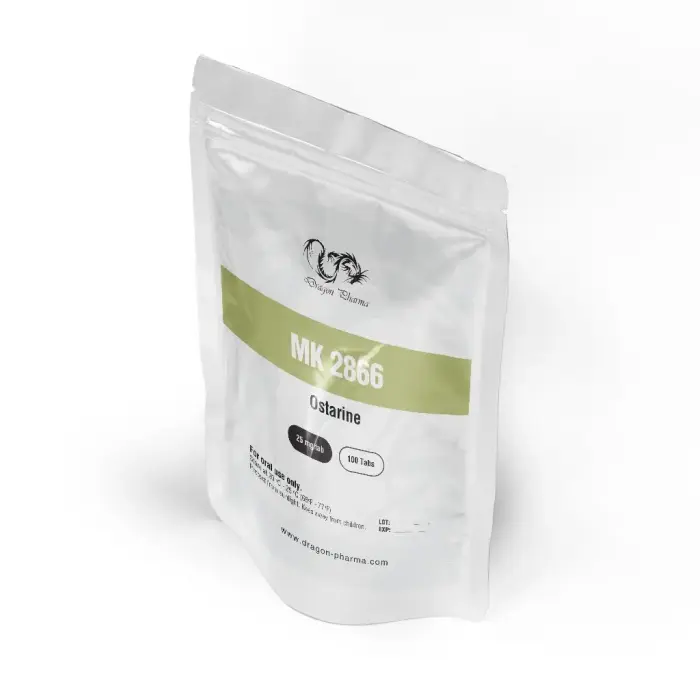
MK 2866 (Ostarine)
MK-2866 Ostarine Dragon Pharma — Overview
MK-2866 Ostarine Dragon Pharma is a selective androgen receptor modulator (SARM) in 25 mg oral tablet form. Ostarine (enobosarm) is the most clinically studied SARM in existence, having progressed through phase II human trials for muscle-wasting conditions before commercial availability. Unlike anabolic-androgenic steroids, SARMs are designed to activate androgen receptors selectively in muscle and bone tissue while minimizing activation in androgenic tissues such as the prostate and skin — resulting in anabolic effects with a reduced androgenic side effect profile.
For physique athletes, Ostarine occupies a well-defined position as the entry point into SARM use: moderate anabolic output, predictable suppression, no estrogenic activity, and a clinical trial safety dataset that other SARMs simply do not have. This page covers Ostarine's mechanism as a SARM, its practical effects, how it compares to LGD-4033 and S23, combination options, bloodwork monitoring, and what a proper post-cycle protocol looks like after an Ostarine-only run.
About the Compound: Ostarine (MK-2866)
Ostarine is a non-steroidal SARM that binds the androgen receptor with high affinity and selectivity. Where anabolic steroids bind the AR non-selectively — activating it in muscle, bone, skin, scalp, prostate, and liver simultaneously — SARMs like Ostarine are designed around tissue-selective coactivator recruitment. The same AR is activated, but the downstream gene expression pattern differs depending on which coactivators are present in a given tissue type. The result is anabolic signaling in skeletal muscle and bone with substantially reduced androgenic stimulation in sebaceous glands, hair follicles, and the prostate.
Ostarine does not convert to estrogen (no aromatization) and does not convert to DHT (no 5α-reduction). Estradiol levels typically remain stable or decrease slightly during an Ostarine cycle, which is pharmacologically relevant: the mild E2 reduction can contribute to joint dryness at higher doses. Ostarine is not 17-alpha alkylated and does not place significant stress on hepatic enzymes at standard doses. Its half-life is approximately 24 hours, supporting a straightforward once-daily dosing schedule.
HPG axis suppression is real but dose-dependent and duration-dependent. At 15 mg/day for 8 weeks, LH and FSH suppression is typically mild and recovery is prompt without PCT. At 25 mg/day for 10–12 weeks, suppression is more meaningful and a short Nolvadex protocol is the standard response. Ostarine does not suppress the HPG axis as severely as full AAS cycles, but treating it as a suppression-free compound is a common protocol error.
What Ostarine Does
- Lean muscle preservation and modest growth — Ostarine provides anabolic signaling in skeletal muscle through direct AR activation; gains are modest relative to AAS but meaningful relative to natural training; expect 2–4 lbs of net lean tissue over an 8-week cycle at 25 mg/day, with the distinguishing characteristic that these gains come without significant water retention or estrogenic activity; the majority of scale weight change reflects actual lean tissue, making results visually cleaner than most injectable or oral AAS
- Muscle preservation in a caloric deficit — this is where Ostarine's clinical evidence base is strongest; the compound was developed specifically to preserve lean mass in catabolic conditions; for physique athletes in a cutting phase, Ostarine attenuates muscle loss from caloric restriction without the androgenic side effects of AAS, making it practical for extended cut phases where AAS use would carry a more significant hormonal cost
- Body recomposition at maintenance calories — at 15–25 mg/day, Ostarine simultaneously supports lean tissue retention and allows fat loss to proceed; this is not as pronounced as with dedicated cutting or bulking compounds, but makes Ostarine a practical choice for recomp phases where the goal is improving body composition without a strict bulk or cut
- Bone density and connective tissue support — clinical trials of Ostarine in older populations showed meaningful improvements in bone mineral density alongside lean mass gains; for physique athletes, this translates to improved connective tissue integrity during training phases, which is a practical advantage over cutting compounds that have no bone-anabolic properties
- No estrogenic activity; no androgenic shedding — absence of aromatization means no gynecomastia risk, no water retention from E2, and no need for an aromatase inhibitor during cycle; absence of DHT conversion means no amplification of androgenic effects in scalp, prostate, or skin; users not predisposed to severe androgenic responses typically run Ostarine without hair loss concerns, which distinguishes it from most AAS
Who It's For
- Users beginning with SARMs for the first time — Ostarine is the entry-level SARM by design; it is the most studied, the most predictable in terms of suppression, and the one with the clearest clinical dose-response data; users who have not previously used either AAS or SARMs and want to evaluate SARM pharmacology before committing to a full AAS cycle are the canonical Ostarine user; the compound's mild suppression profile means the consequences of a first-cycle mistake (wrong dose, wrong duration) are reversible without complex intervention
- Physique athletes in a cutting or recomp phase where AAS androgenic side effects are not acceptable — for users who want anabolic support during a cut without hair loss risk, acne burden, or significant LH/FSH crash, Ostarine delivers the specific benefit of lean mass preservation with a meaningfully lower androgenic cost than even the mildest oral AAS; users who have already experienced scalp androgenic sensitivity from AAS cycles and want to maintain muscle during a post-cycle cut phase are a specific case where Ostarine is the rational choice
- Experienced AAS users running a SARM bridge between cycles — during the off-cycle period after AAS PCT, some users include a low-dose Ostarine bridge (12.5–15 mg/day) to attenuate post-cycle muscle loss while testosterone recovers; this use requires careful monitoring of LH/FSH to ensure recovery is proceeding normally and the bridge is not re-suppressing the axis
- Users who should choose a different compound: users whose primary goal is maximum muscle mass in the shortest time should look at LGD-4033 or full AAS, as Ostarine's anabolic ceiling is modest; users expecting SARM effects to be comparable to injectable testosterone will be disappointed; users unwilling to run any PCT should use a lighter dose-and-duration protocol or choose a different approach entirely, since 25 mg/day for 12 weeks will suppress LH/FSH to a degree that warrants at minimum a Nolvadex taper
Ostarine vs Alternatives
| Compound | Key Differences | Choose Ostarine When | Choose Alternative When |
|---|---|---|---|
| LGD-4033 Dragon Pharma | Stronger anabolic output (4–8 lbs lean tissue vs Ostarine's 2–4 lbs); significantly more HPG axis suppression; recovery typically requires a full Nolvadex + Clomid PCT; no aromatization but suppression profile is closer to mild AAS than to Ostarine | Goal is lean mass preservation, recomp, or cutting; first SARM cycle; minimizing suppression is a priority; no injectable backup or TRT base available | Goal is maximum lean mass gain in a SARM-only context; user has prior SARM/AAS experience and has run PCT before; willing to manage a stronger suppression protocol post-cycle |
| S23 Dragon Pharma | Highest binding affinity among commercially available SARMs; suppression is severe and comparable to mild AAS; distinct from Ostarine in that S23-only cycles often require HCG or full AAS-level PCT; produces harder, drier lean muscle appearance; no clinical trial human safety data | Goal is lean muscle during cut with no commitment to heavy compounds; clinical data matters for harm reduction; first SARM cycle; moderate suppression is acceptable but severe suppression is not | Goal is a pre-contest hardening compound with the strongest available SARM potency; user is experienced with AAS-level PCT; willing to accept near-complete LH/FSH suppression for the cycle duration |
| YK-11 Dragon Pharma | Partial AR agonist with myostatin inhibitor activity; mechanism is distinct from pure SARMs; stronger anabolic potential than Ostarine but also more unpredictable; androgenic side effect profile (hair, acne) is more similar to weak AAS than to standard SARMs; no human clinical trial data | Goal is proven anabolic support with an established human safety dataset; predictability over maximum potency; muscle preservation or recomp rather than aggressive mass gain | Goal is maximizing lean mass via myostatin pathway inhibition and the user is comfortable with a less-characterized compound; experienced with advanced SARM or AAS use; PCT infrastructure is already in place |
Combinations
| Goal | Stack | Protocol Notes |
|---|---|---|
| Lean recomp (foundation) | Ostarine 25 mg/day | Solo cycle, 8 weeks; simplest approach; full expression of Ostarine's recomp characteristics without added suppression from a second compound; best starting point for first-time SARM users; PCT: Nolvadex 20 mg/day × 4 weeks |
| Cutting + endurance | Ostarine 25 mg/day + GW-501516 (Cardarine) 20 mg/day | 8–10 weeks; Cardarine adds PPARδ-mediated fat oxidation and endurance without any androgenic activity or HPG suppression; the combination preserves lean mass (Ostarine) while accelerating fat loss and improving cardiovascular output (Cardarine); PCT for Ostarine component only |
| Lean mass + recovery | Ostarine 25 mg/day + MK-677 25 mg/day | 10–12 weeks; MK-677 (Ibutamoren) is a GH secretagogue, not a SARM; it does not suppress LH/FSH and does not require PCT; it raises IGF-1, improves sleep quality and recovery, and increases appetite; combined with Ostarine the stack addresses both AR-mediated anabolism and GH-axis recovery; MK-677 can be continued past Ostarine cycle end and through PCT |
| Lean bulk (intermediate) | Ostarine 25 mg/day + LGD-4033 10 mg/day | 8 weeks; stacking two SARMs increases anabolic output but also cumulative suppression; expect LGD-level HPG suppression from the combination; PCT must be planned as for LGD-4033 alone (Nolvadex 20 mg/day + Clomid 25 mg/day × 4–6 weeks); recommended only for users who have previously run each SARM solo |
| Recomp + full SARM stack | Ostarine 25 mg/day + GW-501516 20 mg/day + MK-677 25 mg/day | 10–12 weeks; the three-compound stack covers anabolism (Ostarine), fat oxidation and endurance (Cardarine), and GH-axis recovery and sleep (MK-677); no added suppression from GW-501516 or MK-677; PCT for Ostarine component; MK-677 can run continuously; this stack available in full at Steroid Warehouse |
Side Effects & Management
| What May Occur | Background | How to Handle It |
|---|---|---|
| Testosterone suppression (LH/FSH reduction) | All AR agonists suppress the HPG axis through negative feedback on LH and FSH; Ostarine is partial in this suppression relative to AAS but suppression is dose- and duration-dependent; at 25 mg/day for 10–12 weeks, mid-cycle LH and FSH can drop 30–60% from baseline; libido decline and mild fatigue in the final weeks of a cycle are the typical signs | Plan PCT before starting the cycle; run bloodwork at cycle end before deciding whether PCT is required; for 25 mg/day cycles over 8+ weeks, Nolvadex 20 mg/day × 4 weeks is the standard protocol; for shorter or lower-dose runs, a watch-and-wait approach with bloodwork is defensible; see PCT section below |
| HDL cholesterol reduction | Oral administration of any androgen-receptor-active compound, including SARMs, suppresses HDL to some degree; Ostarine's effect on lipids is milder than oral AAS but measurable; a 10–20% reduction in HDL over an 8-week cycle is a reasonable expectation; LDL typically remains stable; the HDL effect is reversible post-cycle | Run a lipid panel at baseline and end of cycle; for users with pre-existing low HDL, minimize cycle duration and support with omega-3 fatty acids (2–4 g/day EPA+DHA); for users running Ostarine in combination with other suppressive compounds, lipid monitoring is more important |
| Joint dryness | Estradiol plays a role in joint lubrication; Ostarine does not aromatize and can mildly reduce E2 in some users, particularly at higher doses or in users with naturally lower E2 baseline; the resulting slight reduction in synovial fluid support can present as joint discomfort, primarily in high-impact joints (knees, shoulders) during training | If joint discomfort develops at 25 mg/day, trial a dose reduction to 15 mg/day; for acute joint pain, Mobic (Meloxicam) 7.5 mg/day is a practical anti-inflammatory option; unlike AAS-related joint dryness, adding an estrogenic compound is generally not warranted given Ostarine's already-non-estrogenic profile |
| Headaches (early cycle) | Commonly reported in the first 2–3 weeks of Ostarine use; exact mechanism is unclear but is believed to relate to the shift in androgen milieu and possibly mild changes in blood pressure or vascular tone; typically transient and resolves without intervention by week 3–4 | Ensure adequate hydration; confirm dose is accurate (25 mg tabs should be taken with food and water); if headaches persist beyond week 4, assess blood pressure; most users do not require intervention and symptoms resolve with continuation |
| Fatigue / reduced drive in late cycle | Progressive LH/FSH suppression over a longer cycle (10–12 weeks) results in progressively lower endogenous testosterone; users typically report reduced training motivation, libido decline, and mild fatigue beginning around weeks 8–10; this is a suppression signal, not a reason to continue extending the cycle | Use this as a monitoring cue rather than managing it with additional compounds; the correct response to late-cycle fatigue in a SARM-only cycle is to complete the planned cycle length and initiate PCT on schedule; extending the cycle or adding compounds to compensate for suppression symptoms compounds the recovery problem |
Bloodwork Monitoring
| Lab | When to Test | Target & Action Threshold |
|---|---|---|
| LH + FSH | Baseline before cycle; end of cycle; 4 weeks post-PCT | End of cycle: suppression expected and acceptable; 4 weeks post-PCT: LH and FSH should be returning toward baseline; failure to recover (LH <1 IU/L, FSH <1 IU/L at 4 weeks post-PCT) → extend PCT or reassess cycle design |
| Total Testosterone | Baseline; 4 weeks post-PCT | Baseline establishes the individual recovery target; at 4 weeks post-PCT, total testosterone should be trending back toward baseline; if still suppressed (<70% of baseline), extend Nolvadex at 10 mg/day for 2 additional weeks |
| Lipid panel (HDL / LDL) | Baseline; end of cycle | HDL drop >20% from baseline → evaluate concurrent dietary and lifestyle factors; for users stacking with GW-501516 or other compounds, lipid impact may be additive; significant HDL reduction requires longer recovery interval between cycles |
| E2 (Estradiol) | Baseline; mid-cycle if joint dryness is reported | Ostarine does not raise E2; a mid-cycle check is only warranted if joint symptoms develop; E2 <15 pg/mL with concurrent joint pain → reduce Ostarine dose to 15 mg/day; do not use an AI on an Ostarine cycle — E2 suppression would compound the joint dryness |
| Blood pressure | Baseline; every 3–4 weeks during cycle | Target <130/80 mmHg; Ostarine does not typically elevate blood pressure significantly, but monitoring is recommended especially when combined with GW-501516 or when training volume is high; no pharmacological BP intervention expected to be needed for Ostarine-only cycles |
| CBC (hemoglobin / hematocrit) | Baseline; optional end of cycle | Ostarine does not stimulate erythropoiesis and does not elevate hematocrit; CBC check is included as a baseline and to rule out confounders; no meaningful EPO-like activity expected at standard doses |
PCT — Post-Cycle Recovery
Ostarine's PCT requirement is lighter than full AAS cycles but is not zero at the standard 25 mg/day, 8–12 week dosing range. The decision whether to run PCT should be based on cycle dose and duration, not on the assumption that SARMs are suppression-free.
| Compound | Protocol | When to Use |
|---|---|---|
| Nolvadex (Tamoxifen) | 20 mg/day × 4 weeks; or 20/20/10/10 taper over 4 weeks | Standard post-cycle for any Ostarine run at 20–25 mg/day over 8+ weeks; start 24–48 hours after last Ostarine dose (no ester clearance required); full PCT protocol guide |
| Clomid (Clomiphene) | 25 mg/day × 4 weeks; optionally combined with Nolvadex | Add Clomid to Nolvadex for cycles exceeding 10 weeks at 25 mg/day, or for any stacked SARM cycle where cumulative suppression is higher (e.g., Ostarine + LGD-4033); not required for short solo Ostarine cycles at lower doses |
| No PCT | — | Acceptable only for short cycles: 15 mg/day × 6 weeks or less; in these cases, a watch-and-wait approach with bloodwork at week 4 post-cycle is appropriate; if LH and FSH are recovering normally, PCT is not required; if bloodwork shows persistent suppression, initiate Nolvadex 10–20 mg/day |
Practical Summary
- Dose Ostarine at 15–25 mg/day once daily; 25 mg is the upper end of the established range and the appropriate dose for physique goals; going higher does not increase anabolism meaningfully but does increase suppression
- Run 8 weeks as the standard cycle length; extend to 10–12 weeks only if bloodwork at week 8 shows manageable suppression; do not extend to manage fatigue symptoms — that is a suppression signal, not a reason to continue
- The combination with GW-501516 (Cardarine) is the most practical stack for recomp and cutting goals without additional HPG suppression; MK-677 adds GH-axis support and can run through and past PCT; LGD-4033 stacking increases anabolic output but also increases suppression to near-LGD levels
- Run bloodwork at baseline and end of cycle as a minimum; add a 4-week post-PCT check to confirm recovery; do not run a second Ostarine cycle until LH, FSH, and total testosterone have returned to baseline
- Do not use an AI on an Ostarine cycle — there is no E2 to block and suppression would worsen joint dryness; if joint discomfort develops, lower the dose first
- PCT starts 24–48 hours after the last Ostarine dose; no ester clearance window is needed; Nolvadex 20 mg/day × 4 weeks is the standard protocol for 25 mg/day, 8-week cycles
Ostarine remains the most clinically documented SARM available, and for users prioritizing a clean lean tissue response with manageable suppression and an established safety reference point, it continues to be the rational starting position within the SARM category. The compound is not a substitute for AAS in terms of absolute anabolic output, but it fills a specific use case — muscle preservation during a cut, body recomposition, or a first exposure to SARM pharmacology — that injectable steroids address with a much larger hormonal cost. Dragon Pharma's 25 mg tablet format delivers the research-validated dose in a single daily tablet, and the full supporting stack including GW-501516, MK-677, and PCT compounds is available at Steroid Warehouse.
References
| Source | Topic | Link |
|---|---|---|
| Journal of Cachexia, Sarcopenia and Muscle / PubMed | Dalton et al. 2011 — double-blind, placebo-controlled phase II trial of GTx-024 / enobosarm in healthy elderly men and postmenopausal women; demonstrates dose-dependent lean body mass gains, functional outcomes, and short-term safety data; primary human efficacy reference for Ostarine | Dalton JT, et al. (2011) ↗ |
| Lancet Oncology / PubMed | Dobs et al. 2013 — randomized, double-blind, placebo-controlled phase II trial of enobosarm in patients with cancer-related muscle wasting; evaluates lean body mass, stair-climb power, physical function, and tolerability at 1 mg and 3 mg doses over 16 weeks | Dobs AS, et al. (2013) ↗ |
| Nuclear Receptor Signaling / PubMed | Narayanan et al. 2008 — review of selective androgen receptor modulators in preclinical and clinical development; covers androgen receptor binding, tissue-selective anabolic activity in muscle and bone, reduced prostate stimulation, and therapeutic rationale for nonsteroidal SARMs | Narayanan R, et al. (2008) ↗ |
| Current Opinion in Clinical Nutrition and Metabolic Care / PubMed | Bhasin & Jasuja 2009 — review of SARMs as function-promoting therapies; explains the development rationale, tissue-selective androgen receptor signaling, muscle and bone anabolic goals, and the attempt to separate anabolic effects from prostate and androgenic adverse effects | Bhasin S & Jasuja R (2009) ↗ |
| Translational Andrology and Urology / PubMed | Christiansen et al. 2020 — broad review of selective androgen receptor modulators covering AR biology, clinical development, therapeutic rationale, safety uncertainties, recreational use, and the lack of FDA-approved SARM indications | Christiansen AR, et al. (2020) ↗ |
| JAMA / PubMed | Van Wagoner et al. 2017 — chemical analysis of 44 products marketed as selective androgen receptor modulators and sold online; documents frequent mislabeling, undeclared compounds, missing active ingredients, and inaccurate dosages; important quality-control context for SARM products | Van Wagoner RM, et al. (2017) ↗ |
| NCBI Bookshelf / LiverTox | Selective Androgen Receptor Modulators — NCBI LiverTox overview of SARMs, liver injury reports, hepatotoxicity concerns, regulatory context, and safety considerations related to non-approved SARM exposure | LiverTox: Selective Androgen Receptor Modulators ↗ |
Does MK 2866 (Ostarine) work?
Yes, Ostarine promotes lean muscle growth and preservation, effective for cutting or bulking; see How It Works. Results vary—consult professionals for expectations.
How to take MK 2866 (Ostarine)?
Take 10-25 mg daily for men, 5-10 mg for women; see How to Use. Use with diet—consult for proper administration.
What is MK 2866 (Ostarine)?
Ostarine is a SARM for lean muscle and strength; see What is MK 2866 (Ostarine). It enhances performance—consult professionals for safe use.
What is MK 2866 (Ostarine) used for?
It's used for lean muscle growth and preservation in cutting or bulking; see Key Benefits. It suits athletes—use with professional oversight.
How long does MK 2866 (Ostarine) stay in your system?
With a 24-hour half-life, it's detectable for ~2-3 weeks; see Mechanism of Action. Plan PCT—consult professionals.
Is MK 2866 (Ostarine) safe?
It's safe with proper dosing and monitoring; see Side Effects. Manage risks with PCT—consult professionals for safety.
How long does it take to notice effects from MK-2866?
Users typically report gradual improvements in strength, muscle fullness, and recovery over several weeks, depending on training, diet, and dosage consistency.
What makes MK-2866 different from other SARMs?
MK-2866 is considered one of the milder and more well-tolerated SARMs, often chosen for its balance between muscle preservation and relatively lower side effect profile compared to stronger compounds.
Related Products