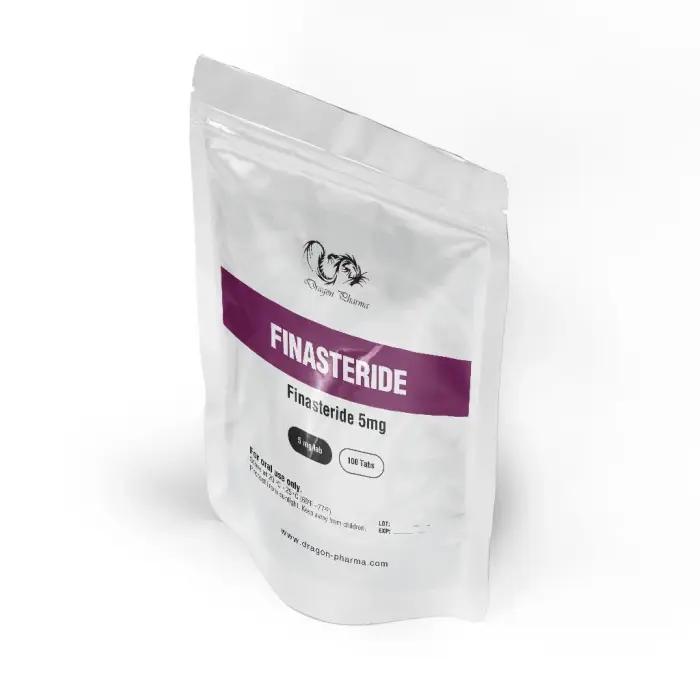
Finasteride
Finasteride Dragon Pharma — Overview
Finasteride Dragon Pharma delivers 5 mg of finasteride per tablet — a Type II 5-alpha reductase inhibitor used to reduce dihydrotestosterone (DHT) levels in scalp and prostate tissue during testosterone-based AAS cycles. The standard 5 mg tab can be split or quartered for the more common 1 mg/day hair loss dose, or used whole for the 5 mg/day prostate-focused protocol.
This page covers how finasteride works, which AAS cycles benefit from it, the compounds where it is ineffective or counterproductive, side effect management, and how to use it correctly during and after a cycle. Finasteride is available at Steroid Warehouse as part of the Dragon Pharma cycle support range.
About the Compound: Finasteride
Finasteride is a competitive, reversible inhibitor of the Type II isoform of 5-alpha reductase (5-AR) — the enzyme responsible for converting testosterone into dihydrotestosterone (DHT) in androgen-sensitive tissues including the scalp, prostate, and liver. DHT has a binding affinity for the androgen receptor approximately five times greater than testosterone, making it the primary driver of androgenic activity in these peripheral tissues. By blocking Type II 5-AR, finasteride reduces DHT levels in scalp tissue by approximately 60–70% and circulating DHT by 65–70% at the standard 1 mg/day dose.
The tablet half-life is approximately 6 hours, but the enzyme inhibition persists for around 24 hours — once-daily dosing is sufficient and consistent plasma levels develop within 1–2 weeks. The 5 mg Dragon Pharma tablet can be scored and split into quarters for a 1.25 mg dose, or halves for 2.5 mg, making it flexible for both hair loss (1–1.25 mg/day) and higher-dose prostate protocols (5 mg/day).
Critical scope limitation: finasteride blocks 5-AR conversion of testosterone and nandrolone derivatives. It has no meaningful effect on trenbolone, boldenone, or already-DHT-derived compounds such as Masteron, Proviron, Winstrol, or Anavar — because these are not converted to more potent metabolites via 5-AR in the scalp. Using finasteride on a trenbolone or boldenone cycle does not protect against their androgenic activity and, in the case of nandrolone, may worsen the androgenic environment at scalp and prostate receptors (see When to Use On-Cycle).
What Finasteride Does
Finasteride acts downstream of testosterone metabolism — it does not alter testosterone levels or androgen receptor binding directly. Its effects are confined to tissues where Type II 5-AR converts testosterone to DHT:
- Scalp DHT reduction — lowers local DHT in hair follicles, slowing the miniaturization process that characterizes male-pattern androgenetic alopecia; the effect is strongest on vertex and mid-scalp loss; does not regenerate fully lost follicles, but preserves existing ones and can stabilize the hairline on testosterone cycles in predisposed users.
- Prostate DHT reduction — reduces prostate gland stimulation by DHT; relevant on long high-testosterone cycles where prostate discomfort or urinary symptoms (frequency, weak stream) develop; 5 mg/day is used clinically for BPH while 1 mg/day is used for hair.
- Modest testosterone increase — by diverting testosterone away from DHT conversion, finasteride slightly raises circulating total testosterone; the increase is modest (approximately 10–15%) and rarely clinically significant on-cycle.
- Sebaceous gland activity reduction — scalp DHT drives oiliness and sebum production in hair follicles; finasteride reduces this indirectly, which may reduce scalp acne and oiliness on high-testosterone cycles.
What finasteride does not do: It does not reduce circulating estrogen, block the androgen receptor directly, protect against trenbolone- or boldenone-related androgenic effects, or reverse established hair loss patterns. It is a preventive and stabilizing tool — not a restoration compound. Its scope is narrow and compound-specific.
Who It Is For
Finasteride is used by AAS athletes who are genetically predisposed to male-pattern hair loss and running testosterone-based cycles where DHT conversion is the primary androgenic driver in scalp tissue.
- What differentiates finasteride from alternatives: unlike Minoxidil, which promotes hair growth through vasodilation and follicle stimulation regardless of DHT levels, finasteride addresses the upstream cause of androgenic hair loss — DHT production — making it a mechanism-specific intervention rather than a symptomatic one. The two work by different pathways and can be combined for greater effect.
- When finasteride is the better choice: users on testosterone-only or testosterone-dominant cycles who notice active hair thinning or scalp recession; athletes with a strong family history of male-pattern baldness who are starting testosterone-based cycles; users who want prostate protection on long high-dose testosterone protocols.
- When to choose something else: users running trenbolone, boldenone, or primarily DHT-derived compounds (Masteron, Winstrol, Anavar, Proviron) will see no meaningful hair protection benefit from finasteride — these compounds are not activated by 5-AR in the scalp; in these contexts Minoxidil is the more practical tool; users primarily dealing with acne rather than hair loss are better served by Accutane (Isotretinoin).
Finasteride vs Alternatives
| Compound | Key Differences | Choose Finasteride When | Choose Alternative When |
|---|---|---|---|
| Minoxidil — Dragon Pharma | Topical vasodilator; promotes follicle survival and new growth through a mechanism unrelated to DHT; does not block androgens; compound-agnostic (works on any cycle type) | DHT-driven hair loss on testosterone cycles; can be combined with Minoxidil simultaneously for additive effect | Primary AAS compound is trenbolone, boldenone, or a DHT-derived drug — where finasteride has no effect; Minoxidil works regardless of the AAS being used |
| Accutane (Isotretinoin) — Dragon Pharma | Systemic retinoid targeting sebaceous gland output and keratinocyte shedding; addresses severe cystic acne; no DHT-blocking or hair-protective action | Primary concern is androgenic hair loss and scalp DHT on a testosterone cycle | Primary concern is moderate-to-severe acne rather than hair; different mechanism and different target organ |
When to Use On-Cycle
Finasteride's effectiveness is strictly compound-dependent. The table below maps AAS contexts to whether finasteride is indicated, neutral, or contraindicated:
| Cycle Context | AAS Involved | Finasteride — Indicated? |
|---|---|---|
| Testosterone-only cycle | Enantat 250, Cypionat 250, Propionat 100 | Yes — primary use case. 1 mg/day for hair; 5 mg/day if prostate symptoms are present. Start at week 1 and continue through cycle. |
| Testosterone + Nandrolone | Enantat 250 + Deca 300 | Use with caution. Finasteride blocks 5-AR conversion of nandrolone to dihydronandrolone (DHN). DHN is less androgenic than nandrolone, so blocking its formation may increase nandrolone's net androgenic activity in scalp and prostate. The testosterone-protective effect still applies, but the overall androgenic environment may not improve as expected. |
| Boldenone (EQ) cycle | EQ 300, EQ 500 | Not indicated. Boldenone converts to dihydroboldenone via 5-AR, which is less androgenic than boldenone itself — 5-AR does not amplify boldenone's androgenic activity. Finasteride has no meaningful hair-protective effect on EQ cycles. Use Minoxidil instead if scalp concerns are present. |
| Trenbolone cycle | Trenbolone 200, Trenbolone 100 | Contraindicated for hair protection. Trenbolone's androgenic activity in scalp tissue is not meaningfully blocked by finasteride. Some evidence suggests finasteride may worsen trenbolone's androgenic profile in certain tissues. Do not use finasteride for hair protection on tren-based cycles. |
| DHT-derived compounds | Masteron 200, Winstrol 10, Anavar 50 | Not indicated. These compounds are already DHT derivatives — they are not converted to more potent metabolites via 5-AR and their androgenic activity is not reduced by finasteride. Use Minoxidil as the hair-protective tool if needed. |
Side Effects and How to Manage Them
Finasteride's side effects are almost entirely driven by two consequences of DHT reduction: a shift in the androgen-to-estrogen ratio, and potential neurosteroid effects from reduced 5-AR activity in non-peripheral tissues.
| What May Occur | Background | How to Handle It |
|---|---|---|
| Libido reduction / sexual dysfunction | DHT plays a role in libido, erectile function, and ejaculate volume. Reducing DHT by 65–70% on-cycle shifts the androgen landscape — most commonly reported as reduced spontaneous arousal and reduced ejaculate volume. Reported in approximately 1–5% of users at 1 mg/day; higher at 5 mg/day. | Reduce to lowest effective dose (0.5–1 mg/day). If symptoms persist, discontinue — sexual function typically recovers within weeks. On-cycle: Proviron 50 mg/day partially restores androgenic tone. For ED: Cialis 5 mg/day as needed. |
| Gynecomastia risk | DHT competes with estrogen at certain receptor sites and exerts mild anti-estrogenic effects in breast tissue. Reducing DHT while testosterone (and therefore aromatization) remains elevated can shift the androgen:estrogen balance toward estrogen sensitivity in breast tissue. | Monitor for nipple sensitivity. Confirm E2 by lab; if elevated, add Arimidex 0.5 mg EOD or Aromasin 12.5 mg EOD. If gyno persists, Nolvadex 10–20 mg/day blocks estrogen receptors at breast tissue directly. |
| Mood changes / low motivation | 5-alpha reductase is involved in the synthesis of neuroactive steroids (neurosteroids) such as allopregnanolone, which modulate GABA-A receptors. Finasteride's enzyme inhibition extends to these pathways in the CNS, and some users report low mood, reduced motivation, or blunted affect — particularly at 5 mg/day doses. | Reduce dose to 1 mg/day or discontinue if mood effects are significant. Neurosteroid effects are dose-dependent and generally resolve on discontinuation. |
| PSA suppression (prostate screening impact) | Finasteride suppresses prostate-specific antigen (PSA) by approximately 50% within 6 months of use. This artificially lowers PSA readings — relevant if PSA is used as a prostate cancer screening marker. | If PSA is tested while on finasteride, multiply the result by 2 to estimate the true PSA value. Disclose finasteride use to any medical provider ordering PSA tests. |
| Post-Finasteride Syndrome (rare) | A subset of users report persistent sexual, cognitive, and psychological effects that continue after discontinuing finasteride. The mechanism is poorly understood and remains controversial, but is documented in peer-reviewed literature. Estimated incidence is low (<1%) but reported severity can be significant. | No confirmed treatment exists. If side effects develop, discontinue promptly rather than continuing on a reduced dose. |
Bloodwork Monitoring
| Lab | When to Test | Target & Action Threshold |
|---|---|---|
| DHT (dihydrotestosterone) | Baseline; week 4–6 on finasteride | Confirms drug is working. On-cycle baseline will be elevated from testosterone; expect 60–70% reduction with 1 mg/day. Not mandatory but useful to confirm response. |
| Total testosterone | Baseline; mid-cycle | Finasteride modestly raises total testosterone by diverting from DHT conversion. Monitor as part of standard on-cycle bloodwork. |
| Estradiol (E2) | Week 4–6; repeat if gyno symptoms arise | Target 20–40 pg/mL on-cycle. Finasteride reduces the anti-estrogenic DHT signal — watch for E2 creep. Introduce AI only if E2 is confirmed elevated by lab. |
| PSA (Prostate-Specific Antigen) | Baseline before starting finasteride (if age >40 or prostate history) | Finasteride suppresses PSA by ~50%. Establish baseline before use. Multiply on-finasteride reading by 2 to estimate true value. Flag any rising PSA trend even at suppressed levels. |
| LH + FSH | End of cycle; 6 weeks post-PCT | Standard AAS cycle monitoring. Finasteride does not directly affect LH/FSH recovery. |
| Lipid panel (HDL / LDL) | Baseline; week 6; end of cycle | Standard on-cycle monitoring. Lipid changes are driven by the AAS compounds in the stack, not finasteride. |
During & After PCT
Finasteride does not interact with SERM-based PCT recovery. Nolvadex and Clomid work at the hypothalamic-pituitary level through estrogen receptor blockade — a mechanism entirely separate from 5-AR inhibition. Finasteride does not impair LH/FSH recovery and does not need to be stopped before starting a SERM.
The decision of whether to continue finasteride through and after PCT depends on the original reason for use:
| Scenario | Recommendation |
|---|---|
| Used for long-term hair loss prevention | Continue through PCT and beyond — hair loss prevention is a chronic application; stopping creates DHT rebound and resumed follicle miniaturization. Finasteride at 1 mg/day as an ongoing daily medication is the standard clinical use. |
| Used only for on-cycle androgenic management | Can discontinue 1–2 weeks after the last AAS injection as testosterone levels decline. DHT drops naturally as exogenous testosterone clears; finasteride is no longer needed once androgenic suppression from the AAS has resolved. |
| Sexual side effects developed on-cycle | Discontinue finasteride at cycle end or sooner. Do not continue into PCT if libido or erectile function are already affected — recovery of DHT is part of restoring sexual function during PCT. |
For standard PCT agents — Nolvadex, Clomid, HCG, Enclomiphene — and full PCT protocol timing, see the PCT guide.
Practical Summary
Key rules for using Finasteride on-cycle:
- 1 mg/day for hair, 5 mg/day for prostate — the 5 mg Dragon Pharma tab can be split for hair loss dosing (1 mg or 1.25 mg/day); using the full 5 mg/day for hair loss does not increase efficacy and substantially raises the risk of sexual side effects.
- Only effective on testosterone-based cycles — finasteride blocks 5-AR conversion of testosterone to DHT; it has no meaningful protective effect on trenbolone, boldenone, or DHT-derived compounds (Masteron, Winstrol, Anavar); use Minoxidil for cycle-agnostic hair protection instead.
- Do not use with trenbolone for hair protection — finasteride does not reduce trenbolone's androgenic activity in the scalp and may worsen the androgenic environment in certain tissues; it offers no benefit and carries the same sexual side effect risk.
- Monitor E2 when running finasteride alongside testosterone — DHT normally exerts mild anti-estrogenic action at peripheral tissues; reducing DHT shifts the balance toward estrogen sensitivity; watch for gyno symptoms and confirm E2 by lab before adding an AI.
- Stop promptly at first sign of persistent sexual side effects — libido reduction and reduced ejaculate volume are the most common complaints; dose reduction resolves most cases; discontinuation resolves the remainder; Post-Finasteride Syndrome risk is associated with continued use through early warning signs.
- PSA interpretation changes on finasteride — the compound suppresses PSA by approximately 50%; multiply the on-finasteride reading by 2 to estimate true PSA for screening purposes.
Finasteride remains one of the most clinically validated options for androgenic hair loss prevention in men, with over two decades of data in the hair loss literature. On AAS cycles, its role is specific and compound-dependent — useful on testosterone-based protocols for athletes with a genetic predisposition toward male-pattern baldness, and entirely ineffective on trenbolone, boldenone, or DHT-derived stacks. When the compound selection is right and dosing stays at 1 mg/day, finasteride is generally well-tolerated and can meaningfully slow cycle-accelerated hair loss over a 12–16 week run.
References
| Source | Relevance | Link |
|---|---|---|
| New England Journal of Medicine / PubMed | Bhasin et al. 1996 — landmark randomized controlled trial on supraphysiologic testosterone exposure and anabolic outcomes; foundational context for testosterone-based cycles where DHT-related androgenic side effects may become clinically relevant | Bhasin S, et al. (1996) ↗ |
| NCBI Bookshelf / StatPearls | Anabolic steroids overview — anabolic-androgenic steroid pharmacology, androgen receptor signaling, testosterone metabolism, HPG-axis suppression, and androgenic adverse effects including hair loss and prostate-related concerns | StatPearls: Anabolic Steroids ↗ |
| NCBI Bookshelf / Endotext | Androgen physiology and pharmacology — testosterone metabolism, 5-alpha reductase activity, dihydrotestosterone formation, androgen receptor signaling, and the physiological basis for DHT-lowering therapies | Endotext: Androgen Physiology, Pharmacology, Use and Misuse ↗ |
| Journal of the American Academy of Dermatology / PubMed | Kaufman et al. 1998 — placebo-controlled clinical trial demonstrating finasteride 1 mg/day efficacy for male pattern hair loss, including improvements in hair count, scalp coverage, and investigator assessments | Kaufman KD, et al. (1998) ↗ |
| NCBI Bookshelf / StatPearls | Finasteride — mechanism of 5-alpha reductase inhibition, pharmacokinetics, DHT suppression, therapeutic applications in androgenetic alopecia and benign prostatic hyperplasia, adverse effects, and clinical monitoring considerations | StatPearls: Finasteride ↗ |
What is Finasteride used for?
Finasteride is used for hair loss prevention and DHT control in bodybuilding; see Key Benefits. It suits men—consult professionals for safe use.
How does Finasteride work?
It reduces DHT by inhibiting 5-alpha reductase; see Mechanism of Action. It prevents hair loss—monitor with professional guidance.
What is Finasteride?
Finasteride is an oral 5-alpha reductase inhibitor for hair loss and DHT control; see What is Finasteride. It's effective—consult professionals for safe use.
Does Finasteride regrow hair?
It slows hair loss and may promote mild regrowth in early stages; see How It Works. Results take months—consult for realistic expectations.
What does Finasteride do?
It prevents hair loss and manages DHT-related side effects; see Mechanism of Action. It supports aesthetics—use with professional oversight.
Is Finasteride safe?
It's safe with proper use and monitoring; see Side Effects. Manage risks with professional guidance—consult for safety.
How long does it take to see results from Finasteride?
Results typically develop gradually. Many users begin noticing reduced hair shedding and stabilization of hair loss within several months of consistent use.
What are the main benefits of Finasteride?
The main benefits include slowing hair loss progression, improving hair retention, and supporting thicker-looking hair over time in individuals sensitive to DHT.
Related Products