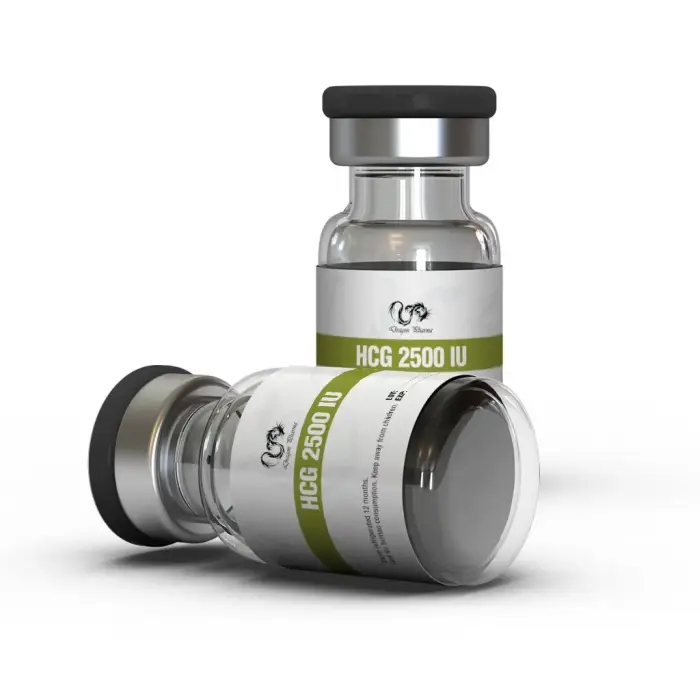
HCG 2500IU
HCG 2500IU Dragon Pharma — Overview
HCG 2500IU Dragon Pharma delivers 2,500 IU of human chorionic gonadotropin (hCG) per vial — a glycoprotein hormone that binds the LH receptor on Leydig cells in the testes and directly stimulates intratesticular testosterone production. In the context of AAS cycles, exogenous androgens suppress LH and FSH through negative feedback at the hypothalamus and pituitary; without an LH signal, Leydig cells become inactive and testicular volume decreases progressively over weeks. HCG provides an exogenous LH-equivalent signal directly to the testes, maintaining Leydig cell function and intratesticular testosterone regardless of HPG suppression status.
The 2,500 IU vial format is designed for two specific use cases: the pre-PCT blast protocol (2,500 IU per injection × 2–3 injections over one week — one vial per injection, zero waste), and targeted on-cycle maintenance at lower doses where a single vial covers 2.5–5 weeks of twice-weekly injections. Available at Steroid Warehouse alongside the full Dragon Pharma PCT and cycle-support range including HCG 5000IU Dragon Pharma for longer on-cycle protocols.
About the Compound: HCG (Human Chorionic Gonadotropin)
Human chorionic gonadotropin is a glycoprotein hormone composed of two non-covalently linked subunits: the α-subunit, which is structurally identical to LH, FSH, and TSH, and a unique β-subunit that confers specific, high-affinity binding to the LH/hCG receptor. In reproductive physiology, hCG is produced by the syncytiotrophoblast during pregnancy to maintain corpus luteum progesterone production. In male performance pharmacology, it is used for its ability to mimic the LH signal at the testicular level.
Leydig cells in the testes bear LH/hCG receptors. Binding of hCG activates adenylyl cyclase via Gs protein coupling, increases intracellular cAMP, and drives the steroidogenic cascade from cholesterol to testosterone. This mechanism is entirely independent of the hypothalamic-pituitary axis — HCG acts directly at the testicular endpoint. When exogenous androgens suppress LH secretion from the pituitary to near-zero, HCG substitutes for the absent LH signal and maintains Leydig cell function, intratesticular testosterone production, and testicular volume.
Critically, HCG does not restore the HPG axis. It bypasses the axis entirely. After stopping HCG, Leydig cells will again go dormant if the HPG axis is still suppressed. This is why HCG is used as preparation for PCT — priming testicular responsiveness — rather than as a PCT agent itself. SERMs (Clomid, Nolvadex) remain required to re-engage the HPG axis and generate endogenous LH/FSH recovery.
What HCG Does
HCG acts on a single target — the LH/hCG receptor on Leydig cells — but the downstream effects of maintaining that signal during and after an AAS cycle are significant:
- Maintains intratesticular testosterone (ITT) — low-dose concurrent HCG prevents the dramatic ITT decline that occurs during exogenous testosterone administration; ITT at the testicular level is orders of magnitude higher than peripheral serum testosterone and is critical for spermatogenesis even when serum testosterone from exogenous AAS is supraphysiologic
- Prevents testicular atrophy — Leydig cell activity and testicular volume are maintained in direct proportion to LH signaling; continuous HCG use prevents the volume reduction that becomes progressively harder to reverse as cycle length increases
- Restores Leydig cell sensitivity before PCT — a pre-PCT HCG blast re-activates Leydig cells that have been dormant for weeks or months; testes that are stimulated and responsive when SERMs are introduced recover faster and more completely than atrophied testes facing SERM-driven LH stimulation cold
- Supports partial spermatogenesis preservation — while FSH is the primary driver of spermatogenesis, the ITT maintained by HCG provides the testosterone concentration at the seminiferous tubule level required for Sertoli cell function; HCG alone is not a complete fertility-preservation protocol but is significantly better than no intervention
- Does not suppress HPG axis further — HCG does not signal at hypothalamic or pituitary level in a suppressive direction; it does not add to the gonadotropin suppression already present from exogenous AAS
Who It's For
HCG 2500IU Dragon Pharma is the right choice for two clearly defined use profiles. Understanding which one applies determines the dosing protocol, the number of vials needed, and the sequencing relative to PCT.
Pre-PCT blast user: any athlete who has run an AAS cycle of 8 weeks or longer and wants to prime testicular function before starting Clomid and Nolvadex. The 2,500 IU vial is sized exactly for this protocol — one vial delivers the full pre-PCT blast injection with no leftover product. Two to three vials cover the standard week-long blast sequence. This is the primary use case for the 2,500 IU format.
On-cycle maintenance user (shorter cycles or targeted protocols): an athlete running a 6–8 week cycle who wants to run HCG at 250 IU twice weekly — one 2,500 IU vial covers 5 weeks at this dose, making it practical for shorter runs without committing to the larger 5,000 IU format.
Who should choose the 5000IU format instead: anyone running a 12–16 week or longer cycle with on-cycle HCG maintenance at 500 IU twice weekly. At that dose and duration, a 12-week cycle requires 12 × 2 × 500 = 12,000 IU → 5 vials of 2,500 IU, compared to 3 vials of 5,000 IU. The 5,000 IU format is more economical for extended maintenance protocols.
Who should not use HCG: users on cycles under 6–8 weeks where meaningful testicular atrophy has not had time to develop; users who are opposed to additional injections beyond their cycle protocol; users who have a personal or medical history of hormone-sensitive conditions.
HCG 2500IU vs Alternatives
| Compound | Key Differences | Choose HCG 2500IU When | Choose Alternative When |
|---|---|---|---|
| HCG 5000IU Dragon Pharma hCG 5,000 IU/vial |
Identical compound at double the vial volume; more economical when multiple injections are needed; one vial covers two full 2,500 IU blast injections or 5 weeks of 500 IU twice-weekly maintenance; slight waste if only a single blast injection is needed | Pre-PCT blast (1–3 injections at 2,500 IU each); on-cycle maintenance on a 6–8 week cycle at 250 IU twice weekly; zero-waste single-dose format | On-cycle maintenance for 12+ week cycle at 500 IU twice weekly — 5000IU format requires fewer vials and is significantly more cost-effective at that volume |
| HMG 150IU Dragon Pharma Human Menopausal Gonadotropin (FSH+LH) |
HMG contains both FSH and LH activity; directly stimulates Sertoli cells via FSH, which HCG alone cannot do; required when spermatogenesis restoration is the specific goal, not just testicular volume maintenance; higher cost and more complex dosing; used alongside HCG in fertility-focused stacks, not as a standalone substitute | Standard testicular volume maintenance; pre-PCT blast preparation; no active fertility concern; single-compound gonadotropin approach | Spermatogenesis restoration is the primary goal (e.g. planning conception after a long AAS cycle); the complete FSH+LH profile is specifically needed for Sertoli cell activation alongside Leydig cell stimulation |
Combinations
| Goal | Stack | Protocol / Timing | Notes |
|---|---|---|---|
| On-cycle testicular maintenance | HCG 2500IU + testosterone base + Arimidex Dragon Pharma | 250–500 IU HCG SubQ twice weekly from week 1 of cycle; Arimidex 0.5 mg EOD to manage E2 from both testosterone aromatization and HCG-stimulated Leydig cell production; continue HCG until 1 week before PCT start, then stop | HCG adds to the total E2 load on cycle — do not skip the AI if using HCG alongside aromatizing AAS. At 250 IU 2×/wk: 1 vial covers exactly 5 weeks. At 500 IU 2×/wk: 1 vial covers 2.5 weeks → a 12-week cycle needs 5 vials at this dose. |
| Pre-PCT blast (standard) | HCG 2500IU → Clomid Dragon Pharma + Nolvadex Dragon Pharma | Last AAS injection clears (ester-dependent) → run HCG 2,500 IU every 3 days for 1 week (injections at day 0, day 3, day 6 = 3 vials total) → stop HCG → wait 72 hours → start Clomid 50 mg + Nolvadex 20 mg/day | Sequencing is critical: HCG and SERMs must not overlap. Running both simultaneously sends competing signals — HCG stimulates testosterone production via LH-receptor bypass while SERMs are trying to drive the HPG axis. The 72-hour gap after the last HCG injection allows it to clear before SERMs begin. |
| Fertility support stack | HCG 2500IU + HMG 150IU Dragon Pharma | HCG 2,500 IU 3×/week + HMG 150 IU 3×/week; specific duration and dose depends on the degree of HPG suppression and fertility timeline; this is a fertility-restoration protocol beyond standard PCT | HMG provides the FSH component that HCG cannot supply; the combination addresses both Leydig cell function (HCG/LH) and Sertoli cell function (HMG/FSH) required for full spermatogenesis recovery. Not a routine PCT protocol — used when active fertility restoration after a prolonged AAS cycle is the specific goal. |
Side Effects & Management
| Side Effect | Severity | How to Handle It |
|---|---|---|
| Estradiol (E2) elevation | Moderate — additive with AAS aromatization on cycle | HCG drives Leydig cell testosterone production → the additional testosterone aromatizes → E2 rises on top of the E2 already generated by the AAS base. Use Arimidex Dragon Pharma (0.5 mg EOD, adjust per bloodwork) when running HCG concurrently with aromatizing AAS. Monitor E2 every 4–6 weeks. Stop the AI when HCG is stopped before PCT. |
| Leydig cell desensitization | Low at recommended doses | High-dose continuous HCG over extended periods can downregulate LH/hCG receptor expression on Leydig cells, reducing their response to both HCG and natural LH. Avoid doses above 500 IU per injection for on-cycle maintenance. Do not run HCG continuously for more than 16 consecutive weeks without assessment. The 1-week pre-PCT blast at 2,500 IU is too short to cause meaningful desensitization. |
| Gynecomastia risk | Low with AI management | Risk arises when E2 rises from HCG-stimulated testosterone without aromatase inhibition, particularly in users with pre-existing sensitivity. Manage proactively with an AI during on-cycle HCG use. If early breast tenderness appears, assess E2 and adjust AI dose. Nolvadex Dragon Pharma can be added for breast tissue protection if E2 control with AI alone is insufficient. |
| Injection site reaction | Low | Use 29–31 G insulin syringe for SubQ injection. Rotate sites (abdomen, lateral thigh, upper arm). Minor bruising or transient local irritation may occur. Store reconstituted HCG refrigerated at 2–8°C; do not freeze. Discard if solution is cloudy or contains particulate matter. |
| HPG axis interaction | None (HCG bypasses HPG) | HCG does not act at hypothalamic or pituitary level in a suppressive direction. It does not add to the existing HPG suppression from AAS. It does not restore HPG function either — that is the role of SERMs. HCG use neither worsens nor accelerates natural HPG recovery; its role ends when the pre-PCT sequence is complete. |
Bloodwork Monitoring
| Lab | When to Test | Target & Action Threshold |
|---|---|---|
| E2 (Estradiol) | Baseline → every 4–6 weeks during on-cycle HCG use | Target 20–40 pg/mL on cycle. HCG adds to the E2 load from aromatizing AAS — the two effects are cumulative. If E2 exceeds 60 pg/mL with active AI use, increase AI dose or reduce HCG frequency. Confirm E2 is returning toward baseline at 4–6 weeks post-PCT. |
| LH + FSH | Baseline (pre-cycle) → 4–6 weeks post-PCT | Both will be suppressed throughout the cycle regardless of HCG use — HCG bypasses HPG, it does not restore it. Post-PCT: LH and FSH returning to lower-normal range (LH >2 IU/L, FSH >1.5 IU/L) within 4–6 weeks confirms the HPG axis is responding to SERM stimulation. Persistent suppression warrants extended monitoring or extended PCT duration. |
| Total testosterone | Baseline (pre-cycle) → 4–6 weeks post-PCT | Will be elevated during cycle from exogenous AAS (not a useful monitoring point on-cycle). Post-PCT target: return to ≥70% of pre-cycle baseline. Values still below 250 ng/dL at 6 weeks post-PCT indicate slow recovery — extend PCT monitoring window. |
| Hematocrit / CBC | Baseline → mid-cycle → end of cycle | HCG-stimulated intratesticular testosterone production contributes a mild erythropoietic component. Combined with AAS erythropoietic activity, monitor hematocrit if stacking HCG with high-dose testosterone or EQ. Target hematocrit <52%; action threshold >54%: dose management or therapeutic assessment. |
| Blood pressure | Self-monitor periodically during on-cycle HCG use | HCG itself does not directly elevate blood pressure; the contribution is indirect via increased Leydig cell testosterone output. Monitor as part of the overall cycle BP protocol, particularly if HCG is used alongside high-dose testosterone or volume-promoting compounds. Target <130/85 mmHg. |
Protocol & Administration
Reconstitution: add exactly 1 mL of bacteriostatic water Dragon Pharma to the lyophilized HCG vial → final concentration 2,500 IU/mL. Inject the water slowly down the vial wall — do not shake; swirl gently until powder dissolves. Store reconstituted vial refrigerated at 2–8°C; use within 28–30 days. Do not freeze reconstituted HCG.
Injection technique: SubQ preferred — 29–31 G × 8–12 mm insulin syringe; pinch skin; inject into abdomen, lateral thigh, or upper arm; rotate sites each injection. IM (deltoid, ventroglute) is also acceptable.
| Protocol | Dose | Frequency | Vials Needed | Notes |
|---|---|---|---|---|
| On-cycle maintenance (low dose) | 250 IU | Twice weekly (e.g. Mon + Thu) | 1 vial covers 5 weeks (2,500 ÷ 250 = 10 injections ÷ 2 per week = 5.0 wk). 12-week cycle: 3 vials needed | Draw 0.1 mL per injection from reconstituted vial (2,500 IU/mL × 0.1 mL = 250 IU). Preferred dose when minimizing E2 elevation is a priority alongside testicular maintenance. |
| On-cycle maintenance (standard dose) | 500 IU | Twice weekly | 1 vial covers 2.5 weeks (2,500 ÷ 500 = 5 injections ÷ 2 per week = 2.5 wk). 12-week cycle: 5 vials needed | Draw 0.2 mL per injection. More effective for larger testicular volume maintenance; carries higher E2 load — AI dose adjustment may be needed. For 12-week+ cycles, the 5000IU vial is more economical. |
| Pre-PCT blast | 2,500 IU | Every 3 days × 2–3 injections | 1 vial per injection = 2–3 vials total | Inject full vial (2,500 IU = 1.0 mL) on day 0, day 3, and day 6. Stop HCG after day 6 injection. Wait 72 hours minimum. Begin Clomid DP 50 mg + Nolvadex DP 20 mg/day. Do not start SERMs before the 72-hour gap has elapsed. |
Practical Summary
- 1 vial = 1 pre-PCT blast injection — zero waste: the 2,500 IU vial format is sized exactly for the standard blast protocol dose; for a full 3-injection blast sequence, order 3 vials before starting the cycle so they are on hand when needed
- Stop HCG 72 hours before SERMs, not the same day: HCG and Clomid/Nolvadex must not overlap; HCG stimulates Leydig cells directly while SERMs are trying to re-engage the HPG axis; running both simultaneously creates competing signals; the 72-hour gap allows HCG to clear before the SERM phase begins
- HCG is pre-PCT preparation, not PCT itself: HCG bypasses the HPG axis rather than restoring it; Leydig cells will go dormant again after HCG is stopped unless the HPG axis recovers; Clomid Dragon Pharma + Nolvadex Dragon Pharma remain mandatory for actual HPG recovery
- Use an AI on-cycle when stacking HCG with aromatizing AAS: HCG-stimulated testosterone production adds to the E2 load from testosterone or other aromatizing compounds; Arimidex Dragon Pharma 0.5 mg EOD is the standard starting point — adjust based on E2 bloodwork
- For 12-week+ on-cycle maintenance at 500 IU 2×/wk, use the 5000IU vial: a 12-week protocol at this dose requires 12,000 IU total → 5 × 2,500 IU vials vs 3 × 5,000 IU vials; the larger format is more economical for sustained maintenance protocols
- Reconstitute with bacteriostatic water, refrigerate, use within 30 days: lyophilized powder is stable at room temperature; once reconstituted it must be kept at 2–8°C and must not be frozen; discard if solution shows any cloudiness or particulate
HCG remains the most practical tool for managing testicular function during and after AAS cycles — not because it restores the HPG axis, but precisely because it works around it. For athletes planning cycles of 8 weeks or longer, the pre-PCT HCG blast is the difference between starting PCT with responsive, primed Leydig cells and starting it with atrophied testes that are slow to respond. The 2,500 IU vial format at Steroid Warehouse is designed for exactly this protocol: clean single-dose precision with no product waste.
References
| Source | Topic | Link |
|---|---|---|
| Journal of Clinical Endocrinology & Metabolism / PubMed | Coviello et al. 2005 — controlled study showing that low-dose human chorionic gonadotropin maintains intratesticular testosterone in normal men with testosterone-induced gonadotropin suppression; foundational mechanistic evidence for using hCG to preserve testicular steroidogenesis during exogenous testosterone exposure | Coviello AD, et al. (2005) ↗ |
| Journal of Urology / PubMed | Hsieh et al. 2013 — clinical study showing that concomitant intramuscular human chorionic gonadotropin preserves spermatogenesis in men undergoing testosterone replacement therapy; practical fertility-preservation evidence for concurrent gonadotropin support | Hsieh TC, et al. (2013) ↗ |
| Asian Journal of Andrology / PubMed | McBride & Coward 2016 — review of spermatogenesis recovery after testosterone replacement therapy or anabolic-androgenic steroid use; covers spontaneous recovery timelines and gonadotropin-based strategies used to restore sperm production after exogenous androgen suppression | McBride JA & Coward RM (2016) ↗ |
| Frontiers in Endocrinology / PubMed | Oduwole et al. 2021 — comprehensive review of luteinizing hormone, follicle-stimulating hormone, testosterone, and intratesticular testosterone in spermatogenesis; explains why LH/hCG signaling and adequate intratesticular testosterone are central to normal seminiferous tubule function | Oduwole OO, et al. (2021) ↗ |
| NCBI Bookshelf / StatPearls | Human chorionic gonadotropin overview — hCG biology, LH/hCG receptor activity, clinical testing context, pharmacologic relevance, reproductive medicine applications, adverse considerations, and broader gonadotropin physiology | StatPearls: Human Chorionic Gonadotropin ↗ |
What is HCG 2500IU?
HCG 2500IU is an injectable hormone for testosterone recovery and fertility; see What is Human Chorionic Gonadotropin. It's key for PCT—consult professionals for safe use.
What is HCG 2500IU used for?
It's used for testosterone restoration and fertility in PCT; see Key Benefits. It suits bodybuilders—use with professional oversight.
How does HCG 2500IU work?
It mimics LH to stimulate testosterone production; see Mechanism of Action. It restores hormones—monitor with labs.
What are the side effects of HCG 2500IU?
Side effects include mild estrogenic effects or injection site reactions; see Side Effects. Manage with ancillaries—consult professionals for safety.
How long does HCG 2500IU stay in your system?
With a 24-36 hour half-life, it's detectable for ~5-7 days; see Mechanism of Action. Plan PCT—consult professionals.
How quickly does HCG 2500 IU start working?
HCG acts relatively quickly once administered, with hormonal signaling effects beginning shortly after use, though full physiological responses can vary by individual.
What are the main benefits of HCG 2500 IU?
Commonly discussed benefits include support for natural testosterone production, maintenance of testicular function, and prevention of testicular shrinkage during suppression states.
What makes HCG 2500 IU different from other hormonal support compounds?
HCG directly mimics luteinizing hormone, making it distinct from compounds that stimulate hormone production indirectly through the hypothalamus or pituitary.
Related Products