IGF-1 LR3
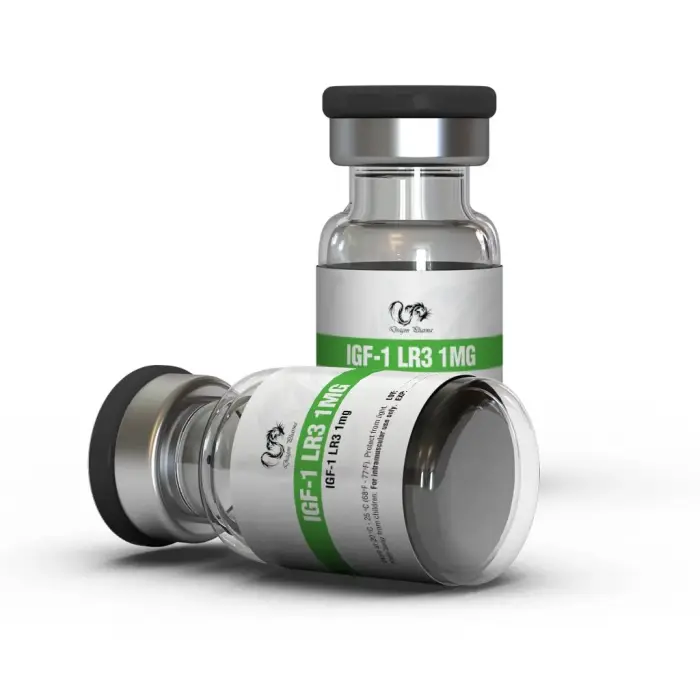
IGF-1 LR3 Dragon Pharma 1 mg — Overview
IGF-1 LR3 Dragon Pharma delivers 1 mg (1,000 mcg) of Long R3 Insulin-like Growth Factor-1 per vial — a synthetic analog of native IGF-1 engineered for dramatically extended duration of action. Two structural modifications distinguish LR3 from endogenous IGF-1: an arginine substitution at position 3 and a 13-amino acid N-terminal extension. Together these changes reduce binding affinity for insulin-like growth factor binding proteins (IGFBPs) by approximately 1,000-fold relative to native IGF-1. Because IGFBPs sequester circulating IGF-1 and control its bioavailability, their virtual exclusion from IGF-1 LR3 binding translates directly into a plasma half-life of 20–30 hours versus the 12–15 minutes typical of endogenous IGF-1.
Unlike GH secretagogues or synthetic HGH, which stimulate the liver to produce IGF-1 indirectly, IGF-1 LR3 acts at the receptor level immediately and directly. It binds the IGF-1 receptor (IGF-1R) — a tyrosine kinase receptor expressed on skeletal muscle, bone, cardiac tissue, and multiple other cell types — and activates downstream PI3K/Akt and MAPK/ERK pathways that drive protein synthesis, satellite cell activation, and cell proliferation. IGF-1 LR3 has no androgenic activity, does not suppress the HPG axis, and requires no post-cycle therapy. The Dragon Pharma 1 mg vial available at Steroid Warehouse provides 12–25 full doses depending on protocol, making it one of the highest-yield direct IGF-1R agonist formats on the market.
About the Compound: IGF-1 LR3
Insulin-like growth factor-1 is a 70-amino acid single-chain polypeptide produced primarily by the liver in response to growth hormone stimulation. It mediates most of GH's anabolic and growth-promoting effects in peripheral tissues. In the circulation, native IGF-1 is almost entirely protein-bound — predominantly to IGFBP-3, which functions as a reservoir that extends IGF-1 half-life slightly while limiting its bioavailability at the receptor level. The engineering decision behind Long R3 IGF-1 was to eliminate this IGFBP interaction: by substituting arginine for glutamate at position 3 and adding an N-terminal extension, IGFBP binding affinity drops by roughly 1,000-fold, leaving IGF-1 LR3 free in plasma to access the IGF-1R on target tissues for the full duration of its 20–30 hour half-life.
IGF-1R is a heterotetrameric transmembrane receptor — two extracellular α-subunits and two transmembrane β-subunits — with intrinsic tyrosine kinase activity in the intracellular β-subunit domain. Ligand binding triggers autophosphorylation and activation of two major downstream cascades: PI3K/Akt/mTOR, which drives protein synthesis and cell survival; and Ras/MAPK/ERK, which promotes cell proliferation and differentiation. In skeletal muscle specifically, IGF-1R activation recruits and activates satellite cells — the resident muscle stem cells responsible for muscle fiber repair and hypertrophy — and upregulates protein synthesis at the translational level through mTORC1 activation. Unlike insulin, which acts primarily on the insulin receptor (IR), IGF-1 LR3 has approximately 500-fold lower affinity for IR, reducing the risk of hypoglycemia compared to direct insulin administration while retaining meaningful anabolic signaling at the IGF-1R.
What IGF-1 LR3 Does
IGF-1 LR3 acts directly on IGF-1R-expressing tissues for the duration of its half-life. In skeletal muscle, bone, and connective tissue, sustained IGF-1R signaling drives a coordinated anabolic response that neither GH secretagogues nor AAS alone fully replicate.
- Satellite cell activation and muscle fiber hyperplasia — IGF-1R stimulation activates quiescent satellite cells, causing them to proliferate and fuse into existing or new muscle fibers; this process — hyperplasia — increases the total number of muscle fibers rather than simply enlarging existing ones (hypertrophy); sustained IGF-1 LR3 exposure during a structured resistance training protocol provides the IGF-1R signaling required to maximize satellite cell-driven muscle adaptation
- mTORC1-driven protein synthesis — PI3K/Akt activation downstream of IGF-1R phosphorylates and activates mTORC1, the master regulator of translational capacity in skeletal muscle; mTORC1 upregulates ribosome biogenesis and protein synthesis rate, amplifying the anabolic response to training at the molecular level
- Anti-catabolic signaling — Akt activation suppresses FOXO transcription factors and reduces ubiquitin-proteasome-mediated protein degradation; this anti-catabolic effect is particularly relevant during caloric restriction where IGF-1 LR3 can partially offset the muscle protein breakdown that accompanies a deficit
- Connective tissue and bone IGF-1R signaling — IGF-1R is expressed on tenocytes, chondrocytes, and osteoblasts; IGF-1 LR3 promotes collagen synthesis in tendons and ligaments and osteoblast activity in bone, supporting connective tissue remodeling alongside muscle growth — particularly relevant when lean mass gain is accelerating faster than connective tissue adaptation
- GH-independent IGF-1R activation — native IGF-1 production depends on liver GH receptor stimulation and is subject to nutritional regulation, IGFBP sequestration, and clearance; IGF-1 LR3 bypasses all of these bottlenecks, delivering a full 20–30 hours of uninterrupted IGF-1R signaling regardless of GH status, feeding state, or endogenous IGFBP levels
- Insulin receptor cross-reactivity (minor) — IGF-1 LR3 has approximately 500-fold lower affinity for the insulin receptor than for IGF-1R, but at higher doses the partial IR activation contributes to glucose uptake in skeletal muscle; this creates a mild hypoglycemic risk at supraphysiological doses, particularly in a fasted state
Who It's For
IGF-1 LR3 is for experienced athletes who want to add direct IGF-1R signaling to their protocol — either alongside AAS for maximum anabolic coverage, alongside GH secretagogues for complementary receptor-level action, or as a standalone in periods where HPG-axis-neutral anabolic support is the goal. It is not a beginner compound: the hypoglycemia risk at incorrect dosing, the requirement for subcutaneous injection, and the need for precise dosing and cycling demand familiarity with peptide handling and self-administration.
What sets IGF-1 LR3 apart: it is the only available injectable peptide that directly and specifically activates IGF-1R with a practical half-life for once-daily dosing. GH secretagogues (GHRPs, CJC-1295) work by stimulating pituitary GH release, which then drives liver IGF-1 production — a two-step process subject to somatostatin regulation, pituitary sensitivity, and hepatic GH receptor density. Synthetic HGH (Dragontropin) takes the same route, adding exogenous GH to drive liver IGF-1 production. IGF-1 LR3 skips both steps and activates IGF-1R directly in muscle tissue — including local muscle IGF-1R that liver-derived IGF-1 may not reach at sufficient concentrations. For athletes where maximizing satellite cell activation and mTOR-driven protein synthesis is the explicit goal, this distinction is meaningful.
Ideal use cases:
- Advanced athletes adding IGF-1 LR3 to an AAS base cycle to maximize the satellite cell activation and lean mass retention that AAS alone provide suboptimally — AAS drives androgen receptor-mediated protein synthesis; IGF-1 LR3 adds IGF-1R-mediated satellite cell recruitment and mTOR activation, covering both primary anabolic pathways simultaneously
- Athletes in a caloric deficit who want to preserve lean tissue via anti-catabolic IGF-1R signaling without adding suppressive androgens — IGF-1 LR3 has no HPG axis effects, no androgenic activity, and can be run between AAS cycles without PCT concerns
- Athletes already running a GH secretagogue stack who want to supplement the indirect IGF-1 production pathway (GH → liver → serum IGF-1) with direct local IGF-1R activation in muscle tissue
Who should choose a different approach: athletes whose primary goal is GH-driven fat loss and recovery — where systemic IGF-1 elevation, GH pulse amplitude, and nocturnal GH effects are the dominant mechanisms — are better served by Dragontropin HGH Dragon Pharma or a GHRP stack. IGF-1 LR3 is highly targeted at IGF-1R signaling; it does not produce the full spectrum of GH effects (lipolysis, fluid balance, sleep quality improvements) that exogenous HGH or GHRP protocols deliver.
IGF-1 LR3 vs Alternatives
| Compound | Key Differences | Choose IGF-1 LR3 When | Choose Alternative When |
|---|---|---|---|
| Dragontropin HGH Dragon Pharma Recombinant somatropin |
Exogenous GH stimulates liver IGF-1 production (indirect); also delivers full spectrum GH effects — lipolysis, fluid balance, sleep quality, IGF-1-independent tissue effects; requires 3–6+ months for full benefit; more systemic breadth but slower and more diffuse; does not directly activate muscle IGF-1R at the local level the way LR3 does; well-established safety profile at clinical doses | Direct IGF-1R activation in muscle tissue is the primary goal; short 4–8 week cycle blocks are the format; HPG-neutral anabolic support is needed between AAS cycles | Full-spectrum GH effects (fat loss, sleep, anti-aging, systemic IGF-1 elevation) are the goal; a 6-month+ run is planned; exogenous HGH is preferred over direct IGF-1R agonism |
| Hexarelin Dragon Pharma GHRP — pituitary GH stimulus → liver IGF-1 |
Hexarelin stimulates endogenous GH pulses from the pituitary → liver produces IGF-1 indirectly; GH pulse amplitude is the highest among GHRPs but serum IGF-1 elevation is modest and delayed relative to direct LR3 injection; hexarelin also elevates cortisol and prolactin as a tradeoff; multiple daily injections required for continuous stimulation; no direct IGF-1R binding | Immediate, direct IGF-1R activation at predictable receptor occupancy for a defined cycle duration; once-daily convenience without cortisol or prolactin tradeoffs | Endogenous GH pulse stimulation is the goal; the GHRP mechanism (pituitary-driven, pulse-based) is preferred; stacking both hexarelin + IGF-1 LR3 for synergistic coverage is the plan |
| CJC-1295 DAC Dragon Pharma GHRH analog — sustained GH baseline → liver IGF-1 |
CJC-1295 DAC raises baseline GH continuously over 1–2 weeks per injection; serum IGF-1 increases gradually over weeks; mechanism is GH receptor stimulation at the pituitary, not direct IGF-1R binding; steady-state IGF-1 elevation from CJC-1295 is more sustained but lower in peak amplitude than direct LR3 dosing; once-weekly injection convenience; no hypoglycemia risk | Direct, predictable, high-concentration IGF-1R activation post-workout is the goal; the receptor-level mechanism is specifically required; short on/off cycles are the format | Convenience of once-weekly injection is the priority; sustained GH baseline is preferred over episodic IGF-1R dosing; CJC-1295 + hexarelin combination for synergistic GH amplification is the plan, without adding direct IGF-1R agonism |
Combinations
| Goal | Stack | Protocol / Timing | Notes |
|---|---|---|---|
| Maximum anabolic coverage — AAS + direct IGF-1R | IGF-1 LR3 + testosterone base (e.g. Enantat 250 Dragon Pharma) | IGF-1 LR3 40–80 mcg SubQ or IM once daily post-workout during weeks 1–6 of an AAS cycle; inject bilaterally into the muscles trained that session (each side separately) when local IGF-1 effect is the goal; have carbohydrates on hand within 30 min post-injection. Run LR3 for 4–6 weeks max within the AAS cycle; continue AAS independently. Vial math: 1 mg at 60 mcg/day = ~16 doses per vial; 6-week run = ~25 doses → 2 vials | AAS provides androgen receptor-driven protein synthesis and nitrogen retention; IGF-1 LR3 adds IGF-1R-driven satellite cell activation and mTOR signaling — two mechanistically distinct anabolic pathways running simultaneously. Monitor fasting glucose during the LR3 phase; always inject with food accessible, never completely fasted. |
| GH secretagogue stack + direct IGF-1R amplification | IGF-1 LR3 + CJC-1295 DAC Dragon Pharma + Hexarelin Dragon Pharma | CJC-1295 DAC 2 mg SubQ once weekly; Hexarelin 100 mcg SubQ 2–3×/day fasted; IGF-1 LR3 40–60 mcg SubQ post-workout once daily (with food). Separate IGF-1 LR3 injection from fasted hexarelin injections by 30+ min to avoid overlapping with the hypoglycemic risk window on an empty stomach | CJC-1295 + Hexarelin drives elevated endogenous GH → systemic IGF-1; LR3 adds direct post-workout IGF-1R activation that the GH-driven systemic IGF-1 does not fully replicate at the local muscle level. Most advanced three-compound GH/IGF axis stack — appropriate only with experience on each compound individually. Check IGF-1 and fasting glucose at week 4. |
| Between-cycle lean mass maintenance (no AAS) | IGF-1 LR3 + Ipamorelin Dragon Pharma | IGF-1 LR3 40 mcg SubQ post-workout on training days only; Ipamorelin 200–300 mcg SubQ pre-bed daily. Run 4–6 weeks between AAS cycles. Ipamorelin provides a clean nocturnal GH pulse (no cortisol or prolactin); LR3 covers direct IGF-1R signaling around training sessions | Designed for the bridge between AAS cycles — no HPG suppression from either compound, no PCT interaction. Lean tissue preservation during the inter-cycle period where endogenous testosterone is recovering. Start this stack only after post-cycle hormonal recovery is confirmed on bloodwork. |
Side Effects & Management
| Side Effect | Severity | How to Handle It |
|---|---|---|
| Hypoglycemia | Moderate — most clinically relevant risk; dose- and timing-dependent | IGF-1 LR3 has ~500-fold lower affinity for the insulin receptor than IGF-1R, but at doses of 60–100+ mcg it produces measurable insulin-like glucose uptake in skeletal muscle and reduces hepatic glucose output. Always inject post-workout with carbohydrates accessible — never inject fasted or pre-sleep without food. Keep fast-acting glucose (glucose tablets, juice) on hand. Signs of hypoglycemia: dizziness, cold sweat, trembling, confusion. If symptomatic: consume 15–20 g fast-acting carbs immediately. Reduce dose at next injection. If glucose drops below 70 mg/dL on routine monitoring: reduce dose or eliminate fasted injection windows entirely. Glucophage (Metformin) is contraindicated alongside IGF-1 LR3 due to additive hypoglycemic risk. |
| Visceral / organ enlargement (gut hypertrophy) | Low at standard doses — risk increases with prolonged high-dose use | IGF-1R is expressed on visceral organs including the intestinal wall. Chronic supraphysiological IGF-1R stimulation over months can contribute to visceral growth — the "GH gut" appearance associated with long-term GH/IGF-1 abuse. At 40–80 mcg on 4–8 week cycles with 4+ week breaks, clinically meaningful organ hypertrophy is not expected. The on/off cycling protocol is the primary protection. Do not run IGF-1 LR3 continuously without breaks. Do not exceed 100 mcg/day. |
| Water retention / peripheral edema | Low — mild and dose-dependent | IGF-1 promotes sodium and water reabsorption at the renal tubule, producing mild fluid retention most noticeable in the hands, ankles, and face during the first 1–2 weeks of a protocol. Typically self-limiting as the body adapts. Dose reduction from 80 to 40–60 mcg/day resolves most cases. Not a sign of pathology at standard doses. Persistent or worsening edema beyond week 3 warrants dose reduction. Amlip (Amlodipine) or Sartel (Telmisartan) if blood pressure is also elevated; Ecosprin (Aspirin) 75 mg/day for cardiovascular support on cycles beyond 6 weeks. |
| Jaw / extremity discomfort (acromegaly-like) | Low at recommended doses | Symptoms of excess IGF-1R stimulation — jaw ache, tingling in hands, joint discomfort — are early warning signs that dose is too high. At 40–80 mcg/day for 4–8 weeks, these effects are uncommon. If they appear: reduce dose to 20–40 mcg/day for the remainder of the cycle. Do not increase dose if these symptoms emerge. Carpal tunnel-like symptoms (wrist tingling) may develop at higher doses — reduce dose; symptoms resolve after cessation. |
| Injection site lipohypertrophy | Low with site rotation | Repeated SubQ injection into the same site produces localized fat growth from IGF-1R activation in adipose tissue. Rotate injection sites rigorously across the abdomen, lateral thigh, and upper arm. When using bilateral intramuscular injection post-workout (into the trained muscle), alternate muscle groups each session and do not inject into the same site two consecutive days. Use a 29–31 G insulin syringe for SubQ; 25–27 G × 16 mm for shallow IM. |
Bloodwork Monitoring
| Lab | When to Test | Target & Action Threshold |
|---|---|---|
| Fasting blood glucose | Baseline → week 2 → week 4–6 | Target: <100 mg/dL fasting. IGF-1 LR3's partial IR activity and IGF-1R-driven glucose uptake in muscle can lower fasting glucose. If fasting glucose drops below 70 mg/dL or you are symptomatic: reduce dose immediately. If glucose is consistently 70–85 mg/dL (low-normal): reduce dose from 80 to 40–50 mcg/day and ensure carbohydrate availability post-injection. Do not use Glucophage (Metformin) concurrently — additive hypoglycemic risk. |
| IGF-1 (fasting, serum) | Baseline → week 4 | Target: upper-normal for age (typically 150–300 ng/mL). IGF-1 LR3 itself does not register as serum IGF-1 in standard immunoassays (it competes poorly with IGFBP in the assay matrix); what you are measuring is endogenous IGF-1 production, which may be partially suppressed by LR3 via negative feedback. Tracking the trend is more informative than absolute values. Rising serum IGF-1 during a protocol may indicate the assay is partially cross-reacting — treat readings above 350 ng/mL as a signal to reduce dose or cycle off. |
| Blood pressure | Self-monitor weekly | Target: <130/85 mmHg. Fluid retention from IGF-1R-driven sodium reabsorption can raise blood pressure modestly. If sustained systolic >140 mmHg: first-line is Amlip (Amlodipine) 5 mg/day or Sartel (Telmisartan) 40 mg/day. Add Ecosprin (Aspirin) 75 mg/day for cardiovascular support on protocols beyond 6 weeks. |
| HbA1c (glycated hemoglobin) | Baseline; optional repeat if fasting glucose trends low throughout cycle | Baseline HbA1c <5.7% is reassuring before starting. Not useful for real-time monitoring within a 4–8 week cycle (HbA1c reflects the prior 2–3 months). If pre-cycle HbA1c is 5.7–6.4% (pre-diabetic range), use particular caution with IGF-1 LR3 dosing — stay at 40 mcg/day maximum and monitor fasting glucose weekly. |
| Resting heart rate + ECG (optional, long protocols) | Baseline; consider at week 8 if running an extended protocol or stacking with HGH | IGF-1 has cardiomyocyte growth effects at chronically supraphysiological concentrations. Resting HR >90 bpm warrants investigation. ECG is optional at standard 4–8 week LR3 cycles but worth considering if LR3 is being stacked with exogenous HGH for extended periods. Not a routine monitoring requirement at the doses and cycle lengths in this protocol. |
Protocol & Administration
Reconstitution: add 2 mL of bacteriostatic water Dragon Pharma to the IGF-1 LR3 vial → final concentration 500 mcg/mL. At this concentration: 40 mcg = 0.08 mL, 60 mcg = 0.12 mL, 80 mcg = 0.16 mL. Alternatively add 1 mL for 1,000 mcg/mL concentration if using very small doses (40 mcg = 0.04 mL — harder to measure accurately). Inject the water gently down the inside vial wall; swirl slowly to dissolve — do not shake or vortex. Store reconstituted vial at 2–8°C; use within 14–21 days. Do not freeze. Discard if cloudy or if particulate matter is visible. IGF-1 LR3 is sensitive to agitation — handle gently throughout.
Injection technique: SubQ (abdomen, lateral thigh, upper arm) is the standard route for systemic effect. IM injection directly into the trained muscle group is used by athletes targeting local satellite cell activation; use a 25–27 G × 16 mm needle for shallow IM, inject bilaterally into each side of the trained muscle group immediately post-workout. Always have fast-acting carbohydrates accessible within 30 minutes of injection. Never inject in a fully fasted state. Rotate injection sites strictly on every injection.
| Protocol | Dose | Draw Volume (at 500 mcg/mL) |
Timing | Cycle | Vial Yield |
|---|---|---|---|---|---|
| Entry / conservative | 40 mcg/day | 0.08 mL | Post-workout SubQ; with food within 30 min | 4–6 weeks on / 4 weeks off | 1 vial = 25 doses = 25 days at 40 mcg/day |
| Standard | 60 mcg/day | 0.12 mL | Post-workout SubQ or bilateral IM into trained muscles | 4–6 weeks on / 4 weeks off | 1 vial = ~16 doses = ~16 days; 2 vials for a 4-week run |
| Advanced | 80–100 mcg/day | 0.16–0.20 mL | Post-workout bilateral IM; food + fast carbs within 20 min | 4 weeks on / 4–6 weeks off; monitor glucose weekly | 1 vial = 10–12 doses; 2–3 vials for a 4-week run; do not exceed 100 mcg/day |
Practical Summary
- Never inject IGF-1 LR3 fasted — carbohydrates must be accessible: the insulin-like glucose uptake driven by IGF-1R activation in skeletal muscle can cause symptomatic hypoglycemia in a fasted state; always have 15–20 g of fast-acting carbohydrates on hand post-injection; post-workout timing with a carbohydrate-containing meal is the standard window
- 4–6 weeks on, 4+ weeks off — mandatory cycling: continuous IGF-1R stimulation leads to receptor desensitization and, over longer periods, IGF-1R downregulation in target tissues; the on/off cycle preserves receptor sensitivity and limits cumulative exposure to IGF-1R-driven organ growth effects; do not run beyond 8 weeks in a single block
- Cap dose at 80–100 mcg/day — more is not more effective: IGF-1R binding saturates at physiologically meaningful doses; doses above 100 mcg/day do not produce proportional additional anabolic effect but do increase hypoglycemia risk, water retention, and long-term organ exposure; the therapeutic window is 40–80 mcg/day for most users
- Rotate injection sites on every injection: repeated SubQ or IM injection into the same site causes localized fat growth (lipohypertrophy) from local adipocyte IGF-1R activation; maintain a strict rotation map across abdomen, thigh, and upper arm; document which site was used on each injection day
- Monitor fasting glucose at week 2 and week 4: fasting glucose is the key safety lab during an IGF-1 LR3 cycle; a drop below 70 mg/dL or consistent low-normal glucose (70–85 mg/dL) is the signal to reduce dose; do not wait for symptomatic hypoglycemia before checking bloodwork
- Reconstituted vial shelf life is 14–21 days at 2–8°C — plan vial timing accordingly: at 60 mcg/day from a 500 mcg/mL solution, 1 vial covers ~16 days — within the reconstituted shelf life; at 40 mcg/day, the 25-dose yield extends to 25 days — discard any remaining solution at day 21 regardless of remaining volume
IGF-1 LR3 remains one of the most pharmacologically targeted anabolic peptides available — a direct IGF-1R agonist with a half-life long enough for once-daily dosing and a mechanism that operates entirely independently of GH status, HPG axis function, or IGFBP availability. For athletes looking to add satellite cell-driven muscle adaptation and mTOR-mediated protein synthesis to an AAS cycle, a GHRP stack, or a hormone-neutral between-cycle protocol, the Dragon Pharma 1 mg vial provides a clean, concentrated format with meaningful dose yield. Used within the 40–80 mcg daily range on strict 4–8 week cycles, and with glucose monitoring in place, IGF-1 LR3 covers the one anabolic axis that neither androgens nor GH secretagogues directly address.
References
| Source | Topic | Link |
|---|---|---|
| Journal of Molecular Endocrinology / PubMed | Francis et al. 1992 — foundational study of recombinant IGF-I analogues showing how altered IGF-binding protein interaction and receptor binding affect biological potency; key mechanistic context for why IGF-1 analogues with reduced IGFBP binding can show enhanced bioactivity | Francis GL, et al. (1992) ↗ |
| Journal of Biological Chemistry / PubMed | Laajoki et al. 2000 — structural analysis of Long-[Arg3]IGF-I, describing the modified IGF-I analogue with Arg3 substitution and an N-terminal extension; useful direct structural reference for IGF-1 LR3 analogue design | Laajoki LG, et al. (2000) ↗ |
| Endocrine Reviews / PubMed | Firth & Baxter 2002 — comprehensive review of insulin-like growth factor binding proteins; explains how IGFBPs regulate IGF-I bioavailability, receptor access, extracellular transport, and IGF-dependent or IGF-independent cellular actions | Firth SM & Baxter RC (2002) ↗ |
| British Journal of Pharmacology / PubMed | Velloso 2008 — review of growth hormone and IGF-I regulation of skeletal muscle mass; covers systemic and local IGF-I signaling, muscle protein metabolism, hypertrophy mechanisms, and the role of the GH/IGF-I axis in muscle tissue | Velloso CP (2008) ↗ |
| Journal of Applied Physiology / PubMed | Adams & McCue 1998 — localized IGF-I infusion study in rats showing skeletal muscle hypertrophy and local anabolic signaling effects; useful preclinical evidence for tissue-level IGF-I activity, but not direct proof of IGF-1 LR3 injection protocols in humans | Adams GR & McCue SA (1998) ↗ |
What is IGF-1 LR3?
IGF-1 LR3 is a modified IGF-1 peptide for muscle growth and recovery; see What is Insulin-like Growth Factor 1, Long R3 Injection. It enhances performance—consult professionals for safe use.
What is IGF-1 LR3 used for?
It's used for muscle recovery, growth, and anti-aging; see Key Benefits. It suits athletes—use with professional oversight.
How does IGF-1 LR3 work?
It binds IGF-1 receptors to promote growth and repair; see Mechanism of Action. It supports vitality—monitor with labs.
What are the side effects of IGF-1 LR3?
Side effects include mild hypoglycemia or injection reactions; see Side Effects. Manage with monitoring—consult professionals for safety.
How long does IGF-1 LR3 stay in your system?
With a 20-30 hour half-life, it's detectable for ~2-3 days; see Mechanism of Action. Plan cycles—consult professionals.
How long does it take to notice effects from IGF-1 LR3?
Perceived effects vary depending on training, nutrition, and individual response. Changes in muscle fullness, recovery, and performance are typically gradual and cumulative.
What are the main benefits of IGF-1 LR3?
Commonly discussed benefits include enhanced muscle growth signaling, improved recovery, increased nutrient uptake in muscle tissue, and support for lean mass development.
What are the possible side effects of IGF-1 LR3?
Potential side effects may include hypoglycemia-like symptoms, water retention, joint discomfort, and changes in insulin sensitivity depending on individual response.
Related Products
- Accelerates muscle and tendon repair for quick recovery.
- Reduces inflammation systemically and locally.
- Enhances joint and tissue resilience for intense training.
- Supports comprehensive healing for uninterrupted performance.