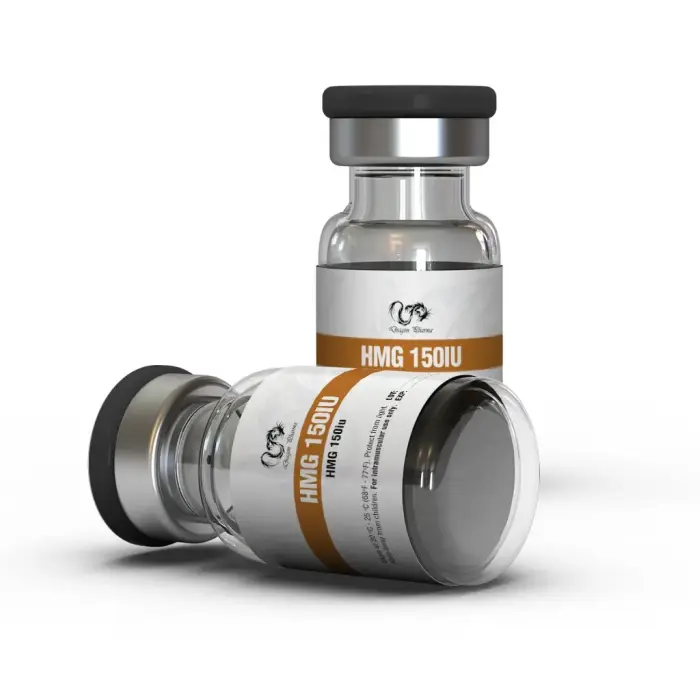
HMG 150IU
HMG 150IU Dragon Pharma — Overview
HMG 150IU Dragon Pharma delivers 150 IU of human menopausal gonadotropin per vial — a preparation containing both follicle-stimulating hormone (FSH) and luteinizing hormone (LH) activity extracted from the urine of postmenopausal women. Where HCG replaces only the LH signal at the Leydig cell, HMG covers both axes of testicular function simultaneously: FSH acts on Sertoli cells to drive spermatogenesis, and the LH component stimulates Leydig cells to maintain intratesticular testosterone. This dual mechanism makes HMG the only injectable gonadotropin available that addresses the full reproductive axis in a single compound.
In male fertility protocols following prolonged AAS use, HCG alone is sufficient to restore testicular volume and Leydig cell function, but it cannot restart spermatogenesis because it provides no FSH activity. HMG fills that gap. Used alongside HCG, it provides the FSH signal that Sertoli cells require to resume and sustain sperm production. HMG does not suppress the HPG axis, does not require PCT, and has no androgenic activity. The 150 IU Dragon Pharma vial is the standard single-dose format available at Steroid Warehouse for athletes and users managing post-cycle fertility restoration.
About the Compound: HMG (Human Menopausal Gonadotropin)
Human menopausal gonadotropin is a urinary-derived preparation that contains both FSH and LH in a roughly 1:1 ratio (approximately 75 IU FSH and 75 IU LH per 150 IU vial, by biological activity). FSH binds FSH receptors on Sertoli cells in the seminiferous tubules and initiates the intracellular signaling cascade that drives spermatocyte proliferation and maturation. LH binds LH/hCG receptors on Leydig cells and stimulates the steroidogenic cascade that produces intratesticular testosterone (ITT) — the high local androgen concentration required inside the testes for Sertoli cell function and sperm maturation. In this way, a single HMG injection simultaneously addresses both cellular endpoints of male gonadal function.
During and after an AAS cycle, the HPG axis is suppressed: LH and FSH fall to near-zero, Leydig cells become quiescent, and Sertoli cell activity declines progressively. The depth of spermatogenic disruption depends on cycle length and compound suppressive potency — on cycles of 12 weeks or longer, especially with 19-nor compounds, spermatogenesis can be severely impaired and may not recover spontaneously within a standard PCT window. HCG restores ITT via the LH-receptor pathway, but FSH suppression remains uncorrected. HMG provides the missing FSH component, completing the gonadotropin signal at the seminiferous tubule level and enabling active spermatogenic recovery rather than passive waiting for endogenous FSH to return through SERM-driven HPG axis re-engagement.
What HMG Does
HMG acts at both testicular cell types simultaneously, making it the only gonadotropin preparation that can address full spermatogenic recovery without relying on endogenous FSH returning through the HPG axis.
- Sertoli cell FSH stimulation — active spermatogenesis — FSH binding the Sertoli cell receptor activates adenylyl cyclase, raises intracellular cAMP, and initiates transcription of proteins required for sperm maturation including androgen-binding protein (ABP), inhibin B, and transferrin; without this FSH signal, spermatogenesis remains functionally arrested even when ITT is restored by HCG
- Leydig cell LH stimulation — intratesticular testosterone — the LH component of HMG acts on the same receptor as HCG and drives the steroidogenic cascade from cholesterol to testosterone; ITT must remain 50–100× higher than peripheral blood testosterone for normal Sertoli cell function, and HMG's LH activity contributes to maintaining this gradient alongside HCG in combined fertility protocols
- Seminiferous tubule restoration — the combination of adequate ITT (from LH/HCG) and direct FSH stimulation recreates the two-signal environment that seminiferous tubules require for complete spermatogenesis; in hypogonadotropic states from prolonged AAS suppression, both signals must be present simultaneously for meaningful sperm production to resume
- Inhibin B secretion — FSH-stimulated Sertoli cells produce inhibin B, a glycoprotein that provides feedback to the pituitary and serves as a clinical marker of Sertoli cell activity; rising inhibin B on HMG therapy is an early indicator that Sertoli cells are re-engaging before sperm counts are measurable
- No HPG axis interference — HMG acts peripherally at the testicular level and does not signal at the hypothalamus or pituitary; it does not suppress, accelerate, or otherwise affect endogenous LH and FSH recovery through the SERM-driven pathway; it can be run concurrently with SERM-based PCT without creating competing signals
Who It's For
HMG 150IU Dragon Pharma is specifically for male athletes and users who have an explicit fertility goal after a suppressive AAS cycle — where restoring sperm production within a defined timeline is the primary objective, not simply recovering testosterone or HPG function. It is not a general PCT compound and is not necessary for most post-cycle protocols where the goal is hormonal recovery alone.
What sets HMG apart from all other available compounds: it is the only preparation that delivers exogenous FSH. No SERM, no AI, no HCG, and no testosterone-based compound provides FSH activity. SERMs drive endogenous FSH recovery through HPG axis stimulation, but this is slow — FSH levels typically take 4–8 weeks post-PCT to normalize — and in users who have run long, deeply suppressive cycles, spontaneous Sertoli cell re-engagement may lag even further. HMG bypasses this delay entirely by providing FSH directly at the Sertoli cell without requiring the HPG axis to recover first.
Ideal use cases:
- Users who have run AAS cycles of 16+ weeks, particularly with 19-nor compounds (nandrolone, trenbolone), where spermatogenic suppression is both deep and prolonged, and where fertility restoration within 3–6 months is a concrete goal
- Couples actively trying to conceive in the 6–12 months following a long suppressive cycle; spontaneous spermatogenesis recovery without HMG can take 6–18+ months after a 19-nor cycle, and HMG significantly compresses that timeline
- Users with confirmed azoospermia or severe oligospermia on post-cycle semen analysis who are not recovering on SERM-based PCT alone; HMG + HCG is the standard two-gonadotropin protocol used to address this
Who should choose HCG alone instead: athletes who want on-cycle testicular maintenance or standard post-cycle hormonal recovery without a fertility goal do not need HMG. HCG 5000IU Dragon Pharma alone is fully adequate for Leydig cell maintenance and testicular volume preservation throughout a cycle and as a pre-PCT blast. Adding HMG to a standard PCT where sperm production is not the objective adds cost and complexity without meaningful benefit to testosterone or HPG recovery speed.
HMG vs Alternatives
| Compound | Key Differences | Choose HMG When | Choose Alternative When |
|---|---|---|---|
| HCG 5000IU Dragon Pharma LH receptor agonist only |
HCG contains only LH activity — stimulates Leydig cells and ITT but provides zero FSH signal to Sertoli cells; adequate for testicular volume maintenance, PCT support, and hormonal recovery; insufficient for spermatogenesis restoration in users with post-cycle azoospermia or severe oligospermia; lower cost per IU than HMG; available in larger multi-dose vials (2,500 and 5,000 IU) | Restoring sperm production is the explicit goal; semen analysis confirms impaired spermatogenesis; cycle was 16+ weeks with 19-nor compounds; FSH-driven Sertoli cell activation is required alongside Leydig cell support | Goal is on-cycle testicular maintenance, pre-PCT blast, or general hormonal recovery post-cycle without a fertility timeline; HCG alone covers Leydig cell function completely and is more cost-effective for non-fertility contexts |
| HCG 2500IU Dragon Pharma LH receptor agonist — single-blast format |
Same compound and mechanism as HCG 5000IU at half the vial volume; sized for single 2,500 IU blast injections on shorter cycles; shares the same fundamental limitation as all HCG formats — no FSH activity; in a combined HMG + HCG fertility protocol, HCG 2500IU is used as the Leydig cell component alongside HMG 3×/week while HMG provides the Sertoli cell FSH stimulation | HMG + HCG combined fertility protocol where HCG blast doses are used alongside HMG 3×/week; FSH component from HMG is essential; short-cycle users with active fertility goals | Standard post-cycle hormonal recovery only; fertility not an active concern; 16-week+ cycle protocols where the 5,000 IU vial offers better cost-efficiency per IU for extended maintenance alongside HMG |
Combinations
| Goal | Stack | Protocol / Timing | Notes |
|---|---|---|---|
| Spermatogenesis restoration — standard two-gonadotropin protocol | HMG 150IU + HCG 5000IU Dragon Pharma | HCG 1,000–2,000 IU SubQ 3×/week + HMG 75–150 IU SubQ 3×/week; administer on the same injection days (e.g. Mon/Wed/Fri); run for 12–24 weeks depending on degree of spermatogenic suppression; assess semen analysis at week 12 and adjust duration. Vial math: HMG at 150 IU 3×/wk = 3 vials/week; 12-week protocol = ~36 vials HMG total | This is the standard two-gonadotropin fertility protocol for post-AAS azoospermia. HCG maintains ITT via the LH pathway; HMG provides the FSH signal that Sertoli cells require to produce sperm. Neither compound alone is sufficient — both signals are required simultaneously. Do not start SERMs during active HMG + HCG gonadotropin phase; add SERMs only after gonadotropin therapy is complete to drive HPG axis recovery. |
| Fertility restoration + HPG axis recovery (sequential) | HMG 150IU + HCG 5000IU Dragon Pharma → Clomid Dragon Pharma + Nolvadex Dragon Pharma | Phase 1 (gonadotropin): HCG 1,500 IU + HMG 150 IU 3×/wk for 12–16 weeks until semen analysis confirms improving sperm count. Phase 2 (SERM): after completing gonadotropin phase, wait 72–96 h post-last HCG injection, then begin Clomid 50 mg + Nolvadex 20 mg/day for 4–6 weeks to drive HPG axis re-engagement and transition to endogenous LH/FSH production | Sequential design allows gonadotropins to restore testicular function and spermatogenesis first, then SERMs to reactivate the HPG axis. Running both simultaneously creates redundant signals and the combination is not synergistic in a SERM + HCG context — HCG blunts SERM-driven HPG recovery. Complete the gonadotropin phase fully before introducing SERMs. |
| E2 management during HMG + HCG fertility protocol | HMG 150IU + HCG + Arimidex Dragon Pharma | Arimidex 0.25–0.5 mg EOD during the gonadotropin phase if E2 rises above 40 pg/mL on bloodwork. Check E2 at week 4; adjust AI dose from that result. Use the minimum effective AI dose — excessive E2 suppression impairs spermatogenesis and Sertoli cell function, as FSH-Sertoli signaling requires some intratesticular estrogen | E2 management during a fertility protocol requires careful calibration. Unlike on-cycle AI use where aggressive E2 suppression is the norm, the target during spermatogenesis restoration is E2 in the normal-to-low-normal male range (20–40 pg/mL) — not near-zero. Over-suppression is counterproductive in this context. |
Side Effects & Management
| Side Effect | Severity | How to Handle It |
|---|---|---|
| Estradiol (E2) elevation | Mild–moderate — from Leydig cell testosterone production → aromatization | HMG's LH component stimulates Leydig cell testosterone production, which aromatizes to E2 — the same mechanism as HCG-driven E2 elevation. In a combined HMG + HCG protocol where both compounds are stimulating Leydig cells, the cumulative E2 load can be significant. Monitor E2 at week 4 of the protocol; if >40 pg/mL, add Arimidex Dragon Pharma 0.25 mg EOD as a starting point. Do not aggressively suppress E2 during fertility protocols — some intratesticular estrogen is required for normal spermatogenesis. |
| Gynecomastia (E2-driven) | Low with appropriate AI use | Elevated E2 from combined HMG + HCG Leydig cell stimulation carries gynecomastia risk, particularly on protocols running 12+ weeks. Proactive E2 monitoring and conservative AI use eliminates most of this risk. If breast tenderness develops, add Nolvadex Dragon Pharma 20 mg/day for direct breast tissue protection while re-evaluating AI dose. Do not combine aggressive AI use with this symptom management — E2 suppression and SERM use together can overshoot into E2 deficiency. |
| Testicular enlargement / scrotal discomfort | Low — expected and generally well-tolerated | FSH-driven Sertoli cell stimulation and LH-driven Leydig cell activation both contribute to testicular volume increase — this is the intended therapeutic effect of HMG in the context of post-cycle atrophy. Mild scrotal discomfort or heaviness is common in the first 2–4 weeks as testicular volume recovers. Not a sign of pathology at standard doses. If acute pain or significant asymmetric swelling develops (not gradual bilateral enlargement), assess for testicular torsion or other mechanical cause. |
| Injection site reaction | Low | SubQ injection with a 29–31 G insulin syringe is standard. At 150 IU per vial reconstituted in 1 mL, the draw volume is 0.5–1 mL depending on the dose — small volumes that are well-tolerated SubQ. Rotate sites between abdomen, lateral thigh, and upper arm across the 3×/week injection schedule. Mild transient bruising or erythema may occur. Store reconstituted vial at 2–8°C; use within 24–48 hours of reconstitution; do not freeze. |
| HPG suppression interaction | None — HMG bypasses HPG | HMG does not signal at the hypothalamus or pituitary. It has no suppressive effect on endogenous LH or FSH and does not worsen or delay HPG axis recovery. Running HMG during a fertility protocol does not create a longer recovery timeline — HPG re-engagement is driven separately by SERM therapy once the gonadotropin phase is complete. HMG and SERMs are used sequentially, not simultaneously, for mechanistic clarity and optimal outcome. |
Bloodwork Monitoring
| Lab | When to Test | Target & Action Threshold |
|---|---|---|
| Semen analysis (sperm count, motility, morphology) | Baseline (post-cycle) → week 12 → week 20–24 | Primary efficacy endpoint. Baseline documents the degree of spermatogenic impairment before therapy starts. Target at week 12: measurable improvement in total motile sperm count. If sperm count remains at zero (azoospermia) at week 12, extend the protocol to week 20–24 before reassessing. WHO normal reference: ≥16 million/mL total count, ≥42% motility, ≥4% normal morphology (Kruger strict criteria). |
| FSH + LH | Baseline → week 4–6 during therapy → 4–6 weeks post-SERM | Both will be suppressed at baseline due to AAS use. On HMG therapy, FSH and LH remain suppressed (HMG acts peripherally — it does not restore HPG function). Post-SERM recovery target: LH >2 IU/L and FSH >1.5 IU/L within 4–6 weeks of completing SERMs. Persistent FSH suppression (<1 IU/L) at 8 weeks post-PCT warrants extended monitoring. |
| Total testosterone | Baseline → week 6 → week 12 → 4–6 weeks post-SERM | During HMG + HCG therapy, testosterone rises from Leydig cell stimulation. Mid-protocol target: testosterone in the normal male range (400–800 ng/dL) — confirms Leydig cell responsiveness. Post-SERM target: ≥70% of pre-cycle baseline or ≥300 ng/dL. Rising testosterone on gonadotropin therapy is a positive signal; supraphysiological testosterone (>1,000 ng/dL) on the protocol suggests HCG dose may need reduction. |
| E2 (Estradiol) | Baseline → week 4 → week 8–12 | Target: 20–40 pg/mL during the gonadotropin phase. Both HMG (LH component) and HCG drive Leydig cell testosterone production that aromatizes; the combined E2 load is higher than either compound alone. If >50 pg/mL at week 4: add Arimidex Dragon Pharma 0.25 mg EOD. Do not suppress E2 below 15 pg/mL — intratesticular estrogen supports normal spermatogenesis. |
| Inhibin B | Baseline → week 8–12 | Inhibin B is secreted by FSH-stimulated Sertoli cells and is the earliest serum marker of Sertoli cell re-engagement — it rises before measurable sperm counts. Target: progressive increase from baseline toward normal range (>80 pg/mL). Rising inhibin B at week 8 in the absence of sperm count improvement indicates Sertoli cells are responding to HMG FSH stimulation and that continued treatment will be productive. Flat or falling inhibin B at week 12 is a signal to reassess the protocol. |
| Blood pressure | Self-monitor weekly | HMG's LH component contributes to testosterone and E2 production, both of which can influence blood pressure — the same indirect mechanism as HCG. Target: <130/85 mmHg. If sustained >140/90 mmHg: Amlip (Amlodipine) or Sartel (Telmisartan). Add Ecosprin (Aspirin) 75 mg/day on protocols exceeding 12 weeks. |
Protocol & Administration
Reconstitution: add 1 mL of bacteriostatic water Dragon Pharma to the HMG vial → final concentration 150 IU/mL. At 150 IU/dose: draw the full 1 mL per injection. At 75 IU/dose: draw 0.5 mL. Inject the water slowly down the inside vial wall; swirl gently until fully dissolved — do not shake. Store reconstituted solution at 2–8°C; use within 24–48 hours. Do not freeze. Discard if cloudy or if particulate matter is present. Because each vial provides only 1–2 doses, reconstitute vials on injection days to minimize storage duration of the reconstituted solution.
Injection: SubQ is the standard route for the volumes used in HMG protocols. Use a 29–31 G × 8–12 mm insulin syringe; pinch skin; inject into the abdomen, lateral thigh, or upper arm. Rotate sites across the 3×/week injection schedule. IM (deltoid or ventroglute) is also acceptable, particularly at the full 1 mL volume. Administer HMG on the same days as HCG injections to ensure both gonadotropin signals reach target cells simultaneously.
| Protocol | HMG Dose | HCG Dose | Frequency | Duration | Notes |
|---|---|---|---|---|---|
| Fertility restoration — standard | 75 IU (0.5 mL) | 1,000–1,500 IU | 3×/week (same days) | 12–16 weeks; extend to 24 weeks if sperm count improving but not yet at target | Starting dose for most users. Semen analysis at week 12 determines whether to continue, adjust dose, or transition to SERM phase. At 75 IU 3×/wk: 1.5 vials/week → ~18–24 vials for a 12–16 week protocol. |
| Fertility restoration — high-dose (severe oligospermia / azoospermia) | 150 IU (1.0 mL) | 1,500–2,000 IU | 3×/week (same days) | 16–24 weeks; assess at week 12 and week 20 with semen analysis | Used when baseline azoospermia is confirmed post-cycle or when the 75 IU protocol shows inadequate inhibin B response at week 8. E2 monitoring is more important at this dose level — check at week 4. At 150 IU 3×/wk: 3 vials/week → ~36–48 vials per 12–16 weeks. Plan procurement before starting; supply gaps mid-protocol disrupt therapy. |
Practical Summary
- HMG only works for fertility — it is not a PCT compound for general hormonal recovery: if the goal is simply testosterone recovery and HPG axis re-engagement after a cycle, HCG + Clomid + Nolvadex covers that completely; HMG is specifically for users where semen analysis has confirmed impaired spermatogenesis and the goal is restored sperm production within a defined window
- Always pair with HCG — HMG alone is insufficient: FSH from HMG stimulates Sertoli cells, but Sertoli cells require adequate intratesticular testosterone (from LH/HCG-stimulated Leydig cells) to function; without HCG providing ITT, HMG's FSH signal operates in a low-testosterone environment that limits spermatogenic output; both gonadotropin signals are required simultaneously
- Plan 3+ vials per week at 150 IU — procurement must be complete before starting: each vial contains one dose at 150 IU; a 12-week protocol at 150 IU 3×/week requires ~36 vials of HMG; interrupting the protocol mid-course due to supply gaps resets Sertoli cell stimulation progress; order the full quantity before beginning therapy
- Do not aggressively suppress E2 during this protocol: unlike AAS cycle AI management where E2 is driven toward low-normal, some intratesticular estrogen is required for normal spermatogenesis; target E2 20–40 pg/mL, not near-zero; Arimidex 0.25 mg EOD is the conservative starting point if E2 rises above 50 pg/mL — not the aggressive doses used on AAS cycles
- Use inhibin B as an early efficacy signal before sperm counts are measurable: rising inhibin B at week 8 confirms Sertoli cells are responding to FSH stimulation even before sperm appears in the ejaculate; flat inhibin B at week 8–12 means either dose needs adjustment or the protocol duration must extend; do not wait for sperm count alone to assess whether treatment is working
- Transition to SERMs only after completing the gonadotropin phase: HCG and SERMs should not run simultaneously — HCG suppresses HPG response to SERM stimulation; complete the full HMG + HCG course first, wait 72–96 hours after the last HCG injection, then begin Clomid Dragon Pharma + Nolvadex Dragon Pharma to drive HPG axis re-engagement
HMG 150IU Dragon Pharma addresses the one gap that no other compound in post-cycle protocols can fill: exogenous FSH for direct Sertoli cell stimulation. For athletes who have run long, suppressive cycles and face delayed spermatogenesis recovery, the two-gonadotropin protocol — HMG alongside HCG — remains the standard of care for restoring sperm production on a defined timeline. Available at Steroid Warehouse alongside the complete Dragon Pharma gonadotropin and cycle-support lineup, HMG provides the FSH component that transforms a Leydig-only recovery into a complete testicular restoration protocol.
References
| Source | Topic | Link |
|---|---|---|
| European Journal of Endocrinology / PubMed | Kliesch et al. 1994 — clinical analysis of gonadotropin or pulsatile GnRH treatment in hypogonadotropic hypogonadal men; supports the effectiveness of hCG/hMG-based gonadotropin therapy for induction of spermatogenesis and fertility in secondary hypogonadism | Kliesch S, et al. (1994) ↗ |
| European Journal of Endocrinology / PubMed | Büchter et al. 1998 — review of 42 cases comparing pulsatile GnRH and hCG/hMG therapy in men with hypogonadotropic hypogonadism; reports induction of spermatogenesis and pregnancy outcomes, supporting hCG/hMG as an effective practical option when GnRH pump therapy is not preferred or available | Büchter D, et al. (1998) ↗ |
| Human Reproduction / PubMed | Burgues & Calderon 1997 — clinical study of subcutaneous self-administration of highly purified FSH plus hCG for male hypogonadotropic hypogonadism; shows that the regimen was well tolerated and effective in stimulating spermatogenesis and steroidogenesis | Burgues S & Calderon MD (1997) ↗ |
| Asian Journal of Andrology / PubMed | McBride & Coward 2016 — review of spermatogenesis recovery following testosterone replacement therapy or anabolic-androgenic steroid use; covers spontaneous recovery timelines, gonadotropin-based strategies, and the role of FSH-containing therapy in post-suppression spermatogenesis restoration | McBride JA & Coward RM (2016) ↗ |
| Frontiers in Endocrinology / PubMed | Oduwole et al. 2021 — comprehensive review of LH, FSH, intratesticular testosterone, and their interplay in spermatogenesis; explains why FSH-Sertoli cell signaling and adequate intratesticular testosterone must work together for normal spermatogenic function | Oduwole OO, et al. (2021) ↗ |
What is HMG 150IU?
HMG 150IU is an injectable hormone for testosterone and fertility recovery; see What is Human Menopausal Gonadotropin. It's key for PCT—consult professionals for safe use.
What is HMG 150IU used for?
It's used for testosterone restoration and fertility in PCT; see Key Benefits. It suits bodybuilders—use with professional oversight.
How does HMG 150IU work?
It stimulates testosterone and sperm production via FSH/LH; see Mechanism of Action. It restores hormones—monitor with labs.
What are the side effects of HMG 150IU?
Side effects include mild estrogenic effects or injection site reactions; see Side Effects. Manage with ancillaries—consult professionals for safety.
How long does HMG 150IU stay in your system?
With a 24-36 hour half-life, it's detectable for ~5-7 days; see Mechanism of Action. Plan PCT—consult professionals.
How long does it take to notice effects from HMG 150 IU?
Hormonal responses can begin relatively quickly, but physiological changes such as improved gonadal activity or spermatogenesis support typically develop gradually over time.
Is HMG 150 IU used with other hormone compounds?
HMG is often discussed in combination contexts with other gonadotropins or hormone-modulating compounds depending on protocol design and desired hormonal outcomes.
What makes HMG 150 IU different from HCG?
HMG provides both LH and FSH activity, while HCG primarily mimics LH. This makes HMG more comprehensive in terms of supporting both testosterone production and spermatogenesis-related pathways.
Related Products
- Accelerates muscle and tendon repair for quick recovery.
- Reduces inflammation systemically and locally.
- Enhances joint and tissue resilience for intense training.
- Supports comprehensive healing for uninterrupted performance.