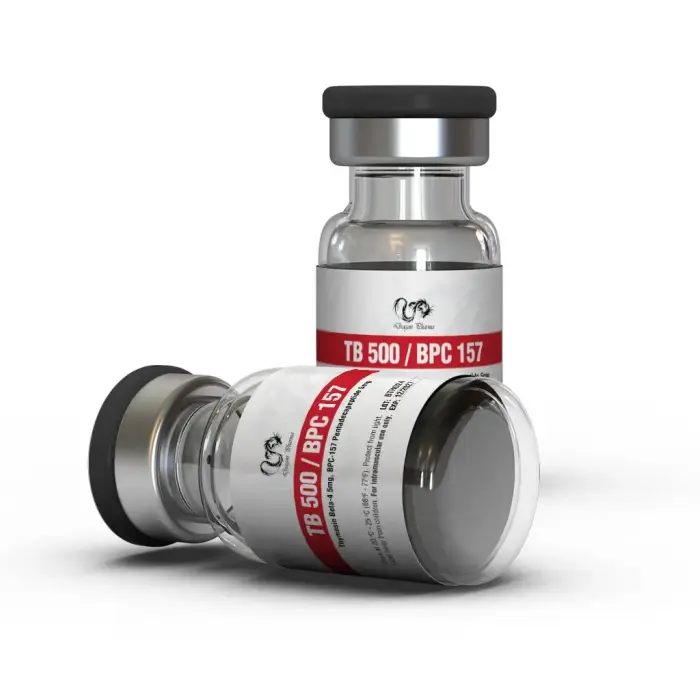
BPC-157 5 mg / TB-500 5 mg (Blend)
- Accelerates muscle and tendon repair for quick recovery.
- Reduces inflammation systemically and locally.
- Enhances joint and tissue resilience for intense training.
- Supports comprehensive healing for uninterrupted performance.
BPC-157 + TB-500 Blend Dragon Pharma — Overview
The BPC-157 + TB-500 Blend Dragon Pharma combines two of the most widely used recovery peptides in a single pre-mixed vial — 5 mg of BPC-157 and 5 mg of TB-500 (Thymosin Beta-4). The two peptides target different but complementary mechanisms in the healing process: BPC-157 works primarily at the injury site by driving new blood vessel formation and structural collagen repair, while TB-500 acts systemically by regulating actin dynamics, promoting cell migration into damaged tissue, and reducing chronic inflammation. Using both together covers more of the recovery cascade than either peptide can address individually.
The blend format is for athletes who already run BPC-157 and TB-500 together and want the convenience of a single vial rather than managing separate reconstitutions and doses. This page covers the mechanism of each compound, the rationale for combining them, how the blend fits into a recovery protocol, and practical reconstitution and dosing information.
About the Compounds: BPC-157 and TB-500
Each component of the blend operates through a distinct mechanism, which is precisely why the combination is more comprehensive than either compound used alone.
BPC-157 (Body Protection Compound 157)
BPC-157 is a synthetic 15-amino acid peptide derived from a protein found in human gastric juice. Its primary recovery mechanism is angiogenic: it promotes the formation of new blood vessels at injury sites. Tendons and ligaments are inherently poorly vascularized, which is a major reason they heal slowly compared to muscle. BPC-157 directly addresses this limitation by driving capillary growth into hypoxic injured tissue, increasing the delivery of oxygen, nutrients, and repair cells. In parallel, it upregulates growth factor receptors, stimulates fibroblast proliferation, and accelerates the organization of new collagen — the structural protein that makes up tendons and ligaments.
BPC-157 also modulates the nitric oxide (NO) system and interacts with the GABAergic and serotonergic pathways, contributing to its documented GI-protective and neuroprotective effects.
TB-500 (Thymosin Beta-4)
TB-500 is a synthetic version of Thymosin Beta-4, a naturally occurring peptide present in high concentrations in wound fluid and platelets. Its core mechanism is the regulation of actin — the structural protein responsible for cell shape and movement. By binding G-actin (the monomeric, inactive form), TB-500 keeps actin available for polymerization, which enables cells to extend and migrate toward injury signals. This cell migration is what allows repair cells — fibroblasts, endothelial cells, muscle progenitors — to reach and populate a damaged site.
TB-500 also downregulates inflammatory cytokines involved in chronic injury states, reduces fibrosis (excessive scar tissue formation), and promotes the differentiation of progenitor cells into functional repair tissue. Its action is systemic: it distributes widely and can address multiple injury sites simultaneously, unlike BPC-157 which has a stronger local effect when injected near the injury.
What the Blend Does
The combination addresses the healing process at more points than either peptide covers individually. BPC-157's local angiogenic and structural actions combined with TB-500's systemic cell-migration and anti-inflammatory effects produce a more complete recovery environment:
- BPC-157 brings blood supply to the injury — new capillary formation in poorly vascularized tissue (tendons, ligament insertions) provides the foundation for everything else; without improved vascular access, other repair processes are limited by nutrient and oxygen delivery
- TB-500 moves repair cells into the injury zone — actin regulation enables the fibroblasts, satellite cells, and endothelial cells that BPC-157 has attracted vasculature for to actually migrate into and populate the damaged tissue; the two mechanisms work in sequence
- Reduced inflammatory stasis — TB-500's anti-inflammatory cytokine downregulation shortens the pro-inflammatory phase that characterizes chronic tendon and joint injuries; BPC-157 adds to this via its NO-mediated anti-inflammatory activity; together they move the tissue from chronic inflammation toward active repair faster
- Collagen organization and tissue remodeling — BPC-157 drives fibroblast activity and collagen synthesis; TB-500 reduces fibrosis and supports proper tissue organization rather than disorganized scar formation; the combination produces more functional repair tissue than either peptide alone in pre-clinical studies
- Broader coverage with one vial — when an athlete has multiple simultaneous injuries or widespread connective tissue stress from heavy training, BPC-157's local action is insufficient to cover all affected sites from a single injection; TB-500's systemic distribution makes the blend more suitable for multi-site or non-localized injury
Dosing in the blend format: the standard loading protocol for TB-500 as a standalone is 5–10 mg/week for 4–6 weeks. Each blend vial contains 5 mg of TB-500, so one vial per week covers the low end of the loading dose. The BPC-157 content (5 mg per vial) provides approximately 10–25 daily doses at 200–500 mcg each, making the vial more efficiently sized for BPC-157 than the 2 mg single product. Splitting the reconstituted vial across 2–3 injections per week aligns the BPC-157 and TB-500 doses naturally without complex separate scheduling.
Who It's For
The blend is specifically useful in scenarios where running both peptides individually is already planned, and where managing two vials adds unnecessary complexity:
- Athletes with acute tendon or ligament injuries — the classic application; when the injury is significant enough that maximum recovery support is warranted, the combined protocol is the practical choice; the blend removes the friction of managing two separate reconstitutions and injection schedules
- Multi-site connective tissue stress — athletes running high-volume or high-intensity AAS cycles who develop stress across multiple joints and connective tissue sites simultaneously; BPC-157 alone would require separate injections at each site; TB-500's systemic action in the blend addresses the full injury landscape from any single injection site
- Post-surgical recovery acceleration — athletes recovering from surgical repair of ligaments or tendons who want to support the remodeling phase; the complementary mechanisms of both peptides are particularly relevant during the organization stage of surgical wound healing
- Off-cycle connective tissue maintenance — athletes who develop joint and tendon accumulation of damage over multiple cycles and use the off period to address it; the blend's anti-fibrotic action from TB-500 alongside BPC-157's structural repair is suited to chronic, multi-site connective tissue work
- Protocol simplicity — athletes who have run BPC-157 and TB-500 separately and want to consolidate to a single vial; the blend is not pharmacologically superior to using both individually — it is a convenience format
Context & Related Products
The individual component products and necessary supplies:
| Product | Relationship to the Blend |
|---|---|
| BPC-157 Dragon Pharma (2 mg) | Single-compound BPC-157 at 2 mg per vial. Appropriate when only BPC-157 is needed — localized injury with a specific target site, or when TB-500 is not part of the protocol. Lower dose per vial means more frequent reconstitutions for a full loading course |
| TB-500 Dragon Pharma (5 mg) | Single-compound TB-500 at 5 mg per vial. For athletes who want TB-500 at independent doses separate from BPC-157, or who are running TB-500 at a higher weekly dose than the blend provides and need to supplement the BPC-157 component separately |
| Bacteriostatic Water Dragon Pharma | Required for reconstituting any lyophilized peptide vial. Add 2 mL per vial for a 5 mg/mL concentration of each component; inject slowly down the side of the vial and swirl — do not shake. Bacteriostatic water preserves the reconstituted solution for 28–30 days refrigerated |
Side Effects & Management
The blend's side effect profile is the sum of the two individual peptides. Both BPC-157 and TB-500 have favorable safety profiles in pre-clinical research, and no additive or synergistic toxicity has been identified in the combination. The practical issues are the same as for either peptide used alone:
| What May Occur | Background | How to Handle It |
|---|---|---|
| Injection site reactions | Localized redness, mild bruising, or soreness at the injection point. More common with repeated injections at the same site. The higher volume of peptide per vial compared to 2 mg BPC-157 alone does not meaningfully change injection site risk | Rotate injection sites. SC injection near the primary injury site is standard practice; for systemic TB-500 distribution, any convenient SC site (abdomen, thigh) is appropriate |
| Transient fatigue or lethargy | Occasionally reported with TB-500, particularly in the first week of loading at higher doses. The mechanism is unclear but may relate to the systemic inflammatory modulation TB-500 produces early in the protocol | Typically self-resolving within the first few days of use. Reducing injection frequency temporarily (once weekly instead of twice) during the first week may reduce this effect |
| Mild nausea | Reported more commonly with BPC-157 at doses above 400 mcg per injection. At the blend's concentration (5 mg each in 2 mL = 2.5 mg/mL per component), a 0.1–0.2 mL injection delivers 250–500 mcg of BPC-157 — within the range where nausea is occasionally noted | Reduce injection volume or split the weekly dose across more injections. Injecting with food or dividing the dose to bid typically resolves it |
| Theoretical angiogenesis concerns | Both BPC-157 and TB-500 promote angiogenesis and cell growth; the same theoretical consideration about use in individuals with undiagnosed malignancies applies to the blend as to either individual component | Same as for BPC-157 standalone: not a practical concern for healthy athletes; relevant only as a flag for individuals with cancer history or active inflammatory disease |
References
| Source | Topic | Link |
|---|---|---|
| PubMed / J Orthop Res | BPC-157 and tendon healing — pre-clinical evidence for Achilles tendon recovery, tendocyte growth, collagen organization, and improved biomechanical healing in transected tendon models | Staresinic et al., 2003 ↗ |
| PubMed / Curr Pharm Des | BPC-157 systemic effects — vascular recruitment, gastrointestinal tract healing, cytoprotection, and broader pre-clinical tissue-repair context | Sikiric et al., 2018 ↗ |
| PubMed / Curr Pharm Des | BPC-157 and nitric oxide system — relationship with NO signaling, vascular response, and tissue-repair mechanisms in pre-clinical models | Sikiric et al., 2014 ↗ |
| PubMed / Ann N Y Acad Sci | Thymosin Beta-4 — actin sequestration, cell migration, angiogenesis, tissue repair, and wound-healing mechanisms | Crockford, 2010 ↗ |
-
First time trying these products and I'm happy with them. Got the BPC-157/TB-500 blend, HCG 5000 IU, and Sema-Pep 5mg from Dragon Pharma. Quality is good, everything works like it should. Guys shipped within 24 hours after payment which was great. Only problem was the carrier took forever to deliver. Not the seller's fault but the wait was annoying. Products are solid though. Would order again.
What does BPC-157 do?
BPC-157 promotes localized tissue repair, reducing inflammation and healing muscles and tendons; see Mechanism of Action. It accelerates recovery—consult professionals for safe use.
How much reconstitution solution for 5 mg BPC-157?
Use 2-3 ml bacteriostatic water for 5 mg BPC-157; see How to Use. Precise reconstitution ensures accurate dosing—consult for proper technique.
What does BPC-157 do for your body?
BPC-157 enhances tissue repair, reduces inflammation, and supports gut health; see Key Benefits. It boosts resilience—use with professional oversight.
How long can you take BPC-157?
Use for 4-8 weeks for acute injuries, up to 12 weeks for chronic issues; see How to Use. Take breaks to avoid tolerance—consult for tailored plans.
Does oral BPC-157 work?
Oral BPC-157 may aid gut health but is less effective for tissue repair than injections; see How to Use. Injections are preferred—consult for administration guidance.
How is BPC-157 different from other recovery peptides?
BPC-157 is often distinguished by its focus on localized tissue repair mechanisms and its origin from a naturally occurring protective gastric protein fragment.
What are the potential benefits of BPC-157?
Commonly discussed benefits include support for tissue repair, reduced inflammation in localized areas, and improved recovery time after physical stress or injury.
How long does it take to notice effects from BPC-157?
The timeline for perceived effects varies widely depending on individual factors and the nature of the injury or condition. Most information comes from anecdotal reports and experimental studies.
Related Products