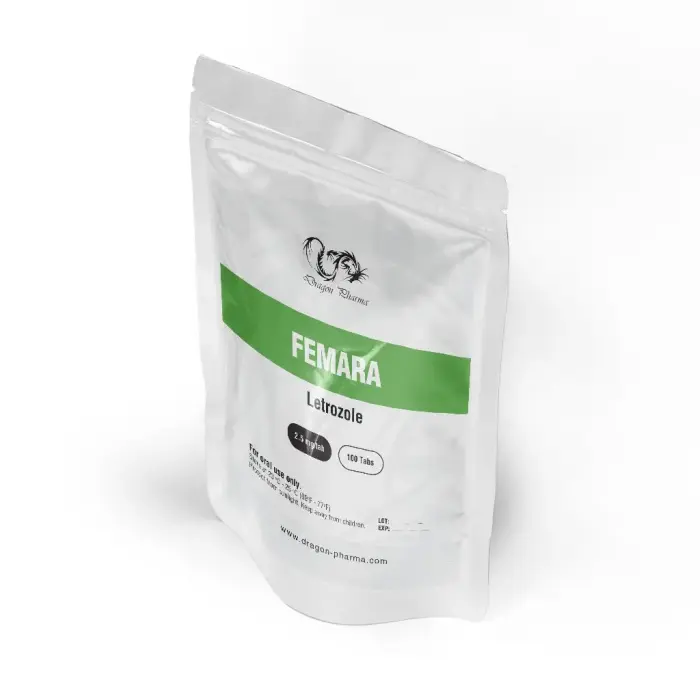
Femara
Femara Dragon Pharma — Overview
Femara is letrozole 2.5 mg/tab from Dragon Pharma — a third-generation non-steroidal aromatase inhibitor used to control estrogen during aromatizing AAS cycles. Among the three primary AIs used in performance contexts (letrozole, anastrozole, exemestane), letrozole provides the most complete aromatase inhibition and is the default choice when moderate AIs fail to bring estradiol into range or when cycle conditions — high-dose testosterone, Dianabol kickstarts, or known high aromatizer stacks — predictably require aggressive E2 management from the start.
This page covers how letrozole works, when to use it instead of other AIs, practical on-cycle protocols, side effect management, bloodwork monitoring, and how to transition off correctly before PCT. Femara is available at Steroid Warehouse as part of the Dragon Pharma cycle support range.
About the Compound: Letrozole
Letrozole is a third-generation non-steroidal aromatase inhibitor that competitively and reversibly binds to the heme group of the CYP19A1 enzyme (aromatase), blocking the conversion of androgens — primarily testosterone and androstenedione — into estradiol (E2). At the standard 2.5 mg/day dose used in oncology, letrozole suppresses circulating estradiol by approximately 97–99%. In AAS cycle contexts, doses of 1.25 mg every other day to 2.5 mg every other day are typically sufficient to manage E2 without driving it to suppressive lows.
Because letrozole is competitive and reversible, estrogen levels rebound when the drug is discontinued — unlike exemestane (Aromasin), which permanently inactivates each aromatase molecule it binds. This means stopping letrozole abruptly on a heavy aromatizing cycle can cause a rapid E2 rebound. The half-life of approximately 45 hours allows for once-daily or every-other-day dosing with stable plasma concentrations by day 3–4 of consistent use.
What Femara Does
Letrozole acts upstream of estrogen — by suppressing aromatase activity, it reduces E2 synthesis rather than blocking estrogen receptors at specific tissues. In practice, athletes and cycle users report the following effects:
- Estradiol suppression — letrozole lowers circulating E2 in a dose-dependent manner; at 1.25 mg EOD most users on moderate testosterone doses see E2 brought into the 20–40 pg/mL target range within 5–7 days of consistent use.
- Water retention reduction — high E2 drives sodium retention and extracellular fluid accumulation; controlling E2 with letrozole removes this driver, resulting in a drier, less bloated appearance on cycle.
- Gynecomastia prevention and rescue — letrozole is the most potent oral AI available for gynecomastia management; at 2.5 mg/day it can reduce early-stage gynecomastia tissue that developed on-cycle, not merely prevent it.
- Blood pressure contribution — E2-driven water retention is one contributor to elevated blood pressure on aromatizing cycles; letrozole addresses this specific component by suppressing E2.
- LH and FSH elevation — by reducing E2 negative feedback on the hypothalamus and pituitary, letrozole can raise LH and FSH — relevant context for off-label hormonal support protocols, though not its primary cycle use.
On E2 and performance: Estradiol is not purely a side effect to eliminate. At appropriate on-cycle levels (20–40 pg/mL), E2 supports joint lubrication, libido, mood, and cardiovascular health. Over-suppression — driving E2 below 15 pg/mL — produces joint pain, fatigue, mood disruption, and lipid deterioration. Letrozole's potency means the gap between effective control and over-suppression is narrower than with Arimidex or Aromasin. Lab-guided dosing is not optional.
Who It Is For
Femara is used by intermediate to advanced AAS users who need reliable, potent estrogen control. It is not the default AI for all cycles — its strength is also its primary risk.
- What differentiates Femara from other AIs: letrozole provides near-complete aromatase inhibition — more thorough than anastrozole (~70–80%) and with a different risk profile than exemestane (irreversible). Its reversibility means E2 recovers after discontinuation, but also means rebound is possible on aromatizing cycles if it is stopped abruptly. Among the three available Dragon Pharma AIs, letrozole is the most aggressive and the least forgiving of dosing errors.
- When Femara is the better choice: cycles running high-dose testosterone (600+ mg/week) or highly aromatizing compounds (Dianabol, Anadrol); situations where Arimidex or Aromasin failed to adequately control E2; active or early-stage gynecomastia requiring aggressive intervention on-cycle.
- When to choose something else: most users on testosterone at 300–500 mg/week are better controlled with Arimidex or Aromasin, which offer more forgiving dosing windows; first-cycle users who have not yet established their individual aromatization pattern should not start with letrozole; users who want irreversible inhibition to prevent rebound on cycle exit should choose Aromasin instead.
Femara vs Alternatives
| Compound | Key Differences | Choose Femara When | Choose Alternative When |
|---|---|---|---|
| Arimidex — Dragon Pharma | Moderate AI, ~70–80% aromatase inhibition; more forgiving dosing; same reversible mechanism | Arimidex failed to control E2 on current cycle; high-aromatization stack from the start | Standard testosterone cycles at 300–500 mg/week where moderate control is sufficient and ease of dosing matters |
| Aromasin — Dragon Pharma | Irreversible (suicidal) AI; permanently inactivates each aromatase molecule; no rebound on discontinuation; steroidal structure with mild anabolic properties | Near-complete inhibition is required and an abrupt E2 rebound on cycle exit is a concern | Irreversibility is a drawback — cannot course-correct if E2 is over-suppressed; rebound risk on cycle exit is acceptable |
When to Use On-Cycle
Femara is a cycle support compound, not an AAS — it does not stack in the traditional sense. The table below shows the cycle contexts where letrozole is the appropriate AI choice and recommended starting protocols:
| Cycle Context | AAS Involved | Femara Protocol |
|---|---|---|
| High-dose testosterone | Enantat 250 600+ mg/week or Cypionat 250 600+ mg/week | 1.25 mg EOD starting week 1; adjust based on E2 labs at week 4. Increase to 2.5 mg EOD only if E2 remains above 50 pg/mL. |
| Dianabol kickstart | Dianabol 20–50 mg/day weeks 1–4 with a long-ester testosterone base | 1.25–2.5 mg EOD during the oral phase; reassess and reduce dose once Dianabol is stopped and aromatization load decreases. |
| Arimidex-resistant E2 | Any aromatizing cycle where Arimidex at standard doses did not control E2 adequately | Switch to Femara 1.25 mg EOD; recheck E2 after 2 weeks before adjusting dose further. |
| Gynecomastia rescue on-cycle | Any aromatizing cycle with active or early gynecomastia symptoms | 2.5 mg/day for 10–14 days; taper to 1.25 mg EOD once symptoms resolve. Confirm E2 suppression with labs before continuing higher dose. |
| Conservative use — moderate testosterone | Testosterone at 300–500 mg/week (any ester) | Consider Arimidex or Aromasin first; use Femara only if bloodwork confirms inadequate E2 control on those options. |
Side Effects and How to Manage Them
Femara's side effect profile is almost entirely driven by one mechanism: excessive E2 suppression. The compound itself is well-tolerated; the risks come from dosing too high relative to the cycle's aromatization load.
| What May Occur | Background | How to Handle It |
|---|---|---|
| E2 over-suppression | Driving E2 below 15 pg/mL causes joint pain, fatigue, mood disruption, and libido loss. Symptoms of low E2 overlap with symptoms of high E2, making lab confirmation essential before adjusting dose. | Reduce Femara dose or switch to Arimidex for easier dose control. Do not add E2 or estrogen supplementation — simply reduce AI dose and recheck in 2 weeks. Always confirm E2 by lab before diagnosing over-suppression. |
| Joint pain and dryness | Estrogen plays a role in collagen synthesis and synovial fluid production; E2 below 15–20 pg/mL often produces noticeable joint discomfort, particularly in shoulders and knees. | Reduce AI dose as first step. Joint support supplements address symptoms but not the cause. The root fix is restoring E2 to the 20–40 pg/mL range. |
| HDL reduction / lipid changes | All aromatase inhibitors suppress HDL to varying degrees by reducing estrogenic effects on lipid metabolism. Letrozole at higher doses has a more pronounced impact than Arimidex. | Run a lipid panel at week 6 on-cycle. If HDL drops >25% from baseline, consider reducing AI dose or adding Atorvastatin 20 mg/day. Omega-3 supplementation (3–4 g/day) supports lipid health. |
| E2 rebound on abrupt discontinuation | Because letrozole is reversible and competitive, stopping it abruptly on a running aromatizing cycle allows aromatase activity — and E2 — to recover rapidly, sometimes overshooting baseline. | Do not stop Femara abruptly mid-cycle. Taper dose over 1–2 weeks before discontinuing, or transition to Aromasin for cycle exit if rebound prevention is a priority. |
| Libido and mood effects | Both high and low E2 disrupt libido and mood. On letrozole, the more common complaint is low-E2-driven libido suppression rather than high-E2 mood instability. | Confirm E2 by lab before attributing libido issues to the AI. If E2 is confirmed low: reduce dose. If E2 is in range and libido remains affected, consider Proviron 50 mg/day for SHBG reduction and libido support. |
Bloodwork Monitoring
| Lab | When to Test | Target & Action Threshold |
|---|---|---|
| Estradiol (E2) | Baseline; week 2–3 after starting Femara; every 4 weeks on-cycle | Target 20–40 pg/mL on-cycle. Below 15 pg/mL: reduce dose immediately. Above 60 pg/mL: increase dose or switch protocol. |
| Total testosterone | Baseline; week 6 on-cycle | Provides context for E2 ratio. Supraphysiologic T on-cycle is expected; used to monitor AI effect relative to AAS load. |
| LH + FSH | Baseline; end of cycle (before PCT start) | Both suppressed on-cycle (expected). End-of-cycle values confirm HPG axis suppression depth and guide PCT intensity. |
| Lipid panel (HDL / LDL) | Baseline; week 6; end of cycle | HDL >40 mg/dL on-cycle. AI use contributes to HDL suppression on top of AAS effect; introduce statin if HDL drops >25% from baseline. |
| Blood pressure | Weekly self-monitoring throughout cycle | Target <130/80 mmHg. If elevated despite E2 control, assess hematocrit and sodium intake as additional contributors. |
| Liver enzymes (ALT / AST) | Baseline; week 6 if using hepatotoxic orals in the stack | Relevant when Femara is combined with Dianabol or other 17-alpha-alkylated orals. ALT/AST <3× upper normal. |
PCT Transition
Femara is not a PCT compound. Letrozole should be stopped — and fully cleared — before starting SERM-based recovery. Continuing an AI into PCT suppresses E2 below the level needed for hypothalamic-pituitary responsiveness to SERM stimulation, reducing the effectiveness of Nolvadex or Clomid.
With a half-life of approximately 45 hours, letrozole clears the system within 4–5 days of the last dose. A practical transition: take the last Femara dose 3 days before starting the SERM. For aromatizing cycles where rebound is a concern, a short Aromasin bridge (12.5 mg EOD for 5–7 days) between the last Femara dose and SERM start prevents sharp E2 rebound while allowing letrozole to clear.
| Product | Role in PCT |
|---|---|
| Nolvadex (Tamoxifen) | Primary SERM for PCT. Blocks estrogen receptors at the hypothalamus and pituitary, driving LH and FSH release. Standard protocol: 40 mg/day weeks 1–2; 20 mg/day weeks 3–4. Start only after Femara has cleared (3+ days after last dose). |
| Clomid (Clomiphene) | Alternative or combined SERM for stronger gonadotropin stimulation on longer or heavier cycles: 50 mg/day weeks 1–2; 25 mg/day weeks 3–4. Same clearing rule applies. |
| Aromasin (Exemestane) | Optional 5–7 day bridge between last Femara dose and SERM start on high-aromatization cycles. Aromasin's irreversibility prevents sharp E2 rebound during Femara washout. Stop Aromasin 2 days before starting SERM. |
| Enclomiphene | Newer alternative to Clomid with a cleaner side-effect profile: 25 mg/day for 4–6 weeks. Suitable for users who experience vision disturbances or mood effects on standard Clomiphene. |
For a full breakdown of PCT protocols, timing, and dosing context, see the PCT guide.
Practical Summary
Key rules for using Femara on-cycle:
- Start with 1.25 mg EOD, not 2.5 mg/day — letrozole's potency makes over-suppression easy at full dose; 1.25 mg EOD controls E2 adequately on most aromatizing cycles; adjust upward only after confirming inadequate E2 control by lab at week 2.
- Always confirm E2 by lab before changing dose — symptoms of high and low E2 overlap significantly; both cause libido issues and mood disruption; dose decisions based on symptoms alone frequently make the situation worse.
- Stop Femara 3 days before starting PCT SERMs — continued E2 suppression during SERM therapy blunts hypothalamic responsiveness and reduces LH/FSH recovery efficiency; Nolvadex and Clomid require E2 in range to drive the HPG axis.
- Monitor HDL every 6 weeks — aromatase inhibition suppresses HDL on top of the AAS effect; letrozole at higher doses produces more pronounced HDL reduction than Arimidex; track lipids and add Atorvastatin if HDL drops significantly.
- Do not combine with Aromasin simultaneously — two AIs in combination produce unpredictable and difficult-to-reverse E2 suppression; choose one AI per cycle and use Aromasin only as a brief transition bridge at cycle exit, not concurrently.
- Rebound risk is real on abrupt stop — because letrozole is reversible, stopping it abruptly on a running aromatizing cycle allows rapid E2 recovery that can overshoot; taper or bridge with Aromasin if stopping mid-cycle.
Femara remains one of the most potent aromatase inhibitors available for on-cycle estrogen management, with a track record in both clinical and performance contexts. Its near-complete aromatase inhibition makes it a reliable option when moderate AIs are insufficient — but that same potency demands precise, lab-guided dosing. For most testosterone-based cycles at 400–600 mg/week, 1.25 mg every other day is an effective starting point; higher doses should be reserved for confirmed high E2 or exceptionally aromatizing stacks. Available at Steroid Warehouse as part of the Dragon Pharma cycle support range.
References
| Source | Relevance | Link |
|---|---|---|
| New England Journal of Medicine / PubMed | Bhasin et al. 1996 — landmark randomized controlled trial on supraphysiologic testosterone exposure and anabolic outcomes; foundational context for aromatizing anabolic steroid cycles where estrogen management may become relevant | Bhasin S, et al. (1996) ↗ |
| NCBI Bookshelf / StatPearls | Anabolic steroids overview — anabolic-androgenic steroid pharmacology, aromatization pathways, endocrine effects, adverse events, and monitoring considerations associated with supraphysiologic androgen exposure | StatPearls: Anabolic Steroids ↗ |
| NCBI Bookshelf / Endotext | Androgen physiology and pharmacology — androgen receptor signaling, testosterone metabolism, estradiol aromatization, HPG axis regulation, and the endocrine context surrounding estrogen control strategies | Endotext: Androgen Physiology, Pharmacology, Use and Misuse ↗ |
| New England Journal of Medicine / PubMed | Finkelstein et al. 2013 — controlled trial demonstrating the independent physiological role of estradiol in male body-fat regulation, sexual function, and body composition; foundational evidence supporting estrogen management rather than complete estrogen suppression | Finkelstein JS, et al. (2013) ↗ |
| NCBI Bookshelf / StatPearls | Aromatase inhibitors overview — aromatase enzyme inhibition, pharmacology, therapeutic applications, adverse effects, monitoring considerations, and clinical characteristics of anastrozole, letrozole, and exemestane | StatPearls: Aromatase Inhibitors ↗ |
What is Femara?
Femara (Letrozole) is an oral aromatase inhibitor for estrogen control in steroid cycles; see What is Letrozole. It prevents bloat—consult professionals for safe use.
How to use Femara?
Take 0.5-2.5 mg EOD or daily during aromatizing cycles; see How to Use. Adjust with bloodwork—consult for tailored plans.
What are the side effects of Femara?
Side effects include joint pain and lipid changes; see Side Effects. Manage with monitoring—consult professionals for safety.
How long does Femara stay in your system?
With a 2-4 day half-life, it's detectable for up to 2 weeks; see Mechanism of Action. Plan cycles accordingly—consult professionals.
What is Femara commonly used for?
Femara is commonly associated with:
- Estrogen management support
- Hormone-related medical treatments
- Aromatase inhibition discussions
- Post-cycle and hormone-balance focused protocols
It is widely discussed in endocrine and performance-focused communities.
Why is Femara popular in bodybuilding discussions?
Users often discuss Femara because it may:
- Help manage estrogen-related water retention
- Support control of gynecomastia-related symptoms
- Complement testosterone and anabolic steroid protocols
It is commonly mentioned in advanced hormone-management routines.
How does Femara work?
Femara works by strongly blocking the aromatase enzyme, which is responsible for converting androgens into estrogen. This leads to a reduction in circulating estrogen levels.
What are the main benefits of Femara?
The main benefits include powerful estrogen suppression, reduced water retention, improved muscle definition, and control of estrogen-related effects in sensitive users.
Related Products