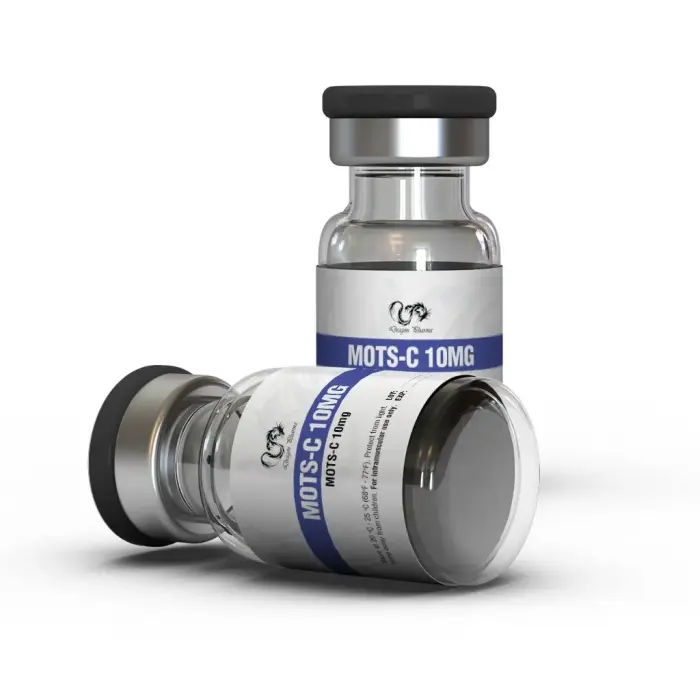
MOTS-c 10mg
MOTS-c 10 mg Dragon Pharma — Overview
MOTS-c 10 mg Dragon Pharma is a lyophilized injectable peptide derived from the mitochondrial genome — specifically encoded within the 12S rRNA gene of mitochondrial DNA. It is a 21-amino-acid mitochondria-derived peptide (MDP) that functions as an endogenous regulator of cellular energy metabolism, activating the AMPK pathway through a mitochondria-to-nucleus signaling cascade. MOTS-c has no androgenic activity, no estrogenic activity, and no effect on the HPG axis. It requires no PCT.
The compound is in a distinct class from SARMs, AAS, or GH secretagogues. Its primary actions center on metabolic regulation: improving insulin sensitivity, supporting fat oxidation, reducing systemic inflammation, and replicating at the cellular level some of the metabolic adaptations triggered by aerobic exercise. Research has also identified MOTS-c as a circulating exercise-induced signal — plasma levels rise with physical exertion — positioning it as a genuine exercise mimetic rather than simply a metabolic drug. This page covers the mitochondrial signaling mechanism, practical metabolic effects, how MOTS-c compares to AICAR and AOD-9604, and combination use with other peptides available at Steroid Warehouse.
About the Compound: MOTS-c
MOTS-c (Mitochondrial Open Reading Frame of the 12S rRNA Type-c) is a 21-amino-acid peptide encoded within the mitochondrial 12S ribosomal RNA gene — an unusual location, as most peptide hormones are encoded in nuclear DNA. Its discovery in 2015 established a new category of signaling molecules: mitochondria-derived peptides (MDPs) that communicate metabolic status from mitochondria to the rest of the cell and to distant tissues via the bloodstream.
The mechanism operates through mitochondrial metabolism. MOTS-c activity leads to accumulation of AICAR (an AMP analog) within mitochondria, which in turn activates AMPK (AMP-activated protein kinase) — the central cellular energy sensor. AMPK activation produces a cascade of metabolic adaptations: increased glucose uptake in skeletal muscle, enhanced fat oxidation, inhibition of anabolic processes that consume ATP without producing energy, reduction of mitochondrial reactive oxygen species, and upregulation of mitochondrial biogenesis. This profile closely mirrors the acute metabolic response to aerobic exercise, which is why MOTS-c is classified as an exercise mimetic alongside compounds like AICAR.
Notably, MOTS-c is not simply a synthetic pharmaceutical — it is an endogenous peptide that rises naturally in human plasma after physical exercise and declines with age. The age-related decline in circulating MOTS-c is proposed as a contributing factor to age-associated insulin resistance, metabolic dysfunction, and reduced exercise capacity. Exogenous MOTS-c supplementation is designed to restore or augment this endogenous signal.
What MOTS-c Does
- AMPK activation and improved insulin sensitivity — AMPK is the master regulator of cellular energy balance; its activation by MOTS-c increases GLUT4 translocation to the cell membrane in skeletal muscle, allowing more efficient glucose uptake without requiring increased insulin secretion; this directly reduces insulin resistance; preclinical data show MOTS-c administration reverses diet-induced insulin resistance in animal models; in practical terms, this means improved nutrient partitioning — ingested carbohydrates are preferentially directed toward muscle glycogen replenishment rather than adipose storage
- Enhanced fat oxidation and body composition support — AMPK activation simultaneously reduces fatty acid synthesis and increases beta-oxidation (fat burning) in mitochondria; this shifts substrate utilization toward fat during both exercise and rest; MOTS-c does not cause acute fat loss in the manner of stimulants or thyroid agents, but over extended use it biases the metabolic machinery toward fat as a fuel source; the effect is more pronounced during physical activity, which is why MOTS-c is most productive when combined with consistent training
- Exercise mimetic and physical performance support — endogenous MOTS-c rises measurably in human plasma during aerobic exercise; exogenous administration replicates some of the metabolic adaptations that exercise training produces at the mitochondrial level, including improvements in mitochondrial efficiency, oxidative capacity, and cellular stress resilience; this makes MOTS-c relevant both as a standalone metabolic compound and as a complement to active training protocols
- Anti-inflammatory and oxidative stress reduction — MOTS-c reduces mitochondrial reactive oxygen species (ROS) production and modulates inflammatory signaling pathways; this anti-inflammatory action is particularly relevant during high-volume training phases, metabolic stress periods, or AAS cycles where systemic inflammation is elevated; the mechanism is distinct from standard anti-inflammatory compounds and operates at the mitochondrial level
- Age-related metabolic support — circulating MOTS-c declines with age in a pattern parallel to the age-related decline in exercise capacity and insulin sensitivity; research positions MOTS-c as one of the mechanisms through which exercise preserves metabolic health across the lifespan; for older users or those with reduced metabolic flexibility, MOTS-c supplementation may restore part of this endogenous signaling loss
Who It's For
- Users targeting insulin sensitivity, nutrient partitioning, and body recomposition — MOTS-c is most directly useful for users who want to improve how their body handles glucose and partitions nutrients: preferring muscle over fat during caloric surplus, improving recovery between training sessions, and supporting fat oxidation during training; this profile makes it relevant for anyone running a body recomposition protocol, managing the metabolic stress of an AAS or SARM cycle, or seeking to counteract the glucose/insulin side effects that can accompany compounds like MK-677
- Users on high-dose AAS cycles where insulin resistance and metabolic stress are elevated — androgenic compounds at supraphysiological doses can impair insulin sensitivity and increase systemic inflammation; MOTS-c's AMPK-activating and insulin-sensitizing effects directly counter these metabolic side effects; adding MOTS-c as a cycle support component addresses a metabolic dimension that most standard cycle support products do not target
- Older or metabolically compromised users seeking exercise-derived metabolic benefits — because MOTS-c is a naturally declining endogenous peptide, its supplementation is particularly rational for users over 40 where the age-related drop in circulating MOTS-c contributes to metabolic stiffening; the exercise mimetic effect is relevant for users who cannot train at high volumes due to injury, age, or recovery constraints but want to preserve the metabolic adaptations that exercise produces
- Users who may not be the right fit for MOTS-c: users seeking acute, visible performance gains on a short 4–6 week cycle will not find those results with MOTS-c; the compound's effects are metabolic and cumulative, not the kind that show up dramatically on a training log within weeks; users primarily focused on muscle mass gain should note that MOTS-c does not directly drive hypertrophy and is better positioned as a metabolic support compound than as a primary anabolic agent
Context & Related Products
MOTS-c occupies a specific niche: mitochondria-driven AMPK activation via the folate-cycle → AICAR → AMPK pathway. Several other peptides and compounds available at Steroid Warehouse address related but distinct metabolic targets.
| Compound | Mechanism | Use MOTS-c When | Use Alternative When |
|---|---|---|---|
| AICAR Dragon Pharma | Direct AMPK activator via AICAR (ZMP); bypasses the mitochondrial pathway that MOTS-c uses upstream; produces similar downstream AMPK activation through a different entry point; more extensively studied in exercise physiology research; higher dose range (50+ mg) | A more physiological AMPK activation pattern via the mitochondria-to-nucleus signaling route is preferred; combining with AICAR for dual-entry-point AMPK stimulation is an option for users targeting maximal AMPK activation; MOTS-c also carries the additional anti-inflammatory and ROS-reducing properties of the mitochondrial MDP pathway | Direct, immediate AMPK activation with well-documented exercise-mimetic effects is the primary goal; user is familiar with AICAR protocols and prefers the directly studied exercise mimetic option |
| AOD-9604 Dragon Pharma | GH fragment (hGH 176–191) targeting fat cell lipolysis specifically; activates beta-3 adrenergic receptors in adipose tissue; does not activate AMPK; does not improve insulin sensitivity; effects are focused narrowly on fat breakdown in adipose tissue rather than metabolic reprogramming at the mitochondrial level | Metabolic reprogramming, insulin sensitivity improvement, and exercise-mimetic effects are the goals; stacking with AOD-9604 is complementary — both target fat reduction via different mechanisms (MOTS-c: mitochondrial metabolic shift; AOD-9604: adipose lipolysis) | The primary goal is direct adipose lipolysis with the specificity of the hGH 176–191 fragment; the user wants a targeted fat-burning peptide without the full metabolic reprogramming profile |
| BPC-157 Dragon Pharma | Body protection compound; primarily acts on tissue repair, angiogenesis, tendon and ligament healing, and GI protection; operates through growth factor signaling and nitric oxide modulation; different target system from MOTS-c's mitochondrial/metabolic axis; the two compounds are highly complementary in recovery-focused stacks | The primary focus is metabolic health, insulin sensitivity, or body recomposition; for an AAS cycle where both metabolic support and tissue repair are desired, stacking MOTS-c + BPC-157 covers both axes without overlap | Tissue repair, tendon healing, joint protection, or GI protection is the primary concern; BPC-157 is the more direct tool for structural and connective tissue recovery goals |
Combination protocols:
| Goal | Stack | Notes |
|---|---|---|
| Metabolic health & insulin sensitivity (solo) | MOTS-c 5–10 mg, 3× per week · subcutaneous | Standalone metabolic support; most appropriate for users focused on nutrient partitioning, reducing insulin resistance, or managing metabolic consequences of AAS use; consistent aerobic training amplifies MOTS-c's AMPK effects significantly; minimum 8-week run for meaningful adaptation |
| Fat loss + fat cell lipolysis (dual-mechanism) | MOTS-c 5 mg 3× per week + AOD-9604 300 mcg/day | MOTS-c addresses fat oxidation via mitochondrial AMPK activation; AOD-9604 directly targets adipose lipolysis via beta-3 adrenergic stimulation; mechanisms are non-overlapping and additive; both peptides are subcutaneous and can be injected in the same session; AOD-9604 daily, MOTS-c 3× per week |
| Full recovery stack (metabolic + structural) | MOTS-c 5–10 mg 3× per week + BPC-157 250–500 mcg/day | MOTS-c covers mitochondrial and metabolic recovery; BPC-157 covers tissue, tendon, and GI repair; no mechanism overlap; ideal for users in high-volume training phases or during AAS cycles where both metabolic stress and structural wear are elevated |
| AAS cycle metabolic support | MOTS-c 5–10 mg 3× per week added to any AAS cycle | Directly counters the insulin resistance and inflammatory burden that supraphysiological AAS doses impose; no pharmacological conflict with any AAS compound; MOTS-c continues through PCT without any interaction with SERMs; addresses a metabolic support angle that standard cycle support products do not cover |
| MK-677 glucose management | MOTS-c 5 mg 3× per week alongside MK-677 25 mg/day | MK-677 at 25 mg/day produces measurable insulin resistance as a class effect of GH elevation; MOTS-c's AMPK-activating insulin-sensitizing action directly counters this; the combination preserves the GH/IGF-1 benefits of MK-677 while partially offsetting its metabolic glucose burden; monitor fasting glucose at 8-week intervals when using this stack |
Side Effects & Management
| What May Occur | Background | How to Handle It |
|---|---|---|
| Injection site reactions | Standard peptide injection response: mild redness, brief tenderness, or small localized nodule at the subcutaneous injection site; typically resolves within 24 hours; most common in the first 1–2 weeks before injection technique is established | Rotate injection sites systematically (abdomen, lateral thigh, upper arm); use a fresh needle for each injection; inject slowly and ensure the peptide is fully reconstituted and at room temperature before injection; persistent or worsening site reactions are typically technique-related rather than compound-related |
| Transient fatigue (early adaptation) | Some users report mild fatigue in the first 1–2 weeks attributed to the metabolic shift initiated by AMPK activation — the transition toward increased fat oxidation and mitochondrial remodeling can transiently reduce high-intensity exercise capacity before adaptation is complete; this mirrors the early fatigue some users experience when starting aerobic training after a sedentary period | Reduce injection frequency to twice per week for the first 2 weeks if fatigue is notable, then increase to 3× per week; ensure adequate caloric intake, as AMPK activation increases energy demand; the adaptation phase typically resolves within 2–3 weeks and is followed by improved baseline energy |
| Mild hypoglycemia risk (during fasted training) | MOTS-c improves insulin sensitivity and increases glucose uptake in skeletal muscle; in users combining MOTS-c with fasted morning training or caloric restriction, this enhanced glucose uptake could contribute to low blood sugar symptoms (lightheadedness, shakiness) particularly during prolonged exercise; the risk is low in normally-fed users but relevant in aggressive cutting protocols | Avoid injecting MOTS-c immediately before fasted training sessions; on training days, inject post-workout or at a meal; maintain adequate pre-workout carbohydrate intake during MOTS-c use; if fasted training is preferred, time the MOTS-c injection in the evening on non-training days or post-workout on training days |
| No established hormonal or organ-specific toxicity | MOTS-c is an endogenous human peptide encoded in mitochondrial DNA; it has no androgenic, estrogenic, or progestogenic activity; it is not hepatotoxic, has no known renal burden, and does not interact with the HPTA; the short peptide structure means it is rapidly metabolized by peptidases and does not accumulate; the current research base does not identify significant systemic toxicity concerns | No specific organ protection is required for MOTS-c use alone; standard injection hygiene and site rotation cover the primary practical risks; no cycle-support compounds are required specifically for MOTS-c; bloodwork monitoring of fasting glucose is prudent when combining with MK-677 or high-dose AAS |
References
| Source | Topic | Link |
|---|---|---|
| Cell Metabolism / PubMed | Lee et al. 2015 — original discovery paper identifying MOTS-c as a mitochondria-derived peptide; shows that MOTS-c promotes metabolic homeostasis, improves insulin sensitivity, reduces diet-induced obesity, and regulates skeletal muscle metabolism through AMPK-linked pathways | Lee C, et al. (2015) ↗ |
| Nature Communications / PubMed | Reynolds et al. 2021 — demonstrates that MOTS-c is an exercise-induced mitochondrial-encoded peptide; shows increased MOTS-c expression in human skeletal muscle and circulation after exercise, improved physical performance in mice, and relevance to age-dependent physical decline and muscle homeostasis | Reynolds JC, et al. (2021) ↗ |
| Cell Metabolism / PubMed | Kim et al. 2018 — reports that MOTS-c translocates to the nucleus in response to metabolic stress and regulates adaptive nuclear gene expression; expands the mechanism beyond AMPK activation toward mitochondrial-to-nuclear stress signaling | Kim KH, et al. (2018) ↗ |
| Aging / PubMed | D'Souza et al. 2020 — human aging study showing that circulating MOTS-c decreases with age while skeletal muscle MOTS-c expression is higher in middle-aged and older men; links MOTS-c expression with myofiber composition and age-related muscle physiology | D'Souza RF, et al. (2020) ↗ |
| Aging / PubMed | Zempo et al. 2021 — study of the m.1382A>C mitochondrial DNA polymorphism in the MOTS-c coding region; describes the K14Q MOTS-c variant, altered metabolic effects, and association with type 2 diabetes susceptibility and visceral fat in men | Zempo H, et al. (2021) ↗ |
| Free Radical Biology and Medicine / PubMed | Lee et al. 2016 — focused review of MOTS-c as a mitochondrial-derived peptide regulating muscle and fat metabolism; summarizes skeletal muscle glucose metabolism, obesity, diabetes, exercise physiology, and aging relevance | Lee C, et al. (2016) ↗ |
What is MOTS-c?
MOTS-c is a mitochondria-derived peptide made of 16 amino acids. It is naturally produced in the body and helps regulate how cells use energy.
What is MOTS-c commonly used for?
MOTS-c is mainly used in research and performance circles for:
- Improving metabolism
- Supporting fat burning
- Enhancing endurance and energy
How does MOTS-c work in the body?
MOTS-c activates AMPK (AMP-activated protein kinase), which is like a "metabolic switch."
This helps:
- Increase fat oxidation
- Improve glucose uptake
- Enhance cellular energy production
How is MOTS-c 10 mg typically used?
In research settings, MOTS-c is usually:
- Supplied as a lyophilized (freeze-dried) powder
- Reconstituted with bacteriostatic water
- Used in cycles (often several weeks)
When can results be noticed?
Users and studies suggest effects may include:
- Better energy levels
- Improved endurance
- Changes in metabolism
Some notice changes within a few weeks, but results depend on diet, activity, and consistency. Research is still ongoing, and human data is limited.
How long does it take to notice effects from MOTS-c?
Individual responses vary, but discussions around MOTS-c often focus on gradual improvements in energy utilization, endurance, and metabolic efficiency over time.
Is MOTS-c used for fat loss or performance?
MOTS-c is often associated with both areas, as research suggests it may support metabolic flexibility, endurance, and healthy energy expenditure.
What makes MOTS-c different from other peptides?
MOTS-c is unique because it originates from mitochondrial DNA and primarily targets metabolic and cellular energy pathways rather than growth hormone or muscle-building mechanisms.
Related Products
- Accelerates muscle and tendon repair for quick recovery.
- Reduces inflammation systemically and locally.
- Enhances joint and tissue resilience for intense training.
- Supports comprehensive healing for uninterrupted performance.