Epitalon
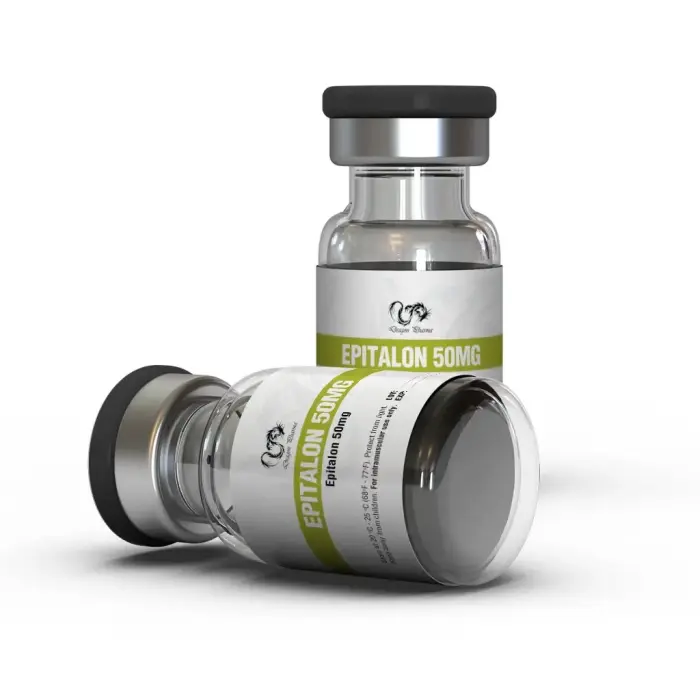
Epitalon Dragon Pharma 50 mg — Overview
Epitalon Dragon Pharma is a synthetic tetrapeptide with the amino acid sequence Ala-Glu-Asp-Gly — a four-residue peptide originally derived from Epithalamin, a polypeptide extract of the bovine pineal gland, by Professor Vladimir Khavinson and colleagues at the St. Petersburg Institute of Bioregulation and Gerontology. It is classified as a peptide bioregulator: a short peptide that interacts with gene regulatory regions and modulates specific tissue functions rather than binding a classical receptor like a hormone or growth factor. Epitalon is not an anabolic-androgenic steroid, does not aromatize, does not suppress the HPTA, and requires no post-cycle therapy.
The 50 mg vial supports one full standard course (10 mg/day for 5 days, or 5 mg/day for 10 days) or a portion of an extended protocol. This page covers the mechanism and research base behind Epitalon, what to expect during a course, practical combination options with other Dragon Pharma peptides, and how to stop and cycle it.
About the Compound: Epitalon (Ala-Glu-Asp-Gly)
Epitalon is a synthetic version of the active tetrapeptide fragment identified within Epithalamin — a natural pineal gland extract studied extensively by the Khavinson group from the 1970s onward. The four amino acids — alanine, glutamic acid, aspartic acid, glycine — represent the minimal bioactive sequence responsible for the effects observed with the full pineal extract. As a synthetic tetrapeptide it is more chemically defined, more stable, and more reproducible than the natural extract.
The primary documented molecular mechanism is the activation of telomerase — the enzyme responsible for adding TTAGGG repeat sequences to the ends of chromosomes (telomeres). Telomeres shorten with each cell division; telomere attrition is one of the accepted hallmarks of cellular aging and is associated with reduced replicative capacity, increased senescence, and higher disease risk. Telomerase activity in somatic cells is very low under normal conditions; Epitalon appears to upregulate this activity, resulting in measurable telomere elongation in human cell cultures. The secondary documented mechanism is normalization of pineal gland function: Epitalon is consistently reported to restore melatonin secretion patterns toward a younger circadian profile in aged animal models, improving circadian rhythm regulation and sleep architecture.
What Epitalon Does
The body of research on Epitalon comes predominantly from the Khavinson group and collaborating Russian institutes, supplemented by telomere biology research from independent laboratories. The main documented effects are:
- Telomerase activation and telomere elongation — Epitalon has been shown to induce telomerase activity in human somatic cells in vitro, resulting in measurable elongation of shortened telomeres; this is the most commonly cited and reproduced effect; longer telomeres correlate with greater replicative capacity, reduced cellular senescence, and lower all-cause mortality risk in large epidemiological studies; this effect is the primary rationale for Epitalon use in longevity protocols.
- Melatonin normalization and circadian restoration — Epitalon reliably restores melatonin secretion patterns toward a younger amplitude profile in aged rodent models; melatonin production declines with age, contributing to disrupted sleep architecture, impaired antioxidant defense, and dysregulated immune function; Epitalon's ability to restore pineal function addresses this downstream; users frequently report improved sleep depth and circadian rhythm stability during and after courses.
- Antioxidant activity — Epitalon reduces markers of lipid peroxidation and oxidative damage in animal studies; this is attributed partly to the melatonin normalization (melatonin is a potent antioxidant) and partly to direct peptide-mediated gene regulation effects; reduced oxidative stress burden contributes to slower accumulation of cellular damage.
- Immune modulation — Epithalamin and its synthetic analog Epitalon have been shown in animal studies to partially restore age-related decline in immune function, including thymus-dependent immune responses; the mechanism involves both direct peptide activity and indirect effects via the pineal-immune axis; no clinical immunosuppression or dysregulation has been reported at standard doses.
- Tumor incidence reduction in animal models — multiple rodent studies from the Khavinson/Anisimov group have shown lower spontaneous tumor incidence and longer survival in animals receiving Epithalamin or Epitalon versus controls; the most consistent finding is in mammary gland tumors in female rodents; this data is animal-only and does not establish cancer prevention in humans, but it provides the theoretical basis for inclusion of Epitalon in longevity and health-extension protocols.
- Possible life extension in model organisms — Epitalon has produced significant lifespan extension in Drosophila melanogaster and increases in maximum lifespan in rodent studies; these findings are consistent across multiple model organisms, which is considered meaningful in aging research, though the translation to human longevity remains theoretical at this stage.
On realistic expectations from a course: Epitalon is not an acutely performance-enhancing compound — unlike AAS or peptide secretagogues, it produces no immediate measurable effect on body composition or physical performance. Its value is as a cellular-level maintenance tool: improving sleep quality (typically within one course), supporting the conditions for healthy cell division, and contributing to the broader longevity stack over repeated cycles across years. Users evaluating it by acute performance markers are measuring the wrong outcome.
Who It Is For
Epitalon is among the few compounds on this site relevant to users at every experience level, including those who have never run AAS. Its mechanism is entirely separate from the androgen or growth hormone pathways; it does not require cycle support, PCT, or any knowledge of estrogen management. The primary user profiles are:
- Athletes and individuals aged 35 and above who are managing the long-term cost of high-intensity training on cellular health — telomere attrition accelerates with high training volumes and oxidative stress; Epitalon is used as a periodic maintenance tool to offset this
- Users running GH-based protocols (Dragontropin) who want to complement the body composition axis with a telomere-level intervention — GH and IGF-1 improve body composition but do not directly address telomere biology; Epitalon addresses a separate longevity pathway
- Individuals primarily focused on healthspan and longevity rather than performance who want a research-backed, non-hormonal tool alongside NAD+ precursors, mitochondrial peptides (MOTS-c), and other aging-biology interventions
- Users experiencing significant age-related sleep deterioration or disrupted circadian rhythm — Epitalon's pineal normalization effect and the associated melatonin restoration produce consistent subjective improvement in sleep depth within one or two courses; this effect is reported across a wide age range
- Anyone already running a multi-peptide protocol who wants to add the telomere/pineal component — Epitalon has no interactions with other peptides and adds a distinct mechanism to any stack
Recommended Combinations
Epitalon stacks naturally with other Dragon Pharma longevity and regenerative peptides. Below are the most clinically coherent combinations, each targeting a distinct but complementary biological axis:
| Goal | Stack | Notes |
|---|---|---|
| Core longevity protocol | Epitalon + MOTS-c Dragon Pharma + NAD+ 500 mg Dragon Pharma | Three distinct aging pathways addressed simultaneously: Epitalon targets the telomere/telomerase and pineal axes; MOTS-c activates AMPK and mitochondrial biogenesis (the MOTS-c peptide from mitochondrial DNA is a key regulator of metabolic homeostasis in aging); NAD+ replenishment supports sirtuin activity, DNA repair, and overall cellular energy metabolism; all three are run concurrently — Epitalon SubQ daily for 10–20 days, MOTS-c 2–3× weekly throughout, NAD+ as directed; this is the most commonly discussed comprehensive longevity stack in the peptide community |
| Sleep + circadian restoration | Epitalon + DSIP Dragon Pharma | DSIP (Delta Sleep Inducing Peptide) is a neuropeptide that promotes slow-wave sleep and modulates stress responsiveness; combined with Epitalon's pineal normalization effect, this stack addresses both the upstream melatonin production deficit and the downstream sleep architecture disruption; the combination is particularly relevant for users experiencing age-related sleep deterioration, post-AAS cycle sleep disruption, or shift-work circadian disruption; both are administered SubQ — Epitalon daily, DSIP 30–60 minutes before sleep during the course |
| Cellular anti-aging (epigenetic) | Epitalon + GHK-Cu 50 mg Dragon Pharma | GHK-Cu (copper tripeptide Gly-His-Lys) is among the most extensively studied anti-aging peptides; it modulates expression of more than 4,000 genes, promotes wound healing and collagen synthesis, stimulates nerve growth, and has antioxidant activity; the combination of Epitalon (telomere/pineal axis) and GHK-Cu (epigenetic gene expression modulation + connective tissue remodeling) addresses aging from two mechanistically independent angles; GHK-Cu is given SubQ or IM concurrently with Epitalon courses; particularly relevant for users concerned with skin quality, connective tissue integrity, and neurological aging markers |
| GH axis + longevity | Epitalon + CJC-1295 / Ipamorelin Dragon Pharma | CJC-1295 (a GHRH analog) combined with Ipamorelin (a GH secretagogue) produces sustained pulsatile GH release that mimics and amplifies the natural nocturnal GH pulse; this combination improves body composition, sleep quality, and recovery; adding Epitalon to a CJC-1295/Ipamorelin protocol addresses the telomere axis not covered by GH secretagogues — the GH/IGF-1 pathway improves body composition while Epitalon operates on cellular aging mechanisms independently; Epitalon at standard course dosing; CJC-1295/Ipamorelin SubQ before sleep nightly; the combination is commonly used by athletes 35+ in longevity-focused performance protocols |
| Regeneration + longevity | Epitalon + BPC-157 / TB-500 Dragon Pharma | BPC-157 is a gastroprotective pentadecapeptide with systemic healing effects on tendons, ligaments, gut lining, and neural tissue; TB-500 (Thymosin Beta-4) promotes actin polymerization, cell migration, and tissue repair; the BPC-157 + TB-500 blend provides a broad systemic healing and repair signal while Epitalon addresses the upstream cellular aging component; the combination is used in extended recovery protocols where both acute tissue repair and long-term cellular maintenance are goals; no interaction or scheduling conflicts between these peptides |
Side Effects & Management
Epitalon has one of the most favorable tolerability profiles of any injectable peptide in common use. At standard doses (5–10 mg/day) across the research literature and reported clinical use, no significant adverse effects have been documented. The following are the only considerations worth noting:
| What May Occur | Background | How to Handle It |
|---|---|---|
| Injection site reactions (mild) | As with any lyophilized peptide reconstituted with bacteriostatic water and administered SubQ, minor redness, mild swelling, or transient itching at the injection site can occur; this is caused by the injection itself and the bacteriostatic water carrier, not the peptide's pharmacological activity; reactions are typically self-limiting within 1–2 hours and leave no residual effect; they are more common in the first few injections before the body adapts to the injection sites | Rotate injection sites — abdomen quadrants, outer thigh, alternating sides; inject bacteriostatic water slowly (over 30–45 seconds); ensure the vial is fully reconstituted before drawing to avoid undissolved peptide; use a thin-gauge needle (29–31G); allow the reconstituted solution to reach room temperature before injection if refrigerated; persistent nodules or significant swelling that does not resolve within 24 hours warrants attention to injection sterility technique |
| Vivid dreaming or altered sleep patterns (initial) | Epitalon's effect on pineal function and melatonin normalization can produce noticeably altered dream content or sleep depth during the first course, particularly in users who have had long-standing melatonin deficiency or disrupted circadian rhythm; this is a functional consequence of pineal normalization rather than an adverse effect; most users report this as a positive change in sleep quality; a minority find the initial vivid dreaming disruptive until the circadian rhythm stabilizes | No intervention is required; the effect typically stabilizes within 3–5 days of beginning the course; if sleep is significantly disrupted, shift the injection to morning rather than evening — Epitalon's mechanism of action does not require evening administration; the melatonin normalization effect occurs regardless of injection timing |
| Theoretical oncological consideration | Telomerase activation is a mechanism used by cancer cells to achieve replicative immortality; the theoretical concern with exogenous telomerase activation is that it could support growth of pre-existing microscopic malignant cells; this is a valid scientific question raised in the research literature; however, in the animal studies from the Khavinson/Anisimov group, Epitalon has consistently reduced rather than increased tumor incidence — the anti-aging and antioxidant effects appear to outweigh the theoretical pro-growth concern in the models tested; the question remains unresolved in human long-term data | Individuals with a known or suspected active malignancy should not use Epitalon without specific guidance; in healthy individuals with no known cancer risk factors, the available evidence does not suggest meaningful oncological risk at standard course doses; the most prudent approach is to use Epitalon in the course-based protocol (10–20 days, then pause) rather than continuously, consistent with how it has been studied and used clinically in the Russian bioregulator research tradition |
Stopping & Course Planning
Epitalon is a course-based compound, not a continuous-use product. It does not suppress the HPTA, does not produce physical dependence, and does not require tapering or PCT. Stopping is straightforward — when the planned course duration ends, injections stop. There is no rebound, no withdrawal, and no hormonal recovery period required.
| Phase | Protocol |
|---|---|
| Standard course (50 mg kit) | 5 mg/day for 10 days — the 50 mg vial covers one full 10-day course at this dose; reconstitute the entire vial at the start of the course and store refrigerated (2–8°C); draw 5 mg per day until the vial is empty; alternatively, 10 mg/day for 5 days uses the full kit in a shorter, higher-dose course; the 10-day protocol is more commonly referenced in the Khavinson literature |
| Extended course | 10 mg/day for 10 days (100 mg total — requires two 50 mg vials) is used in some protocols targeting more pronounced telomere effects; the 10 mg/day dose for 10 days is the format used in several of the more frequently cited Khavinson human study protocols; standard once-daily SubQ injection |
| Course frequency | 2–4 courses per year is the typical recommendation, with a minimum gap of 3–4 months between courses; this spacing is based on the biological rationale that telomere effects accumulate over time and that continuous administration is unlikely to provide benefit beyond the course-based approach; users in intensive longevity protocols sometimes run 3 courses in the first year (spacing them approximately 4 months apart) and then 1–2 courses per year thereafter as maintenance |
| When running alongside AAS or HGH | Epitalon has no pharmacological interaction with AAS, HGH, or other peptides; it can be run during an AAS cycle, during PCT, or in the off-cycle period without restriction; the telomere biology rationale actually suggests running a course during periods of high oxidative stress (intense training phases or blast cycles) when telomere attrition is potentially greatest; no timing adjustment to AI, SERM, or HGH protocols is needed when adding Epitalon |
References
| Source | Topic | Link |
|---|---|---|
| PubMed / Bulletin of Experimental Biology and Medicine | Epithalon-induced telomerase activity and telomere elongation in human somatic cells — primary in vitro study from the Khavinson group showing that the Ala-Glu-Asp-Gly tetrapeptide activates telomerase and produces measurable telomere elongation in human somatic cell cultures | Khavinson et al., 2003 ↗ |
| PubMed / Science | Human telomere biology and aging — comprehensive review of telomere shortening, telomerase biology, cellular senescence, age-related disease risk, and environmental determinants of telomere attrition | Blackburn, Epel & Lin, 2015 ↗ |
| NCBI Bookshelf / Endotext | Pineal gland and melatonin physiology — pineal melatonin synthesis, light-dark circadian regulation, suprachiasmatic nucleus signaling, nocturnal melatonin secretion, and physiological roles of the pineal-melatonin axis | Endotext: Physiology of the Pineal Gland and Melatonin ↗ |
What is Epitalon?
Epitalon is a peptide that activates telomerase for cellular longevity; see What is Epitalon. It promotes anti-aging—consult professionals for safe use.
What is Epitalon used for?
Epitalon is used for anti-aging and cellular health; see Key Benefits. It suits wellness enthusiasts—use with professional oversight.
How long does Epitalon stay in your system?
With a short half-life, it's detectable for hours; see Mechanism of Action. Effects are cumulative—consult professionals.
Is Epitalon dangerous?
It's safe with proper use; see Side Effects. Risks are minimal—consult professionals for safety.
How to use Epitalon?
Inject 5-10 mg daily for 10-20 days; see How to Use. Use with sterile technique—consult for tailored plans.
How does Epitalon work?
Epitalon is believed to influence biological processes related to cellular aging and telomere activity. Research suggests it may interact with mechanisms involved in cell maintenance and regeneration.
How long does it take to notice the effects of Epitalon?
The effects associated with Epitalon are generally considered gradual. Discussions around the peptide often focus on long-term wellness and recovery rather than immediate noticeable changes.
What are the main benefits of Epitalon?
Commonly discussed benefits include support for healthy aging, improved sleep quality, enhanced recovery, cellular health support, and overall well-being.
Related Products
- Accelerates muscle and tendon repair for quick recovery.
- Reduces inflammation systemically and locally.
- Enhances joint and tissue resilience for intense training.
- Supports comprehensive healing for uninterrupted performance.