Cagrilintide
Cagrilintide Dragon Pharma — Overview
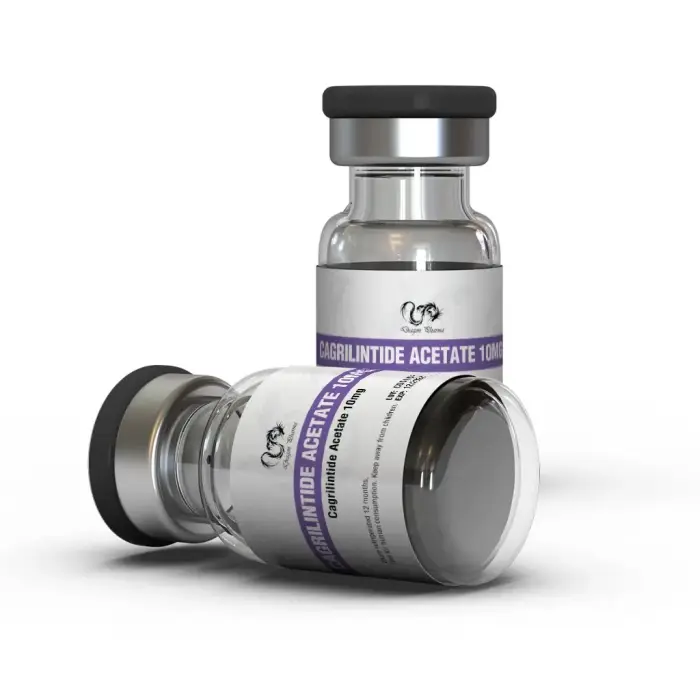
Cagrilintide Dragon Pharma is a long-acting synthetic amylin analogue designed for once-weekly subcutaneous injection. It targets the amylin/calcitonin receptor system in the hypothalamus and brainstem — a distinct signaling pathway from GLP-1 receptor agonists — to reduce appetite, slow gastric emptying, and decrease caloric intake. Because it operates through a different receptor class than GLP-1 agents such as tirzepatide, it can produce additive effects when combined with them.
Each Dragon Pharma vial contains 10 mg of lyophilized cagrilintide. This page covers the amylin system and how cagrilintide engages it, the compound's documented effects on appetite and body weight, its positioning alongside GLP-1 class peptides, and the slow-titration protocol required to manage gastrointestinal tolerability.
About the Compound: Cagrilintide
Amylin (islet amyloid polypeptide, IAPP) is a peptide hormone co-secreted with insulin by pancreatic beta cells in response to meals. It acts on amylin receptors — heterodimers of the calcitonin receptor paired with receptor activity-modifying proteins (RAMPs 1, 2, or 3) — in the area postrema, hypothalamus, and nucleus tractus solitarius. These are brainstem and hypothalamic regions that integrate satiety signaling and regulate feeding behavior. Amylin's natural effects include suppression of appetite, reduction of glucagon secretion, and slowing of gastric emptying. Native amylin is unsuitable for therapeutic use because of its short half-life and tendency to aggregate into amyloid fibrils at pharmacological concentrations.
Cagrilintide is an engineered amylin analogue with structural modifications that prevent aggregation and extend half-life to approximately 7 days, enabling once-weekly dosing. Its fatty acid side chain mediates binding to albumin in circulation, providing the long-acting profile analogous to the engineering approach used in GLP-1 analogues such as semaglutide. Because it acts on the calcitonin/amylin receptor rather than the GLP-1 receptor, it engages a distinct neural circuit and produces appetite reduction by a mechanism orthogonal to GLP-1 drugs — a property that makes it additive rather than redundant when combined with them.
What Cagrilintide Does
Cagrilintide produces its effects through central and peripheral amylin receptor activation. The primary outcomes across clinical data:
- Appetite and caloric intake reduction — activation of amylin receptors in the area postrema and hypothalamus increases satiety signaling and reduces meal-initiated feeding; the effect is dose-dependent across the titration range; at maintenance doses (2.4–4.5 mg/week) appetite suppression is sustained between injections due to the long half-life
- Gastric emptying delay — slowing gastric emptying prolongs the feeling of fullness after meals and reduces post-meal glucose spikes; this effect is amylin-mediated and is present with cagrilintide independent of any GLP-1 activity
- Glucagon suppression — amylin normally co-regulates the glucagon response to meals; cagrilintide reduces postprandial glucagon, which contributes to moderated glucose excursions after eating, though cagrilintide is not a hypoglycemic agent in the way GLP-1 agonists or insulin are
- Body weight reduction — in Phase 2 CagriSema data (cagrilintide combined with semaglutide), participants achieved approximately 15–22% body weight reduction over 32–68 weeks; cagrilintide monotherapy data shows dose-dependent weight loss in the 6–10% range over 26 weeks, attributable to sustained appetite suppression
- Additive effect with GLP-1 receptor agonists — because the amylin and GLP-1 receptor systems are anatomically and functionally distinct, combining cagrilintide with a GLP-1 agonist (such as tirzepatide) engages both pathways simultaneously; clinical trial data consistently shows greater weight reduction from the combination than from either class alone
Titration schedule: cagrilintide requires a slow dose escalation to allow GI tolerance to develop. The standard protocol starts at 0.3 mg/week and increases every 4 weeks through steps of 0.6, 1.2, 2.4, and 4.5 mg/week. Skipping titration steps significantly increases nausea and vomiting risk. The 10 mg vial provides enough material for approximately 2–3 weeks at a maintenance dose, or several weeks of lower doses during titration.
Who It's For
- Individuals seeking appetite-focused weight management — cagrilintide's primary mechanism is satiety and appetite suppression rather than metabolic enhancement; it is most effective for people whose weight management challenge is primarily caloric intake and hunger control
- Users already on a GLP-1 agonist who have plateaued — adding cagrilintide to an existing tirzepatide protocol engages a separate receptor system; the additive effect documented in CagriSema applies to any GLP-1 class combination; this is the most common practical use case
- Athletes managing body composition during off-cycle periods — cagrilintide does not affect the HPG axis, has no androgenic or estrogenic activity, and does not require PCT; it can be run independently of AAS cycle status as a body composition tool
- Users transitioning off a GLP-1 agent — the amylin system provides appetite suppression through a different mechanism, making cagrilintide a potential bridge or alternative when GLP-1 tolerance develops or GI side effects become dose-limiting on a GLP-1 alone
Context & Related Products
Cagrilintide occupies a distinct mechanistic category from the GLP-1 class weight management peptides. The key distinction is receptor target:
| Product | Receptor Target(s) | Mechanism vs Cagrilintide |
|---|---|---|
| Cagrilintide (this product) | Amylin / calcitonin receptor | Central satiety via amylin pathway; orthogonal to GLP-1 signaling; combines additively with all GLP-1 class agents |
| Tirze-Pep 5 mg / Tirze-Pep 10 mg (Tirzepatide) | GLP-1 receptor + GIP receptor | Dual incretin agonist; reduces appetite via GLP-1 pathway + enhances insulin sensitivity via GIP; does not engage the amylin system; combining with cagrilintide adds amylin-pathway appetite suppression on top of dual incretin action |
| Mazdutide | GLP-1 receptor + glucagon receptor | GLP-1/glucagon dual agonist; adds glucagon-mediated energy expenditure to GLP-1 appetite suppression; different mechanistic profile from tirzepatide (GIP vs glucagon); additive with cagrilintide via the same non-overlapping receptor logic |
| Survodutide | GLP-1 receptor + glucagon receptor | GLP-1/glucagon dual agonist similar to mazdutide; glucagon co-agonism increases energy expenditure and drives additional fat oxidation on top of appetite suppression |
Reconstitution supply:
| Product | Why It's Needed |
|---|---|
| Bacteriostatic Water Dragon Pharma | Required for lyophilized peptide reconstitution. Add 1–2 mL per vial; inject the water slowly down the side of the vial and swirl gently. Bacteriostatic water preserves the reconstituted solution for 28–30 days refrigerated. For low weekly doses (0.3–0.6 mg), 2 mL per vial gives a manageable concentration for accurate dosing with an insulin syringe |
Side Effects & Management
Cagrilintide's side effect profile is driven almost entirely by its GI effects — the same mechanism that slows gastric emptying and reduces appetite also causes nausea, particularly when doses are increased too rapidly. Slow titration is the primary management strategy for this drug class.
| What May Occur | Background | How to Handle It |
|---|---|---|
| Nausea (most common) | Gastric emptying delay and central appetite suppression both contribute; nausea is dose-dependent and is most pronounced at dose escalation steps; it typically diminishes after 1–2 weeks at a new dose as GI accommodation develops | Follow the titration schedule strictly — do not skip steps; if nausea is significant at a new dose, hold that dose for an additional 4 weeks before attempting the next escalation; eating smaller meals and avoiding high-fat foods during dose increases reduces severity |
| Vomiting and diarrhea | Less common than nausea but occur with rapid escalation or at higher doses; diarrhea may reflect altered intestinal motility from amylin receptor activation in the gut | Step back to the previous tolerated dose if vomiting is persistent; reintroduce the higher dose after 4 additional weeks at the lower level; maintain hydration |
| Injection site reactions | Redness, induration, or mild pain at the SC injection site; the long-chain fatty acid modification of cagrilintide can occasionally cause localized injection site nodules | Rotate sites weekly (abdomen, thigh, upper arm); use a fine-gauge insulin needle (29–31G); allow the reconstituted solution to reach room temperature before injecting |
| Inadequate nutrition from strong appetite suppression | At effective doses, appetite suppression can reduce caloric intake significantly without effort; protein intake and micronutrient adequacy can be compromised when overall food volume drops sharply | Prioritize protein within the reduced caloric budget; consider a comprehensive multivitamin; track intake during the first weeks at each new dose until the new appetite setpoint is understood |
| Weight regain on discontinuation | Cagrilintide's effects are dependent on continued use; weight regain after stopping is expected and is not a side effect unique to this compound or class | Taper dose gradually rather than stopping abruptly; transition to a maintenance approach before or during the taper; regain rate correlates with how quickly appetite returns to baseline |
References
| Source | Topic | Link |
|---|---|---|
| PubMed / Lancet | Cagrilintide + semaglutide Phase 1b — safety, tolerability, pharmacokinetics, and pharmacodynamics of concomitant multiple-dose cagrilintide with semaglutide 2.4 mg for weight management | Enebo et al., 2021 ↗ |
| PubMed / Lancet | Cagrilintide Phase 2 — once-weekly cagrilintide for weight management in people with overweight and obesity; dose-finding, safety, tolerability, and body-weight outcomes | Lau et al., 2021 ↗ |
| PubMed / Lancet | CagriSema Phase 2 — co-administered once-weekly cagrilintide 2.4 mg with semaglutide 2.4 mg; glycaemic control, body-weight change, tolerability, and additive amylin + GLP-1 clinical effect | Frias et al., 2023 ↗ |
| PubMed / Br J Pharmacol | Amylin receptor pharmacology — amylin structure-function relationships, calcitonin receptor complexes, RAMP accessory proteins, and implications for amylin mimetic drug development | Bower & Hay, 2016 ↗ |
| PubMed / Physiol Behav | Amylin and CNS energy balance — distributed CNS nuclei, satiety signaling, food-intake regulation, and central control of energy balance | Mietlicki-Baase & Hayes, 2014 ↗ |
What is Cagrilintide?
Cagrilintide is an injectable amylin analog for weight loss and appetite suppression; see What is Cagrilintide. It promotes fat loss—consult professionals for safe use.
What is Cagrilintide for men?
Cagrilintide helps men reduce appetite and lose fat, supporting lean physique goals; see How It Works. It's non-hormonal—monitor with professional guidance.
What is Cagrilintide used for?
Cagrilintide is used for weight loss and metabolic health by suppressing appetite; see Key Benefits. It suits fitness-focused users—use with diet and exercise.
How long does it take for Cagrilintide to work?
Appetite reduction starts in 1-2 weeks, fat loss in 6-12 weeks; see Results timeline. Results vary—consult for tailored plans.
Why is Cagrilintide popular in weight-management discussions?
Users and researchers are interested in Cagrilintide because it may:
- Support appetite and craving control
- Promote gradual weight-management support
- Complement healthy eating and wellness routines
It is often discussed alongside modern metabolic-support peptides.
When are effects usually noticed?
Users commonly report:
- Appetite reduction within days or weeks
- Improved portion control and satiety over time
- Gradual body composition and weight-management support
Results depend on nutrition, consistency, and lifestyle habits.
What are the potential benefits of Cagrilintide?
Commonly discussed benefits include appetite suppression, reduced caloric intake, improved satiety, and support for structured eating patterns in weight management contexts.
How does Cagrilintide differ from other weight management peptides?
Cagrilintide works through amylin receptor pathways rather than GLP-1 pathways alone, which makes it mechanistically different from compounds like semaglutide-based products.
Related Products