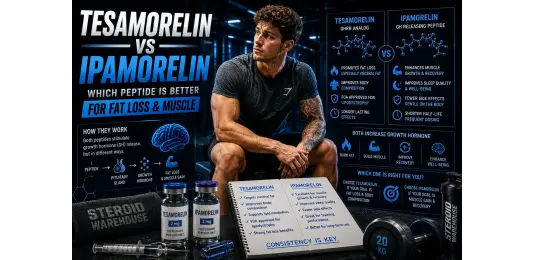
Tesamorelin and Ipamorelin are both growth hormone secretagogues — but they work through different receptors, produce different GH release profiles and have entirely different clinical evidence bases. Tesamorelin is FDA-approved for visceral fat reduction with Phase III trial data. Ipamorelin is the most selective GH secretagogue ever developed — GH release without cortisol, prolactin or ACTH elevation. Neither is simply "better" — they have different strengths and the best approach for most goals is combining both. This guide covers the complete comparison with the actual science behind each compound.
New to peptides? Start with the foundation: Peptides vs Steroids — The Complete Comparison and Best Peptides for Muscle Growth and Recovery.
What Is Tesamorelin?
Tesamorelin is a synthetic analogue of endogenous GHRH (Growth Hormone-Releasing Hormone) — specifically a stabilised form of GHRH(1–44) with a trans-3-hexenoic acid group attached to increase its resistance to DPP-IV enzyme degradation. This modification extends its effective half-life compared to native GHRH while preserving full GHRH receptor agonist activity.
Tesamorelin is the only GH-axis peptide with FDA approval — granted for the reduction of excess abdominal visceral fat in HIV-associated lipodystrophy. This regulatory status means tesamorelin has Phase III randomised controlled trial data that no other performance-relevant peptide can match.
Primary Effects
- Sustained GH and IGF-1 elevation throughout the day — strong, consistent GH pulse amplitude
- Significant visceral adipose tissue (VAT) reduction — clinically proven at 15–20% over 26 weeks
- Hepatic fat reduction — 31–40% in clinical trials
- Improved lipid profile — triglyceride and cholesterol-to-HDL ratio reductions
- Improved insulin sensitivity with no clinically significant glucose elevation at standard doses
What Is Ipamorelin?
Ipamorelin is a synthetic pentapeptide that acts as a selective ghrelin receptor (GHS-R1a) agonist — stimulating GH release from the pituitary through a pathway distinct from GHRH. It was developed by Novo Nordisk in Denmark and first described in a landmark 1998 paper in the European Journal of Endocrinology.
The defining characteristic of Ipamorelin is its exceptional selectivity. The 1998 Raun et al. study demonstrated that Ipamorelin produced GH release without elevating cortisol, ACTH, prolactin, FSH, LH or TSH — even at doses more than 200-fold above the ED50 for GH release. This selectivity profile is unique among GHRPs and is why Ipamorelin is consistently described as the "cleanest" GH secretagogue available.
Primary Effects
- Pulsatile GH release — mimics the natural nocturnal GH pulse pattern
- No cortisol, ACTH or prolactin elevation — unlike GHRP-2 and GHRP-6
- Improved sleep quality — GH peaks during deep sleep; amplifying this pulse improves sleep depth
- Mild fat metabolism support — indirect lipolytic effect through GH elevation
- Recovery and lean mass support — GH/IGF-1 mediated protein synthesis support
Mechanism — How They Differ
| Parameter | Tesamorelin | Ipamorelin |
|---|---|---|
| Receptor | GHRH receptor (GHRH-R) | Ghrelin receptor (GHS-R1a) |
| Class | GHRH analogue | GHRP — ghrelin mimetic |
| GH release pattern | Sustained amplitude — longer, stronger GH pulses | Pulsatile frequency — adds GH pulse frequency |
| IGF-1 elevation | Strong — 1.5–3× baseline in clinical trials | Moderate — incremental above baseline |
| Cortisol effect | Minimal | None — even at 200× ED50 |
| Prolactin effect | Minimal | None |
| Appetite effect | Mild — possible increased hunger | Minimal — unlike GHRP-6 |
| Half-life | ~30 minutes (extended by DPP-IV resistance) | ~2 hours |
| Dosing frequency | Once daily | 1–3× daily or before bed |
| FDA approval | Yes — visceral fat reduction | No — research compound |
Fat Loss — The Evidence
Tesamorelin — The Strongest Clinical Data
- Visceral fat reduction: 15–20% reduction in visceral adipose tissue over 26 weeks vs placebo in two Phase III RCTs
- Waist circumference: statistically significant reduction vs placebo
- Hepatic fat: 31–40% relative reduction in liver fat fraction over 12 months
- Responder rate: ≥8% VAT reduction in 69% of tesamorelin users vs 33% on placebo
- Selectivity: reduces visceral fat specifically — no change in subcutaneous fat or BMI
Ipamorelin — Supportive Rather Than Primary Fat Loss
- Improved sleep quality: nocturnal GH peaks during deep sleep — better sleep means higher GH output and better metabolic function
- Muscle preservation during deficit: GH elevation during caloric restriction reduces muscle protein breakdown
- Synergy with Tesamorelin: combined produces greater GH elevation than either alone
| Fat Loss Parameter | Tesamorelin | Ipamorelin | Combined |
|---|---|---|---|
| Visceral fat reduction | Excellent — 15–20% over 26 weeks | Mild — indirect via GH | Best — synergistic GH elevation |
| Subcutaneous fat | Minimal effect | Mild — via GH lipolysis | Moderate |
| Liver fat | Excellent — 31–40% reduction | Minimal | Good |
| Overall body recomposition | Good — primarily fat-focused | Good — muscle preservation + fat | Excellent |
Muscle Growth and Recovery
Tesamorelin — Strong IGF-1 Elevation
Tesamorelin produces consistent, sustained IGF-1 elevation of 1.5–3× baseline in clinical studies. IGF-1 drives satellite cell activation, protein synthesis and lean mass accumulation.
Ipamorelin — Recovery and Sleep Quality
- The majority of daily GH secretion occurs during slow-wave sleep — Ipamorelin amplifies this pulse
- Enhanced recovery between training sessions — less accumulated fatigue
- Mild IGF-1 elevation supporting lean mass maintenance
Side Effects Comparison
| Side Effect | Tesamorelin | Ipamorelin |
|---|---|---|
| Water retention | Possible — mild | Minimal |
| Cortisol elevation | None significant | None — unique selectivity |
| Prolactin elevation | None significant | None |
| Appetite increase | Possible — mild | Minimal — unlike GHRP-6 |
| Injection site reaction | Possible — mild redness | Minimal |
| Glucose impact | Clinically minimal at 2 mg/day | Minimal |
| HPG axis suppression | None | None |
| PCT required | No | No |
Dosing Protocols
Tesamorelin Dosing
- Standard dose: 1–2 mg subcutaneous injection once daily
- Timing: before bed on an empty stomach — fasting 2 hours before dosing prevents insulin from blunting GH response
- Cycle length: 6–12 weeks minimum; clinical trials ran 26–52 weeks
Ipamorelin Dosing
- Standard dose: 200–300 mcg subcutaneous injection
- Timing: before bed is most effective — amplifies natural nocturnal GH pulse
- Frequency: once daily (before bed) for most users; 2–3× daily for advanced protocols
- Combine with: CJC-1295 DAC for synergistic GHRH + GHRP combined GH release
Reconstitution
Both compounds require reconstitution with bacteriostatic water. Add water slowly down the vial wall, swirl gently — do not shake. Store reconstituted peptides refrigerated at 2–8°C for up to 30 days. Use the Peptide Calculator for exact volumes.
Combining Both — Stack Protocols
Fat Loss Stack
- Tesamorelin 2 mg — once daily before bed
- Ipamorelin 200–300 mcg — before bed (same time as Tesamorelin, separate injections)
- Duration: 12–26 weeks
Body Recomposition Stack
- Tesamorelin 1–2 mg — once daily before bed
- Ipamorelin 200 mcg — before bed
- BPC-157 250 mcg — daily for connective tissue support
- Duration: 16+ weeks
Budget Alternative — Ipamorelin + CJC-1295 DAC
- CJC-1295 DAC 1–2 mg — once or twice weekly
- Ipamorelin 200–300 mcg — before bed daily
- GHRH + GHRP synergy at significantly lower cost than Tesamorelin
All peptides referenced are available at Steroid Warehouse Peptides.
Which to Choose by Goal
| Goal | Best Choice | Why |
|---|---|---|
| Maximum visceral fat reduction | Tesamorelin | FDA-approved, Phase III data — strongest evidence for visceral fat |
| Sleep quality improvement | Ipamorelin | Selective GH pulse amplification — no cortisol disrupting sleep |
| Overall body recomposition | Both combined | Synergistic GH release — fat loss + muscle preservation + sleep |
| On-cycle AAS addition | Ipamorelin primary | Clean nocturnal GH pulse — no interference with AAS pharmacology |
| Budget-conscious protocol | Ipamorelin + CJC-1295 | GHRH + GHRP synergy at lower cost than Tesamorelin |
| Anti-aging and longevity | Ipamorelin + Sermorelin | Most physiological GH pattern — mimics natural GH decline reversal |
- Stanley T.L. et al. (2012) — Tesamorelin reduces VAT by 15–20% and improves lipid profile over 26–52 weeks — Phase III RCT data. PubMed.
- Fourman L. et al. (2024) — Tesamorelin reduces visceral fat by 16% and liver fat by 31% over 12 months. PMC/NIH.
- Raun K. et al. (1998) — Ipamorelin: the first selective growth hormone secretagogue — GH release without cortisol or ACTH elevation. European Journal of Endocrinology. PubMed.
- Ishida J. et al. (2020) — Growth hormone secretagogues: history, mechanism of action and clinical development. JCSM Rapid Communications. Wiley.