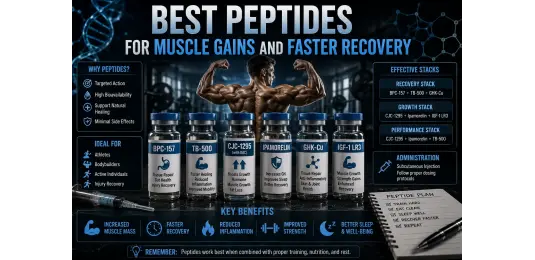
Peptide therapy has moved from specialist anti-aging clinics into mainstream performance and recovery protocols — and for good reason. The right peptides accelerate tissue repair, amplify the GH/IGF-1 axis, protect connective tissue under training load, and improve body composition without the hormonal disruption of anabolic steroids. This guide covers every major performance peptide — mechanism, evidence, dosing protocol and practical application — so you can select compounds based on your actual goals rather than forum mythology.
New to peptides? Read the foundation first: Peptides vs Steroids — The Complete Comparison and Are Peptides a Steroid?
GH Secretagogues — Muscle Growth and Body Composition
Growth hormone secretagogues stimulate the pituitary to release GH — elevating GH and downstream IGF-1, which drives protein synthesis, lipolysis, recovery and connective tissue support. The two primary classes are GHRH analogues (stimulate GH pulse amplitude) and GHRPs/ghrelin receptor agonists (stimulate GH pulse frequency). Using one from each class simultaneously produces synergistic GH release significantly greater than either alone.
Ipamorelin — The Cleanest GH Secretagogue
Ipamorelin is the most selective GH secretagogue available — it stimulates GH release through ghrelin receptors without meaningfully elevating cortisol, prolactin or ACTH. This selectivity makes it the preferred GHRP for most users: clean GH pulse amplification without the cortisol and appetite surge associated with older compounds like GHRP-2 and GHRP-6. A clinical trial published in Growth Hormone & IGF Research confirmed that ipamorelin produces dose-dependent, pulsatile GH increases in healthy volunteers with no serious adverse effects.
Primary effects: improved sleep quality (GH peaks during deep sleep), lean mass support, fat loss, accelerated recovery, anti-aging.
Dosing: 200–300 mcg subcutaneous, 30 minutes before sleep. 3–5× per week. Best combined with CJC-1295 for synergistic GH release.
CJC-1295 DAC — Sustained GH Elevation
CJC-1295 DAC is a GHRH analogue with a Drug Affinity Complex (DAC) that extends its half-life to 6–8 days — providing sustained GH pulse amplitude elevation with once or twice weekly dosing. Subcutaneous administration of CJC-1295 demonstrated dose-dependent increases in plasma GH of 2–10× baseline and IGF-1 elevation of 1.5–3× baseline lasting up to 11 days in clinical studies.
Primary effects: sustained GH/IGF-1 elevation supporting lean mass, fat loss, recovery and sleep quality over weeks to months.
Dosing: 1–2 mg subcutaneous, once weekly or twice weekly. Combined with Ipamorelin before bed for maximum synergy.
Sermorelin — Physiological GH Support
Sermorelin is the shortest active fragment of GHRH — producing more physiological pulsatile GH release than longer-acting analogues. Less GH elevation per dose than CJC-1295 but considered the most "natural" GH secretagogue approach. Widely used in anti-aging medicine and longevity protocols.
Dosing: 200–500 mcg subcutaneous before bed, 5× per week.
GHRP-2 and GHRP-6 — Older Generation Secretagogues
GHRP-2 (Dragon Pharma 5mg) and GHRP-6 (Dragon Pharma 10mg) are first-generation ghrelin receptor agonists. More potent GH release than Ipamorelin but with less selectivity — both elevate cortisol and prolactin to a greater degree. GHRP-6 produces significant appetite stimulation — useful for bulking but problematic for cutting. GHRP-2 has less appetite effect with stronger GH output.
Dosing: 100–300 mcg subcutaneous, 2–3× daily including before bed.
MK-677 (Ibutamoren) — Oral GH Secretagogue
MK-677 is a ghrelin receptor agonist taken orally — the only GH secretagogue with meaningful oral bioavailability. It produces sustained GH and IGF-1 elevation over 24 hours with once daily dosing. It does not require injection, does not suppress testosterone and can be run continuously. Side effects include water retention and increased appetite — particularly in the first 2–4 weeks.
Dosing: 12.5–25 mg orally before bed. Can be run year-round or between injectable peptide cycles.
Repair Peptides — Injury and Tissue Recovery
This is the category where peptides have no equivalent in the AAS or SARM world — compounds that specifically accelerate tissue repair through angiogenesis, growth factor upregulation and cellular migration.
BPC-157 — The Primary Recovery Peptide
BPC-157 (Body Protecting Compound 157) is a 15-amino acid peptide derived from human gastric juice. Its primary mechanisms include promotion of angiogenesis (new blood vessel formation essential for tissue repair), upregulation of growth hormone receptors in tendon fibroblasts, and activation of the nitric oxide system. A 2019 review in Cell and Tissue Research by Gwyer et al. documented BPC-157's role in accelerating musculoskeletal soft tissue healing — tendon, ligament and muscle repair — in animal models. A 2026 orthopaedic review in AJSM confirmed potential benefits in tendon and muscle repair.
Primary effects: accelerated tendon, ligament, muscle and gut repair; reduced inflammation; improved joint function.
Dosing: 250–500 mcg subcutaneous or intramuscular, daily or every other day. For localised injury: inject near the injury site. For systemic gut support: subcutaneous in the abdomen.
Cycle: 4–12 weeks. Can be run continuously during high-risk training periods.
TB-500 — Systemic Tissue Repair
TB-500 is a synthetic analogue of Thymosin Beta-4 — a protein involved in cell migration, angiogenesis and inflammation regulation. Where BPC-157 acts through more localised mechanisms, TB-500 provides systemic tissue repair support — particularly useful for widespread inflammation or multiple concurrent injuries.
Primary effects: systemic tissue repair, reduced inflammation, improved mobility, enhanced cellular migration to injury sites.
Dosing — Loading phase: 5–10 mg subcutaneous weekly × 4–6 weeks. Maintenance: 2.5–5 mg weekly ongoing.
BPC-157 + TB-500 — The Gold Standard Recovery Stack
The BPC-157/TB-500 combination is the most widely used recovery peptide stack. BPC-157 provides localised repair acceleration while TB-500 provides systemic healing support — the two mechanisms are complementary and non-redundant. This stack is particularly valuable for AAS users where strength gains can outpace connective tissue adaptation and injury risk is elevated.
GHK-Cu — Collagen Synthesis and Anti-Inflammatory
GHK-Cu (Copper tripeptide) stimulates collagen synthesis, wound healing and has anti-inflammatory properties. Used in both systemic injection protocols for connective tissue support and topically for skin and hair applications. Supports tendon and joint health alongside BPC-157.
Dosing: 1–3 mg subcutaneous daily for systemic connective tissue support.
Fat Loss and Body Recomposition Peptides
Tesamorelin — FDA-Approved for Visceral Fat
Tesamorelin is a GHRH analogue with FDA approval for HIV-associated lipodystrophy — the only performance-relevant peptide with this regulatory status. Clinical trials demonstrate significant reduction in visceral adipose tissue. It produces GH and IGF-1 elevation similar to CJC-1295 but with a stronger evidence base for fat loss specifically.
Dosing: 1–2 mg subcutaneous daily, rotating injection sites.
AOD-9604 — Lipolytic GH Fragment
AOD-9604 is a modified fragment of GH (hGH 176–191) that retains the lipolytic properties of GH without elevating IGF-1 or producing GH-associated side effects (water retention, insulin resistance). It stimulates fat breakdown and inhibits fat formation without the anabolic or diabetogenic effects of full GH.
Dosing: 300–500 mcg subcutaneous daily, fasted state for maximum lipolytic effect.
Tirzepatide — Most Potent Fat Loss Peptide
Tirzepatide is a dual GIP/GLP-1 receptor agonist with the most robust clinical evidence base for fat loss of any available peptide. Clinical trials demonstrate 15–20% body weight reduction over 72 weeks. Weekly subcutaneous injection. Not a performance peptide in the traditional sense — primarily for significant fat loss goals.
Dosing: 2.5 mg weekly × 4 weeks, titrating to 5–10 mg weekly based on tolerance.
IGF-1 LR3 — Direct Muscle Cell Growth
IGF-1 LR3 is a modified analogue of insulin-like growth factor 1 with a longer half-life than endogenous IGF-1 (~20 hours vs 12–15 minutes). It acts directly on muscle cells to stimulate protein synthesis, satellite cell activation and muscle fibre hypertrophy. Unlike GH secretagogues which work indirectly through GH elevation, IGF-1 LR3 acts directly at the muscle cell level.
Primary effects: direct muscle hypertrophy, increased satellite cell activation, nutrient partitioning, recovery.
Dosing: 20–50 mcg intramuscular or subcutaneous post-workout. Cycle length: 4–6 weeks maximum — receptor downregulation occurs with extended use.
Longevity, Cognitive and Anti-Aging Peptides
Epitalon — Telomere Extension
Epitalon is a tetrapeptide studied for telomere extension and anti-aging effects. Research suggests it activates telomerase — the enzyme responsible for maintaining telomere length. Used in longevity protocols in 10–20 day courses, 1–2× per year.
Dosing: 5–10 mg/day subcutaneous × 10–20 days, 1–2 courses per year.
Selank — Anxiolytic and Cognitive Enhancement
Selank is a heptapeptide developed in Russia with anxiolytic and nootropic properties. Reduces anxiety without sedation, improves memory consolidation and has immunomodulatory effects. Used by athletes for stress management during high-volume training phases.
Dosing: 250–500 mcg subcutaneous or intranasal, as needed or daily for 2–4 week courses.
Semax — Neuroprotection and Focus
Semax is an ACTH analogue with neuroprotective and cognitive-enhancing properties. Increases BDNF, improves focus and mental clarity. Used in cognitive performance protocols and for recovery from neurological stress.
Dosing: 200–600 mcg intranasal or subcutaneous daily for 2–4 week courses.
MOTS-C — Mitochondrial Performance
MOTS-C is a mitochondria-derived peptide that improves insulin sensitivity, fat metabolism and endurance. Activates AMPK — the cellular energy sensor. Increasingly used in athletic performance and metabolic health protocols.
Dosing: 5–10 mg subcutaneous weekly.
Peptide Stacks — How to Combine Effectively
Performance and Body Recomposition Stack
- CJC-1295 DAC 1 mg × 2/week + Ipamorelin 200–300 mcg before bed — GH axis optimisation
- BPC-157 250 mcg daily — connective tissue protection during training
- Duration: 12–16 weeks
Injury Recovery Stack
- BPC-157 + TB-500 blend — loading phase 4–6 weeks
- GHK-Cu 1–2 mg daily — collagen synthesis support
- Can add MK-677 25 mg/day for sustained GH/IGF-1 elevation during recovery
Fat Loss Stack
- Tesamorelin 2 mg daily — visceral fat reduction
- AOD-9604 300 mcg daily fasted — lipolysis
- Ipamorelin 200 mcg before bed — sleep and GH support
On-Cycle AAS + Peptide Stack
- BPC-157 250–500 mcg daily throughout AAS cycle — connective tissue protection
- TB-500 5 mg weekly loading phase — systemic repair support
- Ipamorelin 200 mcg before bed — GH pulse amplification
- See: Combining Steroids, Peptides and SARMs
Dosing Reference Table
| Peptide | Category | Dose | Frequency | Route |
|---|---|---|---|---|
| Ipamorelin | GH secretagogue | 200–300 mcg | Daily before bed | Subcutaneous |
| CJC-1295 DAC | GHRH analogue | 1–2 mg | 1–2× per week | Subcutaneous |
| Sermorelin | GHRH analogue | 200–500 mcg | Daily before bed | Subcutaneous |
| GHRP-2 | GH secretagogue | 100–300 mcg | 2–3× daily | Subcutaneous |
| GHRP-6 | GH secretagogue | 100–300 mcg | 2–3× daily | Subcutaneous |
| MK-677 | Oral GH secretagogue | 12.5–25 mg | Daily before bed | Oral |
| BPC-157 | Repair peptide | 250–500 mcg | Daily or EOD | Subcutaneous/IM |
| TB-500 | Repair peptide | 5–10 mg loading, 2.5–5 mg maintenance | Weekly | Subcutaneous |
| GHK-Cu | Collagen/repair | 1–3 mg | Daily | Subcutaneous |
| Tesamorelin | Fat loss / GHRH | 1–2 mg | Daily | Subcutaneous |
| AOD-9604 | Fat loss | 300–500 mcg | Daily fasted | Subcutaneous |
| IGF-1 LR3 | Direct anabolic | 20–50 mcg | Post-workout | IM or subcutaneous |
| Epitalon | Longevity | 5–10 mg | Daily × 10–20 days | Subcutaneous |
| Selank | Cognitive/anxiolytic | 250–500 mcg | Daily or as needed | Subcutaneous/intranasal |
| Semax | Cognitive/neuroprotective | 200–600 mcg | Daily | Intranasal/subcutaneous |
| MOTS-C | Metabolic/endurance | 5–10 mg | Weekly | Subcutaneous |
Administration and Reconstitution
Most peptides are supplied as lyophilised (freeze-dried) powder requiring reconstitution with bacteriostatic water before injection.
Reconstitution Protocol
- Use bacteriostatic water — not sterile water — for multi-dose vials
- Add water slowly along the vial wall — do not inject directly onto powder
- Do not shake — swirl gently until dissolved
- Store reconstituted peptides refrigerated — most stable for 30 days at 4°C
- Use insulin syringes (29–31 gauge) for subcutaneous injection
Injection Technique
- Subcutaneous: pinch skin, 45° angle, abdomen or outer thigh — most common for peptides
- Intramuscular: 90° angle into muscle belly — used for localised BPC-157 near injury site
- Intranasal: Selank and Semax can be administered nasally — head tilted back, one spray per nostril
- Gwyer D. et al. (2019) — Gastric pentadecapeptide BPC 157 and its role in accelerating musculoskeletal soft tissue healing. Cell Tissue Research. PubMed.
- Chang C.H. et al. (2014) — Pentadecapeptide BPC 157 enhances the growth hormone receptor expression in tendon fibroblasts. Molecules. PubMed.
- Mayfield C.K. et al. (2026) — Injectable Peptide Therapy: A Primer for Orthopaedic and Sports Medicine Physicians. The American Journal of Sports Medicine. SAGE.
- Renke G., Chinellato L. (2026) — Therapeutic Peptides in Aesthetic, Metabolic and Endocrine Conditions: Effects, Safety, Clinical Applications, and Future Perspectives. International Journal of Molecular Sciences. MDPI.