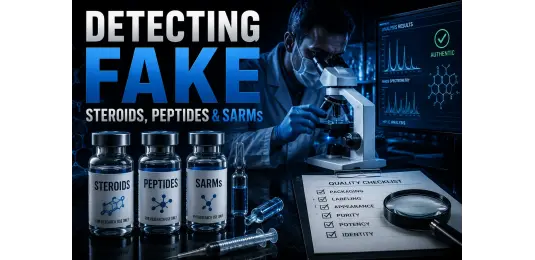
In 2024, the world's first systematic chemical testing programme for anabolic steroids submitted by users found that over 50% of samples had quality problems — wrong compound, wrong concentration, or both. Counterfeit and adulterated performance compounds are not a fringe concern — they are the default reality of unverified sourcing. The consequences range from wasted money to serious infection, unexpected hormonal effects and unknown contaminants. This guide covers how to verify every major compound class, what red flags to look for, and why source selection is the only reliable solution.
For context on the 2024–2025 testing data: Steroid Cycle Planning: The 2026 Evidence Guide.
The Scale of the Problem — What Testing Shows
The 2024 Australian AAS testing programme (Piatkowski et al., published in Harm Reduction Journal) was the first systematic chemical analysis of user-submitted AAS samples. Of 46 analysable samples: 9 had presence issues — the compound differed from what was labelled — and 15 had purity issues — the concentration was either too low or too high. Combined, this means over 52% of submitted samples had meaningful quality problems.
This data aligns with earlier research: a UHPLC-MS/MS analysis of 19 counterfeit drugs collected from internet and offline markets found that nearly 50% contained at least one undisclosed AAS, with concentrations ranging from negligible to over 100,000 mg/kg in suspected samples. A 2025 review in Nutrients documented systematic adulteration of sports supplements with anabolic steroids and prohormones — including products marketed as protein supplements and dietary aids.
Verifying Injectable Steroids
Injectable steroids are the most commonly counterfeited AAS category — vials are easy to refill with vegetable oil, water or underdosed compound, and the equipment to do so is inexpensive.
Physical Verification — What to Check
- Oil clarity: pharmaceutical-grade injectable AAS should be clear to slightly yellow — never cloudy, particulate, or visibly turbid. Cloudiness indicates contamination or improper preparation
- Oil viscosity: should be consistent with the stated carrier oil. Thin, watery consistency in a vial labelled as an oil-based testosterone is a red flag
- Vial integrity: check the rubber stopper — legitimate products have consistent, properly seated stoppers. Damaged, discoloured or improperly sealed stoppers indicate reuse or poor manufacturing
- Label quality: legitimate manufacturers use professional printing — consistent fonts, no spelling errors, no pixelation. Hand-applied or printed-at-home labels are an immediate red flag
- Batch numbers and expiry: every legitimate vial has a batch number and expiry date. Absence of either is disqualifying
- Hologram and verification codes: established manufacturers include holograms and QR/verification codes that can be checked on the manufacturer's website
Dragon Pharma Verification
Dragon Pharma products include a unique verification code that can be checked directly at Dragon Pharma's official website. Each code is single-use — if a code has already been verified, the product has either been verified before (legitimate) or the code has been copied (counterfeited). A new, unverified code on first check is the expected result for a legitimate unused product.
| Feature | Legitimate Product | Counterfeit Red Flag |
|---|---|---|
| Oil clarity | Clear to slightly yellow | Cloudy, particulate, discoloured |
| Label printing | Professional, consistent font | Inconsistent font, spelling errors, pixelation |
| Batch number | Present, matches manufacturer records | Absent, generic, or unverifiable |
| Verification code | Unique, verifiable on manufacturer site | Absent, already used, or links to fake site |
| Stopper condition | Clean, properly seated, undamaged | Damaged, discoloured, evidence of reuse |
| Fill level | Consistent with stated volume | Underfilled or overfilled |
Injection Site Reaction
A legitimate injectable steroid causes minimal injection site reaction — mild soreness for 24–48 hours with short esters like propionate is normal. Severe pain, significant swelling, warmth and redness beyond the injection site, or abscess formation are indicators of contaminated product — bacteria, endotoxins, impure solvents or non-sterile preparation. These require medical attention immediately.
Verifying Oral Steroids
Oral steroids are easier to counterfeit than injectables — tablets and capsules can contain almost anything, and the physical verification options are more limited.
Tablet Physical Characteristics
- Consistency: tablets within the same blister or bottle should be identical in colour, size, shape and surface texture. Variation within a batch is a red flag
- Imprint or score: many pharmaceutical-grade tablets have imprints or score lines — check that these match the manufacturer's specifications
- Blister packaging: legitimate products use professional blister packs with consistent foil backing — not loose tablets in unlabelled bags or pill bottles without seals
- Smell: unusual chemical odour from tablets can indicate improper synthesis or contamination
How to Check — Bloodwork
The most reliable verification for oral steroids is bloodwork response. Dianabol should produce measurable increases in total testosterone (via aromatisation to estradiol) and liver enzyme elevation within 2–3 weeks. Anavar should produce measurable SHBG suppression. If mid-cycle bloodwork shows no hormone response to an oral steroid at standard doses — the product is underdosed or inert.
Verifying Peptides
Peptides present unique verification challenges — lyophilised powder is visually identical regardless of what compound it actually contains, and the equipment to mislabel vials is accessible. The 2024 testing data explicitly identified mislabelled peptides and SARMs as a documented market problem.
Physical Characteristics of Legitimate Peptides
- Form: legitimate lyophilised peptides are white to off-white powder — never liquid. Liquid "ready-to-inject" peptides from unverified sources should be treated with extreme caution — proper lyophilisation is essential for stability and sterility
- Cake structure: properly lyophilised peptide has a light, porous "cake" or plug in the vial — not a compressed powder, not a solid mass. The cake should dissolve readily in bacteriostatic water
- Reconstitution: legitimate peptides dissolve quickly and completely in bacteriostatic water with gentle swirling — no cloudiness, no particles, no residue
- Vial labelling: compound name, concentration (mcg or mg), lot number, manufacture date — all should be present and legible
Effect-Based Verification
- GH secretagogues (Ipamorelin, CJC-1295): within 2–4 weeks of consistent use, noticeable improvement in sleep quality is the most reliable early indicator. Some users notice improved skin quality and mild water retention. If no sleep improvement after 4 weeks at correct dose — product is likely inert
- BPC-157: healing acceleration in an active injury within 1–2 weeks — reduced pain, improved mobility. Harder to quantify but noticeable with a genuine active injury
- HCG (if mislabelled): a standard OTC pregnancy test strip reacts positively to HCG — useful for verifying HCG specifically
| Peptide | Legitimate Form | Effect Verification | Timeframe |
|---|---|---|---|
| Ipamorelin | White lyophilised powder | Improved sleep depth and quality | 2–4 weeks |
| CJC-1295 DAC | White lyophilised powder | Sleep quality + GH-related water retention | 2–4 weeks |
| BPC-157 | White lyophilised powder | Accelerated injury healing | 1–2 weeks |
| TB-500 | White lyophilised powder | Improved mobility, reduced inflammation | 2–3 weeks |
| HCG | White lyophilised powder | Positive pregnancy test strip | Immediate |
Verifying SARMs
SARMs are among the most adulterated compounds in the performance market. Because most SARMs are marketed as "research chemicals," they exist in a regulatory grey zone that attracts low-quality and fraudulent products. The 2023 LiverTox review noted that severe cholestatic jaundice cases from SARM use may in some cases involve unlabelled compounds in products sold as SARMs — the actual substance causing liver injury is unknown.
Certificate of Analysis (COA) — Non-Negotiable
Every legitimate SARM should have a Certificate of Analysis from an independent third-party laboratory confirming compound identity and purity percentage. This is the primary verification mechanism for SARMs — physical inspection alone cannot confirm what a SARM capsule or liquid contains.
- COA should identify the testing laboratory — not just a logo
- The laboratory should be independently verifiable
- COA date should match the production batch — not be reused across multiple batches
- Purity should be stated as a percentage — 98%+ for pharmaceutical-grade research compounds
Physical Red Flags for SARMs
- "Proprietary blend" or unnamed compound: legitimate SARMs are sold by compound name — LGD-4033, Ostarine, RAD-140. "Research blend" or unnamed compounds are evasion of identification
- No lot number or batch date: without these, COA verification is impossible
- Liquid SARMs with no concentration stated: liquid SARMs should state mg/ml clearly — unstated concentration is a dosing and quality red flag
- Abnormal capsule colour variation: as with oral steroids — consistent appearance within a batch is expected from professional manufacturing
Effect-Based Verification for SARMs
- LGD-4033 at 10 mg/day should produce measurable testosterone suppression within 2–3 weeks — mid-cycle bloodwork showing unchanged LH, FSH and testosterone suggests underdosed or inert product
- Ostarine should produce measurable SHBG suppression at 25 mg/day within 2–3 weeks
- MK-677 should produce significantly increased appetite and improved sleep depth within 1–2 weeks — and IGF-1 elevation on bloodwork
Universal Red Flags — Any Compound
| Red Flag | What It Indicates |
|---|---|
| Price significantly below market average | Underdosed, counterfeit or inert product — legitimate pharmaceutical manufacturing has a cost floor |
| Anonymous vendor with no verifiable history | No accountability — disappears after sale |
| No batch number, lot number or expiry date | Cannot verify authenticity or manufacturing date |
| Cryptocurrency-only payment with no alternatives | Designed for untraceability — not a business model of legitimate operators |
| Reviews all posted on same date or obviously templated | Manufactured reviews — not genuine customer history |
| No communication or knowledge-level responses to questions | Drop-shipping operation with no actual product knowledge |
| Peptides shipped at room temperature without cold packs | Reconstituted peptides or improperly stored product — stability compromised |
| No verification mechanism for the brand | Underground lab — no accountability for product quality |
| "Secret formula" or unnamed compound | Cannot be verified — potentially contains anything |
Testing Methods — From Simple to Lab-Grade
Bloodwork — The Most Accessible Verification
Bloodwork is the most practical verification tool available to non-laboratory users. It cannot identify compound identity directly but can confirm physiological response:
- Testosterone: a testosterone product should produce significantly elevated total testosterone on mid-cycle bloodwork — above 1500 ng/dL at standard doses
- Aromatising compounds (Dianabol, Test): should produce elevated estradiol (E2) on bloodwork — confirms the compound is active and aromatising as expected
- Liver enzymes (ALT, AST): oral 17-alpha alkylated steroids should produce measurable liver enzyme elevation — if ALT and AST are completely normal on oral AAS, the product is likely inert or severely underdosed
- LH and FSH suppression: any active AAS or SARM should suppress LH and FSH — confirmed on mid-cycle bloodwork. Unchanged LH/FSH = inactive product
Home Chemical Testing
- Pregnancy test for HCG: OTC pregnancy test strips react to HCG — the only peptide verifiable this way. Positive result confirms HCG is present
- Reagent testing for some AAS: Froehde reagent and similar chemical tests can provide colour reactions that indicate the presence of specific compound classes — crude but accessible
- UV examination: some counterfeit injectable oils fluoresce differently under UV light than legitimate pharmaceutical carriers — not definitive but an additional data point
Third-Party Laboratory Testing
Drug checking services now exist in several countries specifically for AAS and performance compounds. The 2024 Australian CheQpoint programme (referenced in the Piatkowski et al. study) used Radian-ASAP direct mass spectrometry and Orbitrap LC-MS to identify compound identity and concentration. For users in regions without access to drug checking services, commercial analytical laboratories can test samples for compound identity at reasonable cost.
Source Selection — The Only Real Solution
Verification techniques reduce risk but do not eliminate it — the only reliable solution is sourcing from verified manufacturers with established quality histories. The 2024 testing data showing 50%+ quality problems came from a general user-submitted sample set. Products from established, tracked manufacturers with consistent batch testing have categorically different quality profiles.
What Makes a Source Verified
- Established manufacturer with multi-year track record: Dragon Pharma, Kalpa Pharmaceuticals and British Dragon have consistent production histories and established verification systems — not anonymous operations
- Manufacturer verification portal: the ability to verify a specific batch on the manufacturer's website with a unique code
- Consistent product across multiple independent reports: a manufacturer producing consistent bloodwork results across independent users over years is more reliable than one without this track record
- Retailer accountability: a retailer with a verifiable business presence, customer communication and return/replacement policy has accountability that anonymous vendors do not
- Magnolini R. et al. (2025) — Evaluation of implementing drug checking services for anabolic androgenic steroids in Switzerland: a pilot study; 52% of user-provided AAS samples were fake, including counterfeit and substandard products. Harm Reduction Journal. PubMed.
- Piatkowski T. et al. (2025) — Anabolic-androgenic steroid testing as a tool for consumer engagement and harm reduction: a sequential explanatory mixed-method study. Harm Reduction Journal. PubMed.
- Frude E., McKay F.H., Dunn M. (2020) — A focused netnographic study exploring experiences associated with counterfeit and contaminated anabolic-androgenic steroids. Harm Reduction Journal. PubMed.
- Puscasiu D. et al. (2025) — Adulteration of Sports Supplements with Anabolic Steroids: From Innocent Athlete to Vicious Cheater. Nutrients. PubMed.
- Cho S.H. et al. (2015) — Determination of anabolic-androgenic steroid adulterants in counterfeit drugs by UHPLC-MS/MS; nearly 50% of tested samples contained one or more AAS adulterants. Journal of Pharmaceutical and Biomedical Analysis. PubMed.