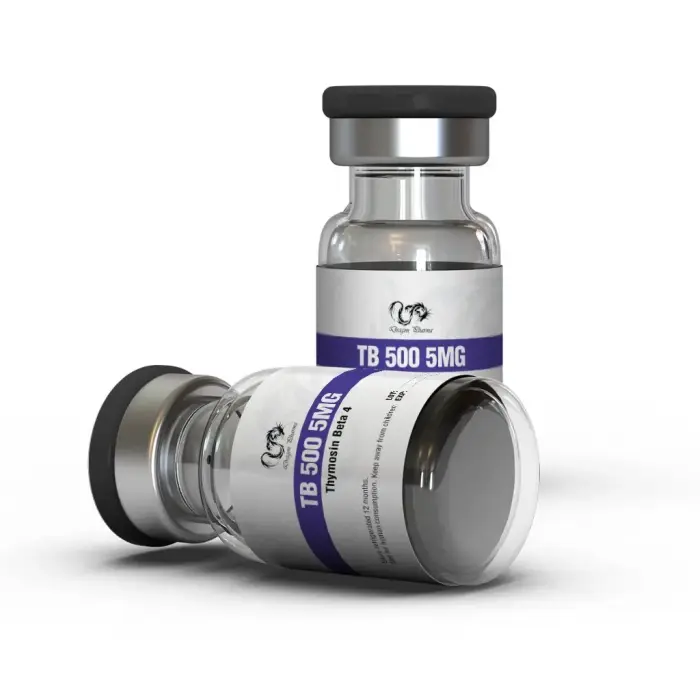
TB 500
TB-500 Dragon Pharma — Overview
TB-500 Dragon Pharma is a synthetic peptide based on the active actin-binding region of Thymosin Beta-4 (Tβ4) — a 43-amino acid protein found in high concentrations in platelets, wound fluid, and virtually every nucleated cell in the body. The synthetic fragment marketed as TB-500 retains the core biological activity of the full Tβ4 protein: promoting cell migration to injury sites, driving angiogenesis, reducing local inflammation, and accelerating the regeneration of damaged connective tissue, muscle, and vasculature. Unlike hormonal compounds, TB-500 does not interact with the HPG axis, does not require post-cycle therapy, and does not suppress endogenous hormone production. Its sole mechanism of action is tissue repair and regeneration.
Each 5 mg vial contains lyophilized powder that is reconstituted with bacteriostatic water before subcutaneous injection. At 5 mg per vial, a single vial covers one week at the standard loading dose of 2.5 mg twice weekly, or two weeks at the maintenance dose of 2.5 mg once weekly. Steroid Warehouse carries Dragon Pharma's TB-500 5 mg vials alongside the reconstitution supplies and complementary recovery peptides needed for a complete tissue repair protocol.
About the Compound: Thymosin Beta-4 (TB-500)
Thymosin Beta-4 is one of the most abundant peptides found in mammalian tissue. It was first isolated from thymic tissue but is now known to be present in platelets, neutrophils, macrophages, and virtually every cell type capable of responding to injury. Its primary physiological role is coordinating the early stages of tissue repair: sequestering G-actin (monomeric actin) to regulate cytoskeletal dynamics, driving directed cell migration toward injury sites, and triggering the vascular and inflammatory signaling cascades required for organised tissue regeneration. The synthetic TB-500 peptide replicates the key functional domain of the full Tβ4 molecule responsible for these repair-promoting activities.
- G-actin sequestration and cytoskeletal regulation — TB-500 binds monomeric G-actin with high affinity, modulating the dynamic equilibrium between free G-actin and polymerized F-actin filaments; actin polymerization is essential for cell motility, and by regulating this balance TB-500 directly facilitates the directed migration of repair cells — keratinocytes, fibroblasts, endothelial cells, and satellite cells — toward damage sites; this is the upstream mechanism that drives most of TB-500's downstream tissue repair effects
- Promotion of angiogenesis — TB-500 upregulates the expression of angiogenic factors and promotes endothelial cell migration and tube formation, supporting the growth of new capillaries into avascular or poorly vascularised injury zones; this is particularly relevant for tendons and ligaments, which have inherently poor blood supply and slow natural healing rates; improved vascularization accelerates the delivery of nutrients, oxygen, and repair cells to damaged tissue and is one of the primary reasons TB-500 is valued for tendon and ligament injuries specifically
- Anti-inflammatory signaling — Tβ4 and its synthetic fragments suppress the production of pro-inflammatory cytokines including IL-1β and TNF-α while promoting the anti-inflammatory M2 macrophage phenotype; this shifts the local tissue environment from a prolonged inflammatory state (which degrades tissue) toward a repair-promoting state; the anti-inflammatory effect is local rather than systemic, meaning TB-500 does not produce the immune suppression or systemic side effects associated with corticosteroid anti-inflammatory therapy
- Satellite cell and stem cell recruitment — TB-500 promotes the migration and differentiation of muscle satellite cells (myogenic progenitor cells) and mesenchymal stem cells at muscle injury sites; this drives myofiber regeneration following tears, strains, or contusion injuries; the satellite cell activation effect is distinct from the anabolic mechanism of IGF-1 or androgens — TB-500 acts specifically on the repair and regeneration pathway, not on hypertrophic signaling
- Anti-fibrotic tissue remodeling — by promoting organized collagen deposition and reducing excessive scar tissue formation, TB-500 supports higher-quality tissue remodeling compared to unassisted healing; this is relevant for tendons, where excessive fibrosis produces scar tissue with inferior mechanical properties to the original tendon; TB-500-assisted tendon healing produces more organized collagen fiber alignment and better tensile strength recovery
What TB-500 Does
TB-500's effects are exclusively in the domain of tissue repair, regeneration, and inflammation resolution. It does not build muscle through anabolic pathways, does not raise metabolic rate, and does not affect strength or endurance directly. Its value in a performance context is in preserving training capacity by accelerating recovery from injuries that would otherwise require extended rest periods, and in protecting connective tissue integrity during high-intensity training blocks.
- Accelerated tendon and ligament repair — tendons and ligaments are notoriously slow-healing due to their limited blood supply and low cellular density; TB-500 directly addresses both limitations by promoting angiogenesis (improving local vascularization) and driving fibroblast migration and collagen synthesis at the injury site; users report measurable reductions in tendon pain and improved functional recovery timelines for Achilles, patellar, rotator cuff, and elbow tendon injuries compared to rest alone; this is the most commonly cited primary use of TB-500 in performance populations
- Muscle tear and strain recovery — satellite cell activation and anti-inflammatory signaling combine to accelerate the repair of muscle fiber tears; the anti-inflammatory effect reduces the prolonged inflammatory phase that delays entry into the proliferation and remodeling stages of muscle healing; users with partial muscle tears report faster functional strength recovery and shorter time-to-return-to-full-training when using TB-500 during the repair phase; TB-500's benefit is in the repair process itself, not in post-repair hypertrophy
- Reduction of chronic joint inflammation — repeated mechanical loading in heavy strength training creates cumulative micro-trauma in joint structures; TB-500 supports resolution of this chronic low-grade inflammation by promoting local M2 macrophage polarization and reducing pro-inflammatory cytokine signaling; athletes running TB-500 during heavy training blocks often report reduced joint discomfort, improved range of motion, and reduced morning stiffness compared to equivalent training periods without the peptide
- Post-surgical tissue healing support — the angiogenic and cell migration-promoting effects of TB-500 are relevant in the context of surgical recovery: promoting vascularization of the repair site, supporting organized collagen deposition, and reducing local inflammation in the early post-surgical period; TB-500 is not a replacement for appropriate surgical aftercare but represents a pharmacologically supported complement to standard post-surgical rehabilitation protocols
- Systemic reach from subcutaneous injection — unlike some locally-acting peptides, TB-500 distributes systemically after subcutaneous injection, reaching injury sites throughout the body from a single injection site on the abdomen or thigh; this means a shoulder tendon injury and a knee ligament strain can both benefit from the same injection without requiring injection at or near each injury site; this systemic distribution distinguishes TB-500 from locally-injected peptides and makes it particularly practical for athletes managing multiple concurrent soft tissue issues
Who It's For
- What sets TB-500 apart: among recovery peptides, TB-500's distinguishing feature is its systemic distribution after subcutaneous injection and its specific promotion of both angiogenesis and organized cell migration — the two biological processes that are most limiting for tendon and ligament repair; BPC-157, the most commonly compared alternative, has stronger gastric protection and local anti-inflammatory effects and is often injected closer to the injury site; TB-500's advantage lies in injuries that are difficult to access locally (deep tendons, multiple simultaneous injuries) and in situations where improved vascularization of poorly-supplied connective tissue is the primary target; the two peptides cover overlapping but distinct recovery mechanisms and are frequently combined rather than used as strict alternatives
- Best scenario: athletes managing acute or chronic tendon injuries that are limiting training capacity; strength athletes running heavy cycles where connective tissue strain is outpacing natural recovery; anyone post-surgery on connective tissue structures wanting to support organized healing and reduce fibrosis; athletes with multiple concurrent soft tissue issues who need a systemically-distributing peptide rather than multiple localized injections; intermediate to advanced users who want to support connective tissue integrity during high-volume or high-intensity training blocks as a preventive measure rather than waiting for injury to occur
- Choose something else instead: users whose primary goal is GI protection, gut lining repair, or local inflammation near an accessible injection site should use BPC-157 Dragon Pharma — its gastric cytoprotective mechanism and local tissue effects at the injection site are not replicated by TB-500; users who want anabolic muscle repair with simultaneous connective tissue support may benefit more from IGF-1 LR3 Dragon Pharma combined with TB-500 than from either compound alone; TB-500 alone is not the right choice for users seeking anabolic or body composition effects — it has no hormonal or hypertrophic mechanism
TB-500 vs Alternatives
| Compound | Key Differences | Choose TB-500 When | Choose Alternative When |
|---|---|---|---|
| BPC-157 Dragon Pharma Body Protection Compound 157 |
BPC-157 is a 15-amino acid synthetic peptide derived from gastric juice protein; primary strengths are GI tract repair, local anti-inflammatory action at the injection site, tendon-to-bone healing, and upregulation of nitric oxide pathways promoting local angiogenesis; BPC-157 is often injected subcutaneously near the injury site for localized effect; no systemic distribution comparable to TB-500; does not have TB-500's G-actin sequestration mechanism; highly complementary rather than a direct alternative | Multiple simultaneous injury sites require systemic peptide distribution from a single injection; the primary target is tendon vascularization improvement or organized collagen remodeling over a multi-week loading phase; no GI involvement or accessible injection site near the injury | GI protection, gut lining repair, or stomach-proximate anti-inflammatory effects are the primary goal; the injury site is accessible for near-site injection and localized action is preferred; a combined protocol covering both mechanisms is the most effective approach — see Combinations |
| BPC-157 + TB-500 Dragon Pharma Combination vial |
Pre-blended vial containing both BPC-157 and TB-500 in a fixed ratio; provides both peptides in a single injection; more convenient than sourcing and reconstituting separately; fixed ratio means individual peptide doses cannot be adjusted independently; cost per mg may differ from standalone vials; reduces injection frequency for users wanting both compounds | Convenience is the priority and the fixed-ratio combination covers the intended use case; users who have already determined the BPC-157/TB-500 combination is the right protocol and do not need to adjust individual peptide doses independently | Independent dose titration of each peptide is needed; or when only one of the two peptides is appropriate for the current injury type; standalone TB-500 allows more precise dosing control and flexibility in combining with other protocols |
| IGF-1 LR3 Dragon Pharma Insulin-Like Growth Factor 1 |
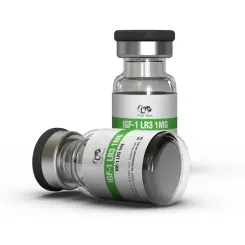
IGF-1 LR3 is a growth factor with anabolic, anti-catabolic, and tissue repair properties; promotes myoblast proliferation and differentiation, satellite cell activation, and protein synthesis; addresses muscle repair through an anabolic pathway (not the actin-sequestration and cell migration pathway of TB-500); also promotes collagen synthesis in tendons and ligaments; systemic after injection; has blood glucose-lowering effects (hypoglycemia risk); requires more careful dosing than TB-500 | Connective tissue repair is the exclusive goal without a concurrent need for muscle anabolism; TB-500's repair mechanism is more specifically oriented to inflammation resolution, vascularization, and organized tissue remodeling without the glycemic management considerations IGF-1 LR3 requires | Muscle mass recovery and anabolic signaling alongside connective tissue repair are both goals; IGF-1 LR3 + TB-500 in combination addresses both the anabolic and the repair/vascularization mechanisms simultaneously; this is a common advanced recovery stack for significant muscle injuries |
Combinations
| Goal | Stack | Notes |
|---|---|---|
| Comprehensive connective tissue repair (most common) | TB-500 2.5 mg × 2/week + BPC-157 DP 200–300 mcg/day (subcutaneous near injury site) | The most widely used injury recovery combination; TB-500 provides systemic distribution and vascularization promotion throughout the body while BPC-157 delivers localized anti-inflammatory and tissue-protective effects at the specific injury site; the mechanisms are complementary rather than redundant — TB-500 addresses cell migration and angiogenesis while BPC-157 addresses local inflammation and tendon-to-bone healing; both are reconstituted separately in bacteriostatic water and injected at separate sites; most users run this combination for 4–6 weeks of loading |
| Muscle injury recovery with anabolic support | TB-500 2.5 mg × 2/week + IGF-1 LR3 DP 40–80 mcg/day post-workout | TB-500 drives satellite cell migration and inflammation resolution while IGF-1 LR3 simultaneously promotes satellite cell proliferation and protein synthesis; the combination addresses both the repair (TB-500) and the anabolic rebuild (IGF-1) phases of muscle injury recovery; IGF-1 LR3 should be injected post-workout for best results; monitor blood glucose when using IGF-1 LR3 — always have a fast-acting carbohydrate source available; TB-500 can be injected at any time of day independently of IGF-1 LR3 |
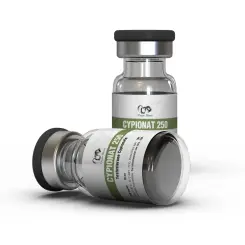
| Advanced recovery during AAS cycle | TB-500 2.5 mg × 2/week + Deca 300 200–300 mg/wk + Enantat 250 400 mg/wk | Heavy AAS cycles increase training intensity and strength levels rapidly, placing connective tissue under load it has not had time to adapt to; Deca 300 provides synovial fluid and joint comfort via its progestin activity; TB-500 addresses the underlying tissue repair and vascularization that Deca's joint feel does not provide; the combination covers both the symptomatic (Deca) and the structural repair (TB-500) components of joint and connective tissue health during a bulk; this stack is particularly relevant for powerlifters and strength athletes running high-load protocols |
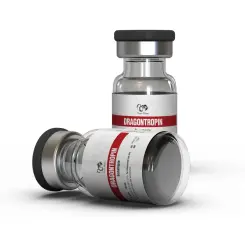
| GH-inclusive recovery protocol (advanced) | TB-500 2.5 mg × 2/week + Dragontropin HGH 2–4 IU/day + BPC-157 DP 200 mcg/day | GH promotes collagen synthesis, connective tissue remodeling, and IGF-1 production; combined with TB-500's vascularization and cell migration effects and BPC-157's local repair activity, this stack covers the widest range of tissue repair mechanisms available without a prescription; used by competitive athletes managing significant injuries during a season where complete rest is not possible; GH is the systemic anabolic/repair driver, TB-500 is the vascularization and migration promoter, and BPC-157 handles local injury site inflammation; the most expensive of the four stacks listed here but the most comprehensive in mechanism coverage |
Side Effects & Management
| What May Occur | Background | How to Handle It |
|---|---|---|
| Injection site discomfort and mild swelling | Any subcutaneous injection carries risk of local irritation, bruising, and transient swelling at the injection site; TB-500 itself does not cause chemical irritation beyond that expected from the injection vehicle; poor injection technique, insufficient site rotation, or contaminated supplies are the most common causes of injection site reactions; the lyophilized peptide reconstituted in bacteriostatic water is well-tolerated in the subcutaneous tissue when properly prepared | Rotate injection sites systematically (abdomen, thigh, deltoid region) to prevent cumulative local irritation; use a new sterile insulin needle for each injection; ensure the reconstituted solution reaches room temperature before injection; swab the injection site with isopropyl alcohol before each injection; mild local swelling resolves within 24–48 hours without intervention; persistent redness, warmth, or swelling beyond 48 hours after injection suggests contamination risk — discontinue that vial |
| Transient head rush or lightheadedness after injection | Some users report a brief vasodilation sensation — warmth, lightheadedness, or a mild head rush — within minutes of TB-500 injection; this is thought to reflect the peptide's angiogenic and vasodilatory activity on local and regional vasculature; the effect is transient (typically resolving within 5–10 minutes) and not indicative of a serious adverse event; it is more commonly reported at higher single doses (5 mg) than at the standard 2.5 mg split dosing | Inject while seated or lying down rather than standing; remain seated for 5–10 minutes after each injection during the first week; if the sensation is uncomfortable, reduce the single injection dose to 2 mg and inject twice daily rather than 2.5 mg twice weekly; the sensation typically attenuates after the first 1–2 weeks of use as tolerance to the acute vasodilatory response develops; no pharmaceutical intervention is required for this effect |
| Fatigue and low-grade flu-like feeling (early loading) | Some users report mild fatigue or a flu-like sense of heaviness in the first 1–2 weeks of the TB-500 loading phase; the prevailing explanation is an accelerated systemic inflammatory and repair response as the peptide mobilizes repair cells and upregulates cytokine signaling throughout the body; this effect is dose-dependent and more commonly reported at 5 mg twice weekly than at the standard 2.5 mg twice weekly protocol; it resolves without intervention as the body adapts to the loading phase | Start at the lower end of the loading dose range (2–2.5 mg twice weekly) rather than jumping to 5 mg twice weekly; ensure adequate sleep and caloric intake during the loading phase — tissue repair is an anabolic process that increases nutritional demand; the fatigue response is temporary and does not indicate that the peptide is not working; if fatigue is significant, reduce the loading dose by 50% for the first 2 weeks before scaling to full dose |
| Theoretical angiogenic concern in users with existing neoplasm | Because TB-500 promotes angiogenesis and cell migration, there is a theoretical concern that these mechanisms could support tumor vascularization or migration in users with existing or undiagnosed malignant tissue; this concern is extrapolated from general angiogenesis biology and has not been demonstrated for TB-500 specifically in clinical or research populations at performance-use doses; it is a relevant consideration for risk-benefit assessment in users with personal or family history of cancer | TB-500 use is not appropriate for anyone with a current or recent history of malignancy; for healthy users without oncologic history the practical risk at cycle doses is considered low based on available data; this is a theoretical mechanism-derived risk rather than an observed clinical one, but it informs appropriate user selection |
Progress Monitoring
TB-500 does not interact with the HPG or HPT axes and does not require a laboratory bloodwork panel for safety monitoring. Progress assessment is functional: tracking the specific injury indicators that prompted TB-500 use and benchmarking them against pre-cycle baselines to assess response.
| Parameter | How to Assess | Expected Response & Action Threshold |
|---|---|---|
| Pain at injury site (subjective 0–10 scale) | Daily self-rating at rest and under load; log weekly average | Noticeable reduction in pain score expected within 2–4 weeks of loading; most users report 40–70% reduction in tendon or joint pain by the end of a 4–6 week loading phase; if pain score is unchanged at week 4, consider adding BPC-157 DP to the protocol or evaluating whether the injury type is responsive to peptide therapy; complete pain elimination is not a reliable outcome measure — functional improvement at load is more meaningful |
| Range of motion at injured joint | Measure weekly using a goniometer or consistent functional benchmark (depth of squat, overhead reach, rotation arc) | Gradual improvement in pain-free range of motion expected over weeks 2–6; range of motion improvements correlate with reduction in fibrotic scar tissue and reduced local inflammation; no change in range of motion by week 4 despite pain score improvement suggests incomplete tissue remodeling — extend loading phase by 2 weeks before assessing further |
| Return-to-load capacity | Track maximum pain-free load at the injured structure weekly (e.g., pain-free bodyweight on a previously injured tendon, pain-free barbell load in a previously impinged position) | Return to 80% of pre-injury load capacity by end of loading phase (weeks 4–6) is a reasonable benchmark; full pre-injury load capacity by end of maintenance phase (weeks 8–12); do not use return of pain-free movement alone as a signal to resume full training loads — tissue remodeling continues for weeks after pain resolves and premature loading is a common cause of re-injury |
| Vial yield and dosing accuracy | Track reconstitution volume and draw volume at each injection | At 5 mg/vial reconstituted in 2 mL bacteriostatic water: concentration = 2.5 mg/mL; 2.5 mg dose = 1 mL draw; 5 mg dose = 2 mL draw; at 1 mL bacteriostatic water: concentration = 5 mg/mL; 2.5 mg = 0.5 mL; keep reconstituted vials refrigerated and use within 28 days; discard if the solution is cloudy or contains particulates after reconstitution |
Cycle Structure & Discontinuation
TB-500 requires no post-cycle therapy and no taper. Because it has no interaction with the HPG or HPT axes and does not suppress endogenous hormone production, there is no recovery period after discontinuation. The protocol structure consists of a loading phase followed by a maintenance phase, with discontinuation occurring when the target injury has resolved to the user's functional benchmark.
| Phase | Protocol | Notes |
|---|---|---|
| Loading phase (acute injury or initial use) | 2.5 mg subcutaneously 2× per week for 4–6 weeks | This phase saturates the tissue repair signaling and produces the primary therapeutic effect; 5 mg once weekly is an alternative loading structure that simplifies scheduling; some practitioners use an accelerated loading protocol of 5 mg twice weekly for 2–3 weeks for severe acute injuries before stepping down to standard dosing; one 5 mg vial covers one week at the standard loading dose; 4–6 vials are required for a full loading course |
| Maintenance phase | 2–2.5 mg once per week for 4–6 additional weeks | After the loading phase produces measurable pain and function improvement, maintenance dosing sustains the ongoing tissue remodeling process while reducing compound consumption; continuing the maintenance phase until functional benchmarks are fully met (pain-free under full training load) produces better long-term outcomes than stopping at pain resolution; one 5 mg vial covers two weeks at the maintenance dose of 2.5 mg once weekly |
| Preventive use (athletes in high-load training blocks) | 2.5 mg once every 10–14 days throughout the training block | Some athletes use TB-500 at a low prophylactic dose during periods of unusually high training volume to support connective tissue integrity before injury occurs; this is a less evidence-supported use pattern than therapeutic injury use, but reflects the practical approach of athletes managing heavy peaking or competition prep cycles where connective tissue stress is high; no specific cycle length limit applies to preventive use at this frequency |
| Discontinuation | Stop when functional benchmarks are met; no taper required | Simply stopping TB-500 at the end of the intended course produces no withdrawal, rebound, or hormonal imbalance; the peptide has no receptor downregulation, no axis suppression, and no feedback loop that would require a gradual taper; if the injury has not responded after 8–10 weeks of combined loading and maintenance dosing, reassess the injury diagnosis and whether the mechanism of TB-500 matches the specific tissue damage type before extending use further |
Practical Summary
- Reconstitute each 5 mg vial with 1–2 mL of bacteriostatic water; use 2 mL for easier dose measurement (2.5 mg dose = 1 mL draw) or 1 mL for a more concentrated solution (2.5 mg dose = 0.5 mL draw); keep refrigerated after reconstitution and use within 28 days
- Standard loading dose is 2.5 mg × 2 per week subcutaneously; injections can be placed anywhere on the abdomen or thigh — TB-500 distributes systemically and does not need to be injected near the injury site to reach it
- Most users see meaningful pain and function improvement within 2–4 weeks of the loading phase; full return-to-load capacity typically requires the complete loading phase (4–6 weeks) plus a maintenance phase (4–6 weeks); stopping at first pain relief risks re-injury before tissue remodeling is complete
- TB-500 and BPC-157 cover complementary mechanisms and are most effective in combination; if the injury involves a tendon attachment, gut health, or localized tissue, adding BPC-157 DP to the protocol addresses mechanisms that TB-500 alone does not cover
- No PCT, no bloodwork panel, no taper required; TB-500 can be stopped cleanly at any point and started again at the next loading dose with no washout period needed
- 1 pack of 5 vials (25 mg total) covers a full 4-week loading phase at 2.5 mg twice weekly (20 mg used) with a partial maintenance week remaining; plan for 6–8 vials to cover a complete loading phase plus transition to maintenance dosing
TB-500 Dragon Pharma addresses the biological rate-limiting steps in connective tissue repair — poor vascularization of tendons and ligaments, insufficient cell migration to injury sites, and prolonged inflammatory phases that delay organized healing — through mechanisms that no training intervention or standard nutritional protocol can replicate. At 5 mg per vial, the dose precisely covers the standard weekly loading requirement, and the systemic distribution of the peptide after a single subcutaneous injection means every injured structure in the body benefits from each dose simultaneously. For athletes managing soft tissue injuries that are affecting training quality, or running high-load training blocks where connective tissue integrity is a limiting factor, steroidwarehouse.com carries the full Dragon Pharma peptide lineup including TB-500, BPC-157, and reconstitution supplies to support a complete evidence-guided recovery protocol.
References
| Source | Topic | Link |
|---|---|---|
| Expert Opinion on Biological Therapy / PubMed | Goldstein et al. 2012 — comprehensive review of Thymosin β4 as a multifunctional regenerative peptide; covers basic molecular properties, actin-binding biology, wound repair, angiogenesis, anti-inflammatory effects, and clinical application context; useful as the primary reference for TB-4 biology, not direct TB-500 human evidence | Goldstein AL, et al. (2012) ↗ |
| Vitamins and Hormones / PubMed | Kleinman & Sosne 2016 — review of Thymosin β4 in dermal healing; covers wound-healing biology, cell migration, angiogenesis, inflammation modulation, and tissue-repair mechanisms relevant to regenerative peptide research | Kleinman HK & Sosne G (2016) ↗ |
| Nature / PubMed | Smart et al. 2007 — experimental study showing that Thymosin β4 induces adult epicardial progenitor mobilization and neovascularization; supports TB4-related cardiac repair and angiogenesis mechanisms, but should not be described as direct TB-500 clinical evidence | Smart N, et al. (2007) ↗ |
What is TB 500?
TB 500 is a peptide (Thymosin Beta 4) for tissue repair; see What is TB 500. It enhances recovery—consult professionals for safe use.
Is there anything stronger than TB 500?
BPC-157 or HGH may offer comparable or stronger healing; see Is There Anything Stronger Than TB 500. Consult professionals for alternatives.
How does TB 500 work?
It promotes cell migration and angiogenesis for tissue repair; see Mechanism of Action. It accelerates healing—monitor with professional guidance.
Is TB 500 safe?
It's safe with proper dosing, but not FDA-approved; see Side Effects. Manage risks with professional guidance—consult for safety.
What is TB-500 commonly used for?
TB-500 is commonly associated with:
- Recovery and rehabilitation support
- Joint and mobility discussions
- Soft tissue and muscle recovery protocols
- Athletic performance and wellness routines
It is widely discussed in peptide and sports recovery communities.
Why is TB-500 popular among athletes and active individuals?
Users often choose TB-500 because it may:
- Support recovery after intense training
- Promote mobility and flexibility
- Complement rehabilitation and wellness programs
- Help maintain consistent training routines
It is frequently discussed as part of injury-recovery protocols.
Is TB-500 used for injury recovery or performance?
TB-500 is primarily associated with injury recovery and tissue repair, though it is also discussed in performance contexts for its potential to support training continuity.
What are the possible side effects of TB-500?
Available research is limited, but reported considerations may include fatigue, temporary injection site irritation, or mild systemic effects depending on individual response.
Related Products