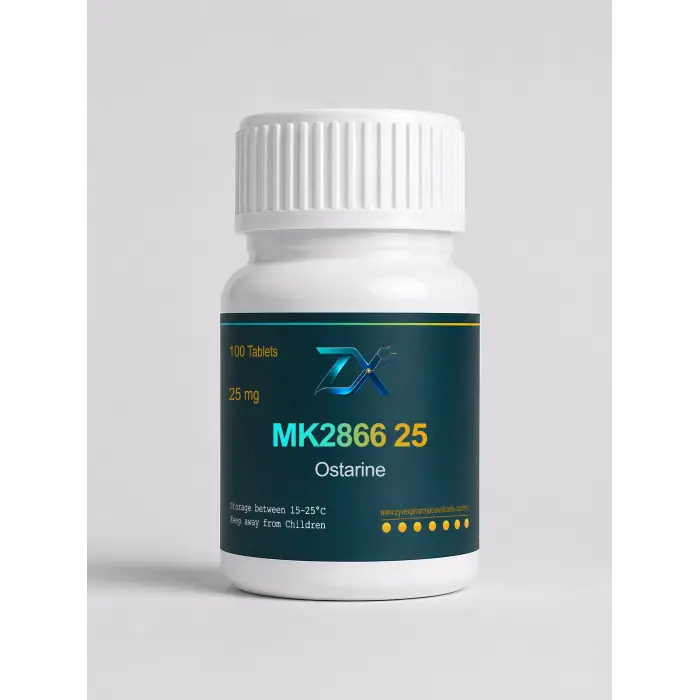
Ostarine MK 2866 - Zyvex Pharmaceuticals
Ostarine MK 2866 - Selective SARM for Lean Muscle and Recomposition
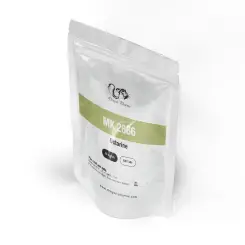
Ostarine MK 2866 by Zyvex Pharmaceuticals contains Ostarine (Enobosarm) at 25 mg per tablet. It is a selective androgen receptor modulator (SARM) - a compound that binds to androgen receptors in muscle and bone tissue with high selectivity, producing anabolic effects in those tissues without the androgenic activity that causes side effects in the prostate, scalp, and other androgen-sensitive organs. Ostarine was originally developed by GTx Inc. under the research designation MK-2866 and the pharmaceutical name Enobosarm, and it proceeded through Phase II and Phase III clinical trials for the treatment of muscle wasting in cancer patients (cancer cachexia) and osteoporosis. It is the most studied and best-documented SARM in clinical literature.
In bodybuilding, Ostarine is used for lean mass gains during a caloric surplus, muscle preservation during a caloric deficit (cutting), and body recomposition at caloric maintenance. Its tissue-selective mechanism produces meaningful anabolic activity in skeletal muscle with minimal suppression of endogenous testosterone at moderate doses and cycle lengths. Unlike anabolic steroids, it does not convert to DHT or estrogen, which eliminates hair loss acceleration, gynecomastia, and prostate concerns at standard doses. Ostarine also produces a documented benefit to connective tissue - making it useful for athletes managing joint pain alongside its primary muscle and recomposition goals.
About the Compound
Ostarine was developed by GTx Inc. in the late 1990s and early 2000s as part of a broader pharmaceutical effort to create anabolic agents that could treat muscle wasting, osteoporosis, and related conditions in aging populations without the androgenic side effects of testosterone and traditional anabolic steroids. It reached Phase III clinical trials under the name Enobosarm for cancer-related muscle wasting, making it one of the few SARMs with a substantial clinical trial dataset in human subjects. The clinical data confirmed both its anabolic activity and its selective tissue profile, and it became the foundational reference compound against which other SARMs are compared.
Ostarine's mechanism of action involves selective binding to androgen receptors. In muscle and bone, this binding triggers the same anabolic signaling that testosterone activates. The selectivity comes from the compound's ability to recruit different co-activator proteins than testosterone does when it binds to the androgen receptor - producing anabolic signaling in muscle while minimally activating androgen receptor signaling in the prostate and other androgenic tissues. The 25 mg/tab concentration of this product provides a single tablet as the standard daily dose for performance use, making dosing straightforward with no splitting or stacking of tablets required at the most common dose range.
Effects and Benefits
Ostarine's anabolic effects are driven by its selective androgen receptor activation in skeletal muscle and bone tissue. The effects are real but more moderate than those of anabolic steroids - a distinction that matters for matching the compound to the appropriate goal and expectation.
- Lean muscle gains - At 25 mg/day for 8 weeks in a caloric surplus, users typically gain 2-4 kg of lean tissue. The gains are lean because there is no aromatization to drive water retention. Clinical studies in cancer patients consistently show statistically significant increases in lean body mass versus placebo, which is the strongest controlled evidence base of any SARM.
- Muscle preservation during cutting - This is Ostarine's most practical competitive advantage over other anabolic compounds. In a caloric deficit, skeletal muscle is catabolized for fuel. Ostarine's androgen receptor activation in muscle tissue counteracts this catabolic drive, allowing users to lose fat while maintaining - and in some cases increasing - lean muscle mass. Clinical trial data specifically documented this effect in cancer-related muscle wasting, which shares the catabolic mechanism of a dietary deficit.
- Body recomposition - At caloric maintenance, the anabolic signal from Ostarine allows simultaneous muscle gain and fat loss, which is very difficult to achieve naturally. The recomposition effect is well-supported by user experience and is consistent with the clinical mechanism of tissue-selective anabolism.
- Joint and connective tissue support - Ostarine activates androgen receptors in connective tissue as well as muscle, which produces a supportive effect on tendons, ligaments, and joint structures. This is distinct from Nandrolone's collagen synthesis mechanism but produces a similar practical result: reduced joint pain and improved tolerance of heavy training loads.
- Bone density improvement - Ostarine was originally developed partly for osteoporosis treatment. Androgen receptor activation in bone tissue increases bone mineral density over the course of a cycle, providing structural support for athletes training with heavy loads.
PCT guidance for Ostarine depends on dose and cycle length. A 4-6 week cycle at 15 mg/day typically produces suppression mild enough to recover without pharmacological PCT. An 8-week cycle at 25 mg/day produces more meaningful suppression and benefits from a 4-week Nolvadex PCT at 20 mg/day beginning 3-5 days after the last dose. Bloodwork (total testosterone, LH, FSH) before and after cycle confirms actual suppression level and recovery. Always dose-adjust based on bloodwork, not assumed suppression.
Dosing and Cycle Length
Standard Dose
The performance dose for Ostarine is 15-25 mg per day taken as a single daily dose. At 25 mg/day (one tablet of this product), users get the full anabolic effect suitable for lean bulking and recomposition. At 15 mg/day (0.6 tablets, or a lower-concentration product), the effect is primarily muscle-preserving with lower suppression - suitable for cutting cycles or for users who want to minimize suppression risk. Women use Ostarine at 10-15 mg/day on cycles of 4-6 weeks, making it one of the few SARMs with documented tolerable female use at appropriate doses.
Cycle Length
Ostarine cycles run for 6-8 weeks. Shorter cycles of 4-6 weeks at 15 mg produce mild suppression that typically resolves without PCT. Longer cycles of 8 weeks at 25 mg produce more suppression and warrant a 4-week Nolvadex PCT. Cycles longer than 8-10 weeks are not recommended because cumulative suppression increases substantially beyond 8 weeks without proportional additional anabolic benefit. The 24-hour half-life means once-daily dosing at the same time each day produces stable blood levels throughout the cycle.
Female Dosing
Ostarine is one of the most widely used SARMs among female athletes due to its mild androgenic profile. The standard female dose is 10-12.5 mg per day (half a 25 mg tablet) for 4-6 weeks. At this dose range, virilization symptoms are rare. Cycle length should be kept to 6 weeks maximum for female users, and bloodwork is advisable before and after to confirm hormonal baseline and recovery.
Use Cases
| Use Case | Cycle Setup | Notes |
|---|---|---|
| Cutting / muscle preservation | Ostarine 20-25 mg/day, 8 weeks, caloric deficit | Primary use case. Preserves lean mass during a cut. No water retention. Nolvadex PCT 20 mg/day x 4 weeks after cycle. |
| Recomposition | Ostarine 20-25 mg/day, 8 weeks, caloric maintenance | Simultaneous muscle gain and fat loss. Best results at strict caloric maintenance with high protein intake (2g/kg bodyweight). |
| Lean bulk (beginner SARM cycle) | Ostarine 25 mg/day, 8 weeks, caloric surplus | Ideal first SARM cycle. Produces 2-4 kg lean mass. Mild suppression, manageable PCT. Lower risk than anabolic steroids. |
| Joint support addition to steroid cycle | Ostarine 12.5-15 mg/day added to existing cycle | Low-dose Ostarine for connective tissue support during heavy training cycles. Complementary to Nandrolone or standalone if joints are the primary concern. |
| Women's lean muscle cycle | Ostarine 10-12.5 mg/day, 4-6 weeks | One of the best-tolerated SARMs for female athletes. Lean mass gains without virilization at this dose range. |
Side Effects
| Side Effect | Background | Management |
|---|---|---|
| Testosterone suppression | Ostarine suppresses LH and FSH through androgen receptor activity, reducing endogenous testosterone production. The degree is dose- and duration-dependent: mild at 15 mg x 6 weeks, more significant at 25 mg x 8 weeks. Suppression is substantially milder than any anabolic steroid at equivalent anabolic doses. | Bloodwork before and after cycle. Nolvadex PCT 20 mg/day x 4 weeks for 8-week cycles at 25 mg. Shorter or lower-dose cycles often recover without pharmacological PCT. |
| Lipid changes | Oral SARMs produce mild unfavorable lipid changes - HDL reduction and LDL increase - through hepatic pathways. The impact is substantially less than oral anabolic steroids but present and worth monitoring on longer cycles. | Lipid panel bloodwork. Fish oil supplementation. The effect resolves within weeks of cycle completion. |
| Mild hepatotoxicity risk | As an orally bioavailable compound metabolized by the liver, Ostarine carries a mild liver stress risk similar to other oral SARMs. This is substantially less than 17-alpha alkylated oral anabolic steroids. At standard doses and cycle lengths, liver enzyme elevation is typically within acceptable ranges. | Liver enzyme panel (ALT/AST) mid-cycle and post-cycle. Keep cycle length to 8 weeks maximum. Avoid concurrent alcohol and hepatotoxic drugs. |
| Hair loss (minimal) | Unlike DHT-derived anabolic steroids, Ostarine does not convert to DHT, making hair loss risk substantially lower. At standard doses, hair thinning is rarely reported. At high doses above 30 mg/day, some androgenic activity at the scalp may occur. | Not a meaningful concern at 15-25 mg/day. Keep doses within the recommended range. |
| Acne (rare) | Low androgenic activity at sebaceous glands means acne is uncommon with Ostarine at standard doses - a notable advantage over testosterone-based cycles. | Standard skincare. If acne appears, assess whether dose is above the recommended range. |
Ostarine vs Other SARMs
| Factor | Ostarine (MK-2866) | LGD-4033 (Ligandrol) | RAD-140 (Testolone) |
|---|---|---|---|
| Anabolic strength | Moderate - best for preservation and recomp | Strong - better for lean bulking | Very strong - closest to testosterone anabolism |
| Suppression level | Mild (dose-dependent) | Moderate to significant | Significant - PCT always required |
| Best use case | Cutting, recomp, first SARM cycle | Lean bulk, intermediate SARM user | Strength and size, experienced SARM user |
| Female use | Yes - widely used at 10-12.5 mg/day | Possible at very low doses (5 mg) | Not recommended - high virilization risk |
| PCT requirement | Cycle-dependent - may not be needed at low doses | Nolvadex PCT always recommended | Full Nolvadex PCT always required |
| Clinical trial data | Extensive - Phase III trials, human data | Limited - Phase I only | Limited - early clinical stage |
Frequently Asked Questions
What is Ostarine MK-2866 and how does it work?
Ostarine MK-2866 by Zyvex Pharmaceuticals contains Enobosarm (Ostarine) at 25 mg per tablet. It is a selective androgen receptor modulator (SARM) - a compound that binds to androgen receptors in skeletal muscle and bone with tissue selectivity, producing anabolic effects without the androgenic activity responsible for side effects in the prostate, scalp, and other tissues. Developed by GTx Inc. and researched through Phase III clinical trials for cancer-related muscle wasting, it is the most clinically documented SARM available. In bodybuilding, it is used for lean muscle preservation during cutting, body recomposition at caloric maintenance, and lean mass gains during a mild surplus - all without estrogen conversion, DHT conversion, or the suppression level of anabolic steroids.
Does Ostarine require PCT?
Whether Ostarine requires post-cycle therapy depends on dose and cycle length - there is no single answer that applies to every user. A 4-6 week cycle at 15 mg/day produces mild LH and FSH suppression that typically resolves naturally within 2-4 weeks of stopping, with no pharmacological PCT needed for most users. An 8-week cycle at 25 mg/day produces more significant suppression and benefits from a 4-week Nolvadex PCT at 20 mg/day, beginning 3-5 days after the last dose. Bloodwork (total testosterone, LH, FSH) before the cycle and 4 weeks after stopping is the most accurate way to determine whether PCT is needed for your specific situation. Do not assume you are suppressed without data - and do not assume you are recovered without data either.
What is the right Ostarine dose for cutting vs bulking?
For cutting and muscle preservation in a caloric deficit, 20-25 mg/day for 8 weeks is the standard protocol. This dose range activates androgen receptors in muscle sufficiently to counteract the catabolic effect of the caloric deficit, allowing fat loss without proportional muscle loss. For lean bulking in a caloric surplus, the same 20-25 mg/day for 8 weeks applies - the anabolic stimulus produces 2-4 kg of lean mass over the cycle. For recomposition at caloric maintenance, 20-25 mg/day is again standard, with results dependent heavily on diet precision and training quality. For users who want the connective tissue support benefit only, or who want to minimize suppression risk, 12.5-15 mg/day for 6 weeks is an effective low-suppression protocol. The 25 mg/tab format allows a full standard dose in one tablet daily.
Does Ostarine help with joint pain?
Yes - Ostarine activates androgen receptors in connective tissue as well as muscle, which produces a supportive effect on tendons, ligaments, and joint structures. This is documented both in clinical research (where it was studied partly for osteoporosis and bone density applications) and extensively in user experience across the bodybuilding community. The mechanism is different from Nandrolone's collagen synthesis pathway, but the practical result is similar: reduced chronic joint pain during heavy training, particularly in the shoulders and knees. Some athletes add low-dose Ostarine (12.5-15 mg/day) specifically for this joint benefit as part of an existing steroid cycle, without necessarily seeking maximum anabolic output. The bone density improvement documented in clinical trials is a related benefit for athletes training with heavy loads over long periods.
How long does Ostarine stay in your system for drug testing?
Ostarine metabolites are detectable in urine for approximately 3-4 weeks from the last dose at standard doses. This is one of the key practical advantages of Ostarine over anabolic steroids, which typically have detection windows of 3-12 months. The 3-4 week detection window is based on research and anti-doping testing data, though individual variation exists and higher doses may extend the detection window somewhat. WADA-sanctioned sports prohibit all SARMs including Ostarine, and WADA-accredited labs have specific tests for Ostarine metabolites. Athletes in tested sports should be aware that "short detection time" is relative - 3-4 weeks is considerably shorter than nandrolone's 12 months, but is still a meaningful window that needs to be factored into competition planning.
Can women use Ostarine?
Yes - Ostarine is one of the most widely used SARMs among female athletes, and one of the best-tolerated at appropriate doses. The standard female protocol is 10-12.5 mg per day (half of a 25 mg tablet) for 4-6 weeks. At this dose range, virilization symptoms (voice deepening, clitoral enlargement, facial hair) are rare because androgenic activity remains low. Women should not exceed 15 mg/day or 6-week cycle lengths without careful monitoring. The anabolic effect at 10-12.5 mg/day is still meaningful - lean mass preservation, modest muscle gain, and joint support are achievable at this dose. Women do not require PCT after Ostarine cycles because they do not produce testosterone through the HPG axis in the same way men do, and Ostarine's LH/FSH suppression does not apply to female hormonal recovery in the same manner.
What is the best Ostarine cycle?
The most effective all-purpose Ostarine cycle is 25 mg/day for 8 weeks with a diet matched to the goal (surplus for lean bulk, deficit for cutting, maintenance for recomp), followed by a 4-week Nolvadex PCT at 20 mg/day beginning 3-5 days after the last dose. For users whose primary goal is muscle preservation during an aggressive cut, stacking Ostarine 20 mg/day with Cardarine GW-501516 20 mg/day produces a powerful cutting combination - Ostarine preserves muscle while Cardarine enhances fat oxidation and endurance, with no overlapping suppression mechanisms. For users seeking maximum lean bulk output from SARMs without moving to anabolic steroids, adding LGD-4033 10 mg/day to Ostarine 20 mg/day for 8 weeks produces significantly more mass than either compound alone, with a combined PCT of Nolvadex 40/20 mg taper over 4 weeks.
Ostarine vs LGD-4033 - which is better?
Neither is universally better - they suit different goals. Ostarine is the right choice for cutting, body recomposition, a first SARM cycle, joint support, or female use. It is milder, better tolerated, and has substantially more clinical data supporting its safety and efficacy. LGD-4033 (Ligandrol) is the right choice when the primary goal is lean mass gain - it produces more muscle growth per cycle than Ostarine at equivalent doses, roughly comparable to a moderate testosterone cycle in anabolic output. LGD-4033 always requires PCT and produces stronger suppression. A user who wants to prioritize lean mass should use LGD-4033 or a combination of both. A user cutting or recomping, dealing with joint issues, or new to SARMs should start with Ostarine. Many experienced SARM users stack both compounds precisely because they complement each other.
Related Products