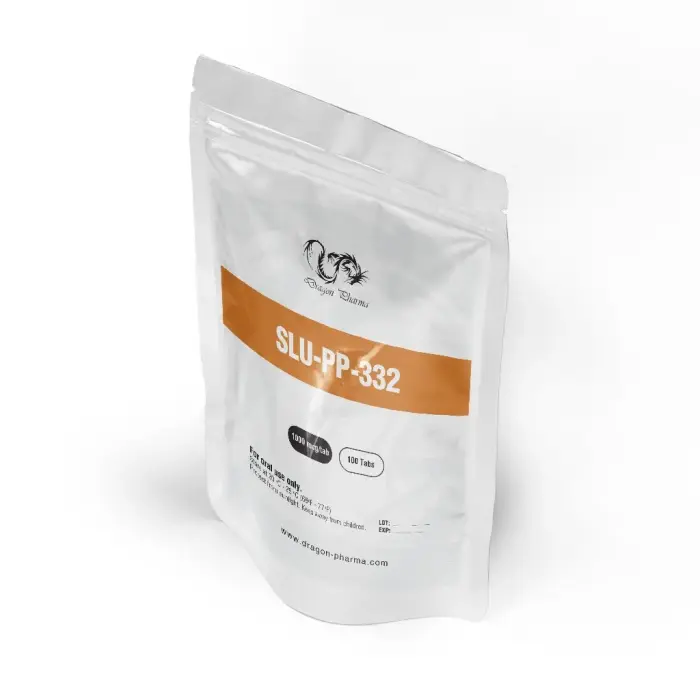
SLU-PP-332
SLU-PP-332 Dragon Pharma — Overview
SLU-PP-332 Dragon Pharma is an oral ERRα/β/γ pan-agonist — a synthetic ligand that simultaneously activates all three estrogen-related receptor isoforms. ERRs are orphan nuclear receptors that regulate the transcriptional programs responsible for mitochondrial biogenesis, fatty acid oxidation, and oxidative phosphorylation in skeletal and cardiac muscle. By activating these receptors directly, SLU-PP-332 engages the same adaptive pathways triggered by sustained endurance training — without requiring the training stimulus itself. It is one of the most mechanistically specific exercise mimetics currently available at Steroid Warehouse.
This page covers the ERR pathway and how SLU-PP-332 engages it, the documented metabolic and endurance effects in preclinical models, practical combination protocols with complementary research compounds, and a monitoring framework appropriate for a novel research compound with limited long-term human data.
About the Compound: SLU-PP-332
Estrogen-related receptors (ERRα, ERRβ, ERRγ) are orphan nuclear receptors — they were identified by structural homology to estrogen receptors but do not bind estrogen and have no estrogenic activity. Their biological role is energy homeostasis: ERRα and ERRγ are master regulators of mitochondrial oxidative metabolism, directly controlling the expression of genes involved in the tricarboxylic acid (TCA) cycle, electron transport chain, fatty acid β-oxidation, and ATP synthesis. ERRα in particular works in concert with the PGC-1α coactivator — the same transcriptional axis that endurance exercise activates to drive mitochondrial adaptation in skeletal muscle.
SLU-PP-332 was developed as the first high-affinity synthetic pan-agonist for all three ERR isoforms. In animal models it produced significant increases in endurance capacity, upregulated fatty acid oxidation enzymes, and expanded mitochondrial density in skeletal muscle — recapitulating key molecular hallmarks of trained endurance athletes. Because its mechanism operates entirely downstream of the exercise signal, it does not require physical activity to activate these pathways, though combining it with training amplifies the effect.
What SLU-PP-332 Does
SLU-PP-332 acts at the transcriptional level, activating ERR-driven gene programs that govern aerobic energy metabolism. All documented effects operate through this nuclear receptor pathway:
- Mitochondrial biogenesis — ERRα/PGC-1α co-activation upregulates the expression of mitochondrial biogenesis genes (TFAM, NRF1, NRF2); over weeks of use this increases mitochondrial density in skeletal muscle, expanding the cell's oxidative capacity; this is the same adaptation that distinguishes endurance-trained muscle from untrained muscle
- Upregulated fatty acid β-oxidation — ERR agonism increases transcription of MCAD, LCAD, and other rate-limiting fatty acid oxidation enzymes; the practical result is a higher proportion of fat used as fuel during moderate-intensity activity, sparing glycogen and improving sustained output
- Increased endurance capacity — in preclinical models SLU-PP-332 significantly extended running duration and improved time-to-exhaustion metrics; the effect was observed at rest as well as in combination with training, suggesting both baseline metabolic remodeling and training amplification
- Oxidative fiber upregulation — ERRγ activation promotes a slow-twitch oxidative fiber phenotype in skeletal muscle; this improves endurance at the expense of peak contractile speed but is highly favorable for prolonged aerobic output
- No androgenic, anabolic, or thermogenic activity — SLU-PP-332 does not bind androgen receptors, does not affect protein synthesis rates directly, and does not raise core temperature; any body composition effects are secondary to improved fat oxidation efficiency
Research context: all quantified efficacy data for SLU-PP-332 is from animal models. Human pharmacokinetics and clinical dose-response data are not yet established. Practical protocols are extrapolated from animal study dosing, community use patterns, and mechanistic parallels with GW-501516 — a better-documented PPAR-δ agonist with a partially overlapping pathway. SLU-PP-332 is a research compound; use reflects early adoption of uncharacterized pharmacology.
Who It's For
- What sets it apart: SLU-PP-332 targets the ERR/PGC-1α axis directly — the core transcriptional program of endurance adaptation. No other compound in the steroidwarehouse lineup works through this specific receptor pathway. GW-501516 activates PPAR-δ (which converges on overlapping gene programs further downstream); AICAR activates AMPK (which also feeds into PGC-1α but through a different upstream signal). SLU-PP-332 acts at the nuclear receptor level on the same genes that endurance training activates, making it the most mechanistically direct exercise mimetic available.
- Best scenario: athletes prioritizing aerobic capacity, fat utilization efficiency, and mitochondrial density — especially when training volume is limited by recovery, injury, or cutting-phase energy restriction. Also suited to experienced users wanting to add a metabolic layer to AAS or peptide cycles without adding hormonal load.
- Choose something else instead: users seeking anabolic muscle growth (LGD-4033, testosterone), thermogenic fat loss (clenbuterol), or appetite suppression will not get those effects from SLU-PP-332. It is not a fat burner in the thermogenic sense and has no muscle-building activity. Users uncomfortable with early-stage research compound pharmacology should use GW-501516 Dragon Pharma as a better-characterized alternative with similar functional goals.
- No gender restrictions; no hormonal activity means equal applicability for male and female users
- Appropriate for intermediate to advanced users who understand the research-stage nature of the compound and are monitoring bloodwork as a baseline safety practice
SLU-PP-332 vs Alternatives
| Compound | Key Difference | Choose SLU-PP-332 When | Choose Alternative When |
|---|---|---|---|
| GW-501516 Dragon Pharma | PPAR-δ agonist; activates fat oxidation and endurance via a different but overlapping receptor pathway; substantially more human community data available | You want the most direct ERR/PGC-1α transcriptional activation or are stacking both for additive pathway coverage | You prefer a compound with more established community dosing data and a longer track record of human use |
| AICAR Dragon Pharma | AMPK activator; works upstream of PGC-1α rather than directly at ERR; injectable; acute energy-sensing mechanism vs sustained transcriptional remodeling | Goal is sustained mitochondrial adaptation via daily oral dosing over weeks | You want acute AMPK-driven effects combined with glycogen management, or prefer injectable administration for precision dosing |
| MK-677 Dragon Pharma | Ghrelin receptor agonist; raises GH and IGF-1; body composition and recovery focus; no endurance or mitochondrial pathway activity | Primary goal is fat oxidation efficiency and aerobic capacity improvement | You want GH-axis body composition benefits — lean mass preservation, recovery, and IGF-1 elevation — rather than endurance adaptation |
| L-Carnitine 500 Dragon Pharma | Mitochondrial fatty acid transport cofactor; supports fat oxidation at the substrate level rather than transcriptionally; significantly milder effect magnitude | You want nuclear receptor-level transcriptional remodeling with measurable endurance impact | You want a low-risk dietary supplement-level fat metabolism support without research compound pharmacology |
Combinations
| Goal | Stack | Notes |
|---|---|---|
| Endurance-only research protocol | SLU-PP-332 1–2 mg/day + structured cardio program | Standalone use; training amplifies ERR-driven mitochondrial adaptation; most informative way to assess individual response before stacking |
| Dual exercise mimetic stack | SLU-PP-332 1 mg/day + GW-501516 Dragon Pharma | ERR (SLU-PP-332) and PPAR-δ (GW-501516) pathways converge on overlapping gene programs via PGC-1α; additive endurance and fat oxidation effects expected; keep GW-501516 at standard doses (10–20 mg/day) |
| Triple pathway exercise mimetic | SLU-PP-332 1 mg/day + GW-501516 + AICAR Dragon Pharma | ERR + PPAR-δ + AMPK pathway coverage; most comprehensive exercise mimetic stack available; monitor liver enzymes with this combination; advanced users only |
| AAS cutting cycle add-on | SLU-PP-332 1–2 mg/day alongside testosterone-based cutting cycle | Adds fat oxidation and mitochondrial efficiency without additional hormonal load; no interaction with AAS mechanism; compatible with AI and SERM use |
| Recomp / endurance-focused bulk | SLU-PP-332 1 mg/day + MK-677 Dragon Pharma | MK-677 supports GH/IGF-1 axis for lean tissue and recovery; SLU-PP-332 improves fat oxidation and aerobic metabolism; complementary mechanisms for body composition without HPG suppression |
Side Effects & Management
SLU-PP-332 has no human clinical trial data. The side effect profile below is based on the receptor biology, preclinical findings, and mechanistic extrapolation from related compounds. ERRs are not estrogen receptors — there is no estrogenic, androgenic, or progestogenic activity.
| What May Occur | Background | How to Handle It |
|---|---|---|
| Unknown / uncharacterized effects | As a first-generation research compound with no human trials, off-target effects not yet observed in animal models may emerge in human use; this is the primary risk of any early-stage research compound | Baseline bloodwork before starting; recheck at week 4; start at the lowest effective dose (1 mg/day) before escalating; stop immediately and run full bloodwork at any unexplained symptom |
| Liver enzyme elevation (theoretical) | All novel oral research compounds carry a precautionary hepatic monitoring requirement; no hepatotoxicity has been reported for SLU-PP-332 specifically, but the absence of data is not confirmation of safety | Run ALT/AST at baseline and week 4; pause use if ALT exceeds 2× upper limit of normal; for liver support consider Liv.52 as a precautionary baseline measure during multi-compound stacks |
| GI discomfort | Common for oral research compounds at novel doses; not receptor-specific; typically adaptation-related in the first 1–2 weeks | Take with food; reduce to 1 mg/day if persistent; Motilium (Domperidone) for nausea if needed |
| Altered energy substrate utilization | ERR agonism shifts skeletal muscle toward fatty acid oxidation; users may notice reduced performance in explosive, glycolytic activities (sprint, heavy lifting) early in a run as mitochondrial remodeling progresses — a normal metabolic shift, not a pathological effect | Maintain adequate carbohydrate intake around training; the substrate shift typically stabilizes after 2–3 weeks as mitochondrial density increases; do not reduce training volume during the adaptation phase |
| Thyroid marker changes (theoretical) | ERRα interacts with thyroid hormone signaling pathways at the transcriptional level; modest effects on TSH or peripheral thyroid hormone metabolism are theoretically possible | Include TSH, T3, T4 in baseline and follow-up bloodwork; no intervention typically required given the indirect nature of any interaction; flag to a physician if thyroid markers move outside normal range |
Bloodwork Monitoring
| Lab | When to Test | Target & Action Threshold |
|---|---|---|
| ALT / AST (liver enzymes) | Baseline; week 4; end of cycle | Target ALT <40 U/L; pause use if ALT exceeds 2× upper limit of normal (>80 U/L); precautionary for any novel oral research compound |
| Lipid panel (HDL, LDL, total cholesterol) | Baseline; week 4–6 | ERR agonism may modulate lipid metabolism; target LDL <130 mg/dL; if HDL drops significantly from baseline, review concurrent compound use and consider Rosulip (Rosuvastatin) |
| Thyroid panel (TSH, Free T3, Free T4) | Baseline; end of cycle | Include as precautionary monitoring given ERRα–thyroid signaling interaction; target TSH 0.4–4.0 mIU/L; flag any movement outside normal range |
| CBC (complete blood count) | Baseline; end of cycle | General safety baseline; no specific hematological concern for ERR agonists; confirms no unexpected effect on erythropoiesis or white cell populations |
| Fasting glucose / insulin | Baseline; week 6 | ERR agonism may improve insulin sensitivity via mitochondrial remodeling; target fasting glucose <100 mg/dL; document baseline to distinguish compound effect from dietary changes during the run |
Cycle Structure
| Phase | Protocol | Notes |
|---|---|---|
| Weeks 1–2 (intro) | 1 mg/day, with food, morning | Baseline assessment period; run bloodwork before starting; document any GI, energy, or performance changes; do not escalate until this window confirms tolerability |
| Weeks 3–6 (main run) | 1–2 mg/day, morning | Most users report noticeable changes in aerobic capacity and substrate utilization within weeks 3–4; escalate to 2 mg only if 1 mg is well tolerated and no bloodwork flags at the week 4 check |
| Weeks 7–8 (extended or exit) | 1–3 mg/day, morning; or taper down to 1 mg to close the cycle | Maximum documented preclinical use is 8 weeks; no established reason to run longer in the absence of human long-term safety data; mitochondrial adaptations persist for weeks after discontinuation |
| Post-cycle | No PCT required | SLU-PP-332 has no hormonal activity; no SERM, AI, or gonadotropin needed. Run end-of-cycle bloodwork (ALT/AST, lipids, thyroid, CBC). Mitochondrial and endurance adaptations fade gradually over 4–6 weeks post-discontinuation without maintenance training. |
Practical Summary
- Start at 1 mg/day with food; run baseline bloodwork before starting and recheck at week 4 — this is non-negotiable for a novel research compound with no human trial data
- ERRs are not estrogen receptors; SLU-PP-332 has zero estrogenic, androgenic, or progestogenic activity — no AI, SERM, or PCT is required
- Combine with regular aerobic training to amplify ERR-driven mitochondrial adaptation; the compound primes the transcriptional program, training provides the mechanical stimulus that solidifies structural changes
- Stacking with GW-501516 targets a complementary receptor pathway (PPAR-δ) for additive endurance and fat oxidation effects; monitor liver enzymes on any multi-compound research stack
- Maximum run: 8 weeks; end-of-cycle bloodwork always; mitochondrial adaptations persist for weeks after stopping if training is maintained
- Do not escalate to 3 mg/day without confirmed tolerability at 2 mg and a clean week 4 bloodwork panel
SLU-PP-332 represents the leading edge of exercise mimetic pharmacology — a compound that engages the ERR/PGC-1α transcriptional axis that endurance training activates, without requiring the training load itself. For athletes prioritizing aerobic capacity, fat oxidation efficiency, and mitochondrial density, it offers a mechanistically distinct tool that no other compound in the steroidwarehouse lineup currently covers. At 1–2 mg/day over 4–8 weeks, with appropriate bloodwork monitoring and realistic expectations about its research-stage status, SLU-PP-332 by Dragon Pharma is positioned as a specialized addition to endurance-focused and recomposition-oriented stacks rather than a mainstream fat burner or anabolic compound.
References
| Source | Topic | Link |
|---|---|---|
| ACS Chemical Biology / PubMed | Billon et al. 2023 — pharmacological characterization of SLU-PP-332 as a synthetic ERRα/β/γ agonist; documents ERRα-dependent acute aerobic exercise-response signaling, increased oxidative skeletal muscle fibers, and enhanced exercise capacity in mouse models | Billon C, et al. (2023) ↗ |
| Endocrine Reviews / PubMed | Giguère 2008 — comprehensive review of estrogen-related receptors in energy homeostasis; covers ERRα, ERRβ, and ERRγ biology, transcriptional control, PGC-1 coactivator interactions, and roles in oxidative metabolism | Giguère V (2008) ↗ |
| Cell / PubMed | Narkar et al. 2008 — study showing that AMPK and PPAR-δ agonists can act as exercise mimetics in mice; useful as mechanistic context for endurance-signaling pathways, but not direct evidence for SLU-PP-332 itself | Narkar VA, et al. (2008) ↗ |
| Molecular and Cellular Biology / PubMed | Huss et al. 2004 — ERRα directs PPARα signaling in transcriptional control of energy metabolism in cardiac and skeletal muscle; supports the ERRα–PGC-1α axis behind fatty acid oxidation and mitochondrial gene regulation | Huss JM, et al. (2004) ↗ |
| Proceedings of the National Academy of Sciences / PubMed | Villena et al. 2007 — ERRα knockout study showing impaired adaptive thermogenesis and altered mitochondrial oxidative metabolism; supports ERRα as a core regulator of mitochondrial biogenesis, oxidative metabolism, and energy adaptation | Villena JA, et al. (2007) ↗ |
What is SLU-PP-332?
SLU-PP-332 is an oral ERR agonist mimicking exercise; see What is SLU-PP-332. It boosts fat loss—consult professionals for safe use.
What is SLU-PP-332 used for?
It's used for fat loss and endurance in cutting cycles; see Key Benefits. It suits bodybuilders—use with professional oversight.
What does SLU-PP-332 do?
It enhances fat metabolism and endurance via ERR activation; see Mechanism of Action. It mimics exercise—monitor with labs.
Is SLU-PP-332 safe?
It's safe with proper dosing and monitoring, but investigational; see Side Effects. Consult professionals for safety due to limited human data.
When are effects usually discussed by users?
Anecdotal discussions often mention:
- Improved endurance and workout capacity
- Better exercise tolerance
- Gradual body composition support when combined with training and nutrition
Individual experiences can vary significantly.
What are the possible side effects?
Because SLU-PP-332 remains an experimental compound, its full safety profile is not established.
Potentially reported effects may include:
- Headaches
- Fatigue
- Digestive discomfort
- Changes in energy levels
Long-term human safety data remain limited.
How does SLU-PP-332 work?
SLU-PP-332 is believed to activate pathways related to ERR (Estrogen-Related Receptor) signaling, which play a role in mitochondrial function, energy production, and metabolic adaptation.
What are the main benefits of SLU-PP-332?
Commonly discussed benefits include enhanced endurance, improved energy metabolism, increased calorie utilization, and support for body composition goals.
Related Products