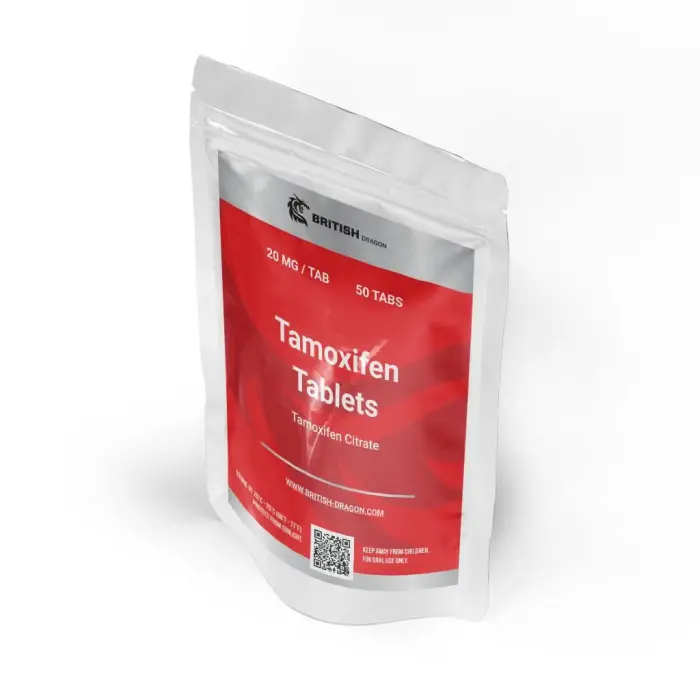
Tamoxifen Tablets
Overview
Tamoxifen Tablets British Dragon deliver tamoxifen citrate at 20 mg per tablet — the standard PCT dose in a 100-tab pack providing 2,000 mg total, sufficient for a complete 4–6 week post-cycle therapy course at either the standard 20 mg/day maintenance dose or the 40 mg/day loading schedule used in the first two weeks of recovery. Tamoxifen is a selective estrogen receptor modulator (SERM): it competitively blocks estrogen receptors in breast tissue and in the hypothalamic-pituitary axis, simultaneously preventing gynecomastia at tissue level and driving LH and FSH secretion to restart endogenous testosterone production. Unlike aromatase inhibitors, tamoxifen does not suppress circulating estradiol — it works downstream, at the receptor level, leaving systemic E2 intact while blocking its action where it is problematic. steroidwarehouse.com carries Tamoxifen BD alongside Clomiphene BD for users building the standard dual-SERM post-cycle protocol.
About the Compound
Tamoxifen is a triphenylethylene SERM developed in the 1960s and still among the most widely used estrogen-pathway drugs in both clinical and performance-sport settings. Its tissue-specific action is the defining characteristic: in breast tissue and in the hypothalamus/pituitary, tamoxifen acts as an estrogen antagonist, blocking estrogen receptor binding by estradiol. In liver, bone, and uterine tissue, it acts as a partial agonist, which contributes to the favourable lipid profile changes (HDL increase) seen during use while also explaining why extended daily use carries a small uterine endometrial risk in women — irrelevant for the typical short-course male PCT use.
The hypothalamic antagonism is the mechanism underlying tamoxifen's utility in PCT: by blocking estradiol's negative feedback on GnRH release, tamoxifen removes the brake on the hypothalamic-pituitary axis. GnRH pulses increase → LH and FSH secretion rises → Leydig cells receive the LH signal → testosterone synthesis restarts. This makes tamoxifen both a gynecomastia prevention tool and an HPG axis restoration agent in a single compound, which is why it remains the most used PCT SERM in AAS protocols despite decades of newer alternatives.
What It Does
- Blocks estrogen receptors in breast tissue: Tamoxifen competes directly with estradiol for binding at estrogen receptors in mammary tissue, preventing E2-driven breast gland stimulation. This is the primary mechanism behind both gynecomastia prevention (on-cycle) and treatment of existing breast tissue sensitivity. Unlike AIs which reduce circulating E2, tamoxifen leaves E2 available for its beneficial effects on libido, joints, mood, and cardiovascular function while protecting breast tissue specifically.
- Restores LH and FSH by removing hypothalamic estrogen brake: During AAS cycles, suppressed LH and FSH reflect negative feedback from supraphysiological testosterone and estradiol on the hypothalamus and pituitary. By blocking estrogen receptors at the hypothalamus, tamoxifen removes this feedback brake, rapidly increasing GnRH pulsatility and downstream LH/FSH secretion. Increases in LH output are measurable within 7–14 days of tamoxifen initiation in suppressed men.
- Drives endogenous testosterone recovery: The LH surge triggered by tamoxifen's hypothalamic action stimulates Leydig cell testosterone synthesis. Recovery rate depends on the length and intensity of prior suppression, but users typically see measurable testosterone increases within 2–3 weeks of tamoxifen PCT, with most recovering to baseline within 4–8 weeks on a standard 4-week protocol.
- Does not suppress circulating E2: This is the key practical advantage over aromatase inhibitors as a PCT tool. E2 is essential for bone health, libido, joint lubrication, and mood regulation — all of which are already stressed post-cycle. Tamoxifen's receptor-level action preserves systemic E2 while selectively blocking its problematic downstream effects, avoiding the crash symptoms (joint pain, low libido, depression) that can occur when AIs are used through PCT.
- Potential lipid benefit: Tamoxifen's partial agonist activity in hepatic tissue modestly improves HDL cholesterol and reduces LDL through liver-mediated mechanisms. This is a minor secondary benefit during the post-cycle period when lipid recovery from AAS-driven suppression is ongoing.
Who It's For
Tamoxifen Tablets BD are suited to any AAS user requiring post-cycle therapy after a suppressive cycle, on-cycle gynecomastia prevention when aromatization is a concern, or as a first-response compound when early gynecomastia signs (nipple sensitivity, puffiness) appear mid-cycle. The key differentiator from aromatase inhibitors (Anastrozole, Letrozole, Exemestane) is mechanism: tamoxifen does not reduce circulating estradiol but blocks its receptor-level action in target tissues. This makes it the preferred PCT tool over AIs because it avoids estrogen-deficiency symptoms during recovery, when the body is already hormonally stressed.
Compared to Clomiphene BD, tamoxifen produces a more modest but smoother LH/FSH stimulation. Clomiphene generates stronger LH pulses and is more effective for fast testosterone recovery in heavily suppressed users, but carries a higher rate of mood side effects including depression, anxiety, and visual disturbances. Tamoxifen is better tolerated, provides superior breast tissue protection, and is preferred as the base of any dual-SERM PCT protocol. Most protocols combine both: Clomiphene for the stronger HPG stimulus, tamoxifen for the breast tissue coverage and E2 management.
Users who should consider an alternative or addition: anyone coming off a long heavy cycle (≥16 weeks) with significant testicular atrophy should add HCG before starting SERM-based PCT to prime Leydig cell sensitivity first. Users with existing gynecomastia that does not respond to tamoxifen alone within 4–6 weeks may require Raloxifene DP, which some evidence suggests may be more effective for resolving established gynecomastia tissue.
Tamoxifen vs Alternatives
| Compound | Key Differences | Choose Tamoxifen BD When | Choose Alternative When |
|---|---|---|---|
| Clomiphene BD (clomiphene citrate — SERM) | Stronger LH/FSH stimulus; faster testosterone recovery in heavily suppressed users; higher rate of mood side effects (depression, anxiety, visual disturbances); less effective than tamoxifen at breast tissue estrogen receptor blockade; typically combined with tamoxifen rather than used instead | Breast tissue protection is the primary concern; milder mood side effect profile preferred; lighter cycles with moderate suppression; base of dual-SERM stack with Clomiphene added for extra HPG stimulus | Heavy suppression requiring maximum LH stimulus; faster testosterone recovery prioritized over tolerability; user has no prior history of mood sensitivity to clomiphene |
| Nolvadex Dragon Pharma (tamoxifen) | Identical active compound (tamoxifen citrate); same half-life, mechanism, and dosing protocol; different brand and manufacturing source; no pharmacological difference; choice is entirely brand preference and stock availability | British Dragon brand preferred; BD-sourced product desired; same protocol, same outcome | Dragon Pharma brand preferred or in stock when BD is not; no clinical reason to prefer one tamoxifen source over another |
| Raloxifene Dragon Pharma (raloxifene — SERM) | Different SERM with potentially stronger breast tissue estrogen receptor blockade; some evidence suggests superior efficacy for established gynecomastia vs tamoxifen; less well-studied in AAS PCT context; does not share tamoxifen's partial uterine agonist activity; similar LH/FSH stimulation profile | Standard PCT and gynecomastia prevention; well-established PCT evidence base preferred; first-line SERM choice | Established gynecomastia (existing breast tissue growth) that did not fully resolve on tamoxifen; stronger breast tissue ER blockade desired |
Combinations
| Goal | Primary | Support Compounds | Notes |
|---|---|---|---|
| Standard PCT — dual SERM protocol | Tamoxifen BD 20–40 mg/day | Clomiphene BD 50 mg/day (wks 1–2), 25 mg/day (wks 3–4) | The most widely used PCT combination; Clomiphene provides the stronger LH/FSH stimulus for fast testosterone recovery; tamoxifen covers breast tissue protection and smooths mood effects; run both simultaneously for 4 weeks; tamoxifen can be extended to week 6 if recovery bloodwork at week 4 shows LH/FSH still below range |
| PCT after long heavy cycle (≥16 weeks) | Tamoxifen BD 40 mg/day (wks 1–2), 20 mg/day (wks 3–6) | HCG 5000IU Dragon Pharma (2,500 IU × 2 injections, 5 days before PCT) + Clomiphene BD | HCG blast 5 days before PCT start primes Leydig cell sensitivity after extended suppression; without HCG, testicular volume reduction from long cycles slows SERM response; Tamoxifen + Clomiphene then manages hypothalamic-pituitary recovery; this three-compound sequence is the standard protocol for cycles exceeding 16 weeks |
| On-cycle gynecomastia prevention | Tamoxifen BD 10–20 mg/day | Anastrozole BD (primary E2 control) | Anastrozole reduces aromatization and lowers circulating E2 as the primary gynecomastia prevention strategy; tamoxifen at 10–20 mg/day added as a receptor-level safety layer for the breast tissue; this dual approach covers both the source (aromatase activity) and the receptor target simultaneously; useful on cycles above 500 mg/week testosterone where E2 can spike unpredictably |
| Early gynecomastia response (mid-cycle) | Tamoxifen BD 40 mg/day for 2 weeks, then 20 mg/day | Anastrozole BD (add or increase dose) | At first signs of nipple sensitivity or puffiness mid-cycle: immediately add tamoxifen at 40 mg/day and review AI dose; tamoxifen blocks the ER signal at the gland level while Anastrozole reduces the circulating E2 that is driving the stimulus; combined, this approach stops early gynecomastia in most users within 1–2 weeks; do not wait to see if it resolves on its own |
Side Effects & Management
| Side Effect | Frequency | How to Handle It |
|---|---|---|
| Hot flashes | Common — most frequent reported side effect; caused by central estrogen receptor blockade at thermoregulatory centres | Typically mild and self-limiting at the 4–6 week PCT duration; reduce dose from 40 mg to 20 mg if severe; hot flashes usually diminish by week 2–3 as the body adapts; no pharmacological intervention required for short PCT courses; ensure adequate hydration |
| Mood changes (irritability, low mood) | Moderate — less pronounced than with clomiphene; central E2 receptor blockade can affect mood regulation | Reduce tamoxifen dose to 20 mg/day if mood disturbance is significant; combining with Clomiphene at high doses amplifies mood effects — reduce clomiphene first; mood typically improves as endogenous testosterone recovers; if severe depression develops, discontinue and reassess the PCT protocol |
| Libido suppression during PCT | Common — central E2 blockade transiently reduces libido; paradox of PCT is that the recovery tool temporarily impairs the function it is trying to restore | Expected during the first 2–3 weeks; libido recovers as testosterone levels rise; Mesterolone BD 25 mg/day can be added during PCT for SHBG suppression and libido support without interfering with the PCT mechanism; Taldabol BD for acute ED if needed |
| Nausea | Mild — dose-dependent; more common at 40 mg/day | Take tamoxifen with food; if nausea persists at 40 mg, split into two 20 mg doses (morning and evening); usually resolves within the first week as tolerance develops |
| Visual disturbances | Rare at short PCT doses — associated with long-term clinical use; more common with clomiphene than tamoxifen at PCT durations | Any blurred vision, light sensitivity, or color perception changes during PCT: stop tamoxifen immediately and do not resume; visual side effects from tamoxifen at PCT doses are very uncommon but represent a zero-tolerance indicator; do not continue dosing while investigating visual symptoms |
| SHBG elevation | Mild — tamoxifen's partial agonist activity in liver slightly raises SHBG, which can bind free testosterone during recovery | Minor at PCT dosing durations; add Mesterolone BD 25 mg/day to displace testosterone from SHBG and maximize free testosterone availability during recovery; this combination is particularly useful for users who feel slow-to-recover libido and energy despite adequate total testosterone levels |
Bloodwork Monitoring
| Lab | When to Test | Target & Action Threshold |
|---|---|---|
| LH + FSH | Baseline (before PCT start); week 4 of PCT; 4 weeks post-PCT | Baseline confirms suppression depth before PCT; on-PCT LH should be rising by week 2–3; post-PCT LH and FSH should be within normal range; persistently low LH/FSH at 4 weeks post-PCT indicates incomplete HPG recovery — extend protocol or consider re-evaluation |
| Total testosterone | Baseline (end of cycle / before PCT); end of PCT; 4 weeks post-PCT | Recovery target: return to pre-cycle baseline; most users reach mid-range normal (400–700 ng/dL) within 4–6 weeks of tamoxifen PCT; values below 300 ng/dL at 6 weeks post-PCT indicate inadequate recovery — reassess protocol and consider extending SERM therapy |
| Estradiol (E2) | Baseline (end of cycle); mid-PCT if symptoms suggest E2 crash | E2 should not be suppressed during tamoxifen PCT — tamoxifen does not reduce circulating E2; if E2 is low at PCT start, this indicates over-aggressive AI use during the cycle; do not add AIs during PCT alongside tamoxifen unless active gynecomastia is present; target E2 in normal male range (20–40 pg/mL) |
| SHBG | Baseline; end of PCT | Tamoxifen mildly elevates SHBG; if total testosterone recovers but free testosterone remains low and libido is poor, check SHBG; elevated SHBG (>55 nmol/L) explains the disconnect; Mesterolone BD 25 mg/day addresses this directly |
| Lipid panel (HDL, LDL, triglycerides) | Baseline (post-cycle); end of PCT | Tamoxifen's partial agonist activity in liver modestly improves HDL and LDL during the recovery period; triglycerides may rise slightly; track against end-of-cycle values to confirm lipid recovery trajectory post-AAS |
| Liver enzymes (ALT, AST) | Baseline; end of PCT if tamoxifen is run beyond 6 weeks | Tamoxifen at standard 4–6 week PCT doses rarely affects liver enzymes; elevated transaminases at PCT baseline are typically residual from oral AAS use; track for resolution during PCT; if ALT/AST rising during tamoxifen use (uncommon), reduce dose and investigate |
Dosing Protocol & PCT Timeline
Tamoxifen timing relative to the end of the AAS cycle depends on the ester length of the compounds used. The SERM only works when exogenous androgen levels are low enough for the HPG axis to respond to the LH stimulus tamoxifen generates. Starting PCT too early, while significant androgen levels remain, wastes the SERM window and extends the suppression period.
Short esters (propionate, phenylpropionate): Wait 3–5 days after the last injection before beginning tamoxifen. These esters clear quickly, and the HPG axis is responsive within days of the last dose.
Long esters (enanthate, cypionate, decanoate): Wait 14–21 days after the last injection. Decanoate (as in Sustabol 350) has a ~15-day half-life; starting PCT at 14 days allows adequate ester clearance while not delaying recovery unnecessarily.
Standard tamoxifen PCT protocol:
- Weeks 1–2: 40 mg/day (2 tablets)
- Weeks 3–4: 20 mg/day (1 tablet)
With Clomiphene BD (dual-SERM):
- Weeks 1–2: Tamoxifen 40 mg/day + Clomiphene BD 50 mg/day
- Weeks 3–4: Tamoxifen 20 mg/day + Clomiphene BD 25 mg/day
Extended PCT for long or heavy cycles: If bloodwork at week 4 shows LH/FSH still below range or total testosterone below 300 ng/dL, extend tamoxifen at 20 mg/day for a further 2 weeks. Retest at week 6. Most users recover fully within 4–6 weeks on a dual-SERM protocol; extended suppression beyond 6 weeks of SERM therapy warrants a full endocrine review.
Practical Summary
- Time the start correctly — wait for ester clearance: 3–5 days after the last injection for short esters; 14–21 days for long esters (enanthate, decanoate); starting while androgens are still elevated makes tamoxifen ineffective.
- Standard dose — 40/20 split: 40 mg/day for the first 2 weeks drives the initial HPG stimulus; drop to 20 mg/day for weeks 3–4 as LH/FSH normalizes; do not maintain 40 mg/day throughout — it adds side effect burden without proportional benefit.
- Add Clomiphene BD for faster recovery: the dual-SERM stack (Tamoxifen 20–40 mg + Clomiphene 25–50 mg) produces faster and more complete HPG axis restoration than either compound alone; this is the standard protocol for any cycle beyond 8 weeks.
- Do not add AIs during PCT: tamoxifen works best when systemic E2 is available; crushing E2 with Anastrozole or Letrozole during PCT impairs the hypothalamic response and worsens joint pain, libido, and mood recovery; AIs should be tapered and stopped before PCT begins.
- Add Mesterolone BD for libido and free testosterone: 25 mg/day throughout PCT displaces testosterone from SHBG (elevated by tamoxifen), improves free testosterone availability, and supports libido during the recovery window without interfering with the SERM mechanism.
- Stop immediately at any visual symptom: any blurred vision, light sensitivity, or color disturbance during tamoxifen use is a zero-tolerance signal; discontinue and do not resume; visual complications from tamoxifen at PCT doses are rare but serious.
Tamoxifen Tablets British Dragon delivers the foundational SERM at the full 20 mg PCT dose, providing the dual functionality that makes tamoxifen the most widely used post-cycle compound in AAS protocols: direct breast tissue estrogen receptor blockade and hypothalamic signaling that drives LH, FSH, and endogenous testosterone recovery simultaneously. At 100 tablets per pack it covers a complete 4–6 week PCT course at either the maintenance dose or the 40 mg loading schedule used in the first two weeks. Steroid Warehouse stocks Tamoxifen BD alongside Clomiphene BD for users building the standard dual-SERM post-cycle stack.
References
| Source | Topic | Link |
|---|---|---|
| Nature Reviews Drug Discovery / PubMed | Jordan VC 2003 — review article on the clinical development of tamoxifen as a pioneering selective estrogen receptor modulator; covers tamoxifen pharmacology, tissue-selective estrogen receptor activity, breast cancer treatment and prevention history, and the broader SERM concept | Jordan VC (2003) ↗ |
| Andrology / PubMed | Huijben M et al. 2022 — systematic review and meta-analysis of clomiphene citrate for men with hypogonadism; reports improved testosterone levels and clinical symptoms, supporting SERM-based stimulation of endogenous testosterone production in male hypogonadism contexts | Huijben M, et al. (2022) ↗ |
| NCBI Bookshelf / StatPearls | Anabolic steroids overview — clinical reference on synthetic testosterone-derived anabolic-androgenic steroids, HPG-axis suppression mechanisms, androgen receptor activity, adverse effect profile including endocrine suppression, and monitoring considerations relevant to post-cycle endocrine recovery | StatPearls: Anabolic Steroids ↗ |
| NCBI Bookshelf / Endotext | Androgen physiology and pharmacology — comprehensive overview of testosterone, HPG-axis regulation, LH/FSH control of endogenous testosterone synthesis, androgen receptor signaling, and endocrine suppression associated with exogenous androgen use | Endotext: Androgen Physiology, Pharmacology, Use and Misuse ↗ |
What are Tamoxifen Tablets?
Tamoxifen Tablets are an oral SERM (Tamoxifen Citrate) for testosterone recovery and estrogen control; see What are Tamoxifen Tablets. They support PCT—consult professionals for safe use.
What do Tamoxifen Tablets do?
They block estrogen and stimulate testosterone; see What Do Tamoxifen Tablets Do. They prevent gynecomastia—monitor with labs.
Are Tamoxifen Tablets safe?
They are generally safe with oversight, but risks include hot flashes and rare clotting; see Are Tamoxifen Tablets Safe. Consult professionals for monitoring.
How do I take Tamoxifen Tablets?
20-40 mg/day during PCT, tapering down; see How to Take Tamoxifen Tablets. Start at 20 mg—consult professionals for dosing.
What is Tamoxifen used for?
Tamoxifen is commonly associated with estrogen management and hormonal balance by modulating the activity of estrogen at receptor sites.
How does Tamoxifen work?
Tamoxifen works by binding to estrogen receptors and selectively blocking or modifying estrogen's effects in specific tissues, depending on the location and physiological context.
What are the main benefits of Tamoxifen?
Commonly discussed benefits include support for estrogen management, hormonal balance, and modulation of estrogen-related activity within the body.
How is Tamoxifen different from aromatase inhibitors?
Unlike aromatase inhibitors, which reduce estrogen production, Tamoxifen primarily works by interacting with estrogen receptors and modifying estrogen's effects at those sites.
Related Products