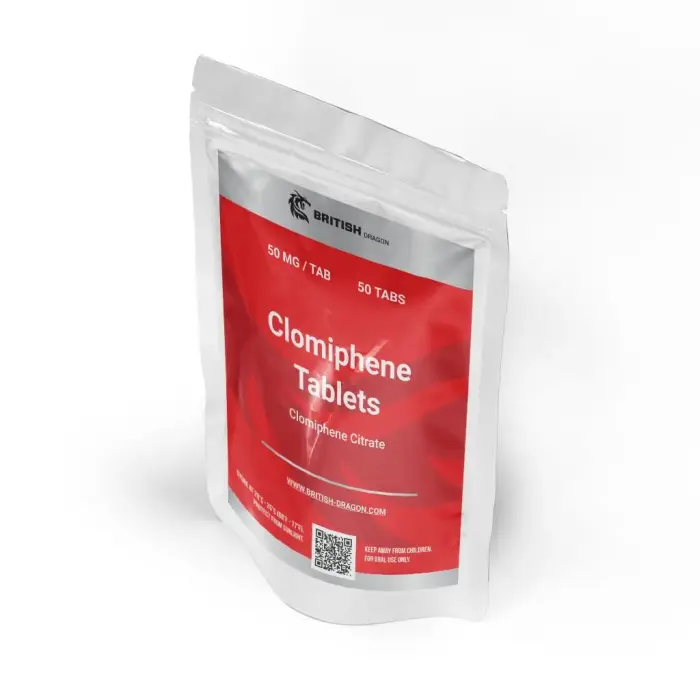
Clomiphene Tablets
Clomiphene Tablets British Dragon — Overview
Clomiphene Tablets British Dragon — selective estrogen receptor modulator (SERM), 50 mg per tablet, 100 tablets per pack. Clomiphene citrate is the most widely used SERM for post-cycle therapy (PCT) in AAS users: it stimulates the hypothalamus and pituitary to increase output of LH and FSH, which in turn drives endogenous testosterone production back toward baseline after the suppression caused by an AAS cycle. It does not aromatize, does not suppress the HPG axis, and carries no anabolic effect.
This page covers clomiphene's mechanism of action in male HPG axis recovery, how it compares to tamoxifen and aromatase inhibitors, PCT protocol design, timing, and side effect management.
About Clomiphene: HPG Axis Mechanism
Clomiphene citrate is a non-steroidal triphenylethylene SERM with both estrogen agonist and antagonist properties depending on the tissue. In the hypothalamus and pituitary — the two sites critical for AAS recovery — clomiphene acts as an estrogen receptor antagonist. By blocking estrogen's negative feedback signal at these sites, clomiphene releases the suppression on GnRH (gonadotropin-releasing hormone) secretion, which drives a compensatory rise in LH (luteinizing hormone) and FSH (follicle-stimulating hormone) output from the pituitary. Elevated LH then stimulates Leydig cells in the testes to resume testosterone biosynthesis.
This mechanism is directly targeted at the root cause of AAS-induced hypogonadism: the HPG axis suppression caused by supraphysiologic androgen and estrogen levels during a cycle. Clomiphene does not increase testosterone by any androgenic route — it restores the hormonal signaling cascade that testosterone production depends on.
The ~5–7 day half-life is long relative to most oral compounds. Once-daily dosing is pharmacologically appropriate and produces stable plasma levels. The long half-life also means that clomiphene continues to exert its LH-stimulating effect even on days when the dose is tapered — there is no abrupt cliff in activity when transitioning from 50 mg/day to 25 mg/day, which is one reason the standard taper at weeks 3–4 is smooth.
What It Does
- LH stimulation — by blocking estrogenic negative feedback at the pituitary, clomiphene drives a rapid and pronounced increase in LH secretion. In male hypogonadism studies, clomiphene raises LH to supranormal levels within days of initiation. The elevated LH signal is the direct trigger for testicular testosterone production to resume.
- FSH stimulation — along with LH, FSH rises under clomiphene. FSH is responsible for spermatogenesis and testicular volume maintenance. Long AAS cycles suppress both LH and FSH, and clomiphene's FSH-restoring effect is one reason it is preferred over tamoxifen in PCT protocols where fertility restoration is a consideration — clomiphene's FSH response is generally more pronounced than tamoxifen's.
- Endogenous testosterone restoration — the combined LH/FSH rise under clomiphene translates within 2–4 weeks into measurable increases in serum testosterone. The rate and ceiling of recovery depend on the depth and duration of the preceding suppression; clomiphene provides the hormonal stimulus but the testes need time to recover Leydig cell function after a long cycle.
- Estrogenic partial agonism at non-pituitary tissues — clomiphene has weak estrogenic agonist activity in some peripheral tissues (bone, liver, endometrium). This distinguishes it from tamoxifen and has minor practical relevance in male PCT: it means clomiphene provides some estrogen-like signaling in tissues where estrogen is beneficial (e.g., bone density) even while blocking it at the pituitary. It also means clomiphene should not be relied upon to fully suppress estrogenic side effects on-cycle — it is not an on-cycle AI.
Who It Is For
Clomiphene is used in PCT by AAS users whose primary goal is restoring the HPG axis — specifically LH, FSH, and natural testosterone production — after a suppressive cycle. It is the most commonly used PCT SERM because its LH-stimulating response is stronger and more direct than tamoxifen's at standard doses.
Clomiphene fits best for:
- Athletes coming off moderate to heavy AAS cycles (testosterone-based, nandrolone, trenbolone, or multi-compound stacks) where HPG suppression is deep and the priority in PCT is strong, rapid LH/FSH recovery. Clomiphene's pronounced LH response makes it the preferred single SERM for cycles with significant gonadotropin suppression.
- Athletes prioritizing fertility restoration post-cycle — clomiphene's dual LH and FSH stimulation is more directly applicable to spermatogenesis recovery than tamoxifen, which is primarily an ER antagonist with a less robust FSH response.
- Post-cycle users who want to use a dual-SERM protocol — combining clomiphene with Tamoxifen BD for the first 2–4 weeks of PCT adds tamoxifen's direct estrogen blockade (particularly at breast tissue) while clomiphene drives the LH/FSH side. This is the standard approach for PCT after heavy or long cycles.
Users who should choose something else or adjust: athletes whose primary PCT concern is controlling elevated estrogen rather than stimulating LH — in that case Exemestane BD is more appropriate as the estrogen-reducing component, used alongside a SERM rather than replacing it; athletes with a history of visual disturbances on clomiphene (a known side effect at higher doses) should consider switching entirely to tamoxifen for PCT.
Clomiphene vs Alternatives
| Compound | Key Differences | Choose Clomiphene When | Choose Alternative When |
|---|---|---|---|
| Clomiphene BD (this product) |
SERM; strong LH and FSH stimulator via ER antagonism at hypothalamus/pituitary; partial estrogenic agonist at peripheral tissues; long half-life (~5–7 days); 50 mg/tab. | Maximum LH/FSH recovery stimulus needed; fertility restoration a priority; standard or dual-SERM PCT after moderate to heavy cycles. | History of visual disturbances on clomiphene; primary concern is peripheral estrogen blockade rather than LH stimulation. |
| Tamoxifen Tablets BD | SERM; ER antagonist in breast tissue and hypothalamus; weaker LH stimulation than clomiphene but stronger anti-estrogenic effect peripherally; half-life ~5–7 days; 20 mg/tab. | Primary concern is gynecomastia prevention or reversal during PCT; visual side effects occurred on clomiphene; used as part of dual-SERM protocol alongside clomiphene. | Maximum LH/FSH stimulus is the priority; fertility restoration; dual-SERM protocol where clomiphene handles LH stimulation and tamoxifen handles estrogen blockade — then run both. |
| Exemestane Tablets BD | Aromatase inhibitor (AI), not a SERM; reduces estrogen synthesis by blocking aromatase; steroidal, mildly androgenic; used on-cycle for E2 control or at PCT start if E2 rebound is significant; does not directly stimulate LH/FSH. | E2 rebound is elevated at PCT start; transition from on-cycle AI to PCT; used short-term at PCT initiation before switching fully to SERM therapy. | The primary PCT goal is LH/FSH and testosterone recovery — in that case a SERM (clomiphene, tamoxifen, or both) is the correct choice; AIs do not stimulate gonadotropin production. |
| Anastrozole Tablets BD | Non-steroidal AI; on-cycle estrogen management tool; suppresses E2 during the cycle; stop at PCT start — continued AI use through PCT blocks the estrogen-driven positive feedback needed for HPG recovery. | On-cycle E2 management alongside aromatizing AAS; never the primary PCT tool. | PCT itself — anastrozole should be discontinued when SERM-based PCT begins. Clomiphene replaces it for the recovery phase. |
PCT Protocol Combinations
| Cycle Type | PCT Stack | Rationale |
|---|---|---|
| Short / mild cycle (oral only or short esters, 6–8 wks) |
Clomiphene Tablets BD — 50 mg/day × 2 wks, then 25 mg/day × 2 wks Start: 3–5 days after last dose |
Single-SERM protocol is sufficient for short, mildly suppressive cycles. LH recovery is typically rapid when suppression was limited in duration. Tab math: 14 tabs (wks 1–2) + 7 tabs (wks 3–4) = 21 tabs per course. One 100-tab pack covers 4 complete PCT courses. Available at steroidwarehouse.com. |
| Standard cycle (testosterone base, 10–14 wks) |
Clomiphene Tablets BD — 50/50/25/25 mg/day (wks 1–4) + Tamoxifen Tablets BD — 20/20/10/10 mg/day (wks 1–4) Start: 14 days after last long-ester injection |
Dual-SERM protocol. Clomiphene drives the LH/FSH stimulus; tamoxifen adds direct ER antagonism at peripheral tissues including breast and blocks estrogenic rebound. The combination is more effective than either SERM alone for moderate cycles. Widely used and well-documented in sports medicine and hypogonadism literature. |
| Heavy / long cycle (600+ mg/wk or 16+ weeks) |
Clomiphene Tablets BD — 100 mg/day × 1 wk, then 50 mg/day × 3 wks, then 25 mg/day × 2 wks + Tamoxifen Tablets BD — 20/20/20/10/10/10 mg/day (wks 1–6) Start: 21 days after last injection (full ester clearance) |
Extended 6-week dual-SERM protocol for deeply suppressive cycles (high doses, long duration, trenbolone, multi-compound stacks). The 100 mg/day loading week for clomiphene reflects the deeper Leydig cell suppression that long cycles produce — a stronger initial LH pulse is needed to restart the axis. Tab math: 7 + 21 + 14 = 42 tabs clomiphene per course. Steroid Warehouse carries adequate pack quantities for extended PCT planning. |
| E2 rebound management at PCT start | Exemestane Tablets BD — 12.5 mg/day × first 1–2 wks of PCT, then discontinue + Clomiphene Tablets BD — standard dose from PCT start |
After aromatizing cycles, E2 can rebound significantly in the first 1–2 weeks of PCT as the AAS that was suppressing SHBG clears. Short-term exemestane use at PCT initiation controls this rebound without blocking the estrogen-dependent recovery signaling needed later. Clomiphene runs concurrently and is continued through the full PCT. Exemestane is tapered out by week 3; clomiphene continues solo. |
For the full PCT guide covering timing, SERM selection, and post-PCT bloodwork, see the PCT guide.
Side Effects and How to Manage Them
Clomiphene's side effects arise from its SERM activity — partial estrogenic agonism in some tissues while blocking estrogen in others. Most side effects are dose-dependent and resolve on dose reduction or at cycle end.
| What May Occur | Background | How to Handle It |
|---|---|---|
| Visual disturbances | The most clinically relevant side effect of clomiphene. Blurred vision, light sensitivity, and visual floaters are reported at doses of 50–100 mg/day. This is thought to result from clomiphene's partial agonist activity at estrogen receptors in retinal tissue. In most cases symptoms are reversible on discontinuation, but persistent cases have been reported. | Dose reduction is the first step — drop from 50 to 25 mg/day and monitor. If symptoms persist at any dose: stop clomiphene and switch entirely to Tamoxifen BD for the remainder of PCT. Do not continue clomiphene through visual symptoms. |
| Mood changes / emotional sensitivity | SERM activity at estrogen receptors in the CNS can cause emotional blunting, irritability, or mood swings. This is more common with clomiphene than tamoxifen due to clomiphene's mixed agonist/antagonist profile across tissues. Typically mild and resolves within 1–2 weeks of discontinuation. | No pharmaceutical intervention needed. If mood changes are significant, reduce dose to 25 mg/day. If symptoms are severe, switch to tamoxifen-only PCT. Ensure adequate sleep and training continuity during PCT — lifestyle factors significantly affect post-cycle mood stability. |
| Elevated estrogen / hot flashes | Paradoxically, clomiphene's LH surge drives testosterone production, which is then aromatized to estradiol. In the early PCT weeks, rising testosterone can produce a transient estrogen spike before the body's own regulatory mechanisms adapt. Hot flashes during PCT are a common symptom of this transitional E2 fluctuation. | Mild and self-limiting in most cases. If E2 is significantly elevated at PCT week 2–3 bloodwork, a short course of Exemestane BD (12.5 mg/day for 1–2 weeks) can be added. Avoid continuing the on-cycle AI (anastrozole or letrozole) through PCT — over-suppressing E2 impairs the estrogen-dependent positive feedback that eventually normalizes the axis. |
| Headaches | Common, particularly in the first 5–7 days of each PCT. Associated with the rapid hormonal flux as LH and FSH begin rising from suppressed levels. Typically mild and self-resolving. | Adequate hydration and over-the-counter analgesics if needed. If severe or persistent beyond week 1: reduce dose. Headaches during PCT are rarely dose-limiting unless accompanied by visual symptoms. |
Recovery Monitoring
| Lab | When to Test | Target & Action Threshold |
|---|---|---|
| LH + FSH | PCT start (baseline); week 4 of PCT; PCT end | LH target: 1.7–8.6 IU/L; FSH: 1.5–12.4 IU/L (reference range). At PCT start, LH/FSH will be fully suppressed (often <0.5 IU/L). The week 4 test confirms clomiphene is working — expect LH to be at or above normal range. If LH is still below 1.0 IU/L at week 4 of dual-SERM PCT, extend the course by 2 weeks before retesting. |
| Total Testosterone | 4 weeks into PCT; PCT end; 4 weeks post-PCT | Target: trending toward 300–800 ng/dL. The week 4 PCT test shows the trajectory; the post-PCT test confirms sustained recovery. A testosterone reading in range at PCT end that then drops at the post-PCT check indicates SERM-driven normalization that hasn't yet become self-sustaining — a short extended course may be needed. |
| Estradiol (E2) | Week 2–3 of PCT | Target: 20–40 pg/mL. During PCT on clomiphene, E2 can spike as rising testosterone aromatizes. An E2 above 60 pg/mL at week 2–3 while on dual-SERM PCT indicates aromatase activity needs short-term management with Exemestane. Low E2 (<15 pg/mL) during PCT slows recovery — do not over-suppress estrogen with AIs during the recovery phase. |
| SHBG | PCT end (optional) | Reference: 10–57 nmol/L. SHBG rises during PCT as AAS are cleared. High SHBG at PCT end with normal total testosterone but low free testosterone symptoms suggests recovery is incomplete at the free T level even when total T looks normal. Relevant for athletes assessing whether PCT was fully effective. |
Protocol and Timing
The timing of PCT initiation is determined by the ester(s) used in the preceding cycle — not by how the user feels. Clomiphene cannot effectively stimulate LH while significant concentrations of exogenous androgens are still present; the androgen suppression will simply override the SERM's effect at the hypothalamus.
| Preceding Cycle Type | PCT Start Timing | Clomiphene Dose | Duration |
|---|---|---|---|
| Oral-only or short esters (Propionate, Suspension, orals) |
3–5 days after last dose | 50 mg/day × 2 wks → 25 mg/day × 2 wks | 4 weeks |
| Long esters — standard cycle (Enanthate, Cypionate, Decanoate) |
14 days after last injection | 50 mg/day × 2 wks → 25 mg/day × 2 wks | 4 weeks |
| Very long esters (Undecanoate, Undecylenate / boldenone) |
21 days after last injection | 50 mg/day × 3 wks → 25 mg/day × 2–3 wks | 5–6 weeks |
| Heavy / long cycles (16+ weeks, multi-compound, trenbolone) |
21 days after last injection | 100 mg/day × 1 wk → 50 mg/day × 3 wks → 25 mg/day × 2 wks | 6 weeks |
Key rule: stop the on-cycle AI (anastrozole, letrozole) when PCT begins. Do not carry AIs into PCT — E2 suppression during recovery inhibits the estrogen-driven positive feedback at the hypothalamus that is required for the HPG axis to become self-sustaining. SERMs (clomiphene, tamoxifen) replace the AI role during PCT.
Practical Summary
Key protocol rules for Clomiphene Tablets British Dragon:
- Timing is ester-dependent — start 3–5 days post short esters, 14 days post long esters, 21 days post very long esters or heavy cycles; starting too early wastes the compound while androgens are still suppressing the axis.
- Standard dose: 50 mg/day weeks 1–2, 25 mg/day weeks 3–4; extend to 6 weeks (100/50/50/50/25/25) after cycles of 16+ weeks or with trenbolone/nandrolone in the stack.
- Use dual-SERM for moderate to heavy cycles — add Tamoxifen BD alongside clomiphene; clomiphene handles LH/FSH stimulation, tamoxifen adds peripheral estrogen blockade; this combination outperforms either SERM used alone.
- Stop the AI when PCT begins — continuing anastrozole or letrozole into PCT over-suppresses E2 and impairs the estrogen-dependent signaling that completes HPG recovery; switch to SERMs exclusively from PCT day 1.
- If visual disturbances appear at any dose: stop clomiphene immediately and switch to tamoxifen-only PCT — this is the one side effect that requires discontinuation rather than dose adjustment.
- Tab math: standard 4-week PCT = 21 tabs; extended 6-week heavy cycle PCT = 42 tabs; one 100-tab pack covers 4 standard PCTs or 2 extended PCTs with tabs remaining.
Clomiphene citrate remains the most widely used SERM for post-cycle HPG axis recovery in AAS users, valued for its direct and measurable LH and FSH stimulation that drives testicular testosterone production back to baseline. When combined with tamoxifen in a dual-SERM protocol, it covers both the gonadotropin-stimulation and peripheral estrogen-blockade requirements of effective PCT. steroidwarehouse.com carries Clomiphene Tablets British Dragon in 100-tab packs, giving athletes clean tab math for standard and extended PCT courses without over-purchasing.
References
| Source | Topic | Link |
|---|---|---|
| BJU International / PubMed | Katz DJ et al. 2012 — prospective study of clomiphene citrate in young hypogonadal men; reported significant increases in LH, FSH, and total testosterone during clomiphene therapy while preserving endogenous testicular function | Katz DJ et al. (2012) ↗ |
| Journal of Sexual Medicine / PubMed | Shabsigh A et al. 2005 — study of clomiphene citrate effects on the testosterone-to-estradiol ratio in male hypogonadism; reported increased testosterone levels and improved testosterone/estradiol ratio during low-dose clomiphene therapy | Shabsigh A et al. (2005) ↗ |
| Journal of Urology / PubMed | Ramasamy R et al. 2014 — age-matched comparison of clomiphene citrate versus testosterone supplementation therapy in men with symptomatic hypogonadism; compared testosterone response, treatment satisfaction, and symptom outcomes between therapies | Ramasamy R et al. (2014) ↗ |
| Journal of Clinical Endocrinology & Metabolism / PubMed | Bhasin S et al. 2010 — Endocrine Society clinical practice guideline on testosterone therapy in men with androgen deficiency syndromes; covers diagnostic criteria, testosterone measurement, treatment indications, contraindications, and monitoring considerations | Bhasin S et al. (2010) ↗ |
| Current Clinical Pharmacology / PubMed | Maximov PY et al. 2013 — review of the discovery and clinical development of selective estrogen receptor modulators; covers SERM pharmacology, tissue-selective estrogen receptor modulation, receptor mechanisms, and clomiphene as a mixed estrogenic and antiestrogenic compound | Maximov PY et al. (2013) ↗ |
What are Clomiphene Tablets?
Clomiphene Tablets are an oral SERM (Clomiphene Citrate) for testosterone recovery; see What are Clomiphene Tablets. It supports PCT—consult professionals for safe use.
How long does Clomiphene stay in your system?
Detectable for ~4-6 weeks; see How Long Does Clomiphene Stay in Your System. Monitor with professional guidance.
How do I take Clomiphene Tablets?
50-100 mg/day during PCT, tapering down; see How to Take Clomiphene Tablets. Start at 50 mg—consult professionals for dosing.
How to cycle Clomiphene Tablets?
4-6 weeks, 100 mg/day to 50 mg/day; see How to Cycle Clomiphene Tablets. Combine with SERMs—consult professionals for protocols.
How long does it take to notice effects from Clomiphene Tablets?
The timeline varies between individuals, but hormonal changes generally develop gradually with consistent use.
What are the main benefits of Clomiphene Tablets?
Commonly discussed benefits include support for natural hormone production, hormonal balance, and maintenance of normal endocrine function.
How are Clomiphene Tablets different from aromatase inhibitors?
Unlike aromatase inhibitors, which reduce estrogen production, Clomiphene Tablets work by modulating estrogen receptor activity and influencing hormonal signaling.
What are the possible side effects of Clomiphene Tablets?
Potential side effects may include headaches, mood changes, visual disturbances, nausea, and temporary discomfort depending on individual sensitivity.
Related Products