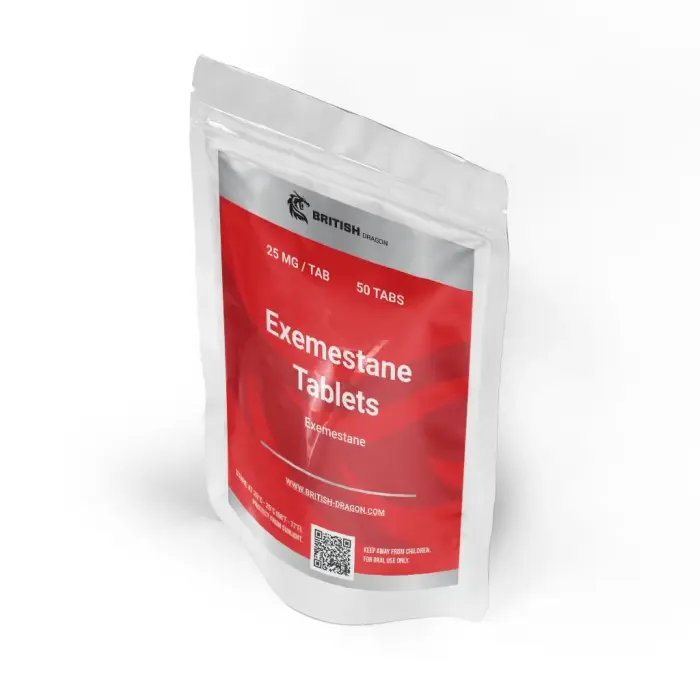
Exemestane Tablets
Exemestane Tablets British Dragon — Overview
Exemestane Tablets from British Dragon deliver 25 mg of exemestane per tablet — a steroidal aromatase inhibitor used on-cycle to manage estrogen elevation from aromatizing AAS. Sold under the brand name Aromasin in clinical settings, exemestane belongs to the steroidal AI class, which means it works differently from non-steroidal AIs like anastrozole or letrozole: it binds aromatase permanently and inactivates the enzyme rather than blocking it temporarily. New aromatase enzyme must be synthesized to replace what exemestane has deactivated, so estrogen suppression continues beyond the last dose and — critically — there is no estrogen rebound when the compound is discontinued.
That no-rebound property is the primary reason exemestane is often the preferred AI for the transition from cycle into PCT: discontinuing a non-steroidal AI can produce a short-term estrogen surge, whereas exemestane clears gradually without triggering rebound. Available at steroidwarehouse.com alongside the full British Dragon cycle support lineup.
About the Compound
Exemestane is a steroidal, irreversible aromatase inhibitor — a "suicide substrate" that mimics the natural androgen substrate of the aromatase enzyme. When exemestane binds to aromatase, it forms an irreversible covalent bond that permanently deactivates that enzyme molecule. This is fundamentally different from the mechanism of non-steroidal AIs (anastrozole, letrozole), which compete reversibly with androgens for the aromatase active site and can dissociate from the enzyme when plasma levels fall.
Because exemestane destroys aromatase rather than blocking it, its estrogen-suppressing effect outlasts its measurable plasma half-life (approximately 24 hours). Aromatization resumes only as new aromatase enzyme is synthesized — a process that takes days. This pharmacokinetic behavior eliminates the estrogen rebound that can occur when reversible AIs are stopped abruptly, making exemestane particularly well suited for the final weeks of a cycle and the transition into post-cycle therapy.
A secondary property relevant in performance settings: exemestane has mild androgenic activity derived from its steroidal structure, which may contribute to a slight anabolic effect and partial mitigation of AI-associated bone density loss seen with long-term non-steroidal AI use.
What Exemestane Does
Exemestane acts as a precision tool for estrogen management during aromatizing AAS cycles. Its effects are defined by its mechanism and dose:
- Estrogen suppression — inhibits the aromatase enzyme responsible for converting androgens (testosterone, androstenedione) into estrogens. At 25 mg/day, exemestane suppresses plasma estradiol by approximately 85–95% in clinical populations. On-cycle, where testosterone levels are supraphysiologic and aromatase substrate is abundant, effective doses are typically lower than maximum clinical suppression — titrated to keep E2 in the functional range rather than eliminating it.
- Prevention of estrogen-related sides — controls water retention, gynecomastia risk, and estrogen-driven mood changes that arise from elevated estradiol during testosterone or mixed AAS cycles.
- Clean PCT transition — because the enzyme remains inactivated after exemestane clearance, stopping the compound at end of cycle does not trigger an estrogen surge. The estrogen rebound that can occur when anastrozole or letrozole is discontinued does not apply to exemestane.
- Mild androgenic activity — exemestane's steroidal structure gives it weak androgenic properties that differentiate it from non-steroidal AIs at the receptor level, though this effect is modest at standard doses.
On E2 targets: the goal of AI use on cycle is not to eliminate estrogen — low E2 causes joint pain, reduced libido, mood dysregulation, and negatively affects the lipid profile. The target is functional E2 in the range of roughly 20–40 pg/mL. Bloodwork rather than symptom-chasing is the correct way to calibrate exemestane dose.
Who It Is For
Exemestane is the AI of choice in two specific scenarios where its irreversible mechanism provides a practical advantage over non-steroidal alternatives.
It is most appropriate when:
- The user wants a clean cycle-to-PCT transition without the risk of post-AI rebound estrogen. Switching from anastrozole to exemestane in the final two to three weeks of a cycle, then stopping exemestane at PCT start, avoids the estrogen spike that can occur when reversible AIs are discontinued abruptly.
- The user is on a heavier aromatizing cycle (high-dose testosterone, testosterone + Dianabol) and wants deeper estrogen control with less dosing complexity — exemestane every other day rather than daily titration.
- Mild androgenic support is desirable alongside estrogen control — the steroidal structure provides a minor effect in this direction not available from anastrozole or letrozole.
Choose something else when: rapid, precisely adjustable estrogen control is needed mid-cycle — non-steroidal AIs like anastrozole reach steady state and clear faster, making dose adjustments more responsive. If bloodwork shows E2 is running too high or too low, an anastrozole dose is easier to titrate up or down in real time. Exemestane's irreversibility is an advantage for stability but a disadvantage for rapid mid-cycle correction.
Exemestane vs Alternatives
| Compound | Key Differences | Choose Exemestane When | Choose Alternative When |
|---|---|---|---|
| Exemestane British Dragon |
Steroidal; suicide inhibitor; irreversible binding; no rebound on stop; mild androgenic activity; ~24h half-life | Clean PCT transition required; consistent on-cycle estrogen control; preference for steroidal AI profile | — |
| Anastrozole Tablets British Dragon |
Non-steroidal; reversible competitive inhibitor; faster dose-response adjustment; rebound possible on abrupt stop; no androgenic activity | Rapid mid-cycle E2 titration needed; dose changes likely based on bloodwork; shorter cycles | Rebound-free stop required; PCT transition; mild androgenic property wanted → Exemestane |
| Letrobol Tablets British Dragon |
Non-steroidal (letrozole); reversible; strongest aromatase inhibitor available; suppresses E2 more aggressively; rebound risk on stop; not suited for standard on-cycle use | Moderate estrogen control on standard cycles; no-rebound property; PCT-transition use | Severe estrogen elevation unresponsive to standard AI doses; refractory gynecomastia management → Letrobol |
When to Use — Cycle Pairings
| Cycle Type | Exemestane Protocol | Notes |
|---|---|---|
| Light testosterone cycle (300–400 mg/wk) | 12.5 mg EOD throughout; adjust by E2 bloodwork at week 4 | Starting point for most first-cycle users. Many find they need less than 12.5 mg EOD — splitting a 25 mg tab is straightforward. Blood levels, not symptoms, dictate dose. |
| Moderate bulk (testosterone 500 mg/wk + nandrolone) | 25 mg EOD; confirm E2 at week 4–5 | Higher testosterone drives more aromatization. Nandrolone adds minimal E2 burden but the testosterone component alone at 500 mg typically requires the full EOD dose. |
| Heavy bulk with oral kickstart (testosterone + Methanabol) | 25 mg EOD baseline; increase to 25 mg ED during the oral phase (weeks 1–5) | Dianabol aromatizes significantly. Temporarily increasing exemestane frequency during the kickstart phase controls the additional estrogen load, then step back to EOD when the oral is dropped. |
| Cycle-to-PCT transition (all aromatizing cycles) | Switch from current AI to exemestane 25 mg EOD in the final 2–3 weeks of cycle; stop exemestane at PCT start | Eliminates the rebound estrogen spike that can occur when anastrozole or letrozole is stopped at PCT. Exemestane's irreversible mechanism ensures a clean handoff into the PCT window. |
Side Effects & Management
Exemestane's side effects are almost entirely a function of excessive estrogen suppression rather than direct toxicity. The compound itself is well tolerated; problems arise when the dose drives E2 below functional levels.
| What May Occur | Background | How to Handle It |
|---|---|---|
| Joint pain / arthralgia | Estradiol plays a direct role in joint lubrication and connective tissue health. Suppressing E2 below ~15 pg/mL commonly produces dry, aching joints — the clearest symptom of over-suppression. | Reduce dose or increase interval (e.g. EOD → E3D). Confirm with bloodwork. Joint symptoms from low E2 resolve once estradiol recovers to functional range — do not treat the joint symptom in isolation without adjusting AI dose. |
| Libido reduction / mood changes | Estrogen is required for normal libido, mood regulation, and cognitive function in males. Low E2 from AI over-suppression manifests as flat mood, reduced motivation, and significantly decreased sex drive. | Reduce exemestane dose. If libido support is needed acutely: Cialis DP. Long-term management is dose reduction — not additional compounds. |
| Lipid changes | Estrogen has a cardioprotective effect on the lipid profile. Excessive E2 suppression reduces HDL and worsens the lipid panel beyond what the AAS cycle alone produces. | Keep E2 in target range (20–40 pg/mL). If LDL is elevated: Atorlip (atorvastatin). Dose calibration is the primary intervention — lipid support is secondary. |
| Fatigue / hot flashes | Symptoms of estrogen deficiency. More common at higher doses (25 mg ED) or in users with naturally lower testosterone driving less aromatization substrate. | Reduce to EOD or E3D dosing. Confirm E2 by bloodwork before making dose changes — fatigue during a cycle has multiple causes and should not be attributed to the AI without lab confirmation. |
| Bone density (long-term use) | Estrogen is essential for bone mineral density maintenance in males. Long-term aggressive AI use — months to years — poses bone health risk. Relevant for extended cruise/TRT contexts, not typical cycle lengths. | Not a concern for standard 8–16 week cycles. For extended use, keep E2 in functional range rather than fully suppressed. The mild androgenic activity of exemestane partially offsets this compared to non-steroidal AIs. |
Bloodwork Monitoring
| Lab | When to Test | Target & Action Threshold |
|---|---|---|
| Estradiol (E2) | Baseline (pre-cycle); week 4–5 on cycle; adjust if symptoms present | Target 20–40 pg/mL on cycle. Below 15 pg/mL: reduce exemestane dose or extend interval. Above 60 pg/mL with symptoms: increase dose or switch to ED administration. This is the primary monitoring metric for AI calibration. |
| Lipid panel (HDL / LDL) | Baseline; week 6–8; post-cycle | HDL should remain above 35 mg/dL; LDL below 130 mg/dL. Excessive E2 suppression worsens lipids beyond AAS baseline — if lipids are abnormally poor, review AI dose in conjunction with overall cycle management. |
| Total testosterone | Mid-cycle (relevant on TRT or cruise contexts) | On a standard cycle with exogenous testosterone, this confirms the cycle is delivering expected levels. In PCT context, rising testosterone confirms HPG axis recovery is underway. |
| LH + FSH | Post-PCT (3–4 weeks after PCT completion) | Recovery to normal range confirms HPG axis has restarted. Exemestane does not suppress gonadotropins — if LH and FSH remain suppressed post-PCT, the issue is the underlying AAS suppression, not the AI. |
| Blood pressure | Weekly on cycle | Target below 130/80 mmHg. Exemestane itself does not raise BP; monitoring is for the overall cycle context. Uncontrolled BP: Amlip (amlodipine). |
Dosing Protocol
Exemestane is taken orally with food — bioavailability increases approximately 40% when taken after a meal. Dosing should always be guided by E2 bloodwork rather than symptom management alone, as both high and low estrogen produce overlapping non-specific symptoms (mood changes, water retention, fatigue) that are easy to misattribute.
| Use Case | Protocol |
|---|---|
| Standard on-cycle control | Start at 12.5 mg EOD (half a 25 mg tablet) when beginning an aromatizing cycle. Test E2 at week 4–5. Adjust up to 25 mg EOD if E2 is above range, down to E3D if E2 is below range or symptoms of low estrogen present. |
| High-aromatization cycle | 25 mg EOD from cycle start. Confirm E2 at week 4 — do not assume 25 mg EOD is sufficient on heavy testosterone or testosterone + Dianabol protocols without lab confirmation. |
| PCT transition switch | If using anastrozole on cycle, switch to exemestane 25 mg EOD approximately two to three weeks before the last AAS injection. Run exemestane through to PCT start, then discontinue. No estrogen rebound expected. |
| Tapering off cycle | Step down from EOD to E3D in the final week of exemestane use before PCT begins. This allows estrogen to begin recovering gradually — avoiding both rebound and over-suppression at PCT start when E2 support for HPG recovery is needed. |
Practical Summary
- Take with food: exemestane bioavailability is ~40% higher after a meal — always dose post-meal, not fasted.
- Start low: 12.5 mg EOD is the appropriate starting point for most testosterone cycles; many users over-suppress at 25 mg EOD, particularly on cycles under 500 mg/week. Bloodwork at week 4–5 calibrates the dose.
- No rebound is the key advantage: use this property actively — switch to exemestane in the final 2–3 weeks of any cycle where you were using a reversible AI, then stop cleanly at PCT start.
- E2 target is 20–40 pg/mL, not zero: estrogen is required for libido, joints, mood, cardiovascular health, and bone density. Suppressing E2 below 15 pg/mL causes measurable harm that offsets cycle benefit.
- Adjust by labs, not symptoms: joint pain, low libido, fatigue, and mood changes occur with both high and low estrogen — the direction of adjustment must be confirmed by E2 bloodwork, not assumed.
- 25 mg tablets split easily: a standard 25 mg tablet can be split into a 12.5 mg dose, making the lower prophylactic dose practical without requiring a separate lower-dose product.
Exemestane occupies a distinct position among AIs: its irreversible mechanism and steroidal structure make it the rational choice for users who prioritize a clean post-cycle estrogen profile and want to avoid rebound at the point when hormonal stability matters most. Steroid Warehouse stocks Exemestane Tablets from British Dragon as part of the complete cycle support range — a reliable format of the compound that has been the standard steroidal AI in performance settings for over two decades.
References
| Source | Description | Link |
|---|---|---|
| NCBI Bookshelf / StatPearls | Aromatase inhibitors overview — clinical reference covering steroidal and non-steroidal aromatase inhibitor pharmacology, mechanism of action, approved indications, adverse effects, and monitoring considerations | StatPearls: Aromatase Inhibitors ↗ |
| New England Journal of Medicine / PubMed | Finkelstein JS et al. 2013 — randomized controlled trial examining the effects of testosterone and estradiol deficiency in men; demonstrated that estrogen deficiency primarily contributed to increased body-fat accumulation, while both testosterone and estradiol influenced sexual function and body-composition outcomes | Finkelstein JS, et al. (2013) ↗ |
| New England Journal of Medicine / PubMed | Coombes RC et al. 2004 — Intergroup Exemestane Study; randomized trial evaluating a switch from tamoxifen to exemestane after 2–3 years of adjuvant therapy in postmenopausal women with breast cancer, demonstrating improved disease-free survival and establishing the clinical efficacy of exemestane | Coombes RC, et al. (2004) ↗ |
| New England Journal of Medicine / PubMed | Smith IE & Dowsett M 2003 — review article titled Aromatase Inhibitors in Breast Cancer; discusses aromatase inhibitor pharmacology, estrogen suppression mechanisms, steroidal versus non-steroidal aromatase inhibitors, efficacy, and tolerability profiles in hormone-sensitive breast cancer treatment | Smith IE & Dowsett M (2003) ↗ |
What are Exemestane Tablets?
Exemestane Tablets are an oral suicidal aromatase inhibitor for estrogen control; see What Are Exemestane Tablets. They prevent gynecomastia—consult professionals for safe use.
How long does Exemestane stay in your system?
Detectable for ~5-7 days; see How Long Does Exemestane Stay in Your System. Monitor with professional guidance.
What are Exemestane Tablets used for in bodybuilding?
They're used to control estrogen and prevent gynecomastia; see What Are Exemestane Tablets Used For in Bodybuilding. They suit cycles—use with oversight.
How to take Exemestane Tablets?
12.5-25 mg daily or EOD; see How to Take Exemestane Tablets. Start low—consult professionals for dosing.
How do Exemestane Tablets work?
Exemestane works by binding to and inhibiting the aromatase enzyme, reducing the conversion of androgens into estrogen and lowering overall estrogen production.
How long does it take to notice effects from Exemestane Tablets?
Exemestane begins affecting estrogen production relatively quickly, although noticeable changes depend on individual hormone levels and intended use.
How is Exemestane different from other aromatase inhibitors?
Exemestane is often described as a steroidal aromatase inhibitor, distinguishing it from non-steroidal aromatase inhibitors while achieving the same goal of reducing estrogen production.
What are the possible side effects of Exemestane Tablets?
Potential side effects may include joint discomfort, fatigue, headaches, mood changes, and symptoms associated with excessively low estrogen levels.
Related Products