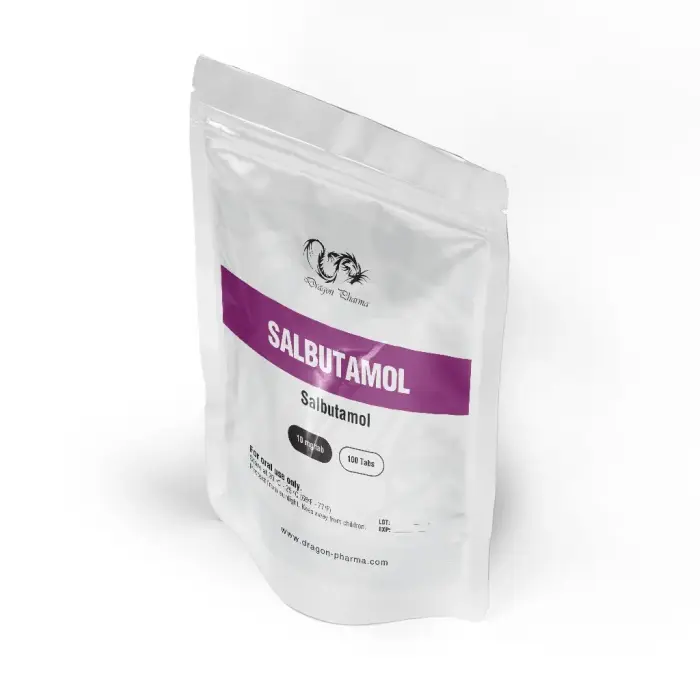
Salbutamol
Salbutamol Dragon Pharma — Overview
Salbutamol Dragon Pharma (known as albuterol in the United States) is a selective beta-2 adrenergic receptor agonist supplied at 10 mg per tablet. In performance protocols it is used as a thermogenic fat-loss compound and lean-mass preservation agent, working through the same receptor pathway as clenbuterol but with a markedly shorter half-life of 4–6 hours. This pharmacokinetic difference is the central practical advantage over clenbuterol: salbutamol clears the body within the same day it is taken, produces no progressive stimulant accumulation, and carries no documented risk of the cardiac hypertrophy associated with prolonged clenbuterol use.
Salbutamol activates beta-2 receptors in adipose tissue, driving lipolysis and increasing basal metabolic rate; in skeletal muscle, beta-2 receptor activation suppresses protein breakdown through the ubiquitin-proteasome pathway, producing an anti-catabolic effect that preserves lean mass during caloric deficit. At performance doses it also produces mild anabolic signaling in muscle via IGF-1-related pathways. The compound requires no PCT, causes no HPTA suppression, and can be used standalone or stacked with other fat-loss compounds. Available at Steroid Warehouse at 10 mg/tab, one tablet in the morning covers a standard 10 mg/day protocol; two tablets (morning and noon) cover a 20 mg/day advanced protocol.
About the Compound: Salbutamol
Salbutamol is a short-acting selective beta-2 adrenergic receptor (β2-AR) agonist developed in the 1960s as a bronchodilator for asthma and chronic obstructive pulmonary disease. Its selectivity for the β2 receptor over the β1 receptor (which drives cardiac output) gives it a more favorable cardiovascular safety profile than non-selective sympathomimetics. The β2 receptor is expressed in smooth muscle of the airways (producing bronchodilation), in adipose tissue (driving lipolysis), and in skeletal muscle (suppressing protein catabolism) — the three receptor locations that determine salbutamol's performance pharmacology.
At the molecular level, β2-AR agonism activates adenylyl cyclase through a Gs-coupled signaling cascade, increasing intracellular cyclic AMP (cAMP). In adipocytes, elevated cAMP activates protein kinase A (PKA), which phosphorylates hormone-sensitive lipase and activates perilipin, releasing fatty acids from stored triglycerides into circulation for oxidation. In skeletal muscle, the same cAMP/PKA signaling reduces activity of the ubiquitin-proteasome degradation pathway, slowing muscle protein breakdown. At high doses and with prolonged activation, β2 signaling in muscle also promotes protein synthesis through MAPK and PI3K/Akt pathways, contributing to the mild anabolic effect observed at performance doses.
The 4–6 hour half-life is the defining pharmacokinetic feature distinguishing salbutamol from clenbuterol (half-life ~35 hours). Salbutamol clears within 24 hours of the last dose, preventing the compound accumulation that drives clenbuterol's progressive side-effect burden and eliminates the risk of cumulative cardiac hypertrophy documented with sustained clenbuterol use. Beta-2 receptor downregulation (tachyphylaxis) still occurs with salbutamol but develops more slowly and recovers faster during off periods.
What Salbutamol Does
- Beta-2-mediated lipolysis and thermogenesis — beta-2 receptor activation in adipose tissue raises intracellular cAMP, activates protein kinase A, and triggers hormone-sensitive lipase to break down stored triglycerides into free fatty acids; simultaneously, mitochondrial uncoupling in adipose tissue and skeletal muscle increases heat generation (thermogenesis), raising basal metabolic rate; the combined effect is increased caloric expenditure and accelerated fat mobilization; at 10–20 mg/day these effects are clinically meaningful and produce visible fat-loss results within 2–3 weeks when combined with a caloric deficit
- Lean-mass preservation during caloric restriction — beta-2 receptor activation in skeletal muscle reduces the rate of muscle protein degradation by suppressing E3 ubiquitin ligase expression (atrogin-1, MuRF-1) in the ubiquitin-proteasome pathway; this anti-catabolic mechanism is the primary reason salbutamol is stacked with fat-loss protocols that impose significant caloric deficits; it allows deeper caloric restriction without proportional lean-mass loss; this effect is documented in multiple controlled studies and is the pharmacological basis for salbutamol's use in lean cutting phases
- Mild anabolic effect in skeletal muscle at performance doses — at doses above 10 mg/day, sustained beta-2 signaling activates MAPK and Akt/mTOR pathways in skeletal muscle, promoting protein synthesis and muscle hypertrophy; this effect is modest compared to anabolic steroids or SARMs but is additive when salbutamol is stacked with a lean-gaining protocol; users on maintenance or mild surplus calories often report visible muscle fullness and strength retention that exceeds what the caloric intake alone would predict
- No HPTA suppression — no hormonal disruption — salbutamol does not interact with the hypothalamus-pituitary-gonadal axis; LH, FSH, and endogenous testosterone are completely unaffected; there is no need for PCT, no suppression window, and no hormonal recovery period; the compound can be started and stopped cleanly without endocrine consequences; this makes it a versatile addition to any protocol regardless of where the user is in their hormonal management cycle
- No cardiac hypertrophy risk — the cardiac hypertrophy documented with clenbuterol is a consequence of prolonged beta-2 and beta-1 stimulation at the cardiac muscle level, compounded by clenbuterol's 35-hour half-life causing continuous receptor activation; salbutamol's 4–6 hour half-life means receptors have off-periods daily; animal studies and clinical evidence have not shown the same cardiac remodeling with salbutamol at performance doses; this is its most clinically important safety advantage over clenbuterol for users planning extended or repeated fat-loss cycles
Who It's For
- Athletes in a cutting phase who need thermogenic fat-loss support without hormonal disruption — salbutamol is appropriate at any stage of a performance protocol because it does not interact with the endocrine axis; it can be run during an AAS cycle, during a SARM cut, during PCT, or as a standalone compound during a natural training phase; the only requirement is a caloric deficit or maintenance calories — without dietary control, the thermogenic effect is insufficient to produce meaningful fat loss on its own
- Users who have experienced adverse cardiac effects with clenbuterol or want to avoid them proactively — clenbuterol's cardiac side-effect profile (palpitations, prolonged tachycardia, cardiac hypertrophy in animal studies) causes concern in users who run repeated fat-loss cycles; salbutamol produces the same receptor-level fat-loss mechanism without the half-life-driven cardiovascular accumulation; it is the appropriate choice for users who want sustained beta-2-mediated fat loss across multiple annual cutting phases
- What differentiates Salbutamol from similar alternatives: vs Clenbuterol Dragon Pharma — clenbuterol has a 35-hour half-life, requires 2-weeks-on/2-weeks-off cycling due to beta-2 receptor downregulation, and carries documented cardiac hypertrophy risk in animal models; salbutamol has a 4–6 hour half-life, produces a less severe cardiovascular side-effect burden, and allows more flexible cycling; both compounds produce equivalent fat loss via the same beta-2 receptor mechanism; salbutamol is the safer long-term choice, clenbuterol the higher-stimulant shorter-burst option; vs T3 Dragon Pharma — T3 increases metabolic rate by upregulating all metabolic processes including protein turnover, which creates significant muscle-loss risk at cutting doses; salbutamol specifically suppresses muscle protein breakdown via beta-2 signaling while promoting fat oxidation; for users concerned about lean-mass preservation, salbutamol is substantially preferable to T3 as a standalone thermogenic; the two are sometimes stacked, with salbutamol offsetting T3's catabolic effect on muscle
- Users who should choose something else: users with pre-existing cardiac arrhythmia or symptomatic tachycardia at baseline should avoid beta-2 agonists; users who want aggressive short-burst thermogenesis over a strict 2-week window may find clenbuterol's higher stimulant effect preferable; users with hypokalemia or electrolyte imbalance should correct those issues before starting salbutamol
Salbutamol vs Alternatives
| Compound | Key Differences | Choose Salbutamol When | Choose Alternative When |
|---|---|---|---|
| Clenbuterol Dragon Pharma | Same beta-2 receptor mechanism; half-life ~35 hours vs salbutamol's 4–6 hours; 2-weeks-on/2-weeks-off cycling required due to faster beta-2 receptor downregulation; stronger stimulant effect (CNS activation, appetite suppression); higher cardiovascular burden (prolonged tachycardia, palpitations, cardiac hypertrophy risk in animal data); higher peak thermogenic output per cycle; generally accepted as producing slightly more aggressive short-cycle fat loss due to sustained receptor activation | Repeated or extended fat-loss cycles across a full season; cardiac safety profile matters; lower cardiovascular side-effect burden is priority; flexible cycle timing without strict 2-week blocks | Maximum stimulant effect over a strict 2-week window; higher short-burst thermogenic output is preferred; user tolerates and accepts clenbuterol's cardiovascular profile |
| T3 Dragon Pharma (Liothyronine) |
Thyroid hormone; increases metabolic rate via genomic transcription of metabolic enzymes; affects all macronutrient metabolism (fat, carbohydrate, and protein); significant muscle catabolism risk at cutting doses; requires careful dose escalation and taper; HPTA-independent but requires thyroid axis management; produces deep metabolic acceleration; suppresses endogenous TSH and T3/T4 during use; stacked with salbutamol to offset T3's catabolic muscle loss | Lean-mass preservation during cut is the primary concern; no thyroid axis disruption is acceptable; simple, HPTA-independent thermogenic without endocrine consequences | Maximum total metabolic rate increase is needed; deep caloric deficits requiring thyroid acceleration; used as an addition to salbutamol to amplify fat loss further while relying on salbutamol for anti-catabolism |
| Sibutramine Dragon Pharma | Serotonin-norepinephrine-dopamine reuptake inhibitor; works primarily via appetite suppression rather than thermogenesis or lipolysis; does not directly activate beta-2 receptors; strong appetite control; different mechanism stack than salbutamol (complementary, not redundant); cardiovascular risks include blood pressure elevation and increased heart rate through norepinephrine pathway; not an anabolic or anti-catabolic compound | Thermogenic lipolysis and lean-mass preservation is the goal; no appetite-suppression mechanism is preferred; cardiovascular norepinephrine pathway stimulation is a concern | Caloric compliance is the limiting factor (appetite control is the primary need); combine sibutramine + salbutamol for simultaneous appetite suppression (sibutramine) and thermogenic lipolysis (salbutamol) |
Dosing Protocol
| Protocol | Dose | Timing | Notes |
|---|---|---|---|
| Standard (10 mg/day) | 1 tab (10 mg) once daily | Morning, with or without food; before training is optimal | Appropriate starting dose for users new to salbutamol or beta-2 agonists; produces meaningful thermogenic and anti-catabolic effect; stimulant side effects (tremor, palpitations) are manageable at this dose for most users; assess tolerance during week 1 before escalating |
| Standard BID (20 mg/day) | 1 tab (10 mg) morning + 1 tab (10 mg) at noon | First dose on waking; second dose no later than 1–2 pm to avoid sleep disruption | The primary performance dose tier; twice-daily dosing matches the 4–6 hour half-life and maintains beta-2 receptor activation across the active portion of the day; the 4–6 hour clearance window at night preserves sleep quality and allows partial receptor resensitization overnight; second dose must be taken before 2 pm to avoid insomnia |
| Stack with T3 | Salbutamol 10–20 mg/day + T3 25–50 mcg/day | Salbutamol morning/noon per above; T3 in the morning | Classic thermogenic stack: T3 drives broad metabolic acceleration while salbutamol provides anti-catabolic beta-2 signaling to offset T3's lean-mass cost; the combination produces greater total fat loss than either compound alone while preserving more muscle than T3 standalone; T3 requires dose escalation (start 12.5 mcg, taper at cycle end) |
| Stack with Clenbuterol (alternating) | Salbutamol 20 mg/day weeks 1–2 → Clenbuterol 40–80 mcg/day weeks 3–4 → Salbutamol weeks 5–6 | Alternate compounds every 2 weeks | Alternating between salbutamol and clenbuterol is used to prevent beta-2 receptor desensitization to either compound; each compound has a slightly different receptor interaction profile; the alternating protocol allows extended continuous beta-2 stimulation across 6–12 weeks without the receptor downregulation that develops with continuous single-compound use |
Side Effects & Management
| What May Occur | Background | How to Handle It |
|---|---|---|
| Tremors / hand shaking | The most common side effect; caused by beta-2 receptor activation at the neuromuscular junction, increasing acetylcholine release and motor unit excitability; most pronounced in the first 3–5 days as the body adapts; severity is dose-dependent and decreases significantly after week 1 as tolerance develops at the neuromuscular level; hands and fingers are most affected | Tolerance develops within 5–7 days; no intervention required if mild; reduce to 10 mg/day if tremors are significantly disruptive; taurine supplementation (3–5 g/day) reduces beta-2-mediated neuromuscular excitability and is the primary practical remedy; magnesium glycinate 300 mg/day provides additional neuromuscular stabilization |
| Tachycardia / palpitations | Beta-2 receptor selectivity is not absolute; at performance doses, some beta-1 cardiac receptor activation occurs, increasing heart rate; salbutamol's 4–6 hour half-life means heart rate elevation is time-limited and returns to baseline during the overnight clearance window; palpitations are more common at 20 mg/day and typically peak 1–2 hours post-dose; less persistent than clenbuterol-induced tachycardia due to salbutamol's short half-life | Monitor resting heart rate; target resting HR below 90 bpm between doses; if resting HR persistently above 100 bpm: reduce to 10 mg/day; Ecosprin 75 mg/day as cardiovascular baseline; avoid caffeine within 3 hours of each dose to reduce additive chronotropic stimulation; if palpitations are symptomatic: hold second dose and reassess |
| Hypokalemia (low potassium) | Beta-2 receptor activation stimulates the Na/K-ATPase pump in skeletal muscle, driving potassium into cells and lowering serum potassium; at performance doses of 10–20 mg/day, the hypokalemic effect is meaningful; hypokalemia presents as muscle cramps, weakness, and in severe cases cardiac arrhythmia; particularly relevant when salbutamol is stacked with T3 (which also affects electrolyte balance) or diuretics | Dietary potassium from high-potassium foods (banana, sweet potato, avocado, leafy greens); potassium supplementation 200–400 mg elemental potassium per day (potassium gluconate or citrate); taurine 3–5 g/day assists electrolyte transport; if muscle cramps are significant: increase dietary potassium intake immediately; check serum potassium at the end of any cycle exceeding 4 weeks |
| Insomnia | Sympathomimetic stimulation from beta-2 receptor agonism; the CNS arousal effect is less pronounced with salbutamol than clenbuterol due to salbutamol's lower CNS penetration, but is still present at 20 mg/day if the second dose is taken too late in the day; the 4–6 hour half-life means a noon dose is largely cleared by 6–8 pm, making sleep disruption avoidable with correct timing | Strict timing: second dose no later than 1–2 pm; if insomnia persists even with correct timing: move to a single 10 mg morning dose only; magnesium glycinate 300–400 mg before bed assists with sleep quality; avoid other stimulants (pre-workout, high-caffeine drinks) after midday during salbutamol use |
| Headache | Vasodilatory effect of beta-2 receptor activation in cerebral vasculature; mild and transient; most common in the first week of use as the body adapts to the compound; typically resolves without intervention; more frequent at 20 mg/day than 10 mg/day | Adequate hydration (2.5–3L water/day); tolerance typically develops within 5–7 days; if persistent: reduce to 10 mg/day and reassess; Ecosprin 75 mg as a dual analgesic and cardiovascular support agent |
Bloodwork Monitoring
| Lab | When to Test | Target & Action Threshold |
|---|---|---|
| Serum potassium | Baseline; end of cycle (particularly cycles >4 weeks or stacked with T3) | Normal range 3.5–5.0 mmol/L; beta-2 agonism drives intracellular potassium shift that may lower serum potassium to 3.0–3.4 mmol/L at performance doses; values below 3.0 mmol/L require dietary and supplemental potassium correction and temporary dose reduction; severe hypokalemia (<2.5 mmol/L) warrants discontinuation until corrected |
| Blood glucose (fasting) | Baseline; if diabetes or insulin resistance is a concern | Beta-2 agonism stimulates hepatic glycogenolysis and gluconeogenesis, transiently raising blood glucose; at performance doses in healthy users this is minor and clinically irrelevant; relevant only in users with pre-existing glucose metabolism issues; fasting glucose target <100 mg/dL |
| Resting heart rate | Daily self-monitoring during the first 2 weeks; weekly thereafter | Target resting HR between doses: below 85 bpm; peak HR 1–2 hours post-dose: below 100 bpm; if resting HR between doses exceeds 100 bpm persistently: reduce dose or discontinue; use a wrist-based monitor for consistent daily measurement |
| Blood pressure | Baseline; weekly self-monitoring | Salbutamol produces mild systolic blood pressure reduction (via smooth-muscle vasodilation) in some users and mild elevation in others from cardiac output increase; target below 135/85 mmHg; if BP exceeds 140/90 mmHg: assess caffeine and other stimulant use; Sartel (telmisartan) 40 mg/day for persistent elevation; reduce salbutamol dose if elevation is directly attributed to the compound |
| Lipid panel | Not mandatory; include in any comprehensive cycle bloodwork panel | Salbutamol does not have a meaningful direct lipid effect; if stacked with T3, lipid panel is relevant (T3 is protective on LDL but affects thyroid-driven lipid metabolism broadly); if stacked with AAS, standard AAS lipid monitoring applies; standalone salbutamol requires no specific lipid monitoring beyond general health practices |
Cycle Structure
Salbutamol's short half-life gives it more flexible cycling options than clenbuterol. Beta-2 receptor downregulation (tachyphylaxis) still occurs — continued stimulation reduces receptor density and sensitivity over time — but the rate and severity are lower than with clenbuterol due to the daily receptor off-periods that salbutamol's short half-life creates.
| Cycle Structure | Protocol | Notes |
|---|---|---|
| Standard 2-on / 2-off | Salbutamol 20 mg/day for 2 weeks; 2 weeks off; repeat as needed | The traditional beta-2 agonist cycling approach borrowed from clenbuterol protocols; the 2-week off period allows beta-2 receptor density to recover before the next cycle; simple and predictable; total salbutamol use of 4 weeks produces meaningful fat-loss results in a lean, active user with a 400–600 kcal/day deficit |
| Continuous with taurine and potassium | Salbutamol 10–20 mg/day for 6–8 weeks continuously; taurine 5 g/day + dietary potassium supplementation throughout | Salbutamol's overnight receptor recovery window (compound clears nightly) allows longer continuous runs than clenbuterol; many users tolerate 6–8 week continuous protocols without significant tachyphylaxis when electrolyte management is maintained; the first sign of receptor downregulation is reduction in tremors and thermogenic sensation — if these disappear entirely, consider a 1–2 week break regardless of planned cycle length |
| Extended run with alternating compounds | Salbutamol weeks 1–2 → Clenbuterol weeks 3–4 → Salbutamol weeks 5–6 → Clenbuterol weeks 7–8 | Alternating beta-2 agonists every 2 weeks partially circumvents receptor downregulation because the two compounds have slightly different receptor subtype interaction profiles; allows continuous beta-2-mediated fat loss across 8–12 weeks without full receptor exhaustion; extended cutting phases without hormonal compounds use this as the primary fat-loss framework |
Practical Summary
- Never take the second dose after 1–2 pm: salbutamol's stimulant effect on the CNS is shorter-lived than clenbuterol but still real; a noon cutoff for the second dose allows adequate clearance before sleep; insomnia is the most avoidable side effect and is almost entirely a timing issue
- Taurine 3–5 g/day throughout: taurine addresses the two most disruptive side effects simultaneously — it reduces beta-2-mediated neuromuscular tremor and assists potassium transport, blunting hypokalemia-driven muscle cramps; start taurine from day one, not after side effects appear
- Potassium intake is mandatory at 20 mg/day: dietary potassium from whole foods is the simplest approach; high-potassium foods (banana, avocado, sweet potato, leafy greens) daily; if cramping occurs despite diet: add 200–400 mg elemental potassium supplement (potassium gluconate or citrate); check serum potassium at end of any cycle longer than 4 weeks
- Salbutamol is a tool for the deficit — not a substitute for it: beta-2-mediated lipolysis and thermogenesis produce fat loss only when there is a caloric deficit or at least maintenance calories; without dietary control, the thermogenic effect is insufficient to overcome a surplus; the compound amplifies a deficit, it does not replace one
- Stack with T3 for maximum cutting output; rely on salbutamol for the muscle: T3 drives broad metabolic acceleration but catabolizes lean mass at cutting doses; salbutamol's anti-catabolic beta-2 signaling in muscle offsets this cost; the combination produces more total fat loss than either alone while preserving significantly more lean mass than T3 standalone
- Ecosprin 75 mg/day as cardiovascular baseline: Ecosprin 75 mg/day is the standard cardiovascular support during any sympathomimetic compound; monitor resting heart rate daily during the first 2 weeks; if resting HR between doses stays above 100 bpm: reduce to 10 mg/day
Salbutamol Dragon Pharma delivers the core beta-2 thermogenic fat-loss mechanism of the agonist class in a compound with a pharmacokinetic profile that makes it the most cardiovascularly appropriate choice for athletes who run fat-loss phases repeatedly across a full competitive season. Its short half-life, absence of cardiac hypertrophy risk, lean-mass preservation via skeletal-muscle anti-catabolism, and clean hormonal profile make it the most practical and sustainable beta-2 agonist available at Steroid Warehouse for ongoing performance use.
References
| Source | Topic | Link |
|---|---|---|
| Drug Testing and Analysis / PubMed | Hostrup et al. 2020 — review of anabolic and lipolytic actions of beta-2 agonists in humans and anti-doping challenges; covers salbutamol, formoterol, salmeterol, route-of-administration issues, systemic exposure, muscle growth, lipolysis, performance implications, adverse effects, and detection concerns | Hostrup M, et al. (2020) ↗ |
| Journal of Physiology / PubMed | Hostrup et al. 2018 — controlled human study showing that oral salbutamol increased skeletal muscle protein turnover rates and altered anabolic signalling after resistance exercise in young men; useful mechanistic evidence for beta-2 agonist effects on human skeletal muscle metabolism | Hostrup M, et al. (2018) ↗ |
| Journal of Applied Physiology / PubMed | Jessen et al. 2021 — randomized study of oral salbutamol during 11 weeks of resistance training in young men; reports augmented hypertrophy in MHCIIa fibers and improved sprint mean power output, while not showing a clear increase in muscle force | Jessen S, et al. (2021) ↗ |
| Medicine & Science in Sports & Exercise / PubMed | van Baak et al. 2000 — double-blind randomized crossover study of acute oral salbutamol in nonasthmatic men; evaluates skeletal muscle strength and endurance performance, providing human performance context without overstating long-term fat-loss effects | van Baak MA, et al. (2000) ↗ |
| American Journal of Physiology-Endocrinology and Metabolism / PubMed | Hoeks et al. 2003 — human study of beta-1 and beta-2 adrenergic stimulation on energy expenditure, lipolysis, and fat oxidation in lean and obese men; includes salbutamol-based beta-2 stimulation and provides cleaner metabolic context than the incorrect van Baak obesity citation | Hoeks J, et al. (2003) ↗ |
How does Salbutamol work?
It stimulates beta-2 receptors for fat loss and bronchodilation; see Mechanism of Action. It enhances performance—monitor with vitals.
What is Salbutamol?
Salbutamol (Albuterol) is an oral bronchodilator for fat loss and breathing; see What is Salbutamol. It's effective—consult professionals for safe use.
Is Salbutamol safe?
It's safe with proper dosing and monitoring, but avoid in cardiovascular issues; see Side Effects. Consult professionals for safety.
Is Salbutamol the same as Albuterol?
Yes, Salbutamol and Albuterol are the same compound; see What is Salbutamol. It's used interchangeably—consult professionals for clarity.
What is Salbutamol used for?
It's used for fat loss and respiratory support in fitness; see Key Benefits. It suits athletes—use with professional oversight.
How long does it take for Salbutamol to start working?
Salbutamol is considered a fast-acting compound. Its effects are often noticeable shortly after administration, particularly in relation to respiratory function and stimulation.
What are the main benefits of Salbutamol?
Commonly discussed benefits include improved breathing capacity, enhanced exercise performance, increased energy expenditure, and support for fat-loss goals.
What are the possible side effects of Salbutamol?
Potential side effects may include increased heart rate, tremors, nervousness, headaches, sweating, and temporary feelings of restlessness.
Related Products