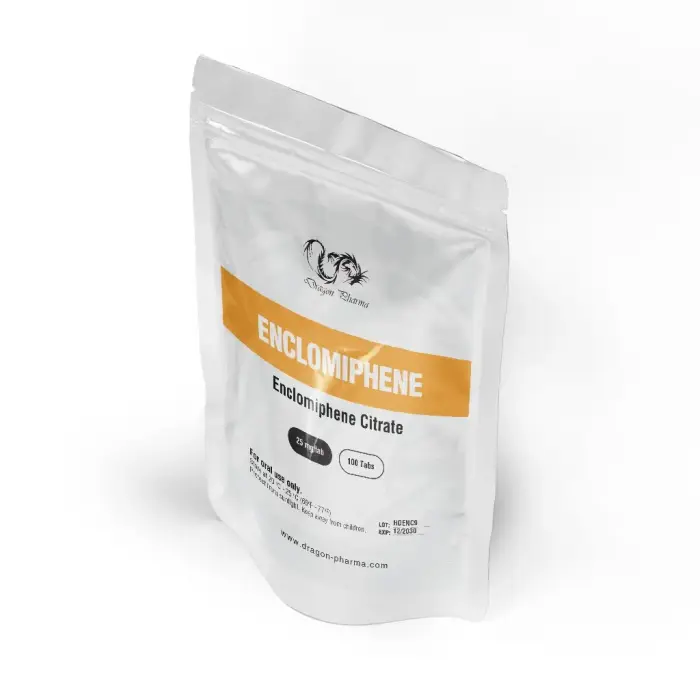
Enclomiphene
Overview
Enclomiphene 25 mg Dragon Pharma delivers the active trans-isomer of clomiphene citrate in tablet form — the pharmacological component responsible for blocking estrogen receptors at the hypothalamus and pituitary, stimulating LH and FSH release, and driving endogenous testosterone recovery during post-cycle therapy. Unlike clomiphene citrate (Clomid), which is a racemic mixture containing both the active trans-isomer (enclomiphene) and the inactive but accumulating cis-isomer (zuclomiphene), enclomiphene delivers the HPG-stimulating mechanism without the prolonged tissue accumulation of zuclomiphene that is responsible for most of clomiphene's visual and mood-related adverse effects. steroidwarehouse.com carries Enclomiphene 25 mg DP as part of the full Dragon Pharma PCT lineup for athletes seeking a cleaner, shorter-clearance alternative to standard clomiphene in post-cycle recovery protocols.
About the Compound
Clomiphene citrate (Clomid) is a racemic 50:50 mixture of two isomers: enclomiphene (the trans or E-isomer) and zuclomiphene (the cis or Z-isomer). Enclomiphene is the pharmacologically active component that blocks hypothalamic and pituitary estrogen receptors, removes estrogen's negative feedback on GnRH release, and drives the upstream hormonal signal that restores endogenous LH and FSH production. Zuclomiphene, by contrast, has a half-life measured in weeks and carries partial estrogen agonist activity: it accumulates in tissue, particularly the retinal pigment epithelium (where it causes visual disturbances) and in brain tissue (where its estrogenic activity contributes to mood instability and emotional side effects reported by clomiphene users). By providing enclomiphene without the zuclomiphene component, the Dragon Pharma formulation delivers the central ER antagonism and HPG stimulation of clomiphene therapy with a substantially cleaner side-effect profile and a post-PCT hormone environment that is not complicated by weeks of residual zuclomiphene activity.
What It Does
- Removes estrogen negative feedback at the hypothalamus and pituitary: enclomiphene binds estrogen receptors (ERα) in the hypothalamus and anterior pituitary; this blocks circulating estradiol from suppressing GnRH pulse frequency; increased GnRH signaling drives LH and FSH release from gonadotroph cells within days of the first dose; this is the central mechanism behind all SERM-based PCT — enclomiphene executes it with a single active isomer rather than a mixed racemic compound.
- Raises LH and FSH — restores Leydig and Sertoli cell drive: LH acts directly on Leydig cells to stimulate testosterone synthesis; FSH acts on Sertoli cells to support spermatogenesis; both signals are suppressed to near-zero during AAS cycles by exogenous androgen negative feedback; enclomiphene's ER block allows GnRH to re-activate both pituitary gonadotropin outputs simultaneously, providing the upstream hormonal signal Leydig cells need to resume endogenous testosterone production.
- Drives endogenous testosterone recovery without adding exogenous androgen: unlike testosterone replacement, which suppresses the HPG axis further, enclomiphene works with the body's own feedback system; it stimulates the pituitary, which stimulates the testes, which produce testosterone — the resulting testosterone feeds back normally to regulate GnRH and LH once levels are restored; this feedback-integrated recovery is what distinguishes SERM-based PCT from indefinite exogenous testosterone replacement.
- Short half-life supports clean post-PCT hormone environment: enclomiphene's ~10–12 hour half-life means the compound clears within 2–3 days of the last dose; unlike zuclomiphene (which persists in tissues for weeks after clomiphene cessation), enclomiphene's short clearance leaves the HPG axis in a clean endogenous state once PCT concludes; this matters for evaluating post-PCT bloodwork — LH, FSH, and testosterone readings at week 4 post-PCT reflect actual HPG axis recovery rather than residual SERM-driven stimulation.
Who It's For
Enclomiphene 25 mg Dragon Pharma is for athletes completing AAS cycles who want SERM-based HPG axis recovery and prefer the isolated trans-isomer formulation over standard clomiphene citrate. The primary PCT use case is any suppressive AAS cycle — testosterone, nandrolone, trenbolone, or oral-based — where exogenous androgen has driven LH and FSH to near-zero and endogenous testosterone production needs to be restored through central ER antagonism and gonadotropin re-stimulation.
What differentiates enclomiphene from clomiphene citrate for this use: users who have experienced visual disturbances, emotional instability, or prolonged post-SERM hormonal disruption from clomiphene citrate are the clearest candidates for enclomiphene; these effects are primarily attributed to zuclomiphene accumulation, which enclomiphene eliminates by design; the shorter half-life also makes enclomiphene suitable for shorter PCT protocols where the goal is rapid clearance and a clean post-PCT evaluation window.
Who should choose something else: users who tolerate standard Clomid Dragon Pharma without side effects and have no reason to switch have no clinical advantage to mandate enclomiphene; users who need tamoxifen's additional benefit for gynecomastia management alongside PCT should use Nolvadex Dragon Pharma (with or without enclomiphene); users whose primary goal is managing active gynecomastia rather than HPG recovery should consider Raloxifene Dragon Pharma instead.
Enclomiphene vs Alternatives
| Compound | Key Differences | Choose Enclomiphene When | Choose Alternative When |
|---|---|---|---|
| Clomid Dragon Pharma (clomiphene citrate 50 mg — racemic enclomiphene + zuclomiphene) | Clomid contains both enclomiphene (active, short half-life) and zuclomiphene (accumulates for weeks, mild estrogen agonist in CNS and retina); the HPG stimulation mechanism is the same; Clomid is the established, lower-cost racemic option; enclomiphene is the isolated active isomer with cleaner side-effect profile and faster post-PCT clearance; Clomid 50 mg = approximately 25 mg enclomiphene + 25 mg zuclomiphene equivalent in terms of the active trans-isomer component | Prior clomiphene cycles caused visual disturbances, mood instability, or prolonged hormone disruption post-SERM; cleaner post-PCT evaluation is needed; shorter clearance from SERM therapy is the priority | Clomiphene citrate has been well tolerated in prior PCT cycles without side effects; cost is a consideration; the added zuclomiphene in Clomid is not a concern for the individual user |
| Nolvadex Dragon Pharma (tamoxifen citrate 10/20 mg) | Both are SERMs that block hypothalamic ER and raise LH/FSH; tamoxifen has a longer half-life (~5–7 days) and is a partial estrogen agonist in some tissues (liver, uterus) and antagonist in others (breast); tamoxifen is more commonly combined with enclomiphene or clomiphene in PCT for synergistic gonadotropin stimulation; Nolvadex is also the standard pharmacological agent for gynecomastia management on-cycle; enclomiphene does not address gynecomastia independently | HPG axis recovery without gynecomastia management is the sole PCT goal; avoiding tamoxifen's longer half-life and partial agonist activity is preferred; enclomiphene is used as the primary HPG stimulator in simplified PCT protocols | Gynecomastia management alongside PCT is needed (tamoxifen addresses both); the combined enclomiphene + Nolvadex protocol is preferred for more suppressive cycles; Nolvadex's established long-term safety record and broader PCT evidence base is preferred |
| Raloxifene Dragon Pharma (raloxifene HCl 60 mg) | Raloxifene is a second-generation SERM primarily used for gynecomastia reversal rather than HPG axis recovery; it has high affinity for breast tissue ER and more limited hypothalamic-pituitary ER activity than enclomiphene or tamoxifen; raloxifene is the preferred pharmacological agent for established gynecomastia nodule reduction; enclomiphene drives superior LH/FSH and testosterone restoration for PCT; they address different primary goals — enclomiphene for HPG recovery, raloxifene for gynecomastia management | Post-cycle testosterone recovery and LH/FSH stimulation are the primary goals; no significant gynecomastia is present | Active or chronic gynecomastia is the primary concern requiring targeted SERM therapy; HPG recovery is secondary or is handled separately; raloxifene + enclomiphene combinations are used when both issues are present simultaneously |
Combinations
| PCT Goal | Protocol | Support | Notes |
|---|---|---|---|
| Standalone enclomiphene PCT — simplified recovery for mild-to-moderate suppression | Enclomiphene 25 mg/day (wks 1–4); taper to 12.5 mg/day (wks 5–6) if extending | Bloodwork at week 4 post-PCT: LH, FSH, total testosterone | Appropriate for 8–10 week testosterone-based cycles where suppression is significant but not prolonged; the absence of zuclomiphene means post-PCT hormones reflect actual HPG recovery without weeks of residual SERM influence; confirm LH and FSH above reference range and testosterone approaching pre-cycle baseline at week 4 post-SERM |
| Enclomiphene + Nolvadex — dual-SERM synergistic HPG recovery for more suppressive cycles | Enclomiphene 12.5–25 mg/day + Nolvadex DP 20 mg/day (wks 1–4); Enclomiphene 12.5 mg/day + Nolvadex 10 mg/day (wks 5–6) | Bloodwork at week 4 post-PCT | Combining two SERMs with different ER binding profiles (enclomiphene as pure agonist, tamoxifen as partial agonist) provides broader receptor coverage for HPG stimulation; commonly used for 12–16 week cycles with 19-Nor compounds (nandrolone, trenbolone) where suppression is deeper; Nolvadex also addresses any residual gynecomastia sensitivity post-cycle; start both SERMs at the same time — 3–5 days post-last-injection for short esters, 14–21 days for long esters |
| HCG priming + enclomiphene — full recovery protocol for long or heavily suppressive cycles | Phase 1 (clearance window): HCG 5,000 IU DP 2,500 IU on 2 days in the clearance window; complete last HCG dose at least 5 days before first SERM; Phase 2: Enclomiphene 25 mg/day × 4 weeks | Bloodwork at week 4 post-enclomiphene; track LH, FSH, total testosterone | HCG primes Leydig cells during the clearance window before SERM therapy begins; Leydig cells kept active during the cycle (on-cycle HCG) or primed in the clearance window respond more robustly to the LH signal generated by enclomiphene's ER block; do not run HCG and SERM simultaneously — hCG's LH-like signal would undermine the HPG stimulation feedback the SERM is trying to establish; enclomiphene's short half-life is particularly well-matched to this protocol as post-HCG timing is precise |
| Enclomiphene for secondary hypogonadism — non-PCT use to raise endogenous testosterone | Enclomiphene 12.5–25 mg/day continuously; duration as needed; monitor LH, FSH, total testosterone every 6–8 weeks | Regular bloodwork; E2 monitoring to avoid over-suppression of estrogen in CNS | In secondary (central) hypogonadism where the HPG axis is intact but underactive, enclomiphene raises endogenous LH and FSH and consequently testosterone without suppressing the HPG axis — unlike exogenous testosterone which does; used in clinical research as an alternative to TRT for men seeking to raise testosterone while maintaining fertility; not a replacement for medical evaluation of secondary hypogonadism; this use is continuous rather than time-limited PCT |
Side Effects & Management
| Side Effect | Frequency | How to Handle It |
|---|---|---|
| Visual disturbances (blurred vision, visual acuity changes, light sensitivity) | Significantly less common than with racemic clomiphene citrate; zuclomiphene accumulation in the retinal pigment epithelium is the primary mechanism behind clomiphene-associated visual effects; enclomiphene's short clearance reduces this risk substantially | Discontinue immediately if any visual symptoms occur; do not re-dose while visual effects persist; report persistent symptoms; unlike clomiphene-associated visual changes (where zuclomiphene clears slowly over weeks), enclomiphene's 10–12 hour half-life means symptoms from the trans-isomer itself resolve within 2–3 days of stopping; persistent symptoms may reflect pre-existing sensitivity rather than ongoing drug effect |
| Mood changes — irritability, emotional lability | Less common than with racemic clomiphene; zuclomiphene's partial CNS estrogen agonism is the primary driver of clomiphene-related mood side effects; enclomiphene's pure antagonism and faster clearance reduce CNS estrogenic activity; some mood variation may occur during HPG axis re-activation as testosterone and estradiol fluctuate | Usually self-limiting as HPG axis stabilises over weeks 2–3 of PCT; if significant mood disruption occurs, reduce dose to 12.5 mg/day; do not add additional ER antagonists that may worsen estrogen suppression in CNS; monitor E2 at week 3–4 to confirm over-suppression is not the cause |
| Estrogen over-suppression — joint pain, fatigue, low mood from low E2 | Uncommon at standard PCT doses (12.5–25 mg/day) but possible; occurs when ER block is too aggressive relative to the cycle's aromatization capacity during recovery; users combining enclomiphene with an AI are at higher risk | Do not combine enclomiphene with aromatase inhibitors during PCT unless there is a specific clinical reason; AIs during PCT suppress the estrogen signal required for normal hypothalamic feedback and can paradoxically delay HPG recovery; if E2 falls below 15 pg/mL with joint pain and low mood, hold enclomiphene for 3–5 days and reintroduce at 12.5 mg/day |
| Hot flashes | Occasional; a class effect of ER antagonism at the hypothalamus; occurs when hypothalamic estrogen receptors are blocked, disrupting thermoregulation; more common in the first week of PCT as estrogen fluctuates | Self-limiting; usually resolves as HPG axis stabilises and testosterone rises during weeks 2–3 of PCT; no specific management is required; reducing dose to 12.5 mg/day during week 1 can reduce intensity |
| GI discomfort — nausea, bloating | Uncommon; mild GI effects are occasionally reported with oral SERMs; less common with enclomiphene than with some tamoxifen formulations | Take with food to reduce GI discomfort; split the 25 mg dose to 12.5 mg morning and 12.5 mg evening if nausea occurs on a single daily dose; GI side effects from enclomiphene typically resolve within the first week as the body adjusts |
Bloodwork Monitoring
| Lab | When to Test | Target & Action Threshold |
|---|---|---|
| LH (luteinizing hormone) | Baseline (before PCT start, during clearance window); week 4 post-PCT completion; optional mid-PCT check at week 2–3 | LH should rise above baseline within the first week of enclomiphene; above reference range (typically 1.5–9.3 mIU/mL) confirms ER block is active and HPG stimulation is working; persistent low LH at week 2–3 suggests inadequate dose or ongoing AAS activity in blood (long ester not yet cleared); post-PCT LH should be at or above pre-cycle baseline |
| FSH (follicle-stimulating hormone) | Baseline; week 4 post-PCT completion | FSH recovery typically lags LH by 1–2 weeks; post-PCT FSH at or above reference range confirms pituitary responsiveness is fully restored; relevant for users with fertility concerns |
| Total testosterone | Baseline (end-of-cycle suppressed value); week 4 post-PCT; optionally week 8 post-PCT for confirmation | Return to pre-cycle baseline or above; below 300 ng/dL at 6 weeks post-SERM completion indicates incomplete HPG recovery; enclomiphene's short clearance means week 4 total testosterone reflects actual HPG axis function rather than residual SERM-driven stimulation — unlike clomiphene where zuclomiphene's long half-life can still be active at week 4 |
| Estradiol (E2) | Baseline; optional mid-PCT check at week 3–4 if symptoms of over-suppression (joint pain, low mood, fatigue) occur | Target 20–40 pg/mL on PCT; E2 should rise proportionally as testosterone recovers (via aromatization); do not combine enclomiphene with AI during PCT unless E2 is clinically elevated above 80 pg/mL; over-suppressed E2 is the most common management error in SERM-based PCT |
Protocol & Administration
When to start: PCT timing is determined by the ester half-life of the last compound in the AAS cycle, not the SERM itself.
- Short esters (testosterone propionate, trenbolone acetate, masteron propionate): start enclomiphene 3–5 days after the last injection; these esters clear within 5–7 days
- Long esters (testosterone enanthate, cypionate, nandrolone decanoate, trenbolone enanthate): start enclomiphene 14–21 days after the last injection; allow the ester to clear sufficiently before initiating the SERM so the HPG axis is not being simultaneously suppressed by residual androgen and stimulated by the SERM
- Mixed-ester cycles: time PCT start from the longest ester present
Standard 4–6 week enclomiphene PCT:
- Weeks 1–4: Enclomiphene 25 mg/day (1 full tab); administer as a single daily dose; can be split to 12.5 mg morning / 12.5 mg evening to reduce GI and mood fluctuation in the first week
- Weeks 5–6 (if extending): Enclomiphene 12.5 mg/day (½ tab) to taper; a 6-week protocol is appropriate for 12–16 week cycles or cycles involving 19-Nor compounds (nandrolone, trenbolone) with deeper suppression
- When combined with Nolvadex Dragon Pharma: use enclomiphene 12.5–25 mg/day + Nolvadex 20 mg/day for weeks 1–4; both SERMs start simultaneously at the PCT timing point above
HCG integration (if used): complete HCG priming during the clearance window before the first enclomiphene dose; do not run HCG and enclomiphene simultaneously; last HCG injection should be at least 5 days before the first enclomiphene dose to allow hCG-driven intratesticular testosterone to subside and the HPG feedback mechanism to engage cleanly with the SERM.
Practical Summary
- Enclomiphene is the active component of clomiphene without the baggage: standard Clomid is a 50:50 racemic mixture of enclomiphene (short half-life, ER antagonist) and zuclomiphene (long half-life, tissue-accumulating, mild estrogenic activity); enclomiphene delivers the HPG stimulation with faster clearance and without the visual disturbance and mood side effects driven primarily by the cis-isomer; if you had significant side effects on clomiphene in prior PCT cycles, switch to enclomiphene.
- Time PCT start to your ester — not to a fixed day count: short esters clear in 3–5 days (start SERM day 3–5); long esters take 14–21 days (start SERM at day 14–21); starting enclomiphene too early against residual AAS blood levels means the SERM drives LH/FSH upward while exogenous androgen simultaneously suppresses them — the result is HPG frustration, not recovery.
- Do not combine with AI during PCT: enclomiphene blocks ER to remove estrogen's negative feedback and let LH rise; adding an aromatase inhibitor simultaneously removes the estrogen substrate that the recovering system needs for normal HPG feedback; the most common PCT management error is AI + SERM combination; use AI only if E2 is genuinely elevated above 80 pg/mL mid-PCT, confirmed by bloodwork.
- Post-PCT bloodwork at week 4 reflects actual recovery — enclomiphene's advantage: unlike clomiphene where zuclomiphene (weeks-long half-life) is still driving LH and FSH at week 4 post-SERM-completion, enclomiphene clears in 2–3 days; a week 4 post-PCT testosterone reading in the normal range confirms real HPG axis recovery, not residual SERM effect.
- 12.5 mg/day is a viable full PCT dose for shorter or milder cycles: users coming off 8–10 week moderate testosterone cycles can run enclomiphene at 12.5 mg/day for 4–6 weeks; the half-tab dose reduces the risk of estrogen over-suppression side effects in users sensitive to ER antagonism; confirm LH and total testosterone recovery at week 4 post-PCT regardless of dose used.
Enclomiphene 25 mg Dragon Pharma, available at Steroid Warehouse, represents a targeted evolution of SERM-based post-cycle therapy — delivering the active HPG-stimulating isomer of clomiphene without the accumulated tissue burden of zuclomiphene. For athletes who have experienced clomiphene's visual or mood side effects in prior cycles, or who want a SERM with fast post-PCT clearance that allows a clean hormonal evaluation window at week 4, enclomiphene is the logical step forward. Run within a structured protocol alongside HCG priming and accurate ester-timed PCT start, it provides reliable LH, FSH, and endogenous testosterone recovery from the suppressive AAS cycles that demand it most.
References
| Source | Topic | Link |
|---|---|---|
| BJU International / PubMed | Katz DJ et al. 2012 — outcomes of clomiphene citrate treatment in young hypogonadal men; demonstrated significant increases in serum testosterone while preserving fertility and endogenous gonadotropin production | Katz DJ, et al. (2012) ↗ |
| Andrology / PubMed | Huijben M et al. 2023 — systematic review and meta-analysis of clomiphene citrate in men with hypogonadism; demonstrated consistent increases in testosterone concentrations and improvement of hypogonadal symptoms across published studies | Huijben M, et al. ↗ |
| NCBI Bookshelf / StatPearls | Anabolic steroids overview — covers HPG-axis suppression from exogenous androgens, gonadotropin suppression mechanisms, and the physiological basis for endocrine recovery after androgen discontinuation | StatPearls: Anabolic Steroids ↗ |
| NCBI Bookshelf / Endotext | Androgen physiology and pharmacology — covers HPG-axis regulation, androgen feedback mechanisms, gonadotropin control, and endocrine suppression associated with exogenous androgen use | Endotext: Androgen Physiology, Pharmacology, Use and Misuse ↗ |
| New England Journal of Medicine / PubMed | Bhasin S et al. 1996 — randomized controlled trial evaluating supraphysiologic testosterone administration in healthy men; provides physiological context for androgen-mediated suppression of endogenous gonadotropin production | Bhasin S, et al. (1996) ↗ |
What is the difference between Enclomiphene and Clomid?
Clomid (Clomiphene) is a mixture of two isomers — approximately 38% Enclomiphene (trans-isomer) and 62% Zuclomiphene (cis-isomer). Enclomiphene is the active testosterone-stimulating component. Zuclomiphene has a ~30-day half-life, accumulates with repeated dosing, and is the primary driver of Clomid's visual side effects. Pure Enclomiphene provides equivalent testosterone stimulation without the Zuclomiphene-related visual disturbances.
Why does Clomid cause visual disturbances but Enclomiphene doesn't?
The visual disturbances associated with Clomid — blurred vision, light sensitivity, floaters — are caused by Zuclomiphene, not Enclomiphene. Zuclomiphene has a much longer half-life (~30 days) and accumulates in tissue including the retina with repeated dosing. Pure Enclomiphene removes this component entirely.
Can Enclomiphene be used instead of TRT?
It has been investigated specifically for this purpose in men with secondary hypogonadism who want to maintain fertility. Phase II and III clinical data showed Enclomiphene at 12.5-25mg/day raised testosterone to eugonadal levels while maintaining or improving sperm parameters — unlike exogenous TRT, which consistently suppresses spermatogenesis.
Is 25mcg of Enclomiphene equivalent to 25mg of Clomid?
No — they are not equivalent doses. A 25mg Clomid tablet contains only approximately 9.5mg of Enclomiphene (the active isomer). On a molar basis, 25mcg of pure Enclomiphene is roughly equivalent to approximately 65mg of Clomid in terms of the active component.
How soon after stopping AAS should Enclomiphene PCT begin?
Timing depends on the ester(s) used in the cycle. For long-ester compounds (Enanthate, Cypionate), PCT begins 14-21 days after the last injection when blood levels have sufficiently declined. For short-ester cycles (Propionate), PCT can begin 3-5 days after the last injection.
Can Enclomiphene be combined with Nolvadex for PCT?
Yes — this combination provides dual pathway coverage. Enclomiphene stimulates LH/FSH secretion through hypothalamic estrogen receptor blockade, driving testosterone production. Nolvadex blocks estrogen receptors in breast tissue providing gynecomastia protection. The two mechanisms are complementary rather than redundant.
Related Products
- Supports liver regeneration and repair.
- Enhances detoxification pathways.
- Normalizes liver enzyme levels.
- Protects against oxidative stress.