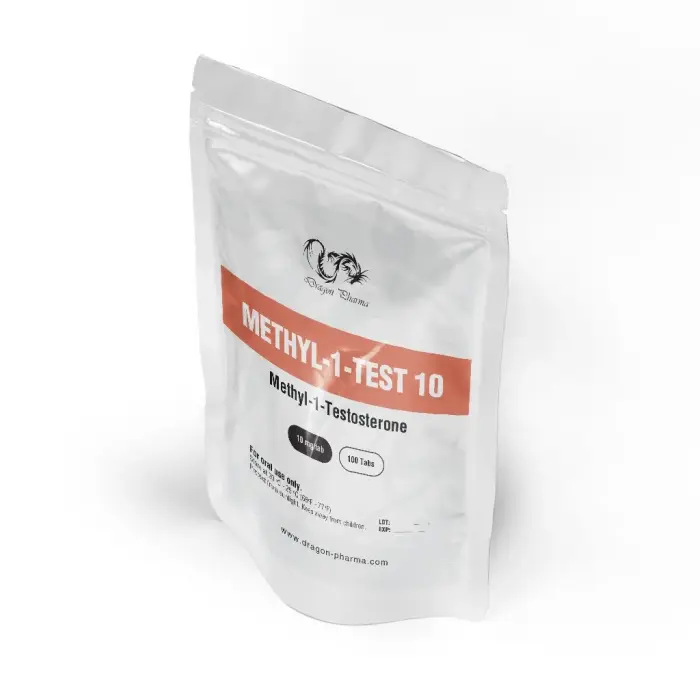
Methyl-1-Test
Methyl-1-Test Dragon Pharma — Overview
Methyl-1-Test Dragon Pharma is an oral tablet formulation of 17α-methyl-1-testosterone (M1T) at 10 mg per tablet. Methyl-1-testosterone is the 17α-methylated analogue of 1-testosterone, a naturally occurring androgen with a double bond at the C1–C2 position rather than the C4–C5 position of testosterone. The 17α-methyl group confers oral bioavailability at the cost of hepatic stress. M1T does not aromatize, does not convert to DHT via 5α-reductase, and produces a predominantly dry, strength-oriented anabolic effect with significant androgenic activity. It is among the most potent oral anabolics per milligram available.
This page covers the pharmacology of 1-testosterone and its 17α-methylated form, what M1T does in practice, appropriate cycle lengths and user profiles, how it compares to other dry oral AAS, goal-based stacking options, the hepatotoxic and androgenic side effect profile, bloodwork monitoring priorities, and PCT.
About the Compound: 17α-Methyl-1-Testosterone
1-Testosterone (androst-1-en-17β-ol-3-one) differs from testosterone in a single structural feature: its double bond sits at C1–C2 rather than C4–C5. This positional shift makes 1-testosterone resistant to aromatase (which requires the C4–C5 double bond as a substrate anchor) and also alters its interaction with 5α-reductase — unlike testosterone, 1-testosterone is not efficiently 5α-reduced to a more potent DHT derivative. The compound binds the androgen receptor with higher affinity than testosterone and, because it lacks the aromatization pathway, all anabolic and androgenic effects are delivered directly through AR activation with no estrogenic bypass.
Methyl-1-testosterone adds a 17α-methyl group, which blocks hepatic first-pass deactivation and makes the compound orally active. This also means M1T is a c-17α-alkylated steroid, carrying the hepatotoxic burden that all oral alkylated androgens share. The 17α-methyl group does not meaningfully alter receptor binding or tissue activity — M1T behaves pharmacologically like oral 1-testosterone with elevated liver enzyme burden as the primary cost of oral administration.
What M1T Does
M1T's effects are driven entirely by direct androgen receptor activation with no estrogenic contribution:
- Rapid strength gains — AR activation in muscle and CNS produces fast, pronounced increases in contractile strength; users typically report strength improvements within the first 7–10 days; this makes M1T one of the faster-acting oral AAS for strength performance
- Lean mass accumulation — nitrogen retention and protein synthesis increase through the AR pathway; muscle fullness and size increase without significant water retention; gains are predominantly dry because there is no estrogenic activity to drive subcutaneous fluid accumulation
- Lethargy (M1T-specific) — unlike most oral AAS, M1T is consistently associated with a notable fatigue or lethargy effect in a significant proportion of users; the mechanism is not fully established but appears dose-dependent; it is one of the distinguishing side effects of this compound compared to similar dry orals
- HPG axis suppression — like all AAS, M1T suppresses LH and FSH through negative feedback at the hypothalamus and pituitary; endogenous testosterone production declines during use; full PCT is required after cycle completion
- No estrogenic effects — there is no water retention, no estrogen-driven mood support, and no estrogenic contribution to joint lubrication; users should not expect the "full" feeling associated with wet compounds; joint discomfort is a known complaint in some users running M1T solo without an estrogenic base
Who It's For
- Experienced oral AAS users targeting short, concentrated strength phases — M1T's 2–4 week window and high mg-for-mg potency make it well-suited for rapid strength peaking before a meet, event, or training block where a brief anabolic pulse is more useful than a long injectable cycle; its dry profile means added body weight is predominantly lean
- Users kick-starting an injectable cycle — long-ester injectables take 3–4 weeks to reach full plasma concentration; running M1T for weeks 1–4 bridges this gap with immediate anabolic and strength activity; by the time M1T is discontinued, the injectable is active and can carry forward the cycle gains
- Users running a dry, non-estrogenic oral stack — M1T's no-aromatization profile suits cutting or recomposition phases where managing estrogen is already complex; unlike wet oral compounds (Dianabol, Anadrol), M1T adds no estrogenic burden and does not require an AI
- Users who should consider alternatives: anyone running their first AAS cycle — M1T's potency and lethargy profile make it difficult to evaluate responses and calibrate training; users who need to maintain energy and focus at work or during high-output training days will find the lethargy effect disruptive; users who want a longer oral-only cycle (8+ weeks) should use Winstrol instead, as M1T's hepatotoxicity is too high for extended runs; users sensitive to androgenic sides without estrogenic offset should note that M1T provides no joint lubrication or mood benefit from E2
M1T vs Alternatives
| Compound | Key Differences | Choose M1T When | Choose Alternative When |
|---|---|---|---|
| Halotestin (Fluoxymesterone) | Extremely androgenic, limited anabolic application; primary use is aggression and strength without meaningful muscle mass; also 17α-alkylated and hepatotoxic; even shorter practical cycle window (2–3 weeks maximum); no aromatization | Both strength and lean mass gain are goals; want the anabolic component alongside the strength increase; less comfortable with extreme androgenic stimulation | Goal is purely strength and aggression output with no mass objective; tolerance to strong androgenic stimulation is high; competitive combat sports or powerlifting peak where aggression output matters more than mass |
| Winstrol 50 (Stanozolol) | Dry oral DHT derivative; no aromatization; significantly milder per-mg potency than M1T; SHBG binding contributes to free androgen elevation; longer cycles possible (6–8 weeks); less hepatotoxic than M1T at standard doses; joints are a known concern on Winstrol due to no estrogenic lubrication | A short, concentrated strength and lean mass phase with maximum output per 2–4 weeks; lethargy is acceptable; potency per mg is the priority | Running a longer (6–8 week) oral phase; lower hepatotoxicity exposure preferred; stacking with another compound where potency from a single oral is sufficient |
| Superdrol (Methasterone) | 17α-alkylated oral; no aromatization; extremely potent mass-building oral; DHT derivative with structural modifications; very high hepatotoxicity (considered harsher than M1T); rapid mass and strength gains; also associated with lethargy and appetite suppression | Lean mass gain is equally important as strength; want a dry mass builder with a longer anabolic ramp per cycle; more comfortable with the compound's documented profile | The goal is primarily strength with moderate mass; want less absolute hepatotoxic burden per cycle; Superdrol's mass-building character and harsher liver profile are both higher than M1T |
Combinations
| Goal | M1T Dose | Stack | Cycle Support Notes |
|---|---|---|---|
| Injectable kick-start | 10–20 mg/day · W1–4 | Testosterone Enanthate 400–500 mg/wk (W1–12+); Test provides estrogenic baseline, M1T covers the loading gap before Test reaches steady state | NAC (Mucinac) 600 mg/day + Liv-52 throughout M1T phase; AI for Test (not for M1T); discontinue M1T at W4 |
| Short strength peak (solo) | 10–15 mg/day · 3–4 weeks | Solo run; use Testosterone base at TRT dose (100–150 mg/wk) to maintain libido and well-being given M1T's HPG suppression and no estrogenic activity | NAC + UDCA (Ursocol) from day one; no AI needed; monitor liver enzymes at W2 |
| Dry lean bulk stack | 10 mg/day · W1–4 | Primobolan 100 400 mg/wk + Testosterone base 200 mg/wk; Primo provides sustained anabolic activity, M1T jump-starts strength and density | NAC + Liv-52; low AI dose if Test base causes E2 elevation; M1T discontinued at W4 |
| Pre-competition strength finisher | 10–20 mg/day · final 2–3 weeks | Used at the end of a longer injectable cycle as a strength finisher (not kick-start); must check cumulative liver enzyme load if other hepatotoxic oral was used earlier in cycle | Liver enzymes at baseline before adding M1T; no other oral AAS running simultaneously; UDCA + NAC mandatory |
Side Effects & Management
M1T's side effect profile is dominated by hepatotoxicity (c-17α-alkylation) and direct androgenic activity. The absence of estrogenic activity removes water retention and gynecomastia from the picture but also removes estrogenic protective effects on lipids, mood, and joints.
| What May Occur | Background | How to Handle It |
|---|---|---|
| Hepatotoxicity (primary concern) | 17α-alkylation prevents hepatic oxidation, concentrating the compound in liver cells and causing dose-dependent AST/ALT elevation; M1T's hepatic strain is considered comparable to or greater than oral Winstrol and Halotestin at equivalent doses; cholestasis (bile flow impairment) has been reported in case literature; the 2–4 week maximum cycle limit is primarily hepatic, not pharmacological | NAC (Mucinac) 600 mg/day from day one — N-acetylcysteine supports glutathione synthesis and directly protects hepatocytes; UDCA (Ursocol) 500–750 mg/day for choleretic effect and bile acid protection; Liv-52 as general hepatoprotective support; check ALT/AST at W2 — if above 3× upper limit of normal, discontinue; alcohol is absolutely contraindicated during the cycle |
| Lethargy and fatigue | A distinguishing feature of M1T relative to other dry orals; a significant proportion of users report persistent tiredness, reduced drive, and subjective "heaviness" beginning in week 1–2; dose-dependent; mechanism not fully established but may involve CNS androgen receptor activity or metabolic burden; occurs in the absence of any E2 crash (unlike lethargy from over-suppressed estrogen) | Keep dose at 10–15 mg/day; split the daily dose across morning and midday rather than a single dose; adequate sleep and carbohydrate intake; if lethargy is debilitating at week 2, consider discontinuing — the compound is not well-tolerated by all users; this is one of the primary quality-of-life reasons to limit cycle length and dose |
| Androgenic effects (acne, oily skin, hair) | Potent direct AR binding in sebaceous glands and hair follicles; oily skin and acne are common; M1T does not amplify via DHT conversion but its raw androgenic activity is high; users with androgenic alopecia susceptibility are at risk | Consistent cleansing routine; for persistent inflammatory acne Doxycycline 100 mg/day is a standard antibiotic option; for severe or cystic acne Accutane (Isotretinoin) is the definitive intervention but requires a clear liver enzyme picture before starting given M1T's concurrent hepatic load; dose reduction is the most reliable first step; finasteride is not applicable (no DHT to block) |
| Joint discomfort | Absence of aromatization means no estrogenic joint lubrication; combined with potentially elevated training intensity from strength gains, connective tissue stress can increase; more common in users running M1T solo without any estrogenic compound in the stack | Pair with a testosterone base to maintain estrogenic joint protection; for acute joint pain Mobic (Meloxicam) 7.5–15 mg/day is a well-tolerated NSAID option; reduce training volume on affected joints; fish oil supplementation for systemic anti-inflammatory support |
| Lipid changes | No estrogenic activity means none of E2's partial HDL-protective effect; HDL suppression tends to be more pronounced with non-aromatizing androgens than aromatizing ones; LDL elevation is a class effect; M1T's short cycle window limits cumulative cardiovascular exposure compared to 12-week injectable cycles | Lipid panel at baseline and end of cycle; cardio training throughout; Rosuvastatin if LDL exceeds 160 mg/dL; blood pressure monitoring |
| Blood pressure elevation | AAS-related BP elevation is primarily driven by sodium retention and erythropoietic effects; less water retention than estrogenic compounds means BP impact is typically moderate; however, androgen-driven hematocrit elevation still occurs and should be monitored | Home BP monitoring weekly; target below 130/85 mmHg; Amlodipine for persistent elevation above 140/90 |
Bloodwork Monitoring
| Lab | When to Test | Target & Action Threshold |
|---|---|---|
| AST & ALT (liver enzymes) | Baseline · W2 · end of cycle · 4 weeks post-cycle | Most critical marker for M1T; above 2× ULN (typically >80 IU/L for ALT): reduce dose and increase NAC/UDCA; above 3× ULN: discontinue immediately; return to baseline within 4 weeks of stopping is expected if liver support was adequate |
| ALP (alkaline phosphatase) | Baseline · end of cycle | Cholestatic pattern (elevated ALP with elevated bilirubin): discontinue M1T and maintain UDCA; ALP elevation alone is less specific but watch trends alongside bilirubin |
| Hematocrit / CBC | Baseline · end of cycle | Keep hematocrit below 52%; above 54%: dose reduction or cycle end; hemoglobin monitored alongside |
| Lipid panel (HDL, LDL) | Baseline · end of cycle | HDL below 35 mg/dL: cardio and dose management; LDL above 160 mg/dL: consider Rosuvastatin; post-cycle lipid recovery expected within 4–6 weeks |
| Blood pressure | Weekly (home monitoring) | Target below 130/85 mmHg; above 140/90 for two consecutive readings: evaluate cycle continuation, add Amlodipine if needed |
| LH & FSH | Baseline · post-cycle (2 weeks after last dose) · post-PCT | Expected to be suppressed on-cycle; LH ≥3 IU/L and FSH ≥2 IU/L post-PCT confirm HPG recovery; short cycle duration (2–4 weeks) generally means faster recovery than after long injectable cycles |
| Total testosterone (endogenous) | Post-PCT (4–6 weeks after last tablet) | Return to pre-cycle baseline confirms HPG recovery; short cycle duration favors faster recovery; if below 350 ng/dL at 6 weeks post-PCT, extend SERM use |
PCT
M1T suppresses LH and FSH during the cycle. Recovery is typically faster after short oral cycles (2–4 weeks) than after long injectable cycles, but PCT should not be skipped. Wait for liver enzymes to return to normal range before starting SERMs to avoid stacking hepatic demands.
| PCT Element | Protocol | Notes |
|---|---|---|
| Washout | 5–7 days after last M1T tablet | M1T is a short-acting oral; clears within days of last dose; verify liver enzymes are trending down before starting SERMs; starting SERMs while M1T-related enzyme elevation is active adds unnecessary hepatic load |
| Nolvadex (Tamoxifen) | 40 mg/day × 2 weeks → 20 mg/day × 2 weeks | 4-week SERM run is typically sufficient after a 2–4 week oral cycle; Nolvadex is preferred over Clomid as the sole SERM here given no estrogenic rebound (no aromatization from M1T) |
| Clomid (Clomiphene) | 50 mg/day × 2 weeks (optional addition for first 2 weeks) | Dual SERM protocol with Clomid + Nolvadex is optional after M1T cycles of 4 weeks; adds stronger LH stimulus; useful if pre-cycle testosterone was already low or if recovery seems slow at the 2-week post-cycle check |
| Continue liver support during PCT | NAC + UDCA for 2–4 weeks into PCT | Liver enzyme normalization continues after stopping M1T; maintaining NAC and UDCA during the early PCT weeks accelerates hepatic recovery; verify ALT/AST return to baseline before clearing liver support |
Practical Summary
- 4 weeks maximum — this is a liver limit, not a pharmacological preference — M1T's hepatotoxicity accumulates; most users keep runs to 2–4 weeks; beyond 4 weeks the risk of significant hepatic damage outweighs incremental gains; check ALT/AST at W2 and act on the result
- Liver support starts on day one, not after symptoms appear — NAC (Mucinac) 600 mg/day + UDCA (Ursocol) 500–750 mg/day from the first tablet; continue through PCT; alcohol is absolutely off the table for the duration of the cycle and 2–4 weeks after
- Lethargy is real and dose-dependent — start at 10 mg/day; only move to 20 mg/day if lethargy at 10 mg is manageable; splitting the dose (morning + midday) is better tolerated than a single daily dose; plan the cycle around reduced energy output, especially in weeks 2–3
- Pair with a testosterone base if running solo — M1T produces no estrogenic activity and suppresses endogenous testosterone; a low-dose Test base (100–150 mg/wk) maintains libido, mood stability, and joint lubrication; running M1T without any androgen base for well-being leads to a poor quality of life mid-cycle
- Do not stack with another c-17α-alkylated oral simultaneously — combining two hepatotoxic orals multiplies the liver burden; M1T should be the only oral AAS in the cycle; wait a minimum of 4 weeks after completing an M1T cycle before introducing another oral
- PCT should not start until liver enzymes are trending toward normal — verify ALT/AST are declining before starting Nolvadex; a 5–7 day post-M1T window is usually sufficient; continue NAC and UDCA through the full PCT run
Methyl-1-Testosterone remains one of the most potent oral anabolics available on a per-milligram basis, producing fast, dry strength and mass gains within a tightly controlled 2–4 week window. Its no-aromatization profile eliminates estrogenic management entirely but demands strict attention to liver enzymes and adequate hepatoprotective support throughout. Available at Steroid Warehouse in Dragon Pharma's 10 mg tablet format, M1T is best suited to experienced AAS users looking for a compact, high-output oral phase with the discipline to monitor bloodwork and support the liver properly.
References
| Source | Topic | Link |
|---|---|---|
| New England Journal of Medicine / PubMed | Bhasin et al. 1996 — randomized controlled trial using 600 mg/week testosterone enanthate for 10 weeks, showing increased fat-free mass, muscle size, and strength, especially when combined with resistance training; foundational evidence for supraphysiologic androgen anabolic effects | Bhasin S, et al. (1996) ↗ |
| NCBI Bookshelf / StatPearls | Anabolic steroids overview — synthetic testosterone-derived AAS pharmacology, androgen receptor mechanism, anabolic-androgenic effects, oral and injectable steroid classes, misuse patterns, monitoring, and adverse effect profile | StatPearls: Anabolic Steroids ↗ |
| NCBI Bookshelf / Endotext | Androgen physiology and pharmacology — testosterone and androgen derivative mechanisms of action, androgen receptor activity, HPG axis suppression, estradiol aromatization, synthetic androgen pharmacology, and androgen misuse context | Endotext: Androgen Physiology, Pharmacology, Use and Misuse ↗ |
| British Journal of Pharmacology / PubMed | Kicman AT 2008 — comprehensive review of anabolic-androgenic steroid pharmacology covering androgen receptor activity, structure-activity relationships, anabolic-to-androgenic activity concepts, 17α-alkylated oral steroids, misuse patterns, and adverse effect mechanisms across compound classes | Kicman AT (2008) ↗ |
| Seminars in Liver Disease / PubMed | Ishak KG & Zimmerman HJ 1987 — classic review of hepatotoxic effects caused by anabolic-androgenic steroids, including cholestasis, peliosis hepatis, nodular regenerative changes, hepatic adenomas, hepatocellular carcinoma, and other liver complications linked to androgenic steroid exposure | Ishak KG & Zimmerman HJ (1987) ↗ |
How to take Methyl-1-Test?
Take 5-20 mg daily, split into 2-3 doses; see How to Use. Use with liver support—consult for proper administration.
What is Methyl-1-Test?
Methyl-1-Test is an oral anabolic steroid for muscle growth; see What is Methyl-1-Test. It's highly potent—consult professionals for safe use.
What is Methyl-1-Test used for?
It's used for rapid muscle growth and strength in bulking; see Key Benefits. It suits advanced users—use with professional oversight.
How long does Methyl-1-Test stay in your system?
With a 5-6 hour half-life, it's detectable for ~2-3 months; see Mechanism of Action. Plan PCT—consult professionals.
Is Methyl-1-Test safe?
It's safe with strict dosing and monitoring; see Side Effects. Manage risks with liver support and PCT—consult professionals for safety.
How long does it take to notice effects from Methyl-1-Test?
Due to its oral and fast-acting nature, users often report noticeable strength and performance changes within a short period after starting use.
What are the main benefits of Methyl-1-Test?
Commonly reported benefits include rapid strength gains, increased muscle hardness, improved training performance, and enhanced anabolic activity.
What are the possible side effects of Methyl-1-Test?
Potential side effects may include liver stress, increased blood pressure, acne, mood changes, and strong suppression of natural testosterone production.
Related Products