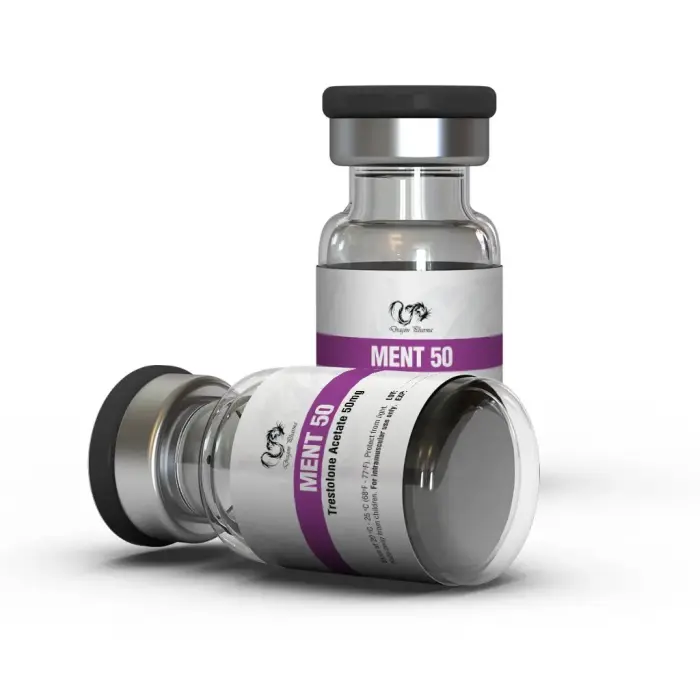
Ment 50
MENT 50 Dragon Pharma — Overview
MENT 50 Dragon Pharma is an injectable oil solution of trestolone acetate (7α-methyl-19-nortestosterone acetate) at 50 mg/mL. MENT is a synthetic 19-nor androgen originally developed as a male hormonal contraceptive and represents one of the most pharmacologically distinctive AAS available: it binds the androgen receptor with roughly six times the affinity of testosterone, does not undergo 5α-reduction to DHT, does not bind sex hormone-binding globulin (SHBG), and aromatizes to a biologically active estrogen. These properties make it a powerful anabolic with a mechanistic profile that differs from testosterone and nandrolone in several clinically meaningful ways.
This page covers trestolone's pharmacology and how it differs from comparable 19-nor steroids, its documented effects on muscle and strength, appropriate user profiles, goal-based stacking options, the estrogenic and progestogenic side effect picture specific to MENT, bloodwork monitoring priorities, PCT, and a practical protocol summary.
About the Compound: Trestolone Acetate (MENT)
Trestolone acetate (7α-methyl-19-nortestosterone acetate) is a synthetic androgen built on the 19-nortestosterone backbone with a 7α-methyl group added. The 19-nor modification (removal of the C-19 angular methyl group) is the same structural feature that defines nandrolone — but the additional 7α-methyl group fundamentally changes trestolone's receptor binding profile and metabolic behavior compared to nandrolone.
Three properties distinguish MENT from other common injectables:
- No SHBG binding — unlike testosterone and nandrolone, MENT has negligible affinity for sex hormone-binding globulin; essentially all circulating MENT is free and pharmacologically active regardless of SHBG levels; this means MENT's effective bioavailability is unusually high per mg administered, and its dose-response curve is steep
- No 5α-reduction — MENT is not a substrate for 5α-reductase, so it does not convert to a dihydro derivative in the scalp, skin, or prostate; the androgenic amplification that testosterone undergoes in these tissues does not occur with MENT; this makes MENT's androgenic activity in DHT-sensitive tissues lower than its strong AR binding affinity at first implies
- Aromatization to 7α-methyl-estradiol — MENT aromatizes and the resulting estrogen is biologically active; because all MENT is free (no SHBG buffering), the estrogenic load can be substantial; aggressive AI use is not optional — it is a requirement from the first week of the cycle
What MENT Does
MENT's primary pharmacological actions result from its direct androgen receptor activation and secondary estrogenic activity:
- Anabolic effects — nitrogen retention, protein synthesis, and muscle glycogen storage are all enhanced through AR activation; users consistently report rapid increases in muscle fullness and size, particularly during the loading weeks; strength gains are pronounced; the SHBG bypass means that even at modest mg-per-week doses, the free androgen load at the receptor is high
- Estrogenic mass and recovery support — aromatization to 7α-methyl-estradiol contributes to joint lubrication, mood, sleep quality, and the anabolic synergy between estrogen and androgen receptor pathways in muscle tissue; some degree of estrogenic activity during a bulk is beneficial; the challenge with MENT is preventing E2 from running too high, not eliminating it entirely
- HPG axis suppression — MENT suppresses luteinizing hormone (LH) and follicle-stimulating hormone (FSH) at doses as low as 50–100 mg/week; at typical physique doses (200–400 mg/week), HPG suppression is complete; endogenous testosterone production falls to near-zero within the first 1–2 weeks
- Progestogenic activity — like all 19-nor compounds, MENT activates the progesterone receptor; this amplifies the risk of gynecomastia (from both estrogenic and progestogenic receptor pathways simultaneously), may contribute to prolactin elevation, and can increase water retention independent of E2 levels
Who It's For
- Experienced AAS users seeking maximum anabolic return per injection volume — MENT's combination of high AR affinity and SHBG bypass produces strong anabolic effects at weekly doses that would be considered moderate for testosterone; users who have already plateaued on testosterone-based compounds and understand estrogenic management are the appropriate user group; MENT is not a compound for first or second cycles
- Users who prefer avoiding DHT-related androgenic sides — the absence of 5α-reduction means MENT does not amplify androgenic activity in the scalp or prostate through the DHT pathway; users who are sensitive to hair loss from testosterone or who want to avoid DHT-derived androgenic effects will find MENT's profile meaningfully different in this respect; this does not mean androgen-free — MENT binds AR directly in all tissues
- Users in off-season mass phases with disciplined monitoring — MENT rewards users who run regular bloodwork and adjust their AI dose dynamically; the steep dose-response curve for E2 means the difference between optimal and excessive estrogen can be a small AI dose adjustment; this is not a compound for users who prefer to cycle without monitoring
- Users who should consider alternatives: anyone new to AAS or to managing aromatization; users sensitive to gynecomastia who have previously experienced nipple sensitivity even with AI on board (the dual E2 + progesterone receptor pathway makes MENT higher-risk in this regard); users who require a dry, low-water-retention look; users who want a simpler, lower-maintenance injectable should opt for NPP 150 or a testosterone ester
MENT vs Alternatives
| Compound | Key Differences | Choose MENT When | Choose Alternative When |
|---|---|---|---|
| NPP 150 (Nandrolone PP) | Moderate AR binding (~3× test); aromatizes less than MENT; binds SHBG; short ester allows rapid dose adjustment; proven mass builder with decades of use data | Maximum anabolic output per mg is the priority; comfortable managing aggressive E2 elevation; SHBG bypass is desired; already established on nandrolone-class compounds | Want a more predictable, lower-maintenance estrogenic profile; sensitive to dual-pathway gyno risk; running a shorter cycle with frequent adjustments where nandrolone's documented track record is preferred |
| Deca 300 (Nandrolone Decanoate) | Same pharmacology as NPP; longer ester means slower onset, slower offset, and less injection frequency; more forgiving E2 curve than MENT; well-established joint support effects | Higher anabolic ceiling with SHBG bypass at lower injection volume; planning a longer cycle (12+ weeks) where rapid titration is not needed | Prefer infrequent injections with stable blood levels; joint support is a primary objective; want to minimize estrogenic management complexity |
| Trestolone 100 | Same compound (trestolone acetate) at 2× concentration (100 mg/mL); identical pharmacology, lower injection volume per dose | Transitioning to MENT 50 as a starting point to assess tolerance before escalating; prefer larger individual injection volumes or have specific dosing needs that work better at 50 mg/mL | Established on a MENT protocol and want to reduce injection volume; prefer fewer mL per injection; Trestolone 100 provides the same dose in half the volume |
| Trenbolone 200 | 19-nor; does NOT aromatize (no E2 elevation); very high progestogenic activity; strong CNS stimulation; androgenic; promotes dry, hard muscle with no water retention | Want muscle fullness and size from an estrogenic anabolic environment; sensitive to trenbolone's CNS-related sides (insomnia, anxiety, sweating); E2 control is the preferred challenge over tren neurological effects | Dry, hard, vascular look is the goal and water retention must be minimal; E2 management is difficult or unpredictable; tren neurological sides are acceptable; cutting or contest prep phase |
Combinations
| Goal | MENT 50 Dose | Added Compound(s) | Cycle Support Notes |
|---|---|---|---|
| Off-season mass | 200–300 mg/wk | Testosterone Enanthate 200 mg/wk (DHT/libido baseline); Deca 300 optional at 200 mg/wk for joint support | Arimidex 0.5 mg EOD from W1; test E2 at W4 and adjust; Cabergoline on hand for prolactin if Deca included |
| Lean bulk / recomposition | 150–200 mg/wk | Testosterone Propionate 100–150 mg/wk; Masteron E 200 mg/wk (partial E2 offset + hardness) | Arimidex 0.5 mg EOD; Masteron's DHT-binding of SHBG provides partial estrogen modulation but does not replace an AI; monitor E2 |
| Advanced bulk (dual 19-nor) | 200–300 mg/wk | NPP 150 at 150–200 mg/wk; Testosterone Enanthate 200 mg/wk | Aromasin 12.5–25 mg EOD; Cabergoline 0.25–0.5 mg 2×/wk mandatory given dual progestogenic load; prolactin and E2 bloodwork at W4 |
| First MENT cycle | 150–200 mg/wk | Solo run to assess individual estrogenic sensitivity before adding complexity | Arimidex 0.5 mg EOD from day one; E2 bloodwork at W4; do not add a second compound until estrogenic response is understood |
Side Effects & Management
MENT's side effect profile is shaped by its dual estrogenic and progestogenic activity, its complete SHBG bypass (amplifying all effects per mg), and its direct androgenic activity in non-5α-reductase-expressing tissues. The absence of DHT conversion is clinically meaningful but does not make MENT androgenically mild.
| What May Occur | Background | How to Handle It |
|---|---|---|
| Gynecomastia (dual-pathway risk) | MENT activates both estrogen receptors (via aromatized 7α-methyl-E2) and progesterone receptors simultaneously; either pathway alone can cause nipple sensitivity and glandular proliferation; the combination is additive; gyno risk with MENT is meaningfully higher than with testosterone alone at equivalent doses | Arimidex 0.5 mg EOD from W1 to suppress E2; keep E2 in mid-normal range (20–35 pg/mL) rather than crashing it; Nolvadex 20 mg/day at first sign of nipple sensitivity as a receptor blocker; Cabergoline if prolactin is contributing; do not wait on gyno symptoms before acting |
| Water retention and bloat | Estrogenic and progestogenic receptor activity both promote sodium and water retention; visible bloat can be significant at 300+ mg/week without AI management; blood pressure elevation is a secondary consequence | E2 management via Arimidex is the primary lever; reduce carbohydrate intake if water retention is cosmetically problematic; monitor blood pressure weekly; Amlodipine for persistent BP elevation above 140/90 |
| Elevated prolactin | 19-nor progestogenic activity can elevate prolactin through progesterone receptor agonism; elevated prolactin contributes to sexual dysfunction (libido, erection quality) and can worsen gynecomastia risk; more likely at higher doses or in dual 19-nor combinations | Check prolactin at W4–6; target below 25 ng/mL; Cabergoline (Caberlin) 0.25–0.5 mg twice per week if prolactin is elevated; do not simply increase AI as this does not address progesterone-driven prolactin |
| Androgenic effects (acne, oily skin) | MENT binds AR directly in the skin and sebaceous glands; while it does not amplify via DHT conversion, its potent AR binding still produces androgenic skin effects in users who are susceptible; oily skin and acne are common at 200+ mg/week | Consistent cleansing routine; topical benzoyl peroxide or adapalene for acne; dose reduction often resolves moderate acne |
| Hair loss (direct AR pathway) | No DHT conversion means no 5α-reductase amplification in the scalp; however, MENT's strong AR binding means direct androgen receptor activation in hair follicles occurs independently of DHT; users with androgenic alopecia are at risk, though typically less so than with equivalent testosterone doses | Finasteride is not effective here (no DHT to block); ketoconazole shampoo reduces scalp androgen receptor binding non-specifically and can be used supportively; dose management is the most reliable lever |
| Lipid changes and cardiovascular impact | AAS class effect: HDL suppression and LDL elevation; the estrogenic activity of MENT provides partial lipid protection compared to non-aromatizing androgens, but significant HDL suppression still occurs at standard doses; elevated blood pressure from water retention adds cardiovascular load | Lipid panel at baseline, W6, and post-cycle; cardio training throughout; Rosuvastatin if LDL exceeds 160 mg/dL during cycle; blood pressure monitoring weekly |
| HPG axis suppression | Complete LH and FSH suppression at physique doses; endogenous testosterone production falls to near-zero by week 2; testicular atrophy occurs during the cycle; full PCT is required for recovery | Expected and unavoidable on-cycle; HCG at 250–500 IU 2×/week during the cycle reduces testicular atrophy and may accelerate post-cycle recovery; plan PCT before starting the cycle (see below) |
Bloodwork Monitoring
| Lab | When to Test | Target & Action Threshold |
|---|---|---|
| Estradiol (E2) | Baseline · W4 · W8 · post-PCT | Target 20–35 pg/mL on-cycle; above 50 pg/mL: increase AI dose; below 15 pg/mL: reduce AI; crashed E2 causes joint pain, low libido, and mood decline — avoid over-suppression |
| Prolactin | Baseline · W4–6 · end of cycle | Target below 25 ng/mL; if ≥25 ng/mL: start Cabergoline 0.25 mg 2×/week; if ≥35 ng/mL or symptomatic (libido loss, nipple discharge): escalate Cabergoline to 0.5 mg 2×/week |
| Hematocrit / CBC | Baseline · W6 · end of cycle | Keep hematocrit below 52%; above 54%: reduce dose or donate blood; monitor hemoglobin alongside; polycythemia elevates stroke and clot risk |
| Lipid panel (HDL, LDL) | Baseline · W6 · post-cycle | HDL below 35 mg/dL warrants dose reduction or cycle pause; LDL above 160 mg/dL: consider Rosuvastatin; post-cycle target: return to pre-cycle baseline within 6–12 weeks |
| Blood pressure | Weekly (home monitoring) | Target below 130/85 mmHg; above 140/90 for two consecutive readings: add Amlodipine 5 mg/day; above 160/100: reduce AI to reassess E2 (high E2 from under-suppressed aromatization is a common BP driver on MENT) |
| LH & FSH | Baseline · post-cycle (2–4 wks after last injection) · post-PCT | Expected to be suppressed to near-zero on-cycle; LH ≥3 IU/L and FSH ≥2 IU/L post-PCT confirm HPG axis recovery; if recovery is incomplete at 6 weeks post-PCT, re-check and extend SERM use |
| Total testosterone (endogenous) | Post-PCT (6–8 wks after last injection) | Target: return to pre-cycle baseline; below 350 ng/dL at 8 weeks post-PCT with low LH/FSH suggests incomplete HPG recovery; do not start another cycle until confirmed |
PCT
MENT is among the most HPG-suppressive compounds available. Complete LH and FSH suppression occurs within the first two weeks at physique doses. PCT planning should be decided before the cycle begins — not improvised at the end.
| PCT Element | Protocol | Notes |
|---|---|---|
| Washout period | 2–3 weeks after last injection before starting SERMs | Trestolone acetate has a short ester; active compound clears within 4–7 days of last injection; a 2-week wait is generally sufficient; starting SERMs while MENT is still active is counterproductive |
| Nolvadex (Tamoxifen) | 40 mg/day × 2 weeks → 20 mg/day × 4 weeks | Standard 6-week SERM run; the higher initial dose addresses residual estrogenic suppression of pituitary LH/FSH secretion; Nolvadex also blocks gyno receptors during PCT if nipple sensitivity carries over from cycle |
| Clomid (Clomiphene) | 50 mg/day × 2 weeks → 25 mg/day × 2–4 weeks (optional dual SERM) | Adding Clomid to Nolvadex for the first 2 weeks of PCT provides a stronger LH stimulus; suitable for MENT cycles of 14+ weeks where recovery may be slower; Clomid alone (without Nolvadex) is acceptable but less preferred given MENT's gyno risk carryover |
| Continue Cabergoline through PCT start | 0.25 mg 2×/week for 2–4 weeks into PCT if prolactin was elevated on-cycle | Elevated prolactin suppresses LH pulsatility independently of SERM activity; normalize prolactin before or during early PCT for optimal recovery; check prolactin at PCT start |
| Recovery confirmation bloodwork | LH, FSH, total testosterone at 6 weeks post-PCT completion | LH ≥3 IU/L + FSH ≥2 IU/L + testosterone at or near pre-cycle baseline = confirmed recovery; insufficient recovery: extend SERMs for 2–4 additional weeks before re-testing |
Practical Summary
- Start at 150–200 mg/week before escalating — MENT's SHBG bypass means the free androgen load is high relative to the nominal dose; most users achieve significant anabolic response at 200 mg/week; moving to 300–400 mg/week adds disproportionate estrogenic burden without proportional mass return
- AI from day one, not on symptom onset — E2 elevation begins within the first week; start Arimidex 0.5 mg EOD from the first injection; test E2 at W4 and adjust; waiting for estrogenic symptoms before introducing an AI is not the correct approach on MENT
- Prolactin monitoring is not optional — progesterone receptor activation can elevate prolactin independent of E2; check at W4–6; if prolactin exceeds 25 ng/mL, Cabergoline 0.25–0.5 mg twice per week; dual 19-nor stacks (MENT + nandrolone) require Cabergoline prophylactically
- No DHT conversion does not mean androgen-free for the scalp — MENT's direct AR binding is potent; users with a history of androgenic alopecia should assess scalp response at the lower end of the dose range; finasteride has no effect here since there is no DHT pathway to block
- SHBG bypass makes dose titration steep — 100% of circulating MENT is free and active; small dose changes produce larger physiological responses than comparable changes in SHBG-binding androgens; do not casually escalate mid-cycle based on a single week of subjective feedback
- Recovery after MENT is not fast — plan PCT before the cycle starts — allow 2–3 weeks washout after last injection; run Nolvadex 40/40/20/20 (6 weeks) with optional Clomid for the first 2 weeks; confirm LH, FSH, and total testosterone before clearing; do not start another cycle on incomplete recovery
MENT (trestolone acetate) remains one of the most pharmacologically distinctive injectables available, combining exceptional AR binding affinity, complete SHBG bypass, and the absence of 5α-reduction into a compound capable of producing significant mass and strength gains at doses that appear modest by conventional AAS standards. Its elevated estrogenic and progestogenic activity requires disciplined AI use, prolactin monitoring, and regular bloodwork — the compound rewards users who manage the cycle correctly. Available at Steroid Warehouse in Dragon Pharma's 50 mg/mL format, MENT 50 is best suited to experienced AAS users who have already optimized their approach to estrogen management and cycle monitoring.
References
| Source | Topic | Link |
|---|---|---|
| New England Journal of Medicine / PubMed | Bhasin et al. 1996 — randomized controlled trial using 600 mg/week testosterone enanthate for 10 weeks, showing increased fat-free mass, muscle size, and strength, especially when combined with resistance training; foundational evidence for supraphysiologic androgen anabolic effects | Bhasin S, et al. (1996) ↗ |
| NCBI Bookshelf / StatPearls | Anabolic steroids overview — synthetic testosterone-derived AAS pharmacology, androgen receptor mechanism, anabolic-androgenic effects, oral and injectable steroid classes, misuse patterns, monitoring, and adverse effect profile | StatPearls: Anabolic Steroids ↗ |
| NCBI Bookshelf / Endotext | Androgen physiology and pharmacology — testosterone and androgen derivative mechanisms of action, androgen receptor activity, HPG axis suppression, estradiol aromatization, synthetic androgen pharmacology, and androgen misuse context | Endotext: Androgen Physiology, Pharmacology, Use and Misuse ↗ |
| Journal of Clinical Endocrinology & Metabolism / PubMed | von Eckardstein et al. 2003 — clinical trial of 7α-methyl-19-nortestosterone acetate implants in men; documents suppression of spermatogenesis and gonadotropins, androgenic effects, and safety findings supporting MENT acetate development as a long-acting male contraceptive androgen | von Eckardstein S, et al. (2003) ↗ |
| Journal of Steroid Biochemistry and Molecular Biology / PubMed | Sundaram et al. 1995 — comparative metabolism study showing that 7α-methyl-19-nortestosterone is not 5α-reduced because of the 7α-methyl group; explains MENT's tissue-specific androgenic profile compared with testosterone and nandrolone | Sundaram K, et al. (1995) ↗ |
How to take Ment 50?
Inject 50-100 mg daily or 100-200 mg EOD; see How to Use. Use sterile technique—consult for proper administration.
What is Ment 50?
Ment 50 is an injectable Trestolone Acetate for muscle growth; see What is Ment 50. It's highly anabolic—consult professionals for safe use.
What is Ment 50 used for?
It's used for rapid muscle growth and strength in bulking; see Key Benefits. It suits advanced users—use with professional oversight.
How long does Ment 50 stay in your system?
With a 1-2 day half-life, it's detectable for ~1-2 months; see Mechanism of Action. Plan PCT—consult professionals.
Is Ment 50 safe?
It's safe with proper dosing and monitoring; see Side Effects. Manage risks with ancillaries—consult professionals for safety.
How does Ment 50 work?
Ment 50 works by strongly binding to androgen receptors, producing powerful anabolic signaling that supports protein synthesis, nitrogen retention, and muscle growth.
What are the main benefits of Ment 50?
Commonly discussed benefits include rapid muscle growth, significant strength gains, increased training intensity, and strong anabolic activity.
What are the possible side effects of Ment 50?
Potential side effects may include estrogen-related effects, acne, oily skin, mood changes, and significant suppression of natural testosterone production.
Related Products