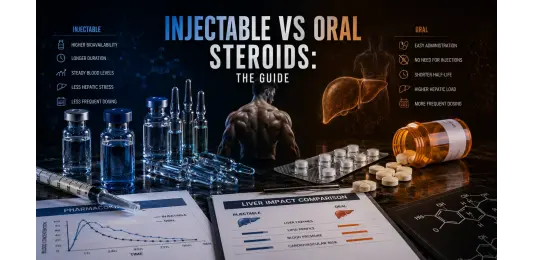
The choice between injectable and oral steroids is one of the most fundamental decisions in cycle planning — and one of the most commonly misunderstood. It is not simply a question of needles versus pills. The two forms differ in mechanism of action, liver impact, blood level stability, side effect profile, optimal use case and cycle duration. This guide covers every dimension of the comparison so you can make an informed decision based on your goals, health baseline and experience level.
Before choosing compounds, make sure you understand the fundamentals: What Are Anabolic Steroids? — and if this is your first cycle, read the Beginner's Guide to Steroid Cycles first.
How They Differ — The Core Mechanism
The fundamental difference between oral and injectable AAS is how they enter the bloodstream and how the body processes them.
Oral Steroids — First-Pass Metabolism
When you swallow an oral steroid, it travels through the digestive system and enters the portal circulation — passing through the liver before reaching systemic circulation. The liver recognises testosterone and its derivatives as compounds to metabolise and break down. Left unmodified, virtually no oral testosterone survives first-pass liver metabolism.
To solve this, oral steroids are chemically modified through C17-alpha alkylation — the addition of a methyl group at the 17th carbon position. This modification makes the compound resistant to hepatic breakdown, allowing it to survive first-pass metabolism and enter the bloodstream with meaningful bioavailability (typically 80–95%). The trade-off is direct: the same structural change that makes an oral steroid bioavailable makes it hepatotoxic.
Injectable Steroids — Bypassing the Liver
Injectable steroids are administered intramuscularly or subcutaneously. They absorb directly into systemic circulation without passing through the liver first. This bypass eliminates the hepatotoxicity mechanism of C17-alpha alkylation entirely — injectable testosterone and its derivatives do not require chemical modification to survive digestion because they do not go through the digestive system.
Injectable steroids are bound to ester chains — fatty acid molecules that control the rate of release from the injection site into the bloodstream. Different esters produce different pharmacokinetic profiles, which is why testosterone propionate (short ester) and testosterone enanthate (long ester) behave so differently despite being the same active hormone.
Liver Toxicity — The Real Picture
Hepatotoxicity is the most significant practical difference between oral and injectable steroids, and it is more nuanced than the simple "orals destroy your liver" narrative suggests.
How C17-Alpha Alkylation Damages the Liver
The mechanism of 17-alpha alkylated steroid hepatotoxicity involves multiple pathways: increased production of reactive oxygen species (ROS) that directly injure hepatocytes, impairment of bile transport through canalicular membrane transporters leading to bile acid accumulation, and disruption of mitochondrial respiratory chain function at high doses. The result can range from mild enzyme elevation to serious conditions including cholestasis, peliosis hepatis, hepatic adenomas and — in severe long-term cases — hepatocellular carcinoma.
Oral Hepatotoxicity by Compound
| Compound | Hepatotoxicity | Max Duration | Notes |
|---|---|---|---|
| Oxymetholone (Anadrol) | Very High | 4–6 weeks | Highest hepatotoxic potential of common orals |
| Methandrostenolone (Dbol) | High | 4–6 weeks | Rapid ALT/AST elevation within weeks |
| Stanozolol (Winstrol) | High | 4–6 weeks | Associated with cholestasis |
| Superdrol (Methyldrostanolone) | Very High | 3–4 weeks | 17α-methylated Drostanolone derivative — no aromatisation, no water retention, very high hepatotoxicity |
| Turinabol | Moderate | 6 weeks | Milder than Dbol, still requires monitoring |
| Oxandrolone (Anavar) | Low–Moderate | 6–8 weeks | Mildest hepatotoxicity among common 17-aa orals |
| Fluoxymesterone (Halotestin) | Very High | 4 weeks | Advanced compound — significant hepatic risk |
Injectable Hepatotoxicity
Injectable steroids are not completely hepatotoxicity-free. Non-alkylated injectables can cause mild liver enzyme elevation at high doses, and there are documented cases of cholestatic hepatitis from injectable compounds including trenbolone enanthate. However, the mechanism and severity are categorically different — without C17-alpha alkylation, the hepatotoxic risk is substantially lower and at standard doses rarely clinically significant.
Blood Level Stability and Esters
One of the most significant practical advantages of injectable steroids is blood level stability. Understanding esters is essential for planning injection frequency and managing side effects.
Short Esters vs Long Esters
| Ester | Compound | Half-Life | Injection Frequency | Best Use Case |
|---|---|---|---|---|
| Propionate | Testosterone Propionate | 2–3 days | Every other day | Cutting, fast-clearing pre-competition |
| Enanthate | Testosterone Enanthate | 7–10 days | 2× per week | Bulking, first cycles, stable levels |
| Cypionate | Testosterone Cypionate | 8–12 days | 2× per week | Equivalent to Enanthate — interchangeable |
| Decanoate | Nandrolone Decanoate | ~15 days | Once per week | Long bulking cycles, joint support |
| Acetate | Trenbolone Acetate | 2–3 days | Every other day | Advanced cutting — fast clearance |
| Enanthate | Trenbolone Enanthate | 7–10 days | 2× per week | Advanced recomp — less frequent pinning |
Oral steroids do not use esters — their short half-lives (typically 6–16 hours) require daily dosing, sometimes split into 2–3 doses per day to maintain stable blood levels. This frequency of dosing also means the liver is continuously exposed to the 17-alpha alkylated compound — a key contributor to cumulative hepatotoxicity over a cycle.
Oral Steroids — Compound Guide
Each oral steroid has a distinct pharmacological profile. Understanding the differences determines appropriate use cases and appropriate risk management.
Dianabol (Methandrostenolone)
Dianabol 20mg is the archetypal oral bulking steroid — developed in 1958, it remains one of the most widely used compounds globally. It produces rapid increases in muscle mass, strength and glycogen storage, with significant water retention. The anabolic-to-androgenic ratio is 90–210:40–60. Primary uses: cycle kickstart (weeks 1–4 of a long injectable cycle), rapid strength phase, off-season mass building. Hepatotoxicity is significant — limit to 4–6 weeks maximum.
Anavar (Oxandrolone)
Anavar 10mg has the most favourable hepatotoxicity profile of commonly used oral AAS. Its anabolic-to-androgenic ratio (322–630:24) makes it highly anabolic with minimal androgenic effects — the reason it is one of the few AAS used in female protocols. Primary uses: lean mass, cutting, strength without mass, women's cycles. Higher doses (60–80 mg/day) significantly increase hepatotoxic risk despite Anavar's mild reputation at lower doses.
Winstrol (Stanozolol)
Winstrol 10mg produces lean, hard gains without water retention — it does not aromatise to estrogen. Commonly used in the final 4–6 weeks of a cutting cycle to harden physique and increase strength without mass. Significant cholesterol impact — HDL suppression is pronounced with stanozolol. Joint dryness is a well-documented side effect at higher doses.
Turinabol
Turinabol is a chlorinated derivative of Dianabol with lower androgenicity and less water retention. It produces slower, drier gains than Dbol with a milder side effect profile. Originally developed in East Germany for athletic enhancement, it was the compound at the centre of the systematic GDR doping programme. Useful as a cycle kickstart or lean cycle addition where Dbol's water retention is undesirable.
Superdrol (Methyldrostanolone)
Superdrol (Methyldrostanolone) is a 17α-methylated derivative of Drostanolone (Masteron) — structurally distinct from most oral AAS which are testosterone derivatives. This makes it unique: it does not aromatise to estrogen, produces no water retention, and delivers exceptional strength and lean mass gains. It is among the most potent and most hepatotoxic oral AAS available. Maximum 3–4 weeks, comprehensive liver monitoring required. Not appropriate without prior AAS experience.
>Injectable Steroids — Compound Guide
Testosterone (Base of All Cycles)
Testosterone is the foundation of every responsible injectable cycle. It replaces the natural testosterone suppressed by all AAS, prevents low-testosterone symptoms and provides its own meaningful anabolic stimulus. Available as Enanthate, Cypionate and Propionate — choice depends on injection frequency preference and cycle goals.
Nandrolone Decanoate (Deca)
Deca 300 is the most widely used injectable bulking compound after testosterone. Anabolic rating of 125 with androgenic rating of 37 — highly anabolic with low androgenicity. Notable for joint lubrication effects via synovial fluid retention — beneficial for users with joint pain under heavy training loads. Requires attention to prolactin management and extended PCT timing (21 days post-last injection) due to the very long decanoate ester.
Boldenone (Equipoise)
EQ 300 produces lean, dry gains with notable appetite stimulation and increased red blood cell production. Lower water retention than testosterone, relatively mild androgenicity. Haematocrit monitoring is important — the erythropoietic effect can push haematocrit to levels requiring management.
Masteron (Drostanolone)
Masteron 100 is an androgenic compound used primarily in cutting phases. It has mild aromatase inhibitor properties, contributes to muscle hardness and definition, and works synergistically with testosterone in a cutting stack. Requires low body fat to produce visible hardening effects — not appropriate for bulking phases.
Trenbolone
Trenbolone — available as Acetate or Enanthate — is the most potent injectable AAS in common use (anabolic rating 500, androgenic rating 500). It does not aromatise and produces exceptional recomposition effects. It is also the most demanding compound from a side effect standpoint — significant cardiovascular, androgenic and psychological effects including anxiety, insomnia and aggression. Not appropriate for beginner or intermediate users.
Primobolan (Methenolone)
Primobolan 200 is considered one of the safest injectable AAS — low androgenicity, no aromatisation, minimal cardiovascular impact at moderate doses. Produces lean, keepable gains without water retention. Higher cost and lower anabolic output per mg compared to testosterone make it more suitable for intermediate to advanced users seeking quality over quantity.
Side Effect Comparison
| Side Effect | Injectable | Oral | Notes |
|---|---|---|---|
| Hepatotoxicity | Low (no 17-aa) | Moderate to Very High | Primary advantage of injectables |
| HDL suppression | Moderate | Severe | Orals — especially Winstrol — devastate HDL |
| LDL elevation | Moderate | Significant | Dose-dependent for both |
| Blood pressure | Moderate | Moderate to High | Water retention compounds BP effect |
| HPG suppression | Complete | Complete | All AAS suppress — PCT required for both |
| Estrogen conversion | Varies by compound | Varies by compound | Dbol aromatises strongly; Anavar does not |
| Androgenic effects | Varies by compound | Varies by compound | Ratio determines acne, hair loss, virilisation |
| Injection site risk | Infection, PIP | None | Sterile technique eliminates infection risk |
| Blood level stability | Excellent (long esters) | Poor (daily dosing required) | Stable levels reduce E2 fluctuation |
Cycle Planning — How to Use Both
The most effective approach for most intermediate and advanced users combines injectable and oral steroids strategically — using each where it provides the most benefit while minimising combined risk.
The Kickstart Method
The most common combined approach: injectable testosterone as the cycle base, with an oral kickstart for the first 4 weeks while the long-ester injectable builds to stable blood levels.
- Weeks 1–4: Dianabol 20–30 mg/day — rapid strength and mass while Test E builds up
- Weeks 1–12: Testosterone Enanthate 400 mg/week — cycle base providing stable anabolic environment
- PCT: 14 days after last injection — Nolvadex 40/40/20/20 mg
The Finisher Method
Adding an oral in the final 4–6 weeks of a cycle to accelerate definition and strength as the cycle ends — common in cutting phases:
- Weeks 1–12: Testosterone Enanthate 350 mg/week + Masteron 100 EOD
- Weeks 8–12: Anavar 50 mg/day or Winstrol 40 mg/day
- PCT: 14 days after last injection
Women — Special Considerations
Women are significantly more sensitive to androgenic AAS effects than men due to lower baseline androgen levels. Virilisation — voice deepening, clitoral enlargement, body and facial hair — can develop at doses men would consider mild. Some virilisation changes are irreversible.
For women, the preferred approach is:
- Anavar at 5–20 mg/day — the most commonly used AAS in female protocols due to its low androgenicity. See Anavar 10mg Dragon Pharma
- Primobolan at 25–75 mg/week injectable — very low androgenicity, no aromatisation. See Primobolan 100
- Turinabol at 5–15 mg/day — milder than Dbol, moderate androgenicity risk at higher doses
Stop immediately at the first sign of voice changes — this is the earliest irreversible virilisation marker. Shorter oral cycles (4–6 weeks) provide more control than long injectable cycles for female users due to faster clearance.
Which Is Right for Beginners?
For a first cycle, injectable testosterone is the correct choice — not oral steroids, not a combination. The reasons:
- Testosterone is the most studied and best-understood AAS — the only compound where risk is fully characterised
- Injectable testosterone does not add hepatotoxicity to the risk profile
- Long esters produce stable blood levels — stable levels mean predictable E2 management
- Running one compound makes it possible to identify the cause of any side effect that appears
- Oral-only cycles suppress testosterone without providing stable androgen replacement — the result is often low-testosterone symptoms during the cycle itself
- Niedfeldt M.W. (2018) — Anabolic Steroid Effect on the Liver. Current Sports Medicine Reports. PubMed.
- LiverTox — Androgenic Steroids: hepatotoxicity, C17-alpha alkylation mechanism, cholestasis, peliosis hepatis, hepatic adenomas, and liver tumor risk. NIH/NCBI. Updated 2020.
- Petrovic A. et al. (2022) — Anabolic androgenic steroid-induced liver injury: An update. World Journal of Gastroenterology. PubMed.
- Albano G.D. et al. (2021) — Adverse Effects of Anabolic-Androgenic Steroids: A Literature Review. Healthcare. PubMed.
- Bond P., Smit D.L., de Ronde W. (2022) — Anabolic-androgenic steroids: How do they work and what are the risks? Frontiers in Endocrinology. PubMed.