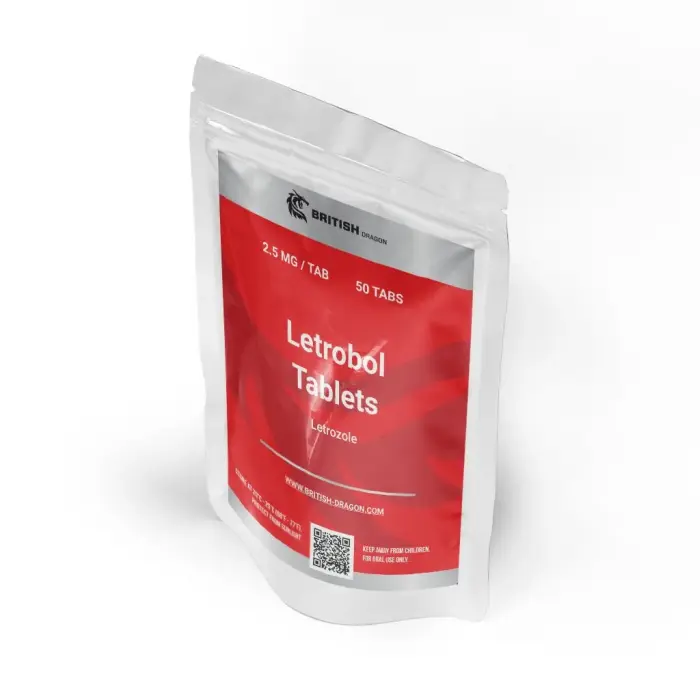
Letrobol Tablets
Letrobol Tablets British Dragon — Overview
Letrobol Tablets deliver letrozole at 2.5 mg per tablet — the most potent aromatase inhibitor available in performance protocols, sold clinically under the brand name Femara. Letrozole is a third-generation non-steroidal AI that suppresses plasma estradiol by up to 98–99% at its full clinical dose. That suppression ceiling is substantially higher than anastrozole or exemestane at standard doses, which makes letrozole the compound of choice when those AIs prove insufficient — specifically on very high-dose testosterone cycles, stacks combining multiple aromatizing compounds, or acute gynecomastia flares requiring rapid, aggressive estrogen reduction.
Letrozole is not the appropriate first-line AI for a standard testosterone cycle. Its potency makes E2 crash a significant risk at doses that might be routine for weaker inhibitors. Used at low doses, titrated carefully by bloodwork, it covers the scenarios where moderate AIs fall short. Available at steroidwarehouse.com as part of the full British Dragon cycle support lineup alongside anastrozole and exemestane.
About the Compound
Letrozole is a triazole-derived non-steroidal aromatase inhibitor — it works by reversibly and competitively binding the aromatase enzyme's active site, blocking conversion of androgens to estrogens. Unlike exemestane (a suicide inhibitor that permanently deactivates the enzyme), letrozole occupies the site without destroying the enzyme. When plasma letrozole levels fall, the enzyme is released and resumes activity. This reversibility has an important practical implication: discontinuing letrozole allows estrogen to rebound, sometimes sharply, as previously inhibited aromatase activity resumes. Managing the end-of-cycle or pre-PCT transition requires attention to this property.
Letrozole achieves its exceptional suppression potency through the high affinity of its triazole nitrogen atoms for the heme iron in aromatase's cytochrome P450 active site. At 2.5 mg/day — the standard clinical oncology dose — plasma estradiol falls by approximately 98–99% in postmenopausal women. In cycling males with high testosterone levels driving substantial aromatase substrate, the same dose produces deep suppression that frequently overshoots the functional E2 range. This is why performance applications use substantially lower doses — 0.5 to 1.25 mg every two to three days — calibrated by bloodwork rather than applied at clinical doses.
Plasma half-life is approximately 45 hours (roughly two days), supporting stable blood levels on every-other-day or every-third-day dosing. Steady state is reached within two to six weeks of regular administration.
What Letrobol Does
Letrozole's effects are an extension of its aromatase inhibition — everything it produces follows from reducing circulating estradiol:
- Deep estrogen suppression — the primary effect and the reason for choosing letrozole over other AIs. At 2.5 mg EOD in a high-testosterone cycle, plasma E2 can be reduced to very low levels within days. Titration down to 0.5–1.25 mg every three days keeps E2 in functional range for most users on 500–700 mg testosterone weekly.
- Gynecomastia flare intervention — letrozole's aggressive E2 suppression makes it the compound of choice for managing acute gynecomastia flares where rapid reduction of circulating estrogen is needed. A short high-dose run (2.5 mg/day for 7–14 days) is the standard aggressive protocol for this scenario.
- Dry, hard appearance at low body fat — eliminating excess estrogen-driven subcutaneous water retention produces a visually harder, more defined look. At high doses this effect overshoots and produces the joint pain and flat appearance of E2 crash, so bloodwork-guided dosing is required.
- LH and FSH stimulation (indirect) — reducing estrogenic negative feedback on the hypothalamus can transiently increase LH and FSH pulses. Some protocols exploit this in PCT, though the rebound risk on discontinuation complicates its use in that context.
On E2 crash risk: letrozole is uniquely capable of crashing E2 to clinically undetectable levels at doses that feel conservative. Joint pain, zero libido, depressive mood, cognitive fog, and fatigue at levels that impair training are the warning signs. The speed and depth of suppression require that users start at the lowest effective dose and confirm E2 by bloodwork before adjusting upward.
Who It Is For
Letrozole is the AI for a specific subset of performance users — those running doses or compounds that outpace what anastrozole or exemestane at standard doses can control, or those managing an acute estrogen-related complication that requires fast, powerful intervention.
It is most appropriate when:
- Total testosterone dose exceeds approximately 700–800 mg per week, particularly when stacked with other aromatizing compounds (e.g. testosterone + Dianabol + boldenone). The aromatase substrate load at these doses can outpace anastrozole's suppressive ceiling.
- E2 remains persistently elevated above range despite adequate anastrozole or exemestane dosing confirmed by bloodwork — the "anastrozole non-responder" scenario, which occurs in some users due to CYP2A6 polymorphisms affecting anastrozole metabolism.
- An acute gynecomastia flare has developed and rapid E2 reduction is needed. Letrozole at 2.5 mg/day for a short burst suppresses estrogen fast enough to halt active glandular tissue growth in its early stages.
Choose something else when: the cycle is a standard testosterone run at 300–600 mg/week — anastrozole or exemestane provides adequate control at lower crash risk. When a rebound-free post-cycle transition is the priority, exemestane is the better choice. When precise mid-cycle dose adjustment is needed quickly, anastrozole's shorter half-life makes it easier to titrate. Letrozole is a specialist tool; using it routinely on moderate cycles adds E2 crash risk without meaningful benefit over a well-dosed moderate AI.
Letrobol vs Alternatives
| Compound | Key Differences | Choose Letrobol When | Choose Alternative When |
|---|---|---|---|
| Letrobol British Dragon |
Non-steroidal; reversible; most potent AI (~98–99% suppression); ~45h half-life; rebound risk on stop; E2 crash risk high at standard doses | Very high-dose cycles; refractory E2 unresponsive to other AIs; acute gynecomastia flare | — |
| Anastrozole Tablets British Dragon |
Non-steroidal; reversible; moderate potency (~85% suppression); ~50h half-life; easier to titrate; rebound risk on abrupt stop; first-line AI for standard cycles | Standard testosterone cycles; moderate aromatization; dose adjustment likely mid-cycle; first-line choice | E2 elevated despite anastrozole at max dose; very high-dose stack; gyno flare → Letrobol |
| Exemestane Tablets British Dragon |
Steroidal; irreversible (suicide inhibitor); no rebound on stop; moderate potency; mild androgenic activity; preferred for PCT transition | Rebound-free cycle-to-PCT transition; moderate cycle with clean stop; mild androgenic support wanted | Rapid high-potency E2 suppression needed; gyno flare; refractory to moderate AIs → Letrobol |
When to Use — Cycle Pairings
| Cycle Type | Letrozole Protocol | Notes |
|---|---|---|
| Very high-dose testosterone (700 mg/wk+) | 0.5–1.25 mg EOD; confirm E2 at week 3–4; adjust by bloodwork only | Start at 0.5 mg EOD — not at 2.5 mg. Even at very high testosterone doses, 2.5 mg EOD will crash E2 in most users. Titrate up based on bloodwork, never by symptom alone. |
| Multi-compound stack (test + oral aromatizer) | 0.5–1.25 mg EOD during oral kickstart phase; reassess when oral is dropped | Dianabol adds substantial additional aromatase substrate on top of a testosterone base. Letrozole at low dose controls the combined load. When the oral is dropped after 4–5 weeks, the reduced substrate may require stepping down to a moderate AI or lowering letrozole frequency. |
| Anastrozole non-responder | Switch to letrozole 0.5–1.25 mg E3D; confirm E2 within 2 weeks of switch | Some users metabolize anastrozole faster than typical due to CYP2A6 variation. If E2 remains above range despite confirmed adequate anastrozole dosing, letrozole is the next step before considering dose increases. |
| Acute gynecomastia flare | 2.5 mg/day × 7–14 days, then taper to 1.25 mg EOD or switch to anastrozole/exemestane for maintenance | Emergency protocol only — not a routine cycle dose. The goal is rapid E2 reduction to halt active glandular growth; once the flare is controlled, taper to the lowest effective maintenance dose. Monitor E2 closely during taper to avoid rebound. |
Side Effects & Management
Letrozole's side effects are almost entirely consequences of excessive estrogen suppression — the same pattern as other AIs, but with a higher incidence at doses that would be moderate for weaker inhibitors. The depth of achievable suppression is what makes letrozole useful and also what makes it easy to overdose.
| What May Occur | Background | How to Handle It |
|---|---|---|
| E2 crash (joint pain, low libido, mood depression) | The most common problem with letrozole in performance use. Suppression below 10–15 pg/mL produces dry, aching joints, complete libido loss, depressive mood, and cognitive flatness. This can occur at doses as low as 1.25 mg EOD in low-aromatizing individuals. | Reduce dose or extend interval immediately. Confirm E2 by bloodwork. Recovery typically takes 5–10 days after dose reduction. If libido support is needed acutely: Cialis DP. Do not attempt to restart estrogen production pharmacologically — dose reduction and time are the only interventions. |
| Estrogen rebound on discontinuation | Reversible binding means aromatase activity resumes when letrozole clears. If letrozole is stopped abruptly mid-cycle or at cycle end, the rebound estrogen surge can trigger gynecomastia or significant water retention — the opposite problem from what letrozole was managing. | Taper letrozole dose over 1–2 weeks before stopping rather than stopping abruptly. When transitioning to PCT, either switch to exemestane in the final 2–3 weeks (rebound-free) or taper letrozole down to 0.5 mg E3D before PCT start. |
| Lipid profile worsening | E2 has cardioprotective effects on HDL cholesterol. Aggressive letrozole-driven E2 suppression compounds the lipid impact of the underlying AAS cycle, particularly on HDL. | Lipid panel at baseline and week 4–6. Elevated LDL: Atorlip (atorvastatin). Keep E2 in functional range — this is the most effective lipid protection strategy in this context. |
| Fatigue and hot flashes | Both are estrogen deficiency symptoms. Hot flashes in males are a reliable indicator that E2 has been suppressed below functional range. | Hot flashes are a clear dosing signal — reduce letrozole immediately and confirm E2. Do not wait for bloodwork if hot flashes appear; they are a reliable symptom of over-suppression. |
| Blood pressure | Letrozole itself does not directly raise blood pressure. However, loss of E2's vasodilatory effects can contribute to increased vascular resistance, and the underlying AAS cycle's erythropoietic and fluid effects remain independent of AI use. | Monitor BP weekly on cycle. Sustained readings above 135/85 mmHg: Amlip (amlodipine) 5 mg/day. |
Bloodwork Monitoring
| Lab | When to Test | Target & Action Threshold |
|---|---|---|
| Estradiol (E2) | Baseline; week 3–4 after starting letrozole; after any dose change; end of cycle | Target 20–40 pg/mL on cycle. Below 15 pg/mL: reduce dose or extend interval immediately — this is the crash threshold. Above 60 pg/mL with symptoms: increase dose modestly (add 0.5 mg to the interval dose, not to the daily dose). Never adjust by more than one step at a time. |
| Lipid panel (HDL / LDL) | Baseline; week 5–6 on cycle; post-cycle | HDL above 35 mg/dL; LDL below 130 mg/dL. Expect adverse movement from both the AAS cycle and E2 suppression; re-test 4 weeks post-cycle to confirm recovery trajectory. |
| Total testosterone | Mid-cycle (weeks 4–6); post-PCT | Confirms the cycle is delivering expected levels. Post-PCT: returning to pre-cycle baseline or normal range confirms HPG recovery. |
| LH + FSH | 3–4 weeks post-PCT | Recovery to normal range. Letrozole itself does not suppress gonadotropins; LH/FSH suppression during cycle is from the AAS. Post-PCT recovery follows the underlying AAS suppression timeline, not letrozole. |
| Blood pressure | Weekly throughout cycle | Target below 130/80 mmHg. Elevated: review both the overall cycle protocol and AI dosing (E2 below range can itself affect vascular tone). |
Dosing Protocol
Letrozole's 45-hour half-life supports once-every-other-day or once-every-three-day administration. The 2.5 mg tablet can be split for sub-full-dose administration — a pill splitter produces 1.25 mg halves. The key rule: always start at the lowest dose and confirm by bloodwork before adjusting up.
| Use Case | Protocol |
|---|---|
| High-dose cycle on-cycle control | Start at 0.5–1.25 mg EOD. Test E2 at week 3. If still above 50 pg/mL with symptoms, increase to 1.25 mg EOD or 2.5 mg E3D. Never start at 2.5 mg EOD — this dose is for emergency gyno protocols, not routine cycle management. |
| Anastrozole non-responder switch | Switch from anastrozole to letrozole 0.5 mg EOD. Allow 2 weeks for letrozole to reach steady state before evaluating. Test E2 before increasing dose. Expect a meaningful difference — letrozole at 0.5 mg EOD often achieves what anastrozole at 1 mg EOD failed to. |
| Acute gynecomastia flare | 2.5 mg/day for 7–14 days. Test E2 at day 7. Taper to 1.25 mg EOD once the flare stabilizes, then to 1.25 mg E3D over the next two weeks, or switch to anastrozole for ongoing maintenance. Monitor closely for rebound during and after taper. |
| End-of-cycle transition | Do not stop letrozole abruptly. Begin tapering 2–3 weeks before the last AAS injection: reduce from EOD to E3D to E4D over two weeks. Alternatively, switch to exemestane 25 mg EOD in the final two weeks — exemestane's suicide inhibitor mechanism eliminates the rebound concern during PCT. |
Splitting 2.5 mg tablets: a 2.5 mg tablet split in half gives 1.25 mg — a practical dose for on-cycle use. Quarters (0.625 mg) are possible with a good pill splitter and approximate a 0.5 mg dose. Uneven splits are common; bloodwork calibration matters more than precise dose matching.
Practical Summary
- Not a first-line AI for standard cycles: anastrozole or exemestane at appropriate doses cover the majority of aromatizing cycle scenarios with less crash risk. Letrozole is the step-up when those fail or for cycles where substrate load is very high.
- Start at 0.5 mg EOD, not at 2.5 mg: the clinical oncology dose is not the performance starting dose. 2.5 mg EOD will crash E2 in most cycling males. The effective performance dose is 5–10× lower than the clinical dose.
- Never stop abruptly: the reversible mechanism means stopping letrozole cold allows aromatase to resume activity rapidly. Always taper over 1–2 weeks or switch to exemestane for the final cycle weeks before PCT.
- E2 bloodwork is mandatory, not optional: letrozole's potency makes symptom-based dosing unreliable — both high and low E2 produce overlapping symptoms. Dose changes must be confirmed by lab values.
- Hot flashes are a stop signal: in cycling males, hot flashes reliably indicate E2 has been suppressed to near-undetectable levels. Reduce dose immediately when they appear — do not wait for a blood draw.
- Gyno protocol: taper after the flare resolves: the 2.5 mg/day acute protocol is for flare interruption only. Once glandular sensitivity and swelling reduce, step down promptly to avoid the extended E2 crash that accompanies prolonged high-dose use.
Letrozole holds a specific and irreplaceable position in the AI toolkit — it reaches suppression depths that no other available inhibitor matches, and that capability is exactly what is needed when moderate AIs are outpaced. Letrobol Tablets from Steroid Warehouse deliver the full 2.5 mg British Dragon format with the flexibility to split doses for the low-end titration that performance use requires. The compound rewards protocol discipline: start low, test early, and taper carefully.
References
| Source | Description | Link |
|---|---|---|
| NCBI Bookshelf / StatPearls | Aromatase inhibitors overview — clinical reference covering steroidal and non-steroidal aromatase inhibitor pharmacology, mechanism of action, approved indications, adverse effects, and monitoring considerations | StatPearls: Aromatase Inhibitors ↗ |
| New England Journal of Medicine / PubMed | Finkelstein JS et al. 2013 — randomized study separating testosterone and estradiol effects in men; demonstrated that estrogen deficiency primarily accounted for increases in body fat, while both testosterone and estradiol contributed to sexual function changes | Finkelstein JS, et al. (2013) ↗ |
| New England Journal of Medicine / PubMed | Smith IE & Dowsett M 2003 — review of aromatase inhibitors in breast cancer; discusses aromatase inhibitor pharmacology, estrogen suppression, clinical applications, efficacy, and tolerability profiles of third-generation aromatase inhibitors | Smith IE & Dowsett M (2003) ↗ |
| New England Journal of Medicine / PubMed | Thürlimann B et al. 2005 — BIG 1-98 randomized trial comparing letrozole versus tamoxifen as adjuvant endocrine therapy in postmenopausal women with hormone-receptor-positive early breast cancer; showed improved disease-free survival with letrozole | Thürlimann B, et al. (2005) ↗ |
What are Letrobol Tablets?
Letrobol Tablets are an oral aromatase inhibitor (Letrozole) for estrogen control; see What Are Letrobol Tablets. They prevent gynecomastia—consult professionals for safe use.
How long does Letrobol stay in your system?
Detectable for ~10-14 days; see How Long Does Letrobol Stay in Your System. Monitor with professional guidance.
What are Letrobol Tablets used for in bodybuilding?
They're used to control estrogen and prevent gynecomastia; see What Are Letrobol Tablets Used For in Bodybuilding. They suit cycles—use with oversight.
How to take Letrobol Tablets?
0.5-2.5 mg daily or EOD; see How to Take Letrobol Tablets. Start low—consult professionals for dosing.
How do Letrobol Tablets work?
Letrozole works by inhibiting the aromatase enzyme responsible for converting androgens into estrogen, thereby reducing overall estrogen production.
How long does it take to notice effects from Letrobol Tablets?
Letrozole begins affecting estrogen production relatively quickly, although noticeable effects depend on individual hormone levels and the intended purpose of use.
What are the main benefits of Letrobol Tablets?
Commonly discussed benefits include support for estrogen control, hormonal balance, and reduction of estrogen-related effects associated with elevated estrogen levels.
What are the possible side effects of Letrobol Tablets?
Potential side effects may include joint discomfort, fatigue, headaches, mood changes, decreased libido, and symptoms associated with excessively low estrogen levels.
Related Products