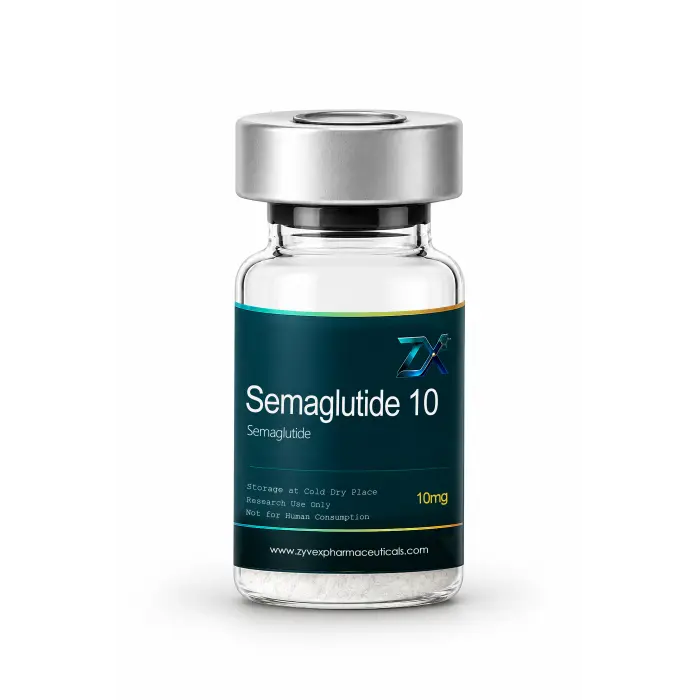
Semaglutide 10 - Zyvex Pharmaceuticals
Semaglutide 10 - The Same Active Compound as Ozempic and Wegovy in Research Vial Format
Semaglutide is a GLP-1 (glucagon-like peptide-1) receptor agonist that replicates and extends the action of a naturally occurring gut hormone released after eating. It slows gastric emptying, signals the hypothalamus to reduce appetite, stimulates glucose-dependent insulin release, and suppresses glucagon secretion after meals. The result is a sustained reduction in caloric intake that - when combined with diet and resistance training - produces meaningful fat loss over weeks and months. The 10 mg lyophilized vial format contains the identical active peptide molecule as Ozempic (the diabetes formulation) and Wegovy (the weight loss formulation). Brand name, indication, and delivery device differ; the pharmacology does not.
In the Phase 3 STEP (Semaglutide Treatment Effect in People with Obesity) clinical trials, participants receiving semaglutide 2.4 mg per week achieved an average body weight reduction of approximately 15% over 68 weeks. This represented a breakthrough in pharmaceutical weight management at the time and established semaglutide as the clinical benchmark against which all subsequent GLP-1 class drugs are measured. For athletes and bodybuilders using semaglutide as a cutting tool, the critical challenge is preserving lean muscle mass during the calorie deficit created by appetite suppression - a goal that requires structured resistance training and high protein intake throughout the entire protocol.
About the Compound
Semaglutide is a synthetic analogue of human GLP-1, modified with a C18 fatty diacid chain at position 34 that binds to albumin in the bloodstream. This albumin binding is what gives semaglutide its approximately 7-day half-life and makes once-weekly dosing possible. Native GLP-1 has a half-life of minutes; semaglutide circulates for days. The drug was developed by Novo Nordisk and is marketed as Ozempic (0.5-2 mg weekly for type 2 diabetes management) and Wegovy (2.4 mg weekly for chronic weight management). Research peptide vials of semaglutide contain the same molecule in lyophilized powder form, requiring reconstitution with bacteriostatic water before injection.
The mechanism of action is primarily hypothalamic. GLP-1 receptors in the brain's appetite centers receive a signal that mimics a fed state even when caloric intake is low. Gastric emptying slows, meaning food stays in the stomach longer and satiety signals persist. The pancreatic response to glucose improves, with more insulin released per unit of blood glucose - beneficial for anyone with insulin resistance or elevated fasting glucose from a high-carbohydrate diet or off-season mass gain phase. These effects combine to make calorie restriction substantially easier to maintain than through willpower alone.
Dosing and Dose Escalation
The semaglutide dose escalation schedule is well-established from the Phase 3 STEP trials and mirrors the Wegovy prescribing protocol. Beginning at a sub-therapeutic dose (0.25 mg weekly) allows the GI tract to adapt to the GLP-1 receptor activation before the dose is increased. Users who start at higher doses immediately experience significantly greater nausea and vomiting that often forces discontinuation. Patience with the escalation schedule is directly rewarded with better tolerability and ultimately reaching and sustaining the doses where meaningful weight loss occurs.
Standard Dose Escalation Schedule
| Week | Weekly Dose | Notes |
|---|---|---|
| Weeks 1-4 | 0.25 mg | Initiation dose, sub-therapeutic, GI adaptation |
| Weeks 5-8 | 0.5 mg | First therapeutic dose, mild appetite suppression begins |
| Weeks 9-12 | 1.0 mg | Moderate appetite suppression, noticeable satiety effect |
| Weeks 13-16 | 1.7 mg | Strong appetite suppression, fat loss accelerates |
| Week 17+ | 2.4 mg | Maximum dose (Wegovy equivalent), full effect |
If GI side effects are significant at any step, hold that dose for an additional 4 weeks before advancing. Do not skip escalation steps to reach the maintenance dose faster - the tolerability benefit of slow escalation is lost if steps are shortened. Some users find 1.0 mg per week to be their personal sweet spot for the balance between fat loss and GI tolerability and choose to maintain there rather than escalating to 2.4 mg.
Using the 10 mg Vial
The 10 mg vial contains lyophilized semaglutide powder. It must be reconstituted with bacteriostatic water before use. The volume of bacteriostatic water used determines the concentration and therefore the injection volume per dose. A common reconstitution protocol: add 2 ml of bacteriostatic water to the 10 mg vial, giving a concentration of 5 mg/ml (5000 mcg/ml). At this concentration, dose volumes are easy to measure with a standard insulin syringe.
| Weekly Dose | Volume at 5 mg/ml | Insulin Syringe Units (U-100) | Doses per 10 mg Vial |
|---|---|---|---|
| 0.25 mg | 0.05 ml | 5 units | 40 doses (40 weeks) |
| 0.5 mg | 0.10 ml | 10 units | 20 doses (20 weeks) |
| 1.0 mg | 0.20 ml | 20 units | 10 doses (10 weeks) |
| 1.7 mg | 0.34 ml | 34 units | ~6 doses (6 weeks) |
| 2.4 mg | 0.48 ml | 48 units | ~4 doses (4 weeks) |
Store reconstituted vials refrigerated at 2-8 degrees Celsius. Use within 30 days of reconstitution. Inject subcutaneously into the abdomen (2 inches from the navel), outer thigh, or upper arm. Rotate injection sites each week. Inject on the same day each week for consistent blood levels.
Use Cases
| Goal | Protocol | Notes |
|---|---|---|
| Off-season fat control | 0.5-1.0 mg/week maintenance | Moderate dose limits fat accumulation during caloric surplus phases |
| Aggressive cutting cycle | Escalate to 2.4 mg/week over 16 weeks | Combine with resistance training and 1.8-2.2 g/kg protein to protect muscle |
| Insulin sensitivity improvement | 0.5-1.0 mg/week | Improves glucose disposal, reduces fasting insulin, supports nutrient partitioning |
| Competition prep (pre-contest) | Escalate 20+ weeks out, maintain 1.7-2.4 mg/week | Pairs well with short-ester cutting stack (Test Prop, Masteron, Winstrol) |
| Post-cycle body recomposition | 1.0-1.7 mg/week during PCT | Continues fat loss while hormonal axis recovers; protect muscle with protein |
Side Effects
| Side Effect | Frequency / Background | Management |
|---|---|---|
| Nausea | Most common; peaks early in each new dose level, typically fades within 2-4 weeks | Eat smaller meals, avoid fatty or very sweet foods, do not advance dose while nausea persists |
| Vomiting | Less common; usually indicates dose escalated too fast | Drop back to previous dose level, hold for 4 weeks, then advance again more slowly |
| Diarrhea / constipation | Variable; GI motility changes from altered gastric emptying | Adequate hydration, soluble fiber, dose timing adjustments |
| Muscle loss | Significant risk without countermeasures - studies indicate up to 40% of weight lost can be lean mass without resistance training | Resistance training 3-4x per week, minimum 1.6-2.2 g/kg protein daily throughout the protocol |
| Fatigue / low energy | Common in first 2-4 weeks at each new dose; relates to reduced caloric intake | Ensure adequate protein and carbohydrates around training; do not go below 1500 kcal |
| Injection site reactions | Mild; redness or slight swelling at injection site | Rotate sites weekly; warm the syringe to room temperature before injecting |
Muscle preservation is the defining challenge of semaglutide use for athletes. The appetite suppression that makes semaglutide effective also makes it easy to under-eat protein, which accelerates lean mass loss during a calorie deficit. Aim for a minimum of 1.8 g of protein per kg of body weight daily regardless of how reduced your appetite feels. Resistance training must continue throughout the protocol - it is not optional. Users who stop training while on semaglutide often report significant strength and muscle loss even when total weight loss looks impressive on the scale.
Semaglutide vs Tirzepatide vs Retatrutide
| Feature | Semaglutide | Tirzepatide | Retatrutide |
|---|---|---|---|
| Receptor targets | GLP-1 only | GIP + GLP-1 | GIP + GLP-1 + Glucagon |
| Clinical weight loss | ~15% body weight (STEP) | ~22.5% body weight (SURMOUNT) | Up to 30.3% body weight (TRIUMPH-1) |
| Dosing frequency | Once weekly | Once weekly | Once weekly |
| GI side effect burden | Moderate | Moderate | Higher |
| FDA approval status | Approved (Ozempic/Wegovy) | Approved (Mounjaro/Zepbound) | Phase 3 research peptide |
| Max maintenance dose | 2.4 mg/week | 15 mg/week | 8-12 mg/week |
| Best for | Entry-level GLP-1 use, well-tolerated fat loss | Greater weight loss with proven approval | Maximum fat loss where ceiling matters |
Frequently Asked Questions
Is research peptide semaglutide the same compound as Ozempic and Wegovy?
Yes. The active molecule is identical. Semaglutide is the generic name for the peptide. Ozempic and Wegovy are brand names owned by Novo Nordisk for the same active compound delivered in different doses and formulations. Ozempic is approved for type 2 diabetes management at doses up to 2 mg per week. Wegovy is approved for chronic weight management at a dose of 2.4 mg per week. Research peptide semaglutide in a 10 mg lyophilized vial contains the same semaglutide molecule. The pharmacology, mechanism of action, half-life, and dose-response relationship are identical because the active ingredient is the same. The practical difference is that the brand-name auto-injector pens are pre-filled and calibrated, while the research vial requires reconstitution with bacteriostatic water and dosing with an insulin syringe. Neither the brand name nor the delivery mechanism changes what the compound does in the body.
How does semaglutide cause weight loss - what is the mechanism?
Semaglutide activates GLP-1 receptors throughout the body, but its weight-loss effect is primarily driven by central nervous system action. GLP-1 receptors in the hypothalamus - specifically in areas that regulate hunger and satiety - receive a continuous signal that mimics a fed state. This reduces appetite and increases feelings of fullness even when caloric intake is low. Simultaneously, GLP-1 receptor activation in the GI tract slows gastric emptying: food moves through the stomach more slowly, extending the physical sensation of fullness after a meal. In the pancreas, semaglutide stimulates insulin release in a glucose-dependent manner (only when blood glucose is elevated) and suppresses glucagon, improving overall glycemic control. The net result is that users eat significantly less - not through willpower, but because hunger signals are pharmacologically reduced. This calorie deficit, sustained over weeks and months, drives fat loss. At 2.4 mg per week, the STEP trials showed approximately 15% average body weight reduction over 68 weeks, which corresponds to roughly 35-40 lbs of average weight loss.
What is the correct semaglutide dose escalation schedule?
The standard protocol follows 4-week increments: 0.25 mg per week for weeks 1-4 (initiation dose - sub-therapeutic, primarily for GI adaptation), 0.5 mg per week for weeks 5-8 (first therapeutic dose), 1.0 mg per week for weeks 9-12 (moderate appetite suppression), 1.7 mg per week for weeks 13-16 (strong effect), then 2.4 mg per week from week 17 onward as the maintenance dose. This is identical to the Wegovy dosing schedule. If GI side effects are significant at any step - nausea that significantly disrupts daily function or vomiting more than once - hold that dose level for an additional 4 weeks before advancing. Do not try to accelerate the schedule. The tolerability benefit of slow escalation is the primary variable that determines whether a user can reach and sustain the higher doses where the most fat loss occurs. Some users find 1.0-1.7 mg to be their personal optimal dose and choose not to escalate to 2.4 mg.
How many doses are in the 10 mg semaglutide vial?
The number of doses depends on the concentration you mix and the dose you inject. The most common reconstitution: add 2 ml of bacteriostatic water to the 10 mg vial, producing a concentration of 5 mg per ml (5000 mcg/ml). At this concentration: 0.25 mg dose = 0.05 ml = 5 units on a U-100 insulin syringe (40 doses per vial, enough for 40 weeks at the initiation dose). 0.5 mg dose = 0.10 ml = 10 units (20 doses, 20 weeks). 1.0 mg dose = 0.20 ml = 20 units (10 doses, 10 weeks). 1.7 mg dose = 0.34 ml = 34 units (approximately 6 doses). 2.4 mg dose = 0.48 ml = 48 units (approximately 4 doses). For a full 17-week escalation protocol starting at 0.25 mg and finishing at 2.4 mg, the doses consumed total approximately 4.45 mg - just under half a vial. A full protocol through 68 weeks at maintenance dose would require multiple vials. Reconstituted vials must be used within 30 days and stored refrigerated.
Will semaglutide cause muscle loss? How do bodybuilders protect lean mass?
This is the most important question for any athlete considering semaglutide. Yes, without active countermeasures, semaglutide causes significant muscle loss alongside fat loss. Research data indicates that without resistance training, up to 40% of the total weight lost on GLP-1 agonists can be lean mass rather than fat. For a person losing 30 lbs on semaglutide without training, that could mean 12 lbs of muscle lost along with 18 lbs of fat - a devastating result for a physique athlete. The appetite suppression that makes semaglutide effective also makes it easy to eat too little protein, compounding the lean mass depletion problem. The protocol for muscle protection is non-negotiable: resistance training 3-4 times per week throughout the entire semaglutide protocol (not reduced or suspended because of reduced calorie intake), and protein intake of 1.8-2.2 g per kg of body weight daily regardless of how suppressed appetite feels. Creatine monohydrate 5g daily provides additional lean mass support. Users who follow this protocol retain the vast majority of their muscle during the fat loss phase.
Can semaglutide be used during a steroid cycle or for competition prep?
Yes, and this is a common application in physique sport. Semaglutide serves as a powerful appetite management tool during a cutting cycle, making sustained calorie deficits easier to maintain alongside anabolic compounds. The typical combination: a testosterone base (Testosterone Propionate, Testosterone Enanthate, or Sustanon) at moderate doses for muscle retention, with Masteron or Primobolan for hardening effects, while semaglutide manages appetite and drives the calorie deficit. For pre-contest preparation, begin semaglutide escalation 16-20 weeks out from the competition date - reaching the 1.7-2.4 mg maintenance dose 8-12 weeks out allows the full appetite-suppressing effect to be in place during the final aggressive dieting phase. There are no known pharmacological interactions between semaglutide and anabolic steroids. However, anabolic steroids at performance doses affect insulin sensitivity and glucose metabolism, so monitor for signs of hypoglycemia (dizziness, weakness, cold sweats) if combining semaglutide with anything that significantly enhances insulin sensitivity.
What are semaglutide's main side effects and how are they managed?
GI symptoms are the primary side effects and the main reason users discontinue the protocol early. Nausea is the most common, occurring in approximately 40-50% of users at some point during escalation. It is most intense when the dose is first increased and typically decreases significantly within 2-4 weeks at a stable dose. Vomiting is less common and usually indicates the dose was advanced too quickly. Diarrhea or constipation can occur as gastric emptying rate changes. Management strategies: eat smaller meals more frequently rather than large meals; avoid high-fat, very rich, or very sweet foods which tend to trigger nausea more than protein-dominant meals; do not advance the dose while actively nauseated; stay well hydrated; and if vomiting occurs more than once, drop back to the previous dose level and hold for an additional month before trying to advance again. Beyond GI effects, fatigue in the first weeks of each new dose level is common and relates to the reduced caloric intake. This typically resolves as the body adapts. There are no androgenic, hepatotoxic, or cardiovascular side effects specific to semaglutide beyond those associated with its drug class (theoretical pancreatitis risk exists but incidence is very low in clinical data).
How does semaglutide compare to tirzepatide and retatrutide for fat loss?
All three are once-weekly subcutaneous injections but with meaningfully different efficacy ceilings. Semaglutide (GLP-1 agonist only) produces approximately 15% average body weight reduction in Phase 3 STEP trials at 2.4 mg per week over 68 weeks. Tirzepatide (dual GIP/GLP-1 agonist, brand names Mounjaro and Zepbound) produces approximately 22.5% body weight reduction in Phase 3 SURMOUNT trials at 15 mg per week. Retatrutide (triple GIP/GLP-1/glucagon agonist) produced up to 30.3% body weight reduction in Phase 3 TRIUMPH-1 data. The gap between them is real and clinically significant in absolute terms. For a 220 lb user: semaglutide produces roughly 33 lbs of fat loss, tirzepatide roughly 49 lbs, and retatrutide up to 67 lbs at maximum doses. The trade-off is that higher efficacy generally comes with a higher GI side effect burden and more demanding escalation protocols. Semaglutide is the most forgiving entry point into GLP-1 class use - well-characterized, with FDA-approved equivalents, and easier GI tolerability than either tirzepatide or retatrutide at their respective maximum doses.
Related Products