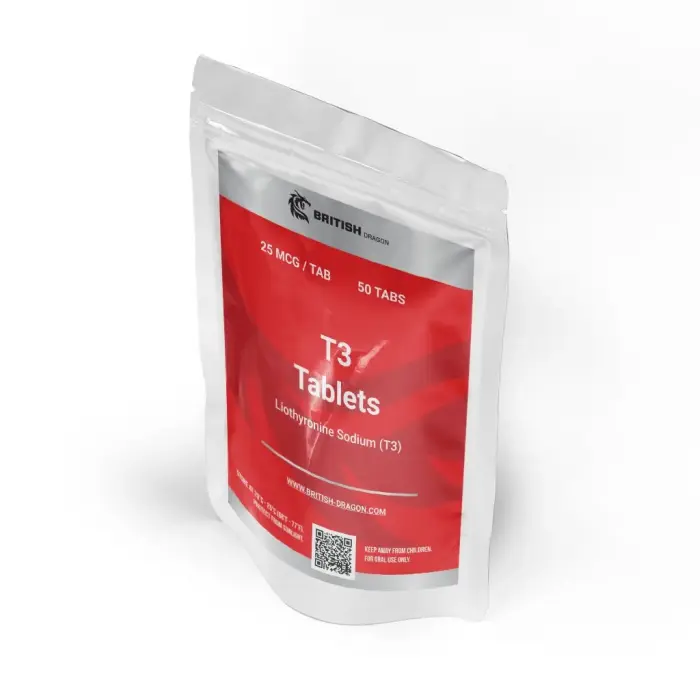
T3 Tablets
Overview
T3 Tablets British Dragon deliver synthetic triiodothyronine (liothyronine) at a precise 25 mcg per tablet, supplied in 100-tab packs for a total of 2,500 mcg per unit. Unlike anabolic steroids, T3 is a thyroid hormone — it does not act on androgen receptors but instead binds thyroid hormone receptors in virtually every cell of the body, directly accelerating basal metabolic rate, thermogenesis, and nutrient oxidation. In bodybuilding and physique sport contexts it is used during cutting phases to amplify the caloric-deficit effect, drive fat oxidation beyond what diet alone achieves, and counter the metabolic slowdown that occurs during extended caloric restriction. steroidwarehouse.com carries the British Dragon T3 formulation alongside Dragon Pharma T3 and T4 for users comparing options within the thyroid hormone category.
About the Compound
Liothyronine is the biologically active form of thyroid hormone — the same molecule produced endogenously when thyroxine (T4) is converted to T3 by deiodinase enzymes in peripheral tissue. Exogenous T3 bypasses that conversion step, producing a faster and more predictable elevation of intracellular thyroid receptor activity than supplemental T4. This pharmacokinetic characteristic — shorter half-life, faster onset, more direct action — makes liothyronine the preferred thyroid compound for performance contexts where the goal is a defined, time-limited metabolic acceleration.
At the cellular level, T3 binds thyroid hormone receptors (predominantly TRα in cardiac and skeletal muscle, TRβ in liver and fat tissue) and upregulates genes responsible for oxidative metabolism, thermogenesis, and protein turnover. The consequence is increased caloric expenditure, enhanced fat substrate utilization, and — at high doses or without protein and anabolic support — accelerated lean tissue catabolism. Managing this catabolic risk through adequate dietary protein and concurrent anabolic compounds is the central protocol consideration when using T3 in a cutting cycle.
What It Does
- Raises basal metabolic rate (BMR): T3 directly upregulates mitochondrial uncoupling and oxidative phosphorylation across multiple tissue types. At 50–75 mcg/day, BMR elevation of 10–20% above baseline is a commonly reported functional outcome, translating to several hundred additional calories burned daily without changes to activity level or diet composition.
- Accelerates fat oxidation: Elevated T3 increases lipolysis signaling and shifts substrate utilization toward fat oxidation. In a caloric deficit this amplifies the rate of fat loss beyond what the deficit alone produces. The effect is particularly pronounced in subcutaneous and visceral fat stores, making T3 useful in the final weeks of a pre-contest cut.
- Counters metabolic adaptation: Prolonged caloric restriction suppresses endogenous T3 production as a homeostatic response, reducing BMR and blunting fat loss progress over time. Exogenous T3 supplementation offsets this adaptive down-regulation, maintaining a more consistent rate of fat loss across the full cut duration.
- Increases protein turnover: T3 accelerates both protein synthesis and protein breakdown simultaneously. At doses above 50 mcg/day, the net effect on lean tissue becomes catabolic without adequate protein intake (>2.2 g/kg/day) and anabolic hormone support. This is why T3 is almost always run alongside AAS or other anabolic compounds in physique protocols.
- Thermogenic output: Thyroid hormone receptor activation in brown adipose tissue and skeletal muscle increases heat production. This thermogenic effect contributes to the elevated sweating and body temperature that users notice within the first week of T3 use, and it represents a meaningful additional source of caloric expenditure on top of the BMR elevation.
- Synergy with lipolytic compounds: T3 potentiates the fat-loss effect of beta-2 agonists (clenbuterol, salbutamol) by upregulating beta-adrenergic receptor sensitivity. When combined, the two compounds produce greater fat oxidation than either does alone, which is the basis of the classic T3 + clenbuterol cutting stack.
Who It's For
T3 Tablets BD are suited to intermediate-to-advanced users in defined cutting phases who have plateaued on diet and cardio alone, or who are managing the metabolic slowdown that accumulates over 10–16 week contest prep cycles. The core differentiator from other metabolic compounds is mechanism: T3 accelerates energy expenditure at the cellular level across the entire body, not just in adrenergic tissue. This makes its fat-loss contribution additive regardless of what other compounds are in the stack.
Compared to Clenbuterol Tablets BD, T3 operates through a completely different pathway — thyroid receptor agonism rather than beta-2 adrenergic stimulation. Clenbuterol provides acute thermogenesis with receptor desensitization at 2–3 weeks; T3 produces a sustained metabolic elevation for the full 4–8 week cycle without receptor downregulation. The two mechanisms are complementary, making T3 + clenbuterol one of the most frequently used cutting combinations. T3 is the better primary choice when the goal is sustained metabolic rate elevation across a long cut, while clenbuterol is more appropriate for a shorter, sharper thermogenic push.
Users who should not use T3: anyone with pre-existing thyroid disease, cardiac arrhythmia, or uncontrolled hypertension. T3 also requires a meaningful anabolic backbone — users who cannot support the cycle with adequate dietary protein and at minimum a testosterone or other anabolic compound should choose a non-catabolic fat-loss approach instead. Beginners without prior cutting cycle experience are better served by optimizing diet and cardio before introducing thyroid hormones.
T3 vs Alternatives
| Compound | Key Differences | Choose T3 BD When | Choose Alternative When |
|---|---|---|---|
| Clenbuterol Tablets BD (beta-2 agonist) | Beta-2 adrenergic mechanism; acute thermogenesis; receptor desensitization at 2–3 weeks requires cycling on/off; no thyroid receptor action; less catabolic risk on lean tissue | Sustained metabolic elevation across 4–8 weeks without receptor downregulation; thyroid-pathway fat loss preferred; T3 + clenbuterol combination for additive effect | Short 2–3 week thermogenic spike needed; thyroid history contraindicates T3; no anabolic support available to cover T3's catabolic risk |
| T3 Dragon Pharma (liothyronine) | Identical active compound (liothyronine); same dose (25 mcg); different brand and manufacturing; protocol is identical; choice comes down to brand preference and stock availability | British Dragon brand preferred; BD packaging or lot verification desired; same compound, same protocol | Dragon Pharma brand preferred; DP product is in stock and BD is not; no pharmacological reason to prefer one over the other |
| T4 Dragon Pharma (levothyroxine) | T4 is a prodrug requiring peripheral conversion to T3 via deiodinase; slower onset; less predictable potency; longer half-life (~7 days); gentler and more stable thyroid hormone elevation; lower acute cardiac risk | Faster, more direct, more predictable thyroid hormone action required; shorter cycle duration; defined cutting phase with anabolic support in place | Gentler thyroid support preferred; longer cycle with stable low-level metabolic boost; first use of thyroid hormones; cardiac sensitivity; individual conversion from T4 to T3 is sufficient |
Combinations
| Goal | Primary | Support Compounds | Notes |
|---|---|---|---|
| Cutting with muscle retention | T3 Tablets BD 50 mcg/day | Mastabol 100 BD + Anastrozole BD | T3 drives fat oxidation and thermogenesis; Masteron provides anabolic cover against T3-driven protein catabolism, adds hardness and SHBG suppression; Anastrozole manages any residual E2 from the testosterone base; a standard pre-contest triad |
| Accelerated fat loss (T3 + beta-2) | T3 Tablets BD 50 mcg/day + Clenbuterol Tablets BD 80–120 mcg/day | Stanabol 50 Inj BD (last 6–8 wks) | Dual-mechanism fat loss: T3 elevates BMR via thyroid receptor pathway; clenbuterol adds beta-2 thermogenesis; Stanabol 50 Inj provides SHBG reduction and lean tissue preservation; three independent mechanisms acting simultaneously |
| Testosterone base + T3 cut | T3 Tablets BD 25–50 mcg/day | Sustabol 350 BD 350 mg/wk + Anastrozole BD | Sustabol 350 provides testosterone as a full anabolic base, directly countering T3's catabolic pressure on lean tissue; T3 runs for the final 6–8 weeks of the testosterone cycle; Anastrozole controls E2 from the testosterone; clean recomposition or lean bulk-to-cut transition |
| Pre-contest peak week | T3 Tablets BD 75 mcg/day (final 2 wks only) | Oxanabol BD + Mastabol 100 BD | Maximum T3 dose reserved for the final 2 weeks of contest prep; Oxanabol preserves lean mass and adds fullness; Masteron hardens and dries; combination produces maximum metabolic output while minimizing muscle loss in the final stretch; taper T3 down immediately after the event |
Side Effects & Management
| Side Effect | Frequency | How to Handle It |
|---|---|---|
| Tachycardia & palpitations | Common at doses ≥50 mcg/day — most frequent user complaint | Monitor resting heart rate daily; target <80 bpm at rest; if HR consistently above 85–90 bpm: reduce dose by 25 mcg and reassess; avoid caffeine and stimulants alongside high-dose T3; if palpitations persist after dose reduction, discontinue and taper off; Amlip (amlodipine) for concurrent blood pressure support if needed |
| Lean tissue catabolism | Dose-dependent — significant above 75 mcg/day without anabolic cover | Always run T3 alongside at least one anabolic compound (testosterone, Masteron, Oxanabol, or Winstrol); dietary protein intake ≥2.2 g/kg/day is non-negotiable; resistance training maintained throughout; do not run T3 in a caloric deficit exceeding 700–800 kcal/day without anabolic support |
| Hyperthyroid symptoms (sweating, insomnia, anxiety, tremors) | Common at doses above 50–75 mcg/day or when dose increases are too fast | Titrate slowly: add 25 mcg no faster than every 5–7 days; if symptoms appear, hold the current dose for 1 additional week before increasing further; most symptoms resolve as the body adapts within 5–10 days at a stable dose; reduce dose if sleep disruption becomes severe |
| GI effects (diarrhea, loose stools, nausea) | Mild — common in first 1–2 weeks as GI motility increases | Take T3 with food to reduce nausea; GI symptoms typically self-resolve within 5–7 days; persistent diarrhea suggests dose is too high for current tolerance — reduce by 25 mcg; Mobic is not indicated here — manage with dose adjustment and dietary modifications |
| Thyroid axis suppression | Certain with extended use (>8 weeks) or abrupt cessation — causes transient rebound hypothyroidism | Keep cycles to 4–8 weeks; taper down on exit (reduce by 25 mcg every 3–5 days rather than stopping abruptly); check TSH 4 weeks post-taper; endogenous thyroid production typically normalizes within 4–8 weeks of proper taper; extended off-periods (≥8 weeks) before next T3 cycle |
| Bone density reduction (prolonged use) | Relevant only with extended use or chronically elevated T3 above physiological range | Keep cycle length within 4–8 weeks; adequate calcium and vitamin D intake throughout; this is not an acute risk during a standard 6-week cutting cycle at 50 mcg/day, but becomes a consideration in repeated back-to-back T3 protocols |
Bloodwork Monitoring
| Lab | When to Test | Target & Action Threshold |
|---|---|---|
| TSH (Thyroid-Stimulating Hormone) | Baseline; 2 weeks into cycle; 4 weeks post-taper | Baseline establishes pre-cycle thyroid status; on-cycle TSH will be suppressed (near zero) — expected and does not require intervention; post-taper TSH should recover to normal range (0.5–4.5 mIU/L) within 4–8 weeks; persistently suppressed TSH at 8 weeks post-taper warrants review |
| Free T3 (fT3) & Free T4 (fT4) | Baseline; optionally mid-cycle if symptoms are excessive | Baseline confirms pre-existing thyroid status; on-cycle fT3 will be elevated above range — expected; mid-cycle testing is primarily useful when hyperthyroid symptoms are pronounced and dose adjustment is being considered |
| Resting heart rate | Daily — self-monitoring with pulse check or wearable device | <80 bpm at rest is the comfort threshold; 80–90 bpm: hold current dose, do not increase; >90 bpm consistently: reduce T3 dose by 25 mcg; resting HR is the most practical real-time indicator of T3 dose tolerance available without a blood draw |
| Blood pressure | Weekly (first month) | <130/80 mmHg; T3-driven increases in cardiac output can raise systolic BP; if elevated: reduce T3 dose first; Amlip (amlodipine) 5 mg/day as second-line if BP remains elevated after dose adjustment |
| CBC (Complete Blood Count) | Baseline; mid-cycle if on concurrent AAS | Primarily relevant when T3 is combined with testosterone or other AAS; ensures hematocrit and RBC values are tracked for the full stack, not T3 specifically; T3 alone does not significantly alter CBC |
| Lipid panel | Baseline; post-cycle at 4–6 weeks | T3 at physiological and mildly supraphysiological doses may modestly improve LDL clearance via TRβ hepatic action; however the full stack (with AAS) determines lipid outcome; track as part of the overall cycle bloodwork, not as a T3-specific concern |
Tapering & Thyroid Recovery
T3 does not suppress the HPG axis and does not require post-cycle therapy in the AAS sense. However, exogenous liothyronine does suppress TSH and the hypothalamic-pituitary-thyroid (HPT) axis during the cycle, and abrupt discontinuation can produce transient rebound hypothyroidism — a state where endogenous T3/T4 production is slower to restart than the exogenous source was removed. The practical consequence is fatigue, cold sensitivity, water retention, and slowed metabolism in the first 1–3 weeks off T3 if the exit is not managed correctly.
Entry taper (ramp up): Start at 25 mcg/day. After 5–7 days at 25 mcg with no adverse cardiac response, increase to 50 mcg/day. If targeting 75 mcg/day, hold at 50 mcg for a further 5–7 days before adding the final increment. Never start at 75 mcg cold.
Exit taper (ramp down): Reverse the titration — reduce by 25 mcg every 3–5 days. A user at 75 mcg/day exits via 75 → 50 → 25 → 0 over approximately 10–15 days. Do not attempt to cut from 75 mcg directly to zero. The slower the exit, the more smoothly endogenous thyroid function restores.
Recovery window: TSH typically returns to the normal range within 4–6 weeks of completing the exit taper. Retest at week 4 post-taper. If TSH remains suppressed beyond 8 weeks, a longer off-period is required before the next T3 cycle. Minimum recommended off-time between T3 cycles: 8–12 weeks to allow full HPT axis normalization.
Practical Summary
- Always taper up on entry: start at 25 mcg/day; increase by 25 mcg no faster than every 5–7 days; jumping to 50–75 mcg immediately causes acute tachycardia and hyperthyroid symptoms that force premature cycle termination.
- Morning dosing only: T3's short half-life allows single daily dosing; take in the morning to align with natural cortisol and metabolic rhythms and to minimize sleep disruption from thermogenic stimulation.
- Anabolic cover is not optional: at doses above 25 mcg/day without a concurrent anabolic compound and protein intake ≥2.2 g/kg/day, lean tissue loss is measurable; pair T3 with at minimum a testosterone base or Masteron.
- Maximum duration 4–8 weeks: longer cycles provide diminishing fat-loss returns and increase thyroid axis suppression depth; most users run 6 weeks at 50 mcg/day as the practical optimum.
- Monitor resting heart rate daily: it is the most immediate and accessible indicator of dose tolerance; above 85–90 bpm consistently — reduce dose by 25 mcg before adding any other intervention.
- Taper down on exit, always: reduce by 25 mcg every 3–5 days; abrupt cessation from 50–75 mcg/day causes rebound hypothyroidism and negates a portion of the cutting progress through water retention and metabolic slowdown.
T3 Tablets British Dragon provides a reliable oral liothyronine dose for athletes integrating thyroid hormone into cutting phases. At 25 mcg per tablet the dose is fully titrable from the starting point through the 50–75 mcg/day working range without tablet splitting. Used within the 4–8 week window, paired with adequate protein and anabolic support, T3 accelerates the caloric-deficit effect and thermogenic output that cutting cycles target. Steroid Warehouse carries the British Dragon formulation alongside Dragon Pharma T3 and T4 options for users comparing sources and brands within the thyroid hormone category.
References
| Source | Topic | Link |
|---|---|---|
| Journal of Clinical Investigation / PubMed | Brent GA 2012 — review of thyroid hormone action mechanisms; covers thyroid hormone receptor signaling, tissue-specific thyroid hormone effects, genomic and non-genomic mechanisms, and physiological regulation of metabolism and development | Brent GA (2012) ↗ |
| Thyroid / PubMed — American Thyroid Association | Jonklaas J et al. 2014 — ATA guidelines for treatment of hypothyroidism; covers thyroid hormone replacement therapy, levothyroxine as standard therapy, evidence on liothyronine and combination T4/T3 therapy, dosing, monitoring, and safety considerations | Jonklaas J, et al. (2014) ↗ |
| Endotext / NCBI Bookshelf | Peeters RP & Visser TJ 2017 — medical reference chapter on thyroid hormone metabolism; explains deiodination as the main pathway of thyroid hormone metabolism, D1/D2 conversion of T4 to active T3, D3 inactivation to reverse T3, tissue-specific T3 production, and clinical relevance of deiodinase regulation | Endotext: Metabolism of Thyroid Hormone ↗ |
| Endocrine Reviews / PubMed | Bianco AC et al. 2018 — review of the deiodinase system and thyroid hormone signaling; explains how type 2 deiodinase activates thyroid hormone by converting T4 to biologically active T3, while type 3 deiodinase inactivates T4 and T3 to regulate local thyroid hormone action | Bianco AC, et al. (2018) ↗ |
What is T3 Tablets?
T3 Tablets are an oral thyroid hormone (Liothyronine Sodium) for fat loss; see What is T3 Tablets. It's potent—consult professionals for safe use.
What does T3 Tablets do?
It accelerates fat loss and boosts metabolism; see What Does T3 Tablets Do. It enhances physique—monitor with labs.
Are T3 Tablets safe?
They can be safe with responsible use, but risks include thyroid suppression; see Are T3 Tablets Safe. Consult professionals for oversight.
How do I take T3 Tablets?
Start at 25 mcg/day, max 50-75 mcg/day, taper off; see How to Take T3 Tablets. Start low—consult professionals for dosing.
How long does it take to notice effects from T3 Tablets?
What are the main benefits of T3 Tablets?
Commonly reported benefits include support for normal metabolism, energy levels, thyroid hormone balance, and overall physiological function when prescribed appropriately.
Why is T3 different from T4?
T3 is the biologically active thyroid hormone, whereas T4 (thyroxine) serves primarily as a precursor that is converted into T3 within the body.
What makes T3 Tablets different from other thyroid hormone products?
T3 Tablets provide the active thyroid hormone directly, which may result in a faster onset of physiological effects compared with medications that rely on conversion from T4 to T3.
Related Products

- Improves erectile function for stronger erections.
- Enhances sexual performance and confidence.
- Provides rapid onset within 30-60 minutes.
- Supports sexual health with minimal side effects.
- Promotes muscle hardness and definition.
- Enhances strength for intense training.
- Supports fat loss for a vascular physique.
- Delivers dry gains with minimal water retention.
- Improves erectile function for stronger erections.
- Enhances sexual performance and confidence.
- Provides long-lasting effects up to 36 hours.
- Supports sexual health with minimal side effects.
- Restores natural testosterone production post-cycle.
- Prevents gynecomastia by blocking estrogen receptors.
- Supports retention of cycle gains.
- Improves hormonal balance with minimal side effects.
- Promotes significant muscle growth and strength gains.
- Enhances fat loss for a lean, defined physique.
- Improves muscle hardness and vascularity.
- Delivers sustained anabolic effects with minimal water retention.