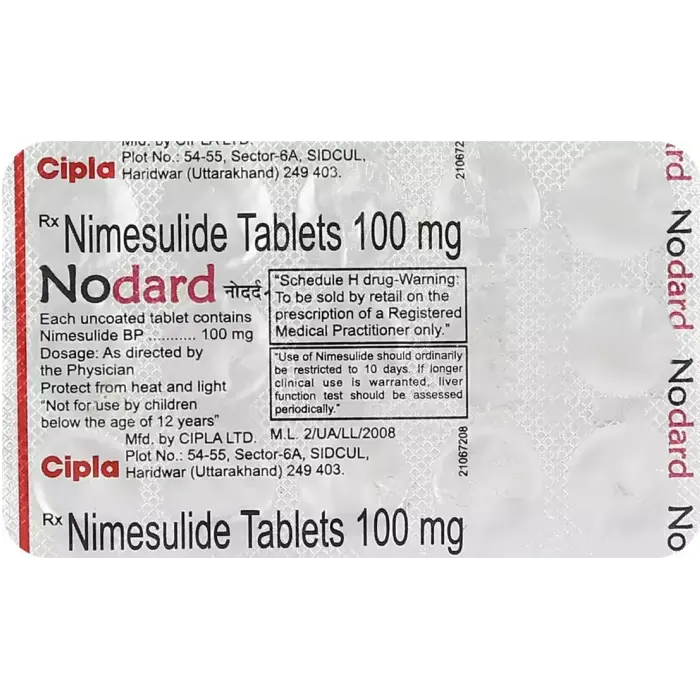
Nodard Tablets
What Is Nodard?
Nodard is nimesulide 100 mg from Cipla, sixty tablets per pack. It is an NSAID of the sulfonanilide class, chemically unrelated to ibuprofen or diclofenac, and it works by inhibiting cyclooxygenase with a relative preference for COX-2. It is fast, it is potent at 100 mg, and it carries one of the most specific safety limits in the whole painkiller cabinet.
Sixty tablets are thirty days at the standard dose, which is exactly double the regulatory ceiling. That mismatch is not a reason to find a longer indication; it is the clearest illustration of what this drug is for. Nimesulide fills a short gap: a flare, a dental procedure, a few days of acute pain.
Nodard Dosage
One hundred milligrams twice a day after meals, and never more than 200 mg in a day. Food matters here more than with most NSAIDs, because nausea and stomach pain are the most frequent complaints. The course stops at fifteen days regardless of how the pain behaves, and a second course should not follow immediately.
| Level | Dose | Units | Cycle | Note |
|---|---|---|---|---|
| Standard | 100 mg | 1 tablet | twice daily, 5-7 days | after food, with water |
| Reduced | 100 mg | 1 tablet | once daily | lower body weight, sensitive stomach |
| Limit | 200 mg | 2 tablets | daily, maximum 15 days | hard stop, not a target |
Cycle Length
Five to seven days is a normal course for acute pain; fifteen days is the absolute ceiling set by regulators, not a recommended duration. The reason is hepatic: nimesulide can cause liver injury that ranges from a transient enzyme rise to acute failure, and most cases appear within the first month of use.
Anyone who has had a previous reaction to nimesulide should not take it again. The same applies to people with active liver disease, a history of ulcer or bleeding, severe kidney impairment or heart failure, and to anyone with a drinking pattern that already loads the liver.
Nodard Stacks
With nimesulide the stack question is mostly what to avoid. Two rows below are alternatives to choose instead of combining, one is a hard contraindication, and one is the liver item people reach for afterwards.
| Partner | Role | Effect |
|---|---|---|
| Mobic | Another NSAID | never combine, double the gut and kidney risk |
| Nurofen | Alternative NSAID | short half-life option for milder pain |
| Ecosprin | Antiplatelet | adds bleeding risk, avoid the pairing |
| Liv.52 | Herbal liver support | background support, no substitute for stopping |
Warfarin and other anticoagulants raise bleeding risk substantially, and combining nimesulide with paracetamol at maximum dose or with alcohol adds to the liver load. Diuretics and blood pressure drugs can be pushed into a kidney problem by any NSAID. The pharmacy category has the alternatives, and the post cycle plan covers bloodwork if liver enzymes were already raised before the first tablet.
Nodard Side Effects
Stomach pain, heartburn, nausea and diarrhoea are the common effects. Dizziness and rash occur. The distinctive risk is hepatic: dark urine, yellowing of the eyes, pale stools, itching or pain under the right ribs are signals to stop immediately and get a liver panel, not to wait for the course to finish.
- Stomach pain, heartburn and nausea.
- Raised liver enzymes and, rarely, acute liver injury.
- Rash, itching and photosensitivity.
- Fluid retention and raised blood pressure.
- Reduced kidney function with dehydration or other NSAIDs.
The liver injury can appear within days of starting, which is why the fifteen day limit exists and why a previous uneventful course is not a guarantee. Alcohol during the course multiplies the risk without improving the pain relief.
Support and Pharmacy Items
The support items around a short nimesulide course are about the liver and the stomach, plus a non-NSAID plan for the days after the fifteen day ceiling is reached.
- Ursocol - bile and liver support when a clinician recommends it.
- Cycle planning guide - pain relief is not a substitute for a deload.
- Pharmacy category - pain, gastro and liver lines in one list.
- Mistakes guide - why stacking painkillers is a common own goal.
Oral steroids and nimesulide both load the liver, and combining them without a reason is a classic mistake. The oral versus injectable article explains the first-pass difference, and cycle support collects the liver items that belong in the same plan.
Where to Buy Nodard
Nodard is stocked at Steroid Warehouse as a Cipla product, nimesulide 100 mg tablets, sixty per pack, with international and US domestic shipping. One pack is thirty days at the standard dose, twice the allowed course, so it is a supply for several separate short episodes rather than one long one. Buy it for a defined flare and keep the fifteen day rule on the box.
This information is for educational purposes. Anabolic steroids are prescription medicines in most countries and carry serious health risks. Speak to a physician before use.
1. What is Nodard used for?
Nodard is used to relieve pain and inflammation. It is commonly used for joint, muscle, or acute pain conditions.
2. How does nimesulide work?
It blocks enzymes that produce inflammatory substances. This reduces pain and swelling.
3. How quickly does it work?
It can provide relief within a few hours. It is considered fast-acting.
4. Can it be used long-term?
It is generally recommended for short-term use. Long-term use requires medical supervision.
5. Should I take it with food?
Yes, taking it after meals helps reduce stomach irritation.
6. Are there side effects?
What are the possible side effects?
Potential side effects may include:.
- Nausea
- Diarrhea
- Vomiting
- Loss of appetite
- Muscle cramps
- Difficulty sleeping (insomnia)
- Fatigue
Donepezil may also slow the heart rate in some individuals and should be used cautiously in patients with certain heart rhythm disorders. Any severe dizziness, fainting, or persistent gastrointestinal symptoms should be reported to a healthcare professional..
What makes Nodard different from memantine?
Nodard (donepezil) increases acetylcholine levels by inhibiting acetylcholinesterase, while memantine works by regulating glutamate activity through NMDA receptors. The two medications have different mechanisms of action and may sometimes be prescribed together in moderate to severe Alzheimer's disease.
Related Products