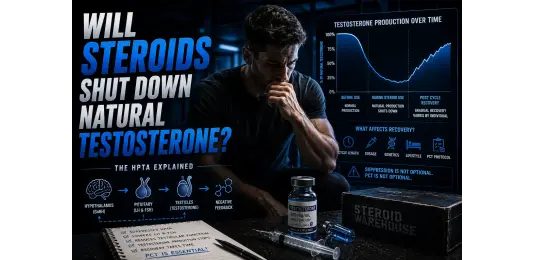
Yes — all anabolic steroids suppress natural testosterone production. This is not a side effect that affects some users. It is a universal, predictable pharmacological consequence of exogenous androgen use. The HPG axis detects supraphysiological androgens and reduces its own output — stopping LH and FSH production, which stops testicular testosterone synthesis. Understanding exactly how this works, how severe suppression becomes, and what determines recovery speed is essential for anyone planning a cycle.
Already know about suppression and ready for the recovery protocol? See our complete PCT — Post Cycle Therapy guide.
How the HPG Axis Controls Testosterone
Natural testosterone production is regulated by the hypothalamic-pituitary-gonadal (HPG) axis — a three-level hormonal feedback system:
- Hypothalamus: releases GnRH (gonadotropin-releasing hormone) in pulses — signals the pituitary to act
- Pituitary: responds to GnRH by releasing LH (luteinizing hormone) and FSH (follicle-stimulating hormone) into the bloodstream
- Testes: respond to LH by producing testosterone in Leydig cells; respond to FSH by supporting sperm production in Sertoli cells
The system is self-regulating through negative feedback: when testosterone levels are sufficient, the hypothalamus and pituitary detect this and reduce GnRH, LH and FSH output — preventing over-production. This negative feedback loop is precisely the mechanism that AAS exploit to cause suppression.
How Steroids Suppress the HPG Axis
When exogenous AAS are introduced, the negative feedback loop triggers immediately and completely:
- Exogenous androgens elevate serum testosterone (or testosterone-equivalent activity) dramatically above normal physiological levels
- The hypothalamus detects high androgen levels and reduces or stops GnRH pulsatile release
- Without GnRH stimulation, pituitary LH and FSH secretion falls to near zero
- Without LH stimulation, testicular Leydig cells stop producing testosterone — endogenous testosterone production falls to negligible levels
- Without FSH stimulation, Sertoli cells reduce sperm production — fertility is impaired
- The testes, without LH stimulation, begin to atrophy — reduced size and volume over weeks to months
This process begins within days of starting a cycle and reaches complete suppression within 1–4 weeks depending on the compound and dose. By the time a typical 10–12 week cycle is complete, endogenous testosterone production is effectively zero — entirely replaced by exogenous AAS.
| Timeline | What Is Happening | LH/FSH Level | Endogenous T Level |
|---|---|---|---|
| Day 1–7 | HPG axis beginning to suppress | Falling | Falling |
| Week 2–4 | Suppression progressing — pituitary output minimal | Very low | Very low to negligible |
| Week 4 onwards | Complete suppression established | Near zero | Near zero — testes atrophy beginning |
| End of cycle | Complete HPG shutdown — no endogenous T production | Near zero | Near zero |
Suppression by Compound and Dose
While all AAS suppress the HPG axis, the degree and speed of suppression varies significantly by compound. This matters for PCT planning — more suppressive cycles require more aggressive PCT protocols.
| Compound | Suppression Level | Mechanism | PCT Requirement |
|---|---|---|---|
| Testosterone (all esters) | Complete | Direct androgen receptor + aromatisation to E2 — dual feedback suppression | Standard — Nolvadex 40/40/20/20 |
| Nandrolone (Deca) | Very High | AR activation + progestin activity — dual suppression mechanism, very long ester clearance | Extended PCT — 6 weeks, wait 21 days |
| Trenbolone | Extreme | Most potent AR agonist — extreme suppression + prolactin involvement | Extended PCT + Cabergoline for prolactin |
| Oxandrolone (Anavar) | Moderate | AR activation — lower androgenic rating reduces suppression degree | Standard PCT — 4 weeks Nolvadex |
| Methandrostenolone (Dbol) | High | AR activation + strong aromatisation — dual feedback suppression | Standard to extended PCT |
| Drostanolone (Masteron) | Moderate-High | AR activation — DHT derivative, no E2 conversion | Standard PCT — 4 weeks |
| Methenolone (Primobolan) | Low-Moderate | Mild AR agonist — considered least suppressive injectable AAS | Standard PCT — 4 weeks |
What Suppression Feels Like
During a cycle, suppression symptoms are masked by the exogenous androgens — you feel good because the AAS are maintaining supraphysiological testosterone. The suppression becomes clinically apparent in the gap between the cycle ending and PCT restoring function — a window that can last days to weeks depending on ester clearance timing and PCT start date.
Symptoms of Hypogonadal State Post-Cycle (Without PCT)
- Severe fatigue: testosterone is a primary driver of energy and motivation — hypogonadal levels produce crushing fatigue that goes beyond normal training tiredness
- Low libido and sexual dysfunction: testosterone drives libido at every level — hypogonadal levels produce near-complete loss of sexual desire and significant erectile dysfunction
- Depression and mood disruption: testosterone has direct neurological effects — hypogonadal depression is clinically distinct and can be severe, particularly after high-dose cycles
- Loss of strength and muscle: without testosterone, protein synthesis falls and catabolism accelerates — the anabolic environment created by the cycle collapses rapidly
- Cognitive impairment: brain fog, poor concentration, impaired memory — testosterone has important neurological functions beyond libido and mood
- Testicular atrophy: visible reduction in testicular size and volume from weeks of LH deprivation
Natural Recovery — How Long Without PCT
Without any intervention, how long does the HPG axis take to recover after a cycle? The research data is clear — and sobering:
| Cycle Type | Recovery Without PCT | Symptomatic Duration |
|---|---|---|
| Short oral cycle (4 weeks) | 4–8 weeks | 2–6 weeks of hypogonadal symptoms |
| Standard Test cycle (10–12 weeks) | 3–6 months | 2–4 months of significant symptoms |
| Long or heavy cycle (16–20 weeks) | 6–12 months | 4–8+ months of severe hypogonadal symptoms |
| Multi-year blast and cruise | 12–24 months or incomplete | Potentially permanent partial hypogonadism |
A peer-reviewed study (Grant et al., 2023) confirmed that PCT significantly reduces AAS withdrawal symptoms compared to stopping without intervention — including reduction in cravings to restart AAS use by 60% and significant improvements in mood and energy during the recovery period.
What PCT Does — The Mechanism
Post Cycle Therapy uses Selective Estrogen Receptor Modulators (SERMs) to restart the HPG axis. The mechanism is specific and elegant:
- SERMs block estrogen receptors in the hypothalamus and pituitary — the brain "sees" low estrogen and interprets this as low androgen production
- This triggers increased GnRH release from the hypothalamus
- Increased GnRH drives increased LH and FSH from the pituitary
- Increased LH drives testicular Leydig cell testosterone production
- Increased FSH restores Sertoli cell function and sperm production
Standard PCT — Testosterone Cycle
- Wait: 14 days after last injection (Enanthate/Cypionate)
- Nolvadex 40 mg/day — weeks 1–2
- Nolvadex 20 mg/day — weeks 3–4
- Bloodwork 4 weeks post-PCT to confirm recovery
Extended PCT — Nandrolone or Trenbolone Cycles
- Wait: 21 days after last Deca injection / 14 days after last Tren E
- Check prolactin — use Cabergoline if elevated (Trenbolone/Deca)
- Optional: HCG 500 IU every other day × 10 days before SERMs — restimulates testes before PCT
- Nolvadex 40 mg + Clomid 50 mg — weeks 1–2
- Nolvadex 20 mg + Clomid 25 mg — weeks 3–4
- Nolvadex 20 mg — weeks 5–6
Enclomiphene — Updated PCT Option
Enclomiphene is the trans-isomer of clomiphene — providing comparable LH and FSH stimulation to Clomid with significantly fewer mood and vision side effects. Increasingly used as a Clomid replacement in 2025–2026 PCT protocols at 25 mg/day for 4–6 weeks.
When Does Suppression Become Permanent?
Permanent or long-term partial hypogonadism is a documented outcome in a subset of AAS users. Risk factors for incomplete recovery:
- Multiple long cycles: cumulative suppression across years of AAS use degrades HPG axis responsiveness
- No PCT after cycles: allowing the HPG axis to remain suppressed for months between cycles impairs its ability to fully restart
- Very high dose cycles: extreme suppression can damage Leydig cell function directly
- Age: older users have lower baseline LH responsiveness — recovery is slower and less complete
- Genetic predisposition: some individuals have inherently less resilient HPG axis responsiveness
Impact on Fertility and Sperm Production
FSH suppression during AAS use reduces sperm production — sometimes to zero (azoospermia) during a cycle. This is why AAS have been researched as male contraceptives. The practical implications:
- Sperm count typically returns to normal within 3–12 months after stopping AAS with appropriate PCT
- HCG during a cycle (250–500 IU every 3–4 days) maintains testicular FSH response and preserves sperm production on-cycle
- Users who want to conceive should stop AAS at least 6–12 months before attempting conception and confirm sperm count recovery with semen analysis
- Fertility recovery is generally good after short cycles with proper PCT — it is more uncertain after years of continuous use without PCT
SARMs — Do They Also Suppress Testosterone?
Yes — SARMs suppress the HPG axis through the same feedback mechanism as AAS. Any compound activating androgen receptors signals the hypothalamus to reduce GnRH output. The degree of suppression varies by compound:
- LGD-4033, RAD-140, S23: significant suppression — full SERM PCT required. See our SARMs vs Steroids guide for compound-specific PCT requirements
- Ostarine at low doses: milder suppression — mini-PCT (Nolvadex 20 mg/day × 4 weeks) typically sufficient
- MK-677 (Ibutamoren): not a SARM — does not activate androgen receptors — does not suppress testosterone
- Hohl A. et al. (2025) — Clomiphene or enclomiphene citrate for the treatment of male hypogonadism: a systematic review and meta-analysis. Archives of Endocrinology and Metabolism. PubMed.
- Grant B. et al. (2023) — The use of post-cycle therapy is associated with reduced withdrawal symptoms from anabolic-androgenic steroid use: a survey of 470 men. Substance Abuse Treatment, Prevention, and Policy. PubMed.
- Bond P., Smit D.L., de Ronde W. (2022) — Anabolic-androgenic steroids: How do they work and what are the risks? Frontiers in Endocrinology. PubMed.
- Leslie S.W., Rahman S., Ganesan K. — Anabolic Steroids: pharmacology, mechanism and adverse effects. StatPearls, NIH/NCBI. Updated 2025.